Posted on

Servicing mechanical clocks

I have wrote a few blogs that I hope you enjoyed about antique cabinet restoration. Clearly antique cabinet restoration once carried out properly is a once in a lifetime operation as a rule. Antique clock movements meanwhile need to be cleaned and serviced at least every ten years.


Horology Department

All antique clock movements at Pendulum of Mayfair are properly serviced by trained high quality horologists. The movements are completely taken apart, cleaned and any necessary bushing & pallets re-facing carried out. Normally there will also be other repairs to undertake. Especially if the movement has not been properly services in the last 20 years.

Many clients believe if the clock is running and has been doing s,o this is sufficient. Dried out oil tends to mix with dust and other foreign bodies to become a grinding paste. Unless the movement is cleaned every 10 years or so this grinding paste can cause undue wear. This will also mean that when the next service is carried out extra work is required.

Service your clock every 10-15 years

It will normally take our horologists a couple of days to complete an overhaul of a grandfather clock mechanism. This only needs to be done every 10-15 years. Therefore a small price to pay to keep your antique clock in full working order and in tip top condition. Please only entrust your antique clock to the finest horologists. We have had our own workshop for over 40 years and all our staff are trained to the highest standards. We undertake work for Embassy’s, major London hotels and for many vip’s. Many clients have shipped their grandfather clock cases and movements back from the States. Then this work can be carried out by us. Poor quality restoration and repairs not to the highest standard can effect the value of your antique clock.

For more information Coppelia Antiques

Posted on

British Summer Time – clocks change

I am an antique clock fanatic and have loved antique clocks and everything about time all my life. I presently run our family business Pendulum of Mayfair Ltd in central London and Cheshire. Various people have looked at changing the clocks time over the years. Most have been unsuccessful in convincing enough people. Either because the changes affect Northern England or Scotland or by people not understanding the major benefits. The system below would benefit pretty much everyone I believe.

Changing time

My proposal is very clear and easy, and will greatly improve most people’s lives. In understanding GMT it is very simple. The hours of daylight are roughly split into the same hours before midday as after. I believe this is fine when there are shorter hours of the day in winter and GMT should remain during the Winter.

Winter and Summer Time

I do believe it works when there are around 16 and ¾ hours of daylight in summer. This spread of time equally between morning and afternoon no longer works for modern living. This is why we have British Summer Time. I believe this should be further enhanced . Sunday March 31st and Sunday October the 27th should remain as the allotted days for changes but British Summer Time should be +2 not +1 (you can call it Double British Summer Time) We will be at the same time as Europe for these months. If you look at the sunrise times for middle England under GMT on the 18th June it is 03.46 under +1 at present this would be 04.46 under my system this would be 05.56. Still early for sunrise, but we will gain by an extra 2 hours of daylight throughout the summer (instead of 1), saving on electricity, enhancing peoples lives.

The need to change

The latest sunset would be 22.31 under this proposal. The economic benefits and peoples health benefits from the extra daylight are considerable. I am sure this would gain the massive support of the majority of the population if this was put to them under a referendum.
Daniel Clements from our London antique clock business , I would welcome your views. Follow my antique clock tweets on twitter.

Posted on

Classic Wall Clocks

Are you interested in buying a new wall clock for your house? Have you thought about maybe making your new clock an old clock, and buying a classic wall clock? Pendulum of Mayfair have a great stock of antique clocks. We have plenty of beautiful wall clocks that will enhance any home, modern or older, contemporary or traditional in style.

Wall clocks have been around since at least the late 1700s, and Pendulum even have an early wall clock for sale, from around 1795. It has a lovely 12 inch brass dial, and was made by William Mills in London. Imagine owning a clock that has been working since around the time of the French Revolution. Perhaps it even graced the walls of an escaped aristocrat! It’s worth paying a bit extra to buy that little bit of history, even if you have to imagine the story for yourself. And If you’d like a clock from slightly later, there are plenty available from the mid-nineteenth century, in sizes ranging from 8 inches to 16 inches in diameter, many with mahogany cases, but some with oak. You’ll be spoilt for choice!

Browse the selection of beautiful antique clocks available online, or for more information, call 0207 629 6606 or email pendulumclocks@aol.com.


Posted on

The Best Provider of Clocks

Here at Pendulum of Mayfair, we are a leading provider of antique clocks. With our main showroom based in Central London you can come and see us directly to view the fantastic antique clocks we have available.

Although we realise we’re not the only provider of antique clocks within the UK, from previous customer feedback, we’re more than confident that we’re one of the best. Here at three reasons why –

  • Experience – We have been selling antique clocks for a number of years. We know what it takes to deliver an impeccable service to all of our customers.
  • Quality – The antique clocks we sell are only the highest of quality. On our website you will be able to see images of our current stock to help give you an excellent idea of what we supply.
  • Price – Although cheapest doesn’t always mean best, especially when it comes to antique clocks, we ensure that our prices are extremely competitive to ensure excellent value for money for you.


We hope from the information above, you feel that we’re the best choice for you when you wish to purchase an antique clock.

To find out more, please call us on 0207 629 6606. We look forward to hearing from you and assisting you further.

For the best provider of antique clocks, come to Pendulum of Mayfair.


Posted on

European Clocks

I have been on a sort of busman’s holiday around the world looking at antique clocks. It is amazing how this country has literally pulled the world together or connected it through our history. I examined the close ties with Australia and antique clocks in my last blog. I have also written about the cloc kmakers that headed to USA for a new life. In both countries this meant the setting up production of a new industry in clockmaking. This will be one of my last blogs concerning clocks from around the world. I will look at antique clocks that were made for a particular market. Two countries spring to mind instantly.

Turkish and Portugese Market For Clocks

In the 18th century antique clocks manufactured in London were being sent to countries like Turkey and to another one of our close allies, Portugal. It is our connection with Portugal I will consider here. We have just restored a fantastic London mahogany grandfather clock. This is pictured above that has spent its entire life in Lisbon, I believe, until we purchased it at the end of last year. The superb example is pictured above.

Spencer and Perkins Lisbon Clock

You will see the clock is made by the great clockmakers Spencer and Perkins in London.Built around C1770. It has a strike/silent to the arch saying Repite and Surdo, clearly in Portuguese. This clock was exhibited in Lisbon in 1986 to commemorate the Battle of Aljubarrota in 1385. It was then 600 years since this historic battle. Right so what exactly is our connection with Portugal. The Anglo-Portugese Treaty of 1373 was signed between King Edward III of England and King Ferdinand and Queen Eleanor of Portugal. This is I believe the oldest treaty in the world. It was a treaty established between two great seafaring nations, a treaty of, “perpetual friendships, unions [and] alliances”.

Close Bonds With Portugal

This little heard of treaty has been reinforced throughout history, including in 1386 in this Battle of Aljubarrota. Here the English sent 100 longbowmen, veterans from the Hundred Years wars to honour this alliance in 1373. There were about 6,500 men on the Portuguese and English side against a force from the Crown of Castile, Kingdom of France and Arogonese allies and Italian allies of over 31,000 men. The Portuguese with the help of the English managed to win against overwhelming odds. In 1386, the closeness of the relations between Portugal and England resulted in a permanent military alliance, with the Treaty of Windsor, the eldest still active in existence. This treaty came into play again in 1643,1654,1660,1661,1703,1815,1899. It was also recognized in the Treaties of Arbitration in 1904 and 1914. This Treaty was also used during the Second World War and was also cited during the 1982 Falklands War.

Rise of Clockmaking

During the rise of the clockmaking in the UK in the 18th century under King George II and III we were at war with or on opposite sides with France many times. Supply of wine after French ports were blockaded became a problem. Our alliances with Portugal made British merchants look further afield. Port was invented as in order to stabilize the wines during their long journey at sea. Merchants added a bucket or two or brandy to the barrels before sending them off.  Britain and Portugal signed the Methuen Treaty providing for, among other things, bolts of cloth from England for pipes of wine from Portugal. This paved the way for the enormous expansion of port trade in the 18th and 19th-centuries.

Port Trade

King George III was rather partial it was believed to this drink, and he helped his allies from Portugal during many occasions. It was believed fine antiques and clocks and other items were sent after various disastrous earth quakes in Portugal. The 1755 Lisbon earthquake was one of the most deadly earthquakes in history.

Lisbon Earthquakes

The pictures above show one such clock that was manufactured in London. This was sent out to Lisbon, Portugal in the 18th century. It has spent, I believe,  all but the last few months overseas. It has a very unusual packing block behind the movement that looks original to the case. This appears to be the way the movement was bolted down for shipment in the 18th century. A really rare feature which you can see below. There is also an 18th century brass plate on the back of the movement that attaches to this block.

It is a fantastic antique clock and it can be viewed on our website, please contact me for any further information.

Daniel R Clements

Posted on

Japanese Pillar Clocks


In my various blogs to date we have studied clockmaking in the UK in great depth, this is with due reason. London was the centre of the clock making during the 17th/18th and 19th centuries. In my later blogs I have looked at clock making in France and Germany. Clock decoration carried out by the Chinese, on lacquer clocks. I wish to end this year with a quick look at antique clocks and timekeeping in Japan. I will focus on the humble Japanese Pillar Clock.


Japanese Time

Japanese clocks were somewhat different to European antique clocks in the 17th,18th and 19th centuries. The earliest clocks to come to Japan from missionaries and merchants had to be adapted to Japanese time. The Japanese clock makers had many challenges adapting these clocks. They also had the problem as a nation they were very isolationist after the mid 17th century. Their technology in this regard somewhat lagged behind the western clocks of the period.

So what is Japanese time I hear you ask? Surely all time is measured the same, well no not for the Japanese culture in these early periods. In fact it was not until 1873 that the Japanese government adopted the 24 hour system used in the West and the Gregorian calendar.

Adjustable Clock Divisions

Japanese time required 6 hours in the daytime from sunrise to sunset and 6 hours at night, from sunset to sunrise. As a result of the seasons these time periods were unequal and the divisions on Japanese clocks had to be adjustable. This was called unequal temporal hours. Daylight hours were longer in the summer and shorter in the winter, with the opposite at night. Clearly this produced problems and the European system of equal hours that did not vary with seasons was far simpler.

Rare Clocks Shitan Wood

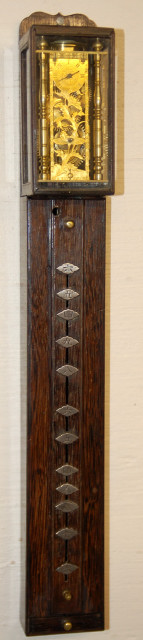
The Japanese pillar clock pictured here is a rare example that is a striking example, most are timepiece. It is also weight driven. It has a verge escapement, beautifully turned pillars and a foliot escapement. As the clock winds out the indicator tells the time by the scales on the door. Typical clocks had six numbered hours from 9 to 4 which counted backwards from noon to midnight. The dials did not have the numbers 1 to 3 for religious reasons. Dawn and dusk were marked as the sixth hour in Japanese timekeeping. A list of the strange dials for the hours is given on Wikipedia, please take a look.

The name pillar clocks comes from the fact they used to hang from the pillars or posts of the Japanese houses. These clocks were generally made from a wood called Shitan. Clearly because of the fragile nature of the construction only a few have survived and they are highly sought after. The movements go for just 1 day on a wind.

Summary

I hope you all have a happy and most important of all healthy Christmas and New Year. Soon restarting my antique clock blog in the New Year. I hope you have enjoyed and hopefully learned something from them. Again have a lovely holiday and see you soon.


Posted on

Carriage Clocks

In my many antique clock blogs to date,  I have talked about the rise of clockmaking in England and London being the centre of clock manufacture in the 17th and 18th centuries. The tide starts to turn though through the 19th century. You will then see more makers from France and Germany exporting their products to the UK.

The Rise of Continental Clock Making

The French clock makers became very adapt at clock making during the start of the 19th century. I will look at the introduction of the French carriage clocks here and its impact on the market. The carriage clock above further details are found by on small carriage clock.

Abraham-Louis Breguet

It was Abraham Louis Breguet (1747-1823) that was in my opinion the finest of all the continental horologists. Breguet is classified as the inventor of the French carriage clock. He gave one of these clocks to Emperor Napoleon in 1812. A.L.Breguet although born in Switzerland spent almost his entire productive life in Paris. His career began with a series of new inventions in the field of watches.

The era of Balance Wheel Clocks

He invented the self winding perpetual watch for example. During the French Revolution Breguet took refuge back in Switzerland but he soon returned to Paris with further new groundbreaking horological ideas. He came up with the Breguet spring balance which was fundamental to the invention of the carriage clock. After his death in 1823 many would mention this great inventor and horologist as one of the greatest pioneers of  scientific achievements in the field of time-keeping in France.

Carriage clocks are usually made of brass or gilt brass have numerous glass windows to see the mechanism. These clocks have a platform escapement visible through the top glass window. These clocks use a balance and balance spring to control the timekeeping. This balance effectively made the clock very transportable, the way other clocks were not at the time.

Easy transportation – clocks on the move

Clocks were thus made smaller by not having to have a pendulum. These clocks were spring driven and could have a repeat function to show the last hour/half hour. These clocks were exported in vast numbers from C 1860 to C 1920. I suppose production was at his height around C 1860/80 in France. Many of these carriage clocks were made in France and retailed in the UK. The makers normally had some mark or feature engraved on the back of the movement. This you can normally decipher in a good French carriage clock makers book.

Conclusion

These French carriage clock are generally of ‘8-day’ duration. They are very good Christmas presents. Prices go from £300 or £400 upwards for timepiece examples. Repeating carriage clocks tend to go from around £1,500 upwards. Some porcelain panel carriage clocks and champleve enamel carriage clocks were also made. These are rarer and tend to be alot more money. It is important when purchasing these French carriage clocks to check the clock has an original escapement. Many have been changed over the years.

Posted on

Clocks for sale

I have now written many blogs about important aspects of antique clocks. Many of these blogs relate to how to find more information about a particular antique clock Setting up antique clocks, the history of antique clocks or timekeeping antique clocks Lessons in finding a genuine antique clock or even advice if you are considering a career in restoring antique clocks. I hope I have showed you there are many pitfalls in choosing antique clocks for sale. You can learn more from visiting our website www.pendulumofmayfair.co.uk.

Where to Find Clocks?

The truth is there are literally thousands of places you can source your antique clock for your home. I am sure you have seen clocks in many places like dusty old curiosity shops. Local, regional and famous auction houses, ebay, and maybe even the odd car boot sale. I want to stress the importance of buying from someone who is a long established expert in the field. They should give you a written guarantee than the item you are interested in, is a genuine antique. There is nothing worse many years later someone knowledgable coming around to dinner telling what you thought was your prize and joy has been butchered.

Reputable Clock Dealer

It will be more expensive buying from a long established reputable dealer offering a money back guarantee. It is worth it in the end though. I have also noticed that with the auction houses some of the prices realized are actually even higher than equivalent for restored examples in dealers shops. People seem to enjoy buying at auction. Remember this is not a place for anyone other than trained experts. Read the conditions in the backs of many auction house catalogues.

Check conditions of Sale in Auctions

Auctions are basically buyer beware. Some auction houses also now charge as much as 30% plus VAT commission on the buying price. The price you bid is not the price you pay and it is easy to get carried away bidding in an auction house.  Yes I may have considerable bias, as I believe you should always buy from a specialist dealer like ourselves. That is if you want a clock or lovely piece of furniture that comes with a guarantee.  I also would recommend buying a genuine picture though from an established picture dealer not an auction house. You are then covered by a written guarantee and are paying for the dealers knowledge and experience. Also when to comes to these items and especially clocks, we at Pendulum of Mayfair Ltd have our own sympathetic restoration facility. Items purchased at auction or elsewhere will normally need lots of money spending on restoration after purchase. Clocks need to work properly, you will not get any guarantees that they will do so from auctions.

Conclusion

To sum up therefore there are lots of antique clocks out there that seem a good deal. On closer inspection this may not always be the case. A changed movement, a new base, there are many factors which reduce the value of an antique clock. In looking for places with antique clocks for sale , my recommendation is to buy from only long established dealers. They will given you a written money back guarantee that the item is genuine.  I do not believe we will be beaten on price at Pendulum of Mayfair Ltd, like for like. We offer sympathetically restored antique clocks and furniture at affordable prices in London and Cheshire.

World Wide Exports

We sell to all four corners of the globe. A specialist antique shipper ships all our items to your front door. We also have comprehensive setting up instructions for all our antique clocks. The world wide web has made it possible buying from anywhere in the world an easy task. Although I always recommend to buy your antique clock in person. You can then touch it, smell it and speak directly to the person selling. Clearly this is not always possible in today’s manic world. We will provide many high profile references on request, and we usually know someone that has purchased from us in your neighborhood. If visiting the shop is not possible, speak to us on the phone or by e.mail and realize what makes us tick ! Trusting the person you are buying from is essential when buying antiques of any sort.

Posted on

Antique Bracket Clocks


The purpose of this blog is to trace the antique bracket clock from its beginnings. This started at the latter end of the 17th century up until the mid 19th century or Regency Period in England.

Best Clocks in the World

During the entire period that I have mentioned above, clock making in Britain was acknowledged to be the best anywhere in the world. Clock makers in the UK maintained this position until at least the mid 19th century. Then imports arrived on our shores from France, Germany and eventually the USA. Clock makers in the UK refused to lower standards and change to the manufacturing methods used by our continental neighbors and those further afield.

Fusee Mechanisms

I have mentioned in my previous blog about lots of different antique clocks. These were manufactured in the UK during our supremacy in the field of clockmaking. I have only really touched on antique bracket clocks. Examples of such clocks can be found on our clocks site by clicking here. I only mentioned these in my piece in antique clock descriptions.Touching on them, describing the differences between mantel clocks and bracket clocks.

During the 18th century,’ the great Georgian period of clockmaking’, many thousands of lovely bracket clocks were manufactured. These at the time were actually costlier to produce than the equivalent longcase clock.

More Expensive making Fusee Bracket than Longcase Clocks

It was expensive making the springs and the fusee’s. The fusee was an ingenious invention. The spring slackens off over the week and before the invention of the fusee, timekeeping would become more eratic. The clock would thus go slower. On fusee clocks however the power delivery is evened out over the course of the week.


Bracket Clocks were only produced by the top clock makers

Bracket clocks were thus only really manufactured by the top makers in the 17th/early to mid 18th century During this time you will find most manufactured in and around London. Clearly the skills were available in London and the customers were there that could afford them. Bracket clocks were also made in the large towns of the UK, but you will not find many provincial bracket clocks, especially early in the 18th century. You will find most provincial bracket clocks dating from the end of the 18th century and on into the 19th century. There are always exceptions though.

Balance Wheel Escapement

The earliest form of escapements were called the balance wheel. Only a handful of these type of clocks still exist. The vast majority of the bracket clocks up to about C1760 were controlled by a ‘verge’ escapement. You will see on lots of these clocks a window on the dial This is where you can see the pendulum swinging by means of a circular brass disc. This brass disc has a connecting rod to the verge bob pendulum at the rear of the clock.

Different woods used

The bracket clocks made up to the mid 18th century, tend to be ebonized. Actual ebony (rare) or walnut veneered, sometimes even marquetry on walnut. In the following years mahogany is used. After 1800 you will see the introduction of more exotic woods like rosewoods and other fruit woods. You will also see the introduction around C1760 of the anchor escapement.

Verge Escapement

The verge escapement was great in so much that the crown wheel was at right angles to other wheels in the train. Therefore and was far easier to put and stay in beat. i.e. not so temperamental to being knocked. The disadvantage of the verge escapement is that the timekeeping is far less accurate than the later anchor escapements. For this reason some original verge escapements are later converted to anchor. This needs to be checked when buying as it is nice to get an original example of either.

Engraved Backplates

The other big difference with the verge earlier clocks, many have profusely engraved backplates. Some anchor escapements have these around C 1760 as well but the later you go through the 18th century, the fine detailing and engraving gets less and less. Around C1800 only a border of engraving is common on the bracket clocks. After C 1800 most bracket clocks have no engraving and at best only the makers name engraved to the backplate.

Conclusion

I will finish this by mentioning the name bracket clocks. I am sure you will assume they all stood on a seperate bracket, but this is not the case. Only a very few had a purpose made bracket. Most were just to be placed on your sideboard or chest of drawers or fireplace. The back door of many 18th century bracket clocks is glazed Meaning you can see the finely engraved backplate on your fireplace, by putting a mirror behind the clock. Clocks commonly have a pull repeat feature to let you know the hours and sometimes the quarters. This was important with no electricity. A string could be put by your bed that was connected to the clocks rack mechanism this would let you know either the last hour or next hour, or on some like I say the hour and the quarter. i.e. 4.15.

Highly Sought After Clocks

Genuine Bracket clocks are highly sought after, especially smaller original examples. Larger examples are easier to find and are less commercial as a rule. All bracket clocks tend to go for a minimum of ‘8-days’. Longer duration examples are also possible. Visit our homepage at www.pendulumofmayfair.co.uk for more information.

Posted on

Lacquer- Chinese Decorated Clocks

East India Company

When talking about antique lacquer clocks and their cases we need to discuss the China trade and the formation of the East India Company.

People today see the trade with China as a route for cheap goods or services. They also probably believe this trade route is a relevantly new process. This is far from the truth though on both counts. We have traded with China and areas of the world like this for many centuries. The ability to trade came about with our nation making huge advancements in marine technology that I have discussed in previous blogs.

Role of our Great Navy in Trade

We were undoubtedly a great sea power. Merchants in the 16th and 17th and 18th centuries were amazed at the many treasures and skills the Chinese people possessed. It was not until 1672 that the famous East India Company secured a trading post in Taiwan. This was ten years or so later than their counterpart, the Dutch East India Company which was expelled from the country by the Chinese. At the start of 1700, the company’s base was changed from Taiwan to Canton. With its Royal Charter the company was granted a monopoly of trade in the East Indies until 1833.

As I have discussed in previous blogs about the Clockmakers Company. London and the UK was the centre of the world’s clock making in the 17th and 18th centuries.

Trade With China

The China trade expanded many different skill sets though, and cabinets from English clockmakers were sent out to China to be decorated. True lacquering originated from Asia and it is obtained by applying many coats of the sap of the lac tree with polishing between coats. The colour or surface dye is mixed with this lacquer. (Black, blue, red, green and many other colours) Then the lacquered cabinet is decorated with raised gold leaf decoration. These skills are thought to have been employed in Japan and China as early as the third century BC. Clearly its importation into Europe came at a much later time and was facilitated by the East India Company described above.

Lacquer Decoration

Furniture, boxes and antique clock cases were all decorated in this way. They were then transported back to homes in the UK. It is suggested that very few clock cases were sent out to the Far East for decorating. I do not agree with this. If you look closely at the records of the East India Company. Many clocks and pieces of furniture are clearly listed, with the lacquered description clearly evident. I am not saying some lacquer production does not start up in the UK. Any that does I believe to be not of the same quality as the clock cases decorated out in the Far East. Later 18th and 19th century clocks with have been lacquered sometimes show an inferior quality. These from UK decorators trying to copy the highly skilled Chinese in this regard.

UK versus Chinese Quality in Lacquer Work

No lacquer cabinets have a decorators mark so we will never know for sure which is which. The records of the East India Company do show a large importation of lacquered products throughout this period, this is for sure. We have a great history in this country in the UK but it is amazing what countries like China manufactured many centuries earlier. The East India Company imported fantastic Chinese porcelain and many other items into the UK during this time. These were not inferior cheap products at all. UK Porcelain Factories in places like Stoke set up off the back of this. We need to remember the great contribution of the Chinese nation. This development is carried out far earlier than in the UK. https://www.pendulumofmayfair.co.uk