Posted on

Clocks – UK / USA

It is Ryder Cup weekend again. Great sporting battles between Europe and America at golf come to a head. These are friendly sporting battles but lets not forget the close ties between our great nations.


Exporting clocks

In the 17th and 18th century clock manufacture was the UK’s greatest export. The Clockmaker’s Company was formed as one of the UK’s oldest learned professions by Royal Charter in 1631. This started two centuries of UK dominance in this field. It was just before this in 1620 that the famous Mayflower set sail for America.

The Mayflower Boston Journey

The Mayflower has a famous place in American history. It is a symbol of early European colonization of the future United States. This ship set off from Plymouth, England to arrive at the now Plymouth, Massachusetts. It is the same reason why Boston, Massachusetts is called so today. John Cotton, a Puritan,who served as a Minster of the church in Boston, Lincolnshire England fled persecution. He moved to Massachusetts in 1633 as a leader of the settlers already there and some of his own people. He was instrumental in founding and naming Boston, Massachusetts.

American Clockmaking

Clock makers from the UK arrived in America, William Davis for instance is one of the earliest clock makers in America. He arrived in 1683 from the UK. Many of the oldest clocks on US public buildings were made by UK clock makers. These had fled for mostly religious reasons. New England had thus developed and the English community was strong here as thousands emigrated to the emerging America.

Ban Importation of Clocks

During the 18th century many English clocks were still imported to the US. One of the first things the new independent government did in US was to ban the importation of clocks. It is still the case though that many of the earliest American clock makers were English. They still imported dials etc from the new painted dial works (set up in 1771) in Birmingham, England and movements from the UK.

Rise of American Clock making

The rise of the American clock making industry from about 1850 to 1920’s coincided with the decline of the same in the UK.  Generally as quality went down and mass production rose, the US factories now churned out clocks better than anywhere else. Many famous 19th century American companies were set up, many of them in Conneticut. The Ansonia Company was founded in 1851 and thrived until its decline in the 1920’s. There was the Gilbert Company in the second half of the 19th century The famous Seth Thomas Company and many many more. The Waterbury Clock Company is one I will finish with.

Waterbury Clock Company

This company started in 1857, eventually became the Time Corporation, that made Timex watches. As a collector, I am only really interested in the first 200 years of clockmaking. Items were then handmade and were alot higher quality. There are always exceptions though and we have a clock made by the Waterbury Clock Company. This I believe is a one off, made for Christchurch Cathedral in Dublin. Its movement is of good quality and shows little signs of wear. It is a really rare and interesting example. This is pictured below. I suppose it also shows the strong Irish / American links that existed during the 19th century.
 

Conclusion

Visit our shop in London, if you love 18th century antique grandfather clocks like me. We have a large selection of genuine fantastic examples all fully restored. These clocks will keep ticking for generations to come. If you consider the painstaking hours in the manufacture. They represent amazing value for money by todays standards. Remember London was the centre of clock making from 1631 to the start of the 19th century century, some outstanding pieces were produced. 80% of our clocks from our shop in London, Pendulum of Mayfair Ltd,  are still exported to America. Owning your piece of history is easier than you think. We use a specialist antique shipping company that ships antique clocks to you door. Please visit our website for more information www.pendulumofmayfair.co.uk

Posted on

Shipping Fine Clocks

At present our family antiques business probably ships about 60% of its total sales of antique clocks. They go abroad to countries like USA , Canada, Australia and China. For shipments to these countries antique clocks need to be professionally packed.  So what does this entail?

Packing Clocks For Export

After you have purchased your antique clock we offer a full door to door shipping service. This is provided at present by a superb company that we have used for many years called the British Shop. They will pick the clock up from our shop in London or our premises in Cheshire and arrange for a crate to be made. This is for the trunk, hood and movement. They export and deliver to your home. The timber crate is necessary when export packing. The clock with have tissue/bubble wrap all around the polished surfaces, and then the trunk will be held down in the crate by battons. Further layers of bubble wrap and packing will then be used to fill the voids and further the item further.

Good packing minimizes transport risk

The parts of the clock will usually be kept seperate to ensure they can not damage one another. The crate will then be screwed down and be ready for transport either by air or sea freight. I always recommend air freight as it is far quicker.

Setting Up Instructions

All documentation will be provided with the antique clocks to ensure they pass customs. Full setting up instructions are always available on our website or included with the crate.

It is important in my opinion to use a specialist antique shipper to minimize the possibility of any damage during transport. Accidents do happen from time to time though and so make sure you take out the proper insurance for your peace of mind.

On delivery of your crate, please check all items have arrived in perfect condition as the shipper normally has a time frame in which he requires any damage to be noted and the insurance company informed. When the clock arrives always make sure you keep the antique clock in the correct humidity conditions. Above 40% to about 65% R.H is about ideal.

Value for Money

Clearly the UK was the centre of antique clock manufacture and the best clocks made in the 17th and 18th centuries were in the UK. If you are from the USA or other countries around the world, visiting the UK on holiday. Then choosing your very own antique clock is a special experience. We welcome our foreign customers and can provide them with special export prices. On antique grandfather clocks we are running a special promotion at the moment. This normally means we can discount the clock for you to effectively cover the cost of export shipping door to door.

Posted on

Regional Characteristics of Antique Grandfather Clocks

Antique grandfather clock cabinet production was separate from the clock maker. The clock maker just produced the fine antique clock movements. As you can imagine communities stayed very much together during the early years and people did not travel long distances. As a result you will notice every area of the country in the 18th century had a very different case style. It is very easy to place the manufacture of an antique clock cabinet from just a very few features on the case.

Case Styles on Antique Clocks

Further case styles can be found by clicking here.

London cabinet designs changed only slightly during the 18th century. You will see after C 1720 and up to C 1800 usually two plinths, moulding to trunk door and high quality walnut, mahogany veneers or fine lacquer work cases. Examples of this can be seen below. After about C 1800 London clocks can lose the second plinth and the moulding to the door, but you will still see them being quite similar in design. You will also find these close similarities in cases of clocks within 50 miles or so of London. Many clock makers actually bought London style cases in these areas.

London Case Styles


Scottish case styles

You will find many regional designs of cabinets. After looking for a while you will get a good idea of where the clock maker was based from just looking a certain case features. In Scotland for example, especially the East Coast you get some wonderful cases from C1770 to c1810. They are all very slender, shaped top to the trunk door, high proportion base and standing on bracket feet. The most similar characteristic is the swan neck pediments to the hood.


North Western UK Case Styles

You will also find Manchester, Liverpool and Bristol cabinets to be quite distinctive. In the 18th century these areas were very wealthy, especially because of the trade going on with the West Indies and the USA. Manchester was the birth place for the industrial revolution. Cabinets in Manchester and Liverpool, tend to be quite large with quite imposing features,  Og feet, Corinthian columns, fine veneers. You will see a typical high quality Liverpool case below.


Bristol was another very important port in the 18th century and the clocks made in this part of the country are very distinctive. Wobbly doors are very common and scenes engraved to dial are very popular, pierced swan neck pediments and OG bracket feet show the fine cabinet work. Again it is easy to see the wealth in this part of the country in the 18th century, the cases are very flambouyant. Understanding case design and the styles of the various parts of the UK cabinet design is important when looking to buy an antique grandfather clock. You can use this knowledge with further research to pinpoint all those important questions that you need reassurance with, when purchasing antique grandfather clocks. Our shop Pendulum of Mayfair takes all these worries away from you.


Posted on

Buying new or antique clocks ?

The question should I buy new or old is normally a no brainer. Clearly for 95% of items buying new is clearly more attractive. The question in relation to clocks is somewhat different.

There are many many reasons why in this instance buying an antique clock from a recognized clock dealer is the correct decision.

Handmade or Machine Made Clocks

1) Clocks generally made prior to C1800 will be handmade. The quality of the movements is generally far better than there new equivalent.

2) Labour costs are increasing ever year and they are considerably more expensive than they were in the 17th and 18th centuries. Buying antique items with intrinsic labour costs built in is a good thing.

3) The skill base in clocks has dramatically decreased over the years. In the 17/18 th centuries etc London was the centre of clockmaking and every little village had its own clockmaker. Today the clockmaking industry is a shadow of its former self.

4) The cabinets are generally far better looking on an antique clock. Veneers on 18th century clocks are clearly hand cut and the finest slow grown timbers are used. Furniture veneers today are generally chisel cut on machines to less than a millimeter thick. Also the finish of antique cabinets has improved with age. The sun and years of waxing gives them a softer more mellow finish. Modern furniture has generally little or no character and usually has a sticky french polish open grain finish.

5) Investment is another key factor and plays a big part in decision making. Although many people keep their antique clocks and hand them down their family trees to the children. (Antique clocks are a great way of reducing capital gains and inheritance tax bills.) For those people that should a rainy day come and they require funds urgently, genuine antique clocks normally increase in value, assuming you keep them in a good condition. Generally modern clocks lose value and depreciate.

Conclusion

The 5 reasons stated above are just a few advantages to buying antique clocks, there is nothing better than owning your little piece of history and a lovely antique clock. Antique clocks have stood the test of time, and with everyone today focusing on green issues, what could be more green. 100% recycled ! Our London shop Pendulum of Mayfair provides an excellent selection to choose from.

Many people will point out that the disadvantage that they are more expensive, this may be true in some instances but you will more than make this up if you come to sell. The increase in value over time of antique clocks has been documented in many books. Don’t delay buy an antique clock today !

Posted on

English Antique Dial Clocks


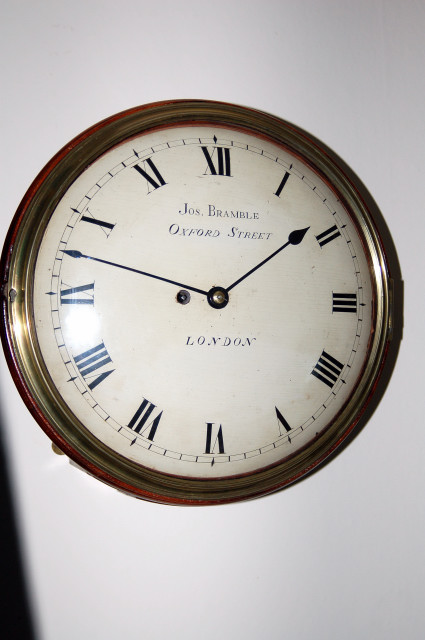
In my last post I talked about tavern clocks. These are really the start and a branch of English dial clocks. In this post I would like to focus on the more standard wooden dial clocks or drop dial clocks. These run from about C 1770 to right up until modern day. I will focus up until WWII. High quality fusee wall clock were made for station clocks and post offices etc  up until the advent of radio controlled quartz clocks.

The Act of Parliament in 1797 imposed a tax on clocks and watches. This forced many clock making factories to close or cut back production or swap production to these wall clocks. Many which could escape the tax. When the tax was repealed many factories that swapped over production to dial clocks. They increased production to take advantage of the more favourable conditions.

Large Established Movement Firms

During the 19th century movement factories making fusee movements for these dial clocks were becoming increasingly successful. The later you go through the 19th century more and more movements for these dial clocks are made by larger established firms. It was found increasingly that the clockmaker bought in movements for his clocks during the 19th century and fewer and fewer clocks were made by the clockmaker on the dial. Production had turned to a form of assembly. In fact from the middle of the  19th century onwards more and more clocks were signed by the retailer of the clock and not the actual maker.

Verge Dial Clocks

The earliest round dial wall clocks are very collectible and they are found with silvered brass dials,  verge movements and ‘salt box cases’. It is rare to find these types of clocks. Most dial clocks will be from C 1820 in date and typically the most I see on my travels date from around C1860/80.  These clocks will usually have mahogany cases and anchor escapements. 99% of these clocks will not be striking and have only one train, just for the timekeeping. The dials can either be flat or convex as will be the glass.

Standard 12 inch Dial Clocks

The most popular size for manufacture was 12 inches across the dial, using a flat white painted dial. More collectible dial clocks tend to have 8 inch or 10 inch dials and the very large 18inch dials are also very hard to find. Most of the best spring driven wall clocks throughout the 19th and even 20th centuries will have fusee movements. These are far better movements than the typical French movements made throughout the 19th century. The French may have excelled in design with interesting mystery clocks etc but the British still excelled in the quality of the movements made through this period.


Wooden Dial Clocks

As I have pointed out the earliest dials were silvered brass dials. Most of the dials produced after C1820 are iron white painted dials, but you will sometimes find a rare example of a wooden dial dial clock like pictured above right.


RAF SECTOR CLOCKS

During the 20th century dial clocks still had an important role to play in the emerging factories. In the post offices and stations many were used in the UK. RAF sector clocks are very rare and were used during WWII and the Battle of Britain. These wall clocks are very collectible and so be very careful when purchasing. Many have repainted dials and are made to look like original sector clocks. RAF sector clocks commonly had 14 inch dials and movements were generally made by the Elliot company and they were dated. The cases usually had a RAF log on the back and a date as well. The finest examples had fusee movements whereas some cheaper examples had going barrel movements. These sector clocks allowed you to see which squadron was in the air at any one time.

Which Squadron was Flying

There were normally three colours painted to the dial in triangles by the side of the numerals. see picture below. Our London store www.pendulumofmayfair.co.uk sometimes has one of these rare antique clocks in stock.


Posted on

Antique Tavern Clocks


Antique tavern clocks have been studied widely and many books have been written. I wish to correct the commonly held view that these clocks started life only as early as C.1720. You may know these antique clocks by another name, they are sometimes called ‘ Act of Parliament’ clocks.

Act of Parliament Clocks

They were later commonly called this as a result of the tax imposed on clocks and watches in July 1797. With the government being short of funds as a result of many years of war, extra ways to increase tax were thought out. The Act imposed a duty of 5 shillings on every clock, 10 shillings of every gold watch and 2s.6d on every silver or other watch. Assessors were sent round to take account of how many clocks you owned above a certain value.

Public Houses Exempt from the Clock Tax

There were certain exemptions to the Act, these included public houses. Alot of these tavern clocks as the name says were housed in public houses. They were exempt from this very unpopular tax. It led to a decline in the clock trade and luckily was repealed after only 9 months of it being in force.

Lacquer and Chinoiserie Decoration

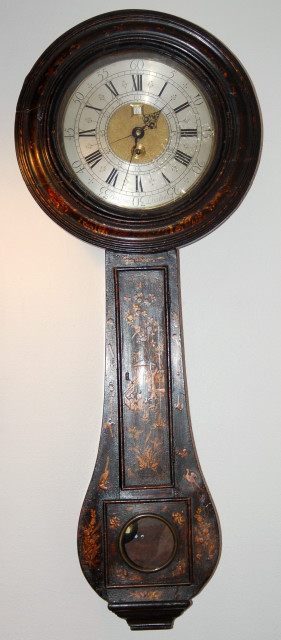
These tavern clocks were usually decorated in lacquer work. They had wooden dials that were made up from usually three sections. They also usually had simple single 5 wheel train movements. The extra wheel in the train generally makes them go for longer than a standard longcase clock, even though they actually have a shorter drop. They usually had brass hands so the time could easily be read against the black painted dial. The earliest dials known were wooden and shaped like a shield. Then later circular dials were introduced and tear drop shapes to the cabinets.

When did they start?

Many books on the subject commonly state the earliest examples of these clocks are from C1720. We have owned for over 10 years, a clock of this form that is pre 1700 in date. It is an amazing tavern clock, it is the only antique clock of this type I have ever seen with an original brass dial, instead of the usual wood form. The antique clock maker is from a family which emigrated to London from Augsburg in Germany. Bushman is a fantastic clock maker and by all accounts the finest clockmaker to come out of Germany! He is mentioned as being on a par with the great Thomas Tompion in some quarters.


Augsburg Influence

If I took a picture of the clock minus the hood it looks like a very early Augsburg table clock. I can see where the idea for the manufacture started. I believe this clock to be one of the first, if not the first,  tavern clock. John Bushman is provable in London between 1661 until just after 1692 ( date of death unknown). We do know he came from the Augsburg area, but you can see the influence from the design of the cabinet work on this clock. Bushman was admitted to the Clockmaker’s Company in 1662. You can see the huge pull of this Guild which I have talked about previously. The best clockmakers from all over Europe came to London. Everyone wanted to come to London and work in the 17th and 18th centuries. It truly was the centre for clock making in the world at the time.

Many people will ask if this clock has 5 wheel train, how does it have a second hand, a sweep centre seconds hand in this case. The movement has a one to one reversing wheel to enable for it to do this. You can see the amazing engraving to the unusual dial and superb unrestored lacquer work to the case. A very rare collectors clock, for more information please contact me direct.


Posted on

Moonphase Antique Clocks

Moonphase Clock With Tidal Times

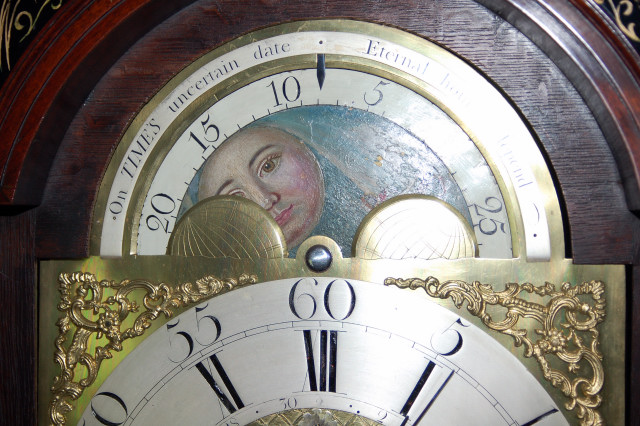
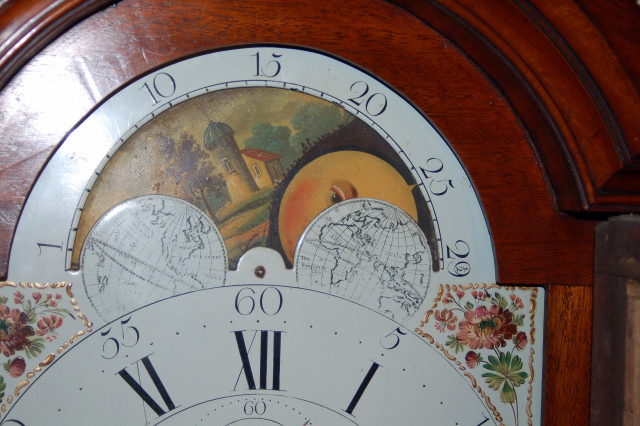
We often get asked about moon phase grandfather clocks. Were they just a form of decoration or were they an important feature on clocks? The lunar moon repeats with a cycle of 29.5 days. This is shown on all antique clocks with a moon feature as a result the moon disc moves once or twice per day.

Moon Disc Use On Clocks

On early pre C.1800 examples they certainly were more of a feature that the owner required for a specific purpose. That purpose was first and foremost travel, whether you would be travelling by ship or travelling by road. Knowing when the next full moon was vital part of life back in the 18th century. A merchant might live near the coast and need to know when the next high tide was. This feature will also be accompanied by a moon disc and he could look at his clock. On that day it would say the high tide would be 7am /7pm etc.

Stationary or Fixed High Tide Indicator on clocks

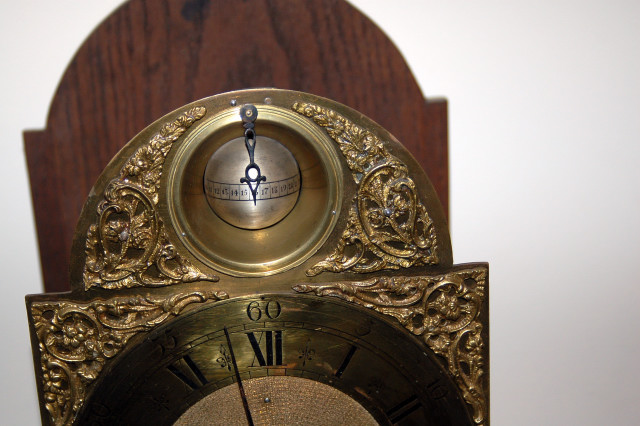
Tidal times are sometimes stationary. i.e. set to the port of the clock. Bristol Key etc or variable by an indicator to the arch which can be set to your local port, high tide time.

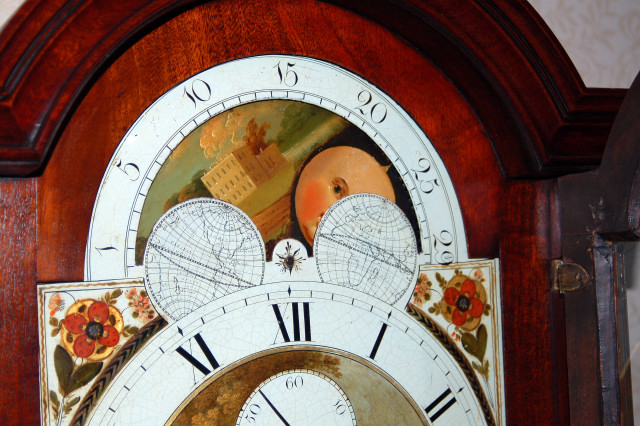
On an 18th century antique clock, a moon disc can either be a  circular disc to the arch or a globe moon to the arch, sometimes called a ‘Halifax Moon’. They also could be, or a small ‘penny moon’ normally to the dial centre. This is where the seconds disc normally would be. Clocks with moon discs and not accompanied with high tide indicators were for help when travelling by road.

Highwayman Higgins

The highwayman was always a risk for the merchant in the 18th century. Tt was always advisable to travel on days with the full moon and lots of light. Generally the highwayman did not work on such nights They were more likely to be recognised. The most famous of northern highwayman was a Edward ‘Highwayman’ Higgins, who was a gentleman by day and a thief by night. He resided on Gaskell Avenue in Knutsford. This is only 5 miles from where our antique clock workshop is based. Higgins was hanged for his crimes in 1767.

London longcase clocks with moon features are very collectible as London had street lighting in the 18th century. Also the arches on London clocks are slightly reduced and not a full semi-circle. They were not really designed for moons.  On provincial clocks you will notice the arch is a full semi-circle and alot more suited to a moon disc. It is for that reason finding a genuine London 18th century clock with a moon is highly sought after. Adding this feature to an 18th century London grandfather clock, can add up to £5,000 to the price on an equivalent clock.

Conclusion

I have been talking above about pre C.1800 clocks and clocks where the dials are 12 inches from side to side or less. Later clocks with dials of 13 inches or even larger are more likely to have moons and are not quite so rare. Clearly lots of later 19th century wider examples can have moons. These are more common and the moon disc on these is more for a form of decoration in my opinion than for any other purpose. We stock a few good examples at Pendulum of Mayfair of moon-phase clocks.

Pictures of different styles of moon dials below

Moonphase feature to square dialstandard moonphase C.1790


penny moon clock


Posted on

30 Hour Clocks

antique cottage clock - 30 hour

30 Hour Country Clocks

My last post was about my most special antique clock makers. I jumped to the support of a superb provincial clock maker at the expense of the hundreds of high quality London makers. In no way was I undermining the great London clockmakers though. We sell more London clocks than any others. I must say we all owe a great deal to the formation of the Clockmaker’s Company in London. The Clockmaker’s Company set standards high and as a result we have lots of special clocks. The UK and London became the centre of clock-making in the 18th century. It is something I am very proud of.

I do think there is a place though for the simple 30 hour clock produced in the provinces. London looked down on the simple 30 hour in the 18th century. No 30 hour grandfather clock examples I believe were produced here after the about C1700. They thought the same of oak cabinets. You will not see a genuine oak London longcase clock I believe, all these were veneered in walnut/marquetry or in figured mahogany, or decorated with chinese lacquer work.

Antique 30 hour clock

Clockmakers Company

The Clockmaker’s Company kept standards in London high. Provincial 30 hour clocks though have a character of there own. In the 18th century you still had to be well off to own a grandfather clock. They were normally the most expensive item in the household.

lovely 30 hour dial

30 hours clocks can have a single hand or two hands to tell the time. Most examples do not have a second hand. For a 30 Hour clock to have a second hand it would need a extra wheel in its train or it would run backwards.

Original 18th century 30 hour oak or pine clocks that have not been altered or have not suffered from the dreaded rot or worm infestation are rare though, many have lost parts of their bases over the years or had their movements converted from 30 hour to ‘8-day’ examples. Both of these dramatically effects the value and I would not recommend purchasing one of these.

wilson 30 hour clock

If you own a cottage though there is nothing better than a simple oak ’30-hour’. You will find they will be very reliable and will fit in with the low ceilings in a cottage much better. Most collectible ’30-hour’ grandfather clocks will have either 10 or 11inch dials, this makes them smaller and slimmer than their standard ‘8-day’ equivalent.

Most of these clocks are wound with a rope or chain, since this rope or chain is on a continious loop, the clocks weight is always engaged when winding. This means that the clock will not stop or lose time during winding. This is effectively the same as ‘maintaining power’ on the fine regulator clocks. They will strike on the hour and it is the same weight that drives the time or going side and the striking side. This is partly why the clock will only last one day on a wind. If you put a clothes peg on the flywheel of the strike mechanism, a 30 hour clock would normally last for about 3 days before needing to be wound.

Conclusion

If you do decide to take the plunge and buy a collectible 30 hour after reading this. Make sure you buy from a recognised dealer. They will give you a money back guarantee that the clock is genuine. Remember to enjoy your search for your grandfather clock whether that be a simple 30 hour clock or a ‘8-day’ example.

As with all antique clocks you are only a custodian of them for future generations. They with live long beyond us if cared for properly.

Posted on

Dating Antique Painted Dial Clocks

Dating clocks

Longcase or grandfather clocks were made in Britain from about 1658 and during the first few years their production was confined almost exclusively to London. One of the earliest provincial grandfather clocks I have seen is dated 1689 by a maker called John Washbourn.

Painted dials on the other hand were brought out just after C.1770, these were made to compete with the single sheet dial or one-piece brass dial, that was introduced around C.1760.

I like to catagorize painted dial grandfather clocks into three seperate time periods.

Period 1 – 1770 – 1790

Painted dial manufacture and painting was started in Birmingham by two individuals called Osborne and Wilson. They were in partnership between 1772 and 1777, they later went there own ways producing dials on their own merit, Wilson died in 1809. White dial production became very popular in Birmingham in the 18th century. Towards the end of the 18th century there were a large number of dial painters situated in Birmingham. Most dial manufacturer’s stamp their names on the iron false plate behind the dial. It is true to say Birmingham dominated the market in painted grandfather clock dial production, but there were a few other areas that set-up dial painting and manufacture for example in Halifax and Edinburgh. 

Falseplate

The very earliest dials were attached to the front plate of the movement directly. After a short time, dials were attached by means of an iron false plate. This made it easy for the clock maker to attach his dials. It would not interfere with any part of his movement. Also it meant you could have smaller dial feet, which were therefore more stable and less prone to bending.


The two dials above are exceedingly early white dials and just have the gold leaf decoration to the corners. These type of dials date from about C.1772-1775

Below you will see the second stage of period 1 antique clock dials. Some colour is added to the gold leaf decoration to the corners and arch. These clock dials below date from C1775-C1785

You will notice in London gold leaf decoration and flower to the corners is earlier than the corresponding dials in the provinces. In London new advances were always ahead of their time. Even though dial painting originally started in Birmingham. Early London dials around C1775 will have gold leaf decoration and flowers to the corners. Sometimes London dials have no decoration at all. Also sometimes the chapter ring and the strike/silent ring are porcelain or painted with the rest of the dial left brass.


There is therefore three stages in my opinion of period 1 antique clock white dials. The last stage of period 1 is between C.1785 and C.1795. This is when the dial painter drops the gold to the corners and sometimes a scene is included or a bird.

Period 2 – 1790 – 1810

Period 2 can be mixed in certain ways with period 1 dials. They are certainly in no way inferior to period 1 dials. In fact the two dials I have included here are amazing works of art. I suppose it is the real height of dial design and some of the dials produced certainly in the C.1790-C1800 period are of the finest detailing.

Period 3 – 1810 onwards

I must admit  period’s 1 , 2 and the very start of period 3 white dials are the most collectable. These are of the highest value and my favourite. The two pictured below are very nice clocks both dating from start of the 19th century.  As the 19th century progresses the dials become larger and the scenes not so well painted. Generally if your dial is 13 inches or below and your clock is an antique and not a copy. Your clock will date from earlier than C.1820 as a rule of thumb.

Conclusion

You will also notice the dial progression, the very earliest white dial grandfather clocks are mostly white. As time progresses more of the dial becomes painted. The later you go, the painting gets quite dense. On the later mid 19th century ones, these sometimes are not of a very high quality or very appealing. The dials below are very good period 3 antique clock dials, and still very collectable. The clock dial on the left is a rare oval dial. You will notice most dials produced were either square and arched. Visit our homepage https://www.pendulumofmayfair.co.uk for further information.

Posted on

Wood Identification Guide

For antique furniture and clocks different types of wood were used in their manufacture. In this handy guide I am going to cover some of the main woods used. These woods can be of solid form but most flamboyant grained woods are used as hand cut veneers. The carcass is generally made from oak or pine in the provinces or oak generally in London.

Woods Used in London and Provinces

In London oak is only used as a carcas material in the 17th and 18th centuries. Whereas in the provinces you will find antique grandfather clocks being made of oak as the finished wood. Clearly oak was veneered on as well, especially in London by English Walnut up to say C1750 . Then from this date fine Honduras and Cuban mahogany veneers are found. On some clocks you will find very early examples to be of ebony construction or ebonized (black stained fruitwood generally)

Chinoiserie Clocks

You can also get oak grandfather clocks in London that were painted and decorated by Chinoiserie or lacquer work. The finest examples were sent out on boats and decorated in China.  On some later clocks you will see these veneered in more exotic woods. Rosewood or maple or even ewe wood. I suppose the smaller size means you can use veneers of the more slow growing and smaller trees.  With early clocks these exotic woods were used as well in small pieces and matched. We have owned a lovely walnut burr oyster veneered grandfather clock.

Below is a selection of woods used for antique clocks and furniture during the 17th and 18th and 19th centuries in England. A brief insight into each wood pictured is given. I hope from this blog you will discover what type of wood your clock or piece of furniture is manufactured from.

Honduras Mahogany


Cuban mahogany
Plum Pudding (spotted) mahogany

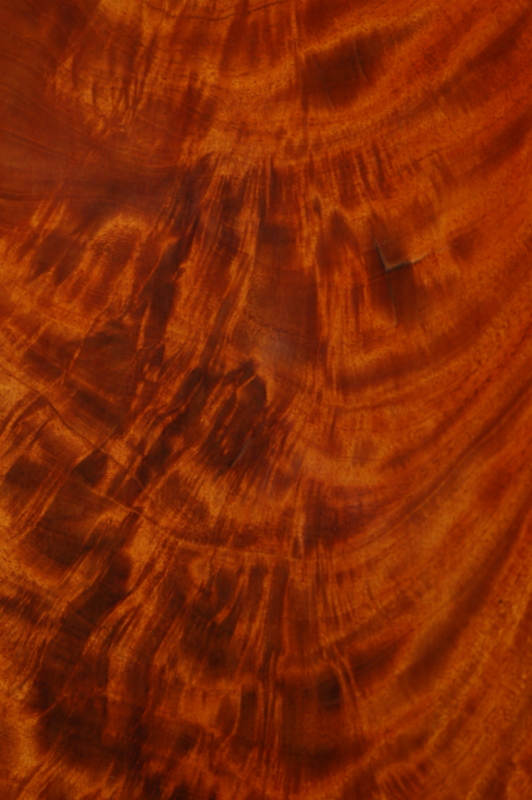
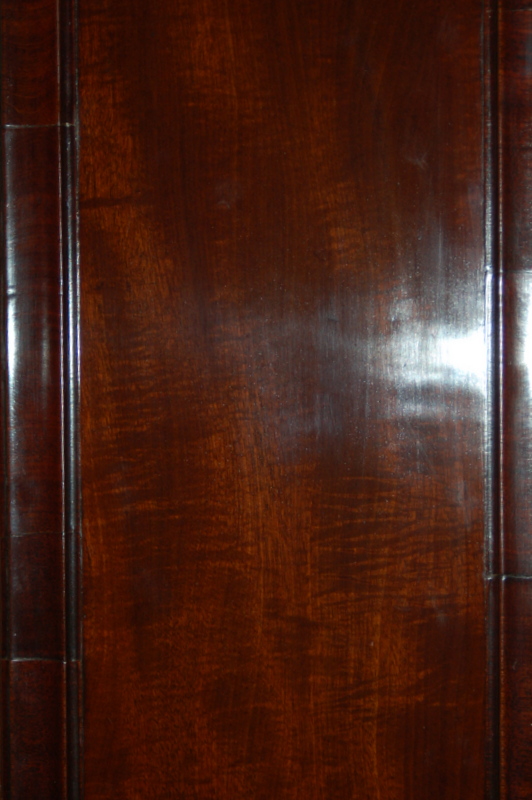
Mahogany can be a beautiful wood, it starts in the UK being used around C1750 and continues being used throughout the 18th and 19th centuries. Two most common variants are Honduras (lighter) and Cuban mahogany (darker). It is a close grain hardwood coming commonly from the South America or the West Indies type regions. This tree can be found quite wide and so large sections could be veneered with this wood.

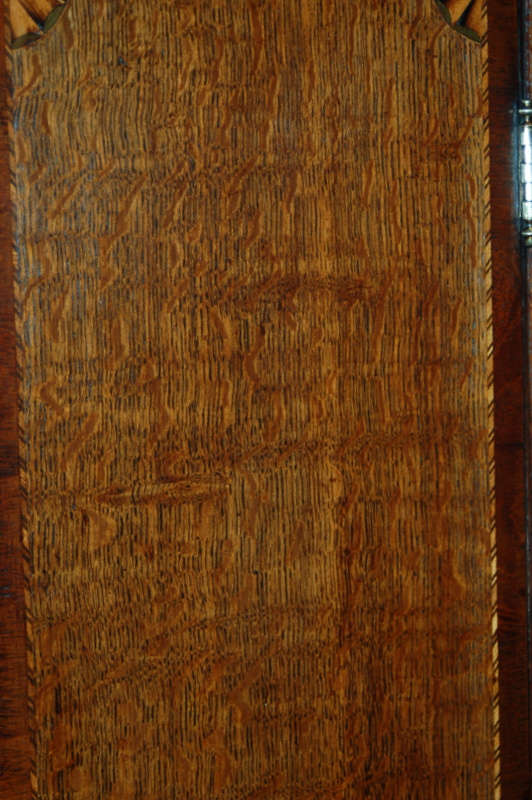
Quarter Cut or star-fleck figured oak
Solid English Oak

English Oak

English oak is a slow growing and so very heavy wood. Used in construction and veneered some of the time, but it is a beautiful wood in its own right. Oak being so heavy and close grained it is good at preventing things like wood worm. It is one of the reasons why London used it in the construction of its clock cases ahead of pine. Pine is used in the provinces as a rule for carcases as it is cheaper. You will notice the weight difference between an antique clock veneered on oak and an antique clock veneered on pine. Oak just gets better with age and polishing, we call this the patina. Less close grain oak can come from countries like Japan. This wood although called oak, is a far poorer wood to the slower growing English oak.

The climate effects the grain of the wood

English Burr Walnut
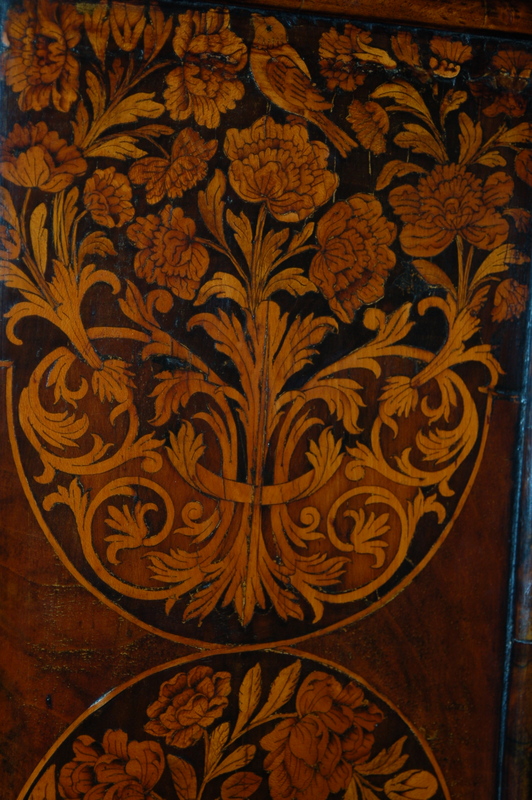
Marquetry inlay on English Walnut
Marquetry on Walnut
Continental walnut


Walnut is a lovely wood and English walnut gets used as veneers in antique furniture and clock manufacture up until C1750. After this date most walnut used is Continental walnut. Continental walnut is a quicker growing tree and so the grain is never as fine as English burr walnut. Again English walnut is a very heavy wood with a close grain. The tighter the burr or knot in the walnut the better. Walnut can range in colour from quite light if the sun has taken it, to quite dark. Walnut is used on all of the German wall regulators or commonly called ‘Vienna  style’ wall clocks  etc through the 19th century.

Satinwood

Satinwood used as a blank canvass to artists

Satinwood being a very light wood was used towards the end of the 18th centuries and early 19th centuries in the main. Many expensive pieces are manufactured with Satinwood veneers. We have some Pergolesi painted tables with satinwood veneers. I suppose the light colour makes the painting stand out better.

Pine

Pine, many of you will be familiar with this wood. It is rare to see a surviving antique grandfather clock made in this wood like the above. It was prone to woodworm unfortunately. Some were painted and this helped preserve them.Many provincial cabinets were constructed out of pine and then veneered. Pine is also used alot today as it is a relatively cheap wood, unlike oak. Clearly as you can see from the grain and if you lifted it from the weight , it is a fairly quick growing tree.

Lacquer or Chinoiserie

Oak can be veneered or painted

Oak was only used on internal construction of cabinets of English London clocks. When this wood was used and if it is not veneered in London you will find it sometimes decorated with lacquer work or Chinoiserie. This is gold leaf and gesso. The best types of these works are seen when they were sent out to China in the early/mid 18th century and decorated their.

I think I have covered the majority of main woods used in English cabinet making. There are others like ewe wood, maple , elm, fruitwood and rosewood. These are not covered as they are used alot less. I hope this blog has been of help to you. If you are still struggling with finding out what wood your clock or piece of furniture is made from, please send me a picture to PendulumClocks@aol.com

Daniel Clements – Pendulum of Mayfair