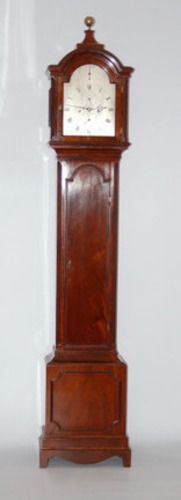
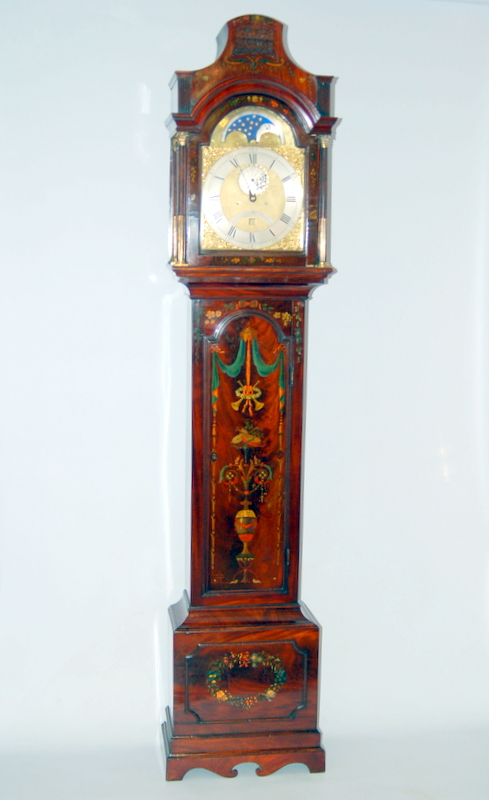
Featured here an outstanding ‘8-day’ London mahogany Longcase clock. Showing quality arch white dial by Wright. The cabinet also with typical high quality London case features and of superb colour and patination. The white dial with seconds and calendar. Including strike silent feature to the arch and makers name to dial centre. Gold leaf spandrels and flowers to corners. Together with gold leaf decoration to the arch. The 5-pillar movement striking the hours on a single bell. A collector’s clock.
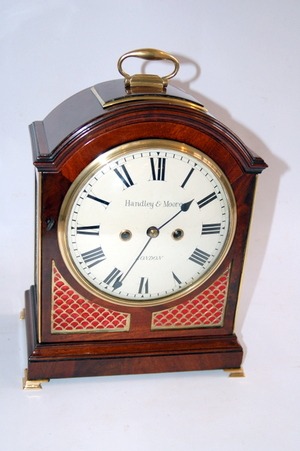
A lovely mahogany ‘pad-top’ bracket clock. Complete here with round convex white painted dial signed Handley & Moore of London. The good quality twin fusee movement of 8 day duration and striking the hours on a bell. The cabinet featuring brass ‘fish-scale’ fretwork to front door and sides of cabinet.
A special ’10inch’ dial ‘8-day’ longcase clock with high quality movement. Shown with arched silvered by London maker Josiah Emery. The movement with dead-beat escapement and maintaining power. The dial with seconds and calendar. In addition strike silent feature to the arch. Clearly lovely flame mahogany veneered cabinet. Also with typical London high quality design. Good colour and patination. To sum up a rare collector’s clock.
When I come to think of 18th century antique furniture design, I think primarily of 4 names. There is the great Thomas Chippendale, George Hepplewhite, Thomas Sheraton and last but by no means least Robert Adam. Robert Adam was probably better known for his influence on architecture in the 18th century but he also designed lovely pieces of furniture.
Famous Floral Designs, Pergolesi
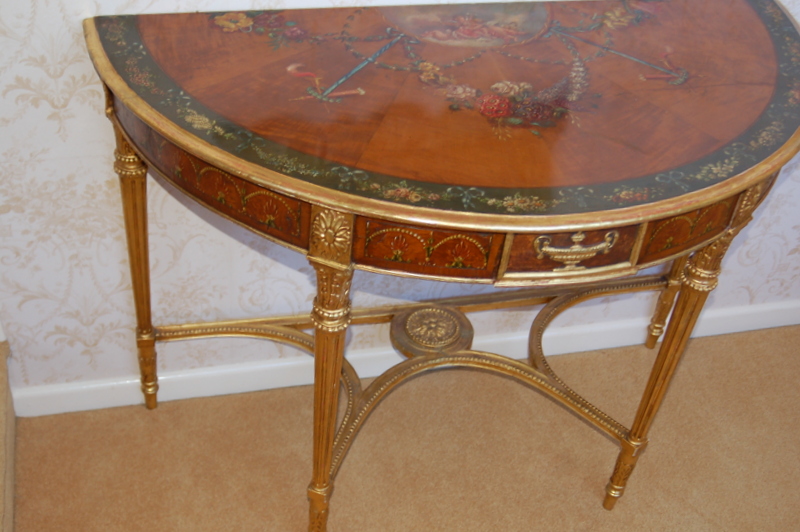
It was on one of his trips to the Continent to study foreign designs he came across Michael Angelo Pergolesi. Pergolesi was one of the main characters in the start of painted antique furniture. Designs on antique furniture up to this point had been inlaid into the wood surface.
Pergolesi trip to UK
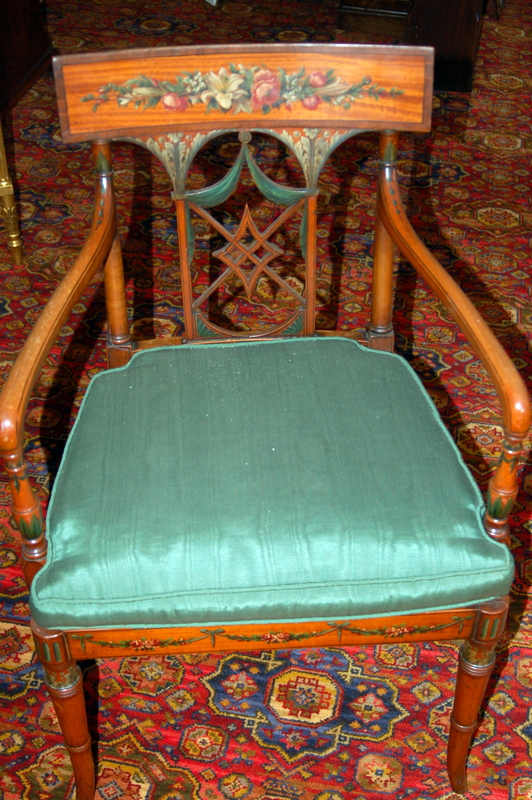
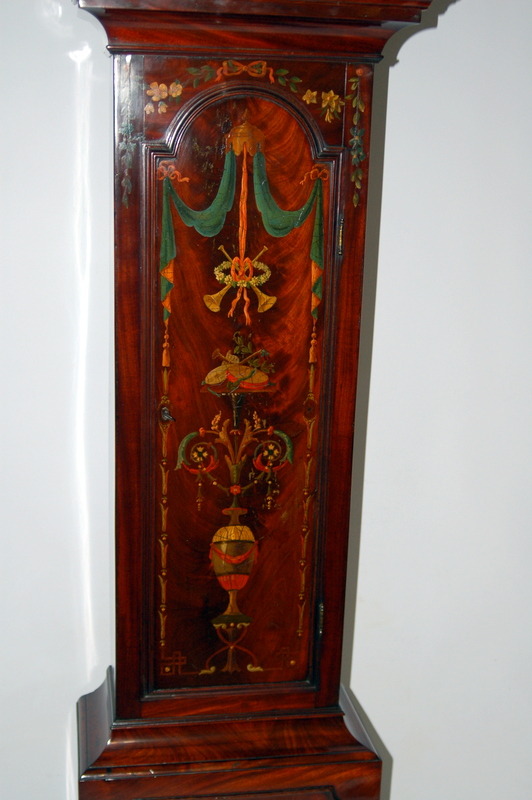
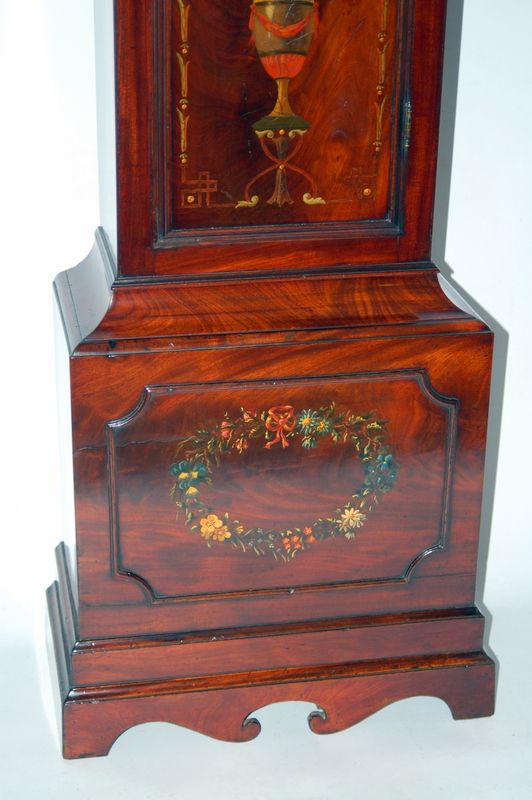
Pergolesi stayed in the UK until the end of the 18th century. He worked with the celebrated Adelphi firm. He designed and painted beautiful pieces of furniture and the occasional antique clock. Many of these works decorated with fine figures, flowers and classical urns. He published a book of these designs taken between 1777 and 1801. He worked with other leading figures at he time, many were members of the Royal Academy. These individuals revolutionized the decoration applied to antique furniture.
Pergolesi Designs
Pergolesi designs on antique furniture are rare by the fact he worked only a sort period of time in the UK. Those who worked with him in this area left London to work overseas before the end of the 18th century. With this short window of opportunity, very few pieces were made by these celebrated artists and designers, making them highly sought after. Later work like this can be seen in the late 19th century. This is when this type of work hit a revival in the fashion moods at the time.
Most of written information on this subject can be found by reading books on the ‘Age of Satinwood’. Many pieces were decorated on this wood surface as satinwood offers a ‘plain canvas’ so to speak for the artists work. It is also true though you will see works decorated on mahogany cabinets in the last quarter of the 18th century. One outstanding such painted decorated clock is seen below.
I have written many pieces about different types of antique clocks. In my next few blogs, I would like to concentrate on clockmaking from different parts of the British Isles. My first port of call is to the great country of Scotland. As I speak this great country is still part of the United Kingdom. Fingers crossed after over 300 years of being together, it will still be part of the United Kingdom come September 2014.
Clock Makers from North Britain
A great reference book on this topic is Scottish Clockmakers. This is written by John Smith, this charts the development of clockmaking in Scotland from 1453 to 1850. In this book it shows the importance of the Hammermen in Scotland. An organization governing antique clocks and various other trades. In London, clocks were produced by the rules governed by the Clockmakers Company. By 1650 clockmakers started increasing in Scotland.
Hammermen
This was when the clockmakers started being recognized by this branch of the locksmith trade, the various Hammermen Incorporations. The clockmakers were recognized as a branch of the Hammermen in Aberdeen.
Below I have given some but by no means all of the leading lights of Scottish antique clockmaking in the 17th and 18th and 19th centuries. Apologies to those makers I have left out, as the list is very long.
Quality Clock Makers in Scotland
There were a number of very distinguished Scottish makers: such men as Humphrey Milne Edinburgh; Andrew Brown,1665-1712 Edinburgh; Alexander Brownlie 1710-39 Edinburgh;James Cowan, 1744-81 Edinburgh;John Smith Pittenweem unknown-1814; Thomas Gordon; Thomas Reid 1762-1823 Edinburgh; James Howden and son 1764-1842 Edinburgh;Laurence Dalgleish; Alexander Dickie 1762-1808 Edinburgh; Alexander Cumming 1733-1814 Edinburgh /London; finally Dallaway and sons Edinburgh 1785-1812 being but a few of them.
Dial Painters in Scotland
The last entry on this list deserves a mention even though they are not strictly clockmakers. Dallaway produced nearly all the white dial grandfather clock dials in Edinburgh during the end of the 18th century. In England this was carried out in Birmingham by Wilson and Osborne.
John Smith Pittenweem
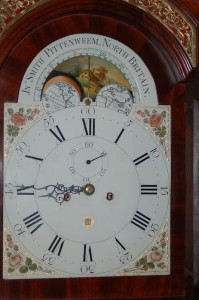
There are some very special names on the list above, John Smith produced some amazing clocks from a tiny fishing village called Pittenweem in the 18th century. You will notice most of the other top makers come from the major towns like Edinburgh. To produce the spectacular clocks that John Smith did in such a tiny place miles from anywhere is astonishing. He deserves special mention. He has clocks in Royal collections and there is a superb example pictured below. The case I believe was purchased from a London case maker on John Smiths only recorded visit to London. A really rare example.
Lovely Scottish Cabinet Work
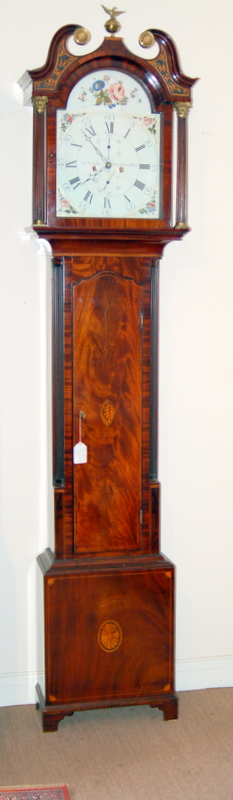
The finest Scottish Grandfathers clocks from the middle to the end of the 18th century had there very own distinctive elegant case style as shown by the clock pictured by the top clockmaker below.
You will notice superb case design on the Pre C1800 antique clocks from the east coast of Scotland. The clock above is from Prestonpans is a small town to the east of Edinburgh, but for all account is classical Edinburgh case design for the period.
East Versus West Coast Scotland Case Making Style
Antique Clocks from Edinburgh and further through Perth and Dundee to Aberdeen case design is really good. I must admit in over 40 years of seeing clocks to the west coast of Scotland though the case design is not the finest in this vicinity. Whereas we have owned and sold hundreds of clocks from Edinburgh, Perth and Dundee, we have only wanted to own one clock from Glasgow in all that time. Most of the time the grandfather clocks from the west coast are not so elegant. The hoods tend to be not greatly proportioned. It is in my opinion clocks from cities like Edinburgh and the east coast of Scotland managed to find some of the best proportions in case design of all clocks, and Glasgow case design some of the worst.
Case style changed in every town
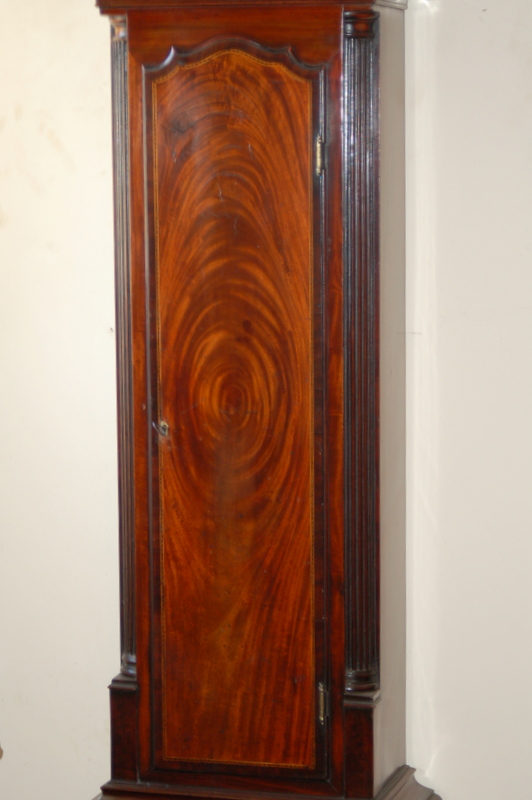
The contrast in design is very large but I suppose everyone’s taste is different! In the picture below you will see the lovely figuring of the mahogany to the trunk door. Many Scottish examples have this twirl to the trunk door from the tree veneers. A lovely feature, quarter columns etc make the elegance of the Scottish cabinets even better. You will not go far wrong in choosing an antique grandfather clock from Scotland, especially if it was made pre C1800 and from the east coast of Scotland.
Lovely Trunk Door from a Edinburgh Clock C1790
Conclusion
We also stock a superb selection of Scottish antique clocks. Most of them pre C1800 but occasionally we have a lovely later Scottish clock like this one from a small town called Old Deer. You can find this clock by clicking here: Old Deer Scottish Antique Grandfather Clock.
A couple of years ago I wrote an informative post on painted dial grandfather clocks. Their history and development. I have written this piece in conjunction with that post as the two really go hand in hand. Right I hear you all ask, well how are they connected?
Engraved Brass Dials
The rise of the white dial grandfather clock dials in Birmingham made the brass dial manufacturers sit up and take notice. This new technology could easily take over and this was centered in Birmingham. Dial painters would really have a monopoly over the supply. The clock makers who had specialist engravers and relied on the brass cast dials clearly had to do something. The white dials were pretty and they served a purpose of being easier to read the time on the clocks face.
A challenge to the white dial dominance
White dials with blued iron hands were really easy to read, even from a distance. The clock above is so significant as it is dated 1771 and is an all over brass silvered dial clock. The painted dials were recorded as starting in pretty much the same time as silvered brass dials. It is probably of a great deal of significance that the clock above was made in the same town as where the white dials started production in Birmingham. I believe Mr Cranmer has his ear to the ground so to speak.
First of its kind
He developed the dial above as one of the first of its kind, to compete with these new painted dials coming on the market. You will notice the unusual painted scene to the arch and the slightly strange thick engraving to the dial. Further examples of silvered dial white dial grandfather clocks. These can be found on our website of Pendulum of Mayfair or by clicking here: Pendulum of Mayfair Ltd.
London silvered brass dial clock by Tatnell C1790
Tatnell London clock
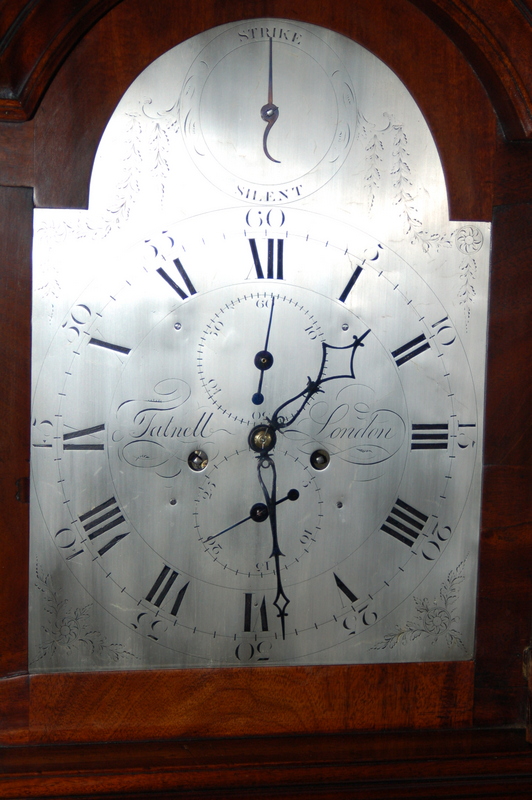
You will see a later more standard London silvered brass dial clock by Tatnell of London. With an all over silvered brass dial, the dial is cast brass in the 18th century. this is then made to look like silver by rubbing with a white powder called silver chloride. This leaves deposits of silver on the dial. It gives it its silver look. In most cases the dial is then lacquered to make it slightly harder wearing. Generally though a silver coating on the dial will wear over time and needs re-silvering every generation.
Temporary Solution to White Dial Dominance
In the 20 years after the development of the painted dial grandfather clock dials sales boomed. The sales on the other hand of the standard grandfather clock dial decreased. The brass dial with chapter ring and spandrels started to become less popular. Up to 1790 as a result of the development of the silvered brass dials sales were running about equal. After C1790 though the sales of white dial continued at a pace. By C1820 you were looking at a market that was dominated with painted dial clocks. The painted dial manufacture set up in other places around the country. Not just in Birmingham. The brass dial clocks were on the decline. The silvered brass dial saved the production for 20/30 years. The decline of brass dials and rise of painted dials had taken hold.
Antique grandfather clocks tend to be weight driven and go for a specific amount of time on a wind. I will cover the standard examples in this blog. For examples of different types of grandfather clocks please visit our grandfather clock stock page by clicking this link: Antique Clocks For Sale.
1 Day to 1 Year Duration
The most basic of antique grandfather clocks is the simple 30 hour duration antique grandfather clock. These were made generally for simple cottages in the country. They have simple mechanisms with one weight that drives both the striking mechanism and the going side mechanism of the clock. Since the weight drives both sides of the clock is has more work to do and thus it winds out far quicker. The weight is normally about 8lbs in weight driving this clock.
The most standard of all antique grandfather clocks is the ‘8-day’ grandfather clock. These clocks have a movement split into two separate sides. One weight driving each side. There is a striking side weight and a going side weight. Each weight has its own separate job to do. The movements tend to be 4 wheel train and the weight of the weight is usually around 13lb each. Sometimes higher quality movements run on a slightly smaller weight, as there is less friction involved. An example of a standard ‘8-day’ grandfather clock is found below.
We are now moving into the realms of the rarer clocks. Every so often you come across a month duration or maybe a 3 or 6 month duration grandfather clock. Months duration grandfather clocks have like the ‘8-day’ grandfather clocks two trains for the mechanism. Usually one weight for the striking side and one for the going side. The movements tend to be 5 wheel trains and tend to wind anti-clockwise. The driving force tends to increase dramatically as well. The weights tend to be around 30lbs in weight each one. That is over the double the weight of an ‘8-day’ example. A lovely month clock can be found below.
Cabinet gets thicker construction on long duration clocks
One important point to note is as the duration of the clock increases the structure of the case gets more robust. This is required to cope with this extra weight. The sides of the case get thicker and construction gets all round slightly better to cope. A month case should be heavier than the equivalent ‘8-day’ example.
Lovely Month Duration Marquetry Grandfather Clock
Year Duration Clocks
Finally on very rare occasions you will find year duration antique grandfather clocks. We have only ever owned a handful of these very rare clocks. Some examples use the power from two weights to drive the clock. Alot of power is required to keep the clock running. You can also find some examples that will strike. These are generally on the earlier examples. The later Georgian examples tend to more about timekeeping and precision movements. Weights are very heavy in these clocks. Generally they need steel cable to support the weights. Each weight can be over 60lb. A minimum of 6 wheel train and high pinion counts are found of these types of grandfather clock. Clearly only the top makers produced such clocks.
I have had the pleasure to come across this amazing early 18th century ‘equation of time’ clock by John Topping of London. John Topping is not a household name in today’s clock world but he really should be. He built some of the most fantastic complex antique clocks during his time working in London.
Complex Clocks
He started as an apprentice to William Grimes in 1691 and he worked up until his death in 1747. He always described himself as ‘Memory Master’. I am not sure if this was a honour bestowed on him or if it was like a sales and marketing slogan. Either way he produced some exceptional clocks.
Further details of month duration ‘Equation of Time’ John Topping Clock.
Figure 1: Equation of Time John Topping Clock C1730
Equation clocks
The clock above is a fine example by John Topping. A superb early 18th century antique clock manufacturer in London. It is a most desirable combination of a superb and interesting complex movement and a beautiful veneered walnut cabinet. The dial is 12 inch and is signed to a recessed triangular sector, ‘John Topping Memory Master.’ The dial is of a specific elongated dimension to fit the extra large seconds. The rise and fall of pendulum and strike/silent dials is to the arch.
Year Calendars
If you continue down from where the makers name is signed and above the six o’clock position on the dial, you will see a revolving year calendar. On this year calendar there is an equation table allowing you to set ‘true time’ in the 18th century. I will come to what ‘true time’ is later in this piece. The top line of this year calendar is engraved ‘Sun Slower’ or ‘Sun Faster’. The next line gives the months divided into days which are numbered 5,15 etc for each month. The equation and calendar dial is set by a winding square next to the 60 and midday position on the clock.
True Time
You will notice that the winding holes are located above the centre position rather than below centre on most clocks This allows enough room for the equation of time year calendar ring. The thin blued iron strip marks the day of the mont. Then so many minutes faster or slower than a sundial can be read off for calculating actual time. The dial has superbly matted centre, chapter ring, specifically made spandrels and engraving to small sections within the arch.
The seconds feature to the arch is large which is a really nice feature. It also has a sunburst feature cut in the dial to the top centre section. A superbly laid out and designed dial by this wonderful clockmaker. In the picture below you will see how complex the movement requires to be in developing a dial like this.
Fantastic Quality Movement
The movement has a brass centre section and two side sections. From the picture above you can see the cam which lifts and lowers the pendulum for small adjustments to time. You can also see the many pillars used in this high quality movement.
18th century ‘Equation of Time’ table
Equation Table
The table above was sometimes pasted inside some special London clocks when they did not have a proper year calendar. Owners could work out the calculation manually. Clearly full year calendar equation clocks are exceedingly rare. Most likely these cost huge amounts of money. As such probably only a very small amount of these clocks were ever manufactured.
So what is ‘true time’ then ? In the 18th century finding out what midday was was relatively easy, a sundial could be used. The problem comes as this is not ‘actual time.’ As a result of the elliptical rotation of the earth. Clocks were sometimes slower or sometimes ahead of this sundial time. A good explanation and for the science minded of us can be found on the Wikpedia Equation of Time Page.
The following piece ,’The Swing of the Pendulum’, is taken from April 2014 edition of Antique Collecting. It is based on John Andrews interview and discussions with myself Daniel Clements. Manager of Pendulum of Mayfair Ltd.
Figure 1. Superb and rare GIII, arched, brass dial, mahogany, ‘8-day’ London-style Longcase clock by John Grantham Newbury. Bat and ball automaton.
Interesting clock facts
It takes courage to come from a business in the provinces and open up in the West End of London. Especially when so many antiques concerns have been doing precisely the opposite. But this is what Pendulum did twenty years ago Taking Fred Perry’s shop and residence at 51, Maddox Street by buying the freehold. We then had control over the rent as one important cost element. This having been achieved as a deliberate long-term measure. The costs of converting the shop were a safe investment and Pendulum of Mayfair was launched.
Family Business
Many businesses in this field have come about as a result of what was a part-time hobby. A source of incidental income becoming so absorbing that the plunge to launching into full time was taken. Daniel Clements says that his father is a classic example. He used to say that he became a dealer in 1974 to pay for his vice of collecting. As a qualified mechanical engineer he was engaged in building factories. Designing new machines all over the world, acting as engineering director at Pilkington’s. But his love of clocks, playing with and restoring them, became a passion. This provided relaxation from the stresses of work. Eventually bringing about the decision to leave his job and set up as a dealer full time.
Nearly half a century old
When he did this 40 years ago it was considered to be a crazy thing to do. Like many who have entered the antiques business after years of dealing on the fringes of it. The impulse was too strong to resist. Even now, in his seventies, Mr Clements love of clocks is still as powerful as it was when he set up the business of Coppelia Antiques in Cheshire forty years ago. This passion has led to the establishment of a highly regarded business with a worldwide field of activity.
Figure 2. Superb ‘8-day’, c.1790, white-dial, moonphase, mahogany Longcase by collectable and well-regarded maker Bancroft Scarborough.
Finding special clocks
Throughout the 40 years since its start, Daniel Clements says the greatest pleasure the business has provided is in finding special antique clocks. Then restoring them as sympathetically as possible. Over the years they have developed the skills of lots of young people in their care. Trying to instill a love of old things and learning about their origins along the way. Touching old things, smelling them, and getting under ‘their skin’ is a long process and needs patience and understanding.
The workshop
The clock workshop is the hub of the entire operation and nothing is allowed to leave until Mr Clements is satisfied with the result. A familiar motto of the business is the saying ‘well bought, is half sold’. The special type of antique clocks Pendulum look for are so hard to find, selling them is the easiest part.
Figure 3. Lovely ‘8-day’, London, musical Longcase with mahogany cabinet, c.1770, Herring of London.
So many customers are now long term friends
Over the years many special pieces have come into their hands and customers have become friends.Examples of this provide instances of expertise combining with history to provide the customer with a truly remarkable acquisition. One particular clock sold to an Australian client was by the clockmaker Henry Lane. This was a superb musical Bristol Longcase clock from c.1790. Henry Lane, as it happens,was the first clockmaker in Australia. The story of how this comes about was a compelling one.
Transported to Australia
Henry was sentenced to death for forging money.This sentence was later changed by an act of clemency to transportation to Australia. He left Spithead on the Perseus with 112 other male prisoner son the 12th February 1802. This is what Clements feels is so special about antique clocks: they have a history and you can research more about the clockmaker’s life. They are a living working museum to the past and attractive pieces of furniture as well. How proud master clockmakers would feel if they could see their clocks still working perfectly in many homes today.
Figure 4. Fine c.1785 Peter Wood, painted-dial, mahogany, bell-top, double-fusee bracket clock with anchor escapement striking on bell and with repeat.
The Centre of London
With the Pendulum shop being situated right in the heart of London they have sold and restored clocks to many VIPs. Large companies like Asprey’s and Garrard’s, and major hotels like the Conaught. Recently they had the pleasure of restoring some really complex antique clocks for the Russian Embassy in London. Clements states that ‘the Ambassador and his assistants have shown us great kindness and consideration. We have lovely presents from them and also were delighted to attend their special day earlier this year. This was another of the fantastic memories we have built up over the years. The clocks were a challenge but they now look wonderful and are now fully functioning & proudly taking up their prestigious places at the Embassy. It was a real honour for us, and it shows how far we have come as a business over the years.’
Figure 5. Early 19th-century, double-fusee bracket clock by Hanson of London.
Great finds
Another entertaining example comes from their local specialist auction house in Chester. They had a lovely little clock for sale at auction about 20 years ago. There were four clocks in the sale,of which one was of great interest: it was catalogued as an ‘electric clock‘. When the hood was taken off the clock, the movement looked as though it was in a salmon tin, because it was enclosed. ‘We instantly knew what this clock was,and so, says Clements, my mother and father decided to split up in the room.My father said to my mother: you bid; if the other dealers see me bidding they will twig. My mother started bidding on the clock but she was very laid back. So much so that the auctioneer asked her are you bidding Ma’am? She said yes and the auctioneer slammed the hammer down.
Dust Encased Regulator
One dealer who was standing by my father noticed it was his wife bidding. He asked what the clock that she had just bought was. My father said, ‘oh, my wife collects electric clocks.’ Of course it was not an electric clock at all. The clock’s movement had been dust encased. It was a fantastic clock by John Holmes of London. The cartouche had been reversed on the dial and engraved electric clock. It clearly had been used as a ‘slave clock’ in the early 20th century, to drive other clocks around a factory.
‘Daniel Clements says ‘I wish these bargains happened more often but it is not the case. Everyone thinks they have a master piece under their pillow or in their garage. The guy who purchased this ‘electric’ clock was told the story. He laughed; luckily he did not mind paying a handsome profit at the time.
This clock will have appreciated many times in price since then though. Investing in antique clocks is just about as safe as houses. These master timekeepers come from an age where intrinsic labour costs are built in. Movements are handmade and built to exacting standards; they will continue telling the time in peoples’ homes for hundreds of years to come. Even throughout the recession, good genuine clocks have always appreciated in price.’
Figure 7. J & B Levi Dover, early (c.1795), mahogany, verge wall clock with silvered dial.
Hyman Russian Clock
‘I also remember when we purchased a lovely regulator clock with a painted dial. This clock was made for Catherine the Great of Russia. She was the most renowned and long ruling female leader of Russia. The clock came from the Winter Palace.It was brought out on a horse and cart just before the Russian Revolution at the start of the 20th century. I wish we had kept this clock, but then I wish we had kept many clocks we have sold over the years. We are in a business where we only buy what we love and we grow very attached to all our clocks. They are like extended branches of our family. Once you have restored the clocks, you feel part of them.Like selling puppies etc., the potential owners of our clocks, all get proper vetting! Luckily the people who love clocks are generally lovely people.’
Always Learning
Figure 8 . Mid-19th-century Austrian ‘2- day’ automaton and quarterstriking, large and impressive clock.
‘Every clock we buy and sell has its own story. You realize you are always learning new things; a lifetime is not nearly long enough. We can be proud of restoring and bringing back to life some lovely antique clocks. Yesterday’s craftsman’s work will live on at our shop in London, Pendulum of Mayfair Ltd. We stock some of the finest antique clocks anywhere in the UK. All these are fully restored and come with a year’s guarantee. All antique grandfather clocks are delivered free of charge anywhere in the UK. We have a full export shipping service to all four corners of the world. The USA is one of our biggest markets.’
At a time when there are so many stories of retrenchment in the antiques business it is a pleasure to find one of sturdy optimism.Pendulum of Mayfair at 51 MaddoxStreet, London W1S 2PH
Antique clocks with automaton features, have been built for many thousands of years. You can go back back as far as Roman times to get a mention. The engineer Vitrivius describing alarm clocks with a gong or trumpet feature. From the these primitive automaton’s I am heading for some of the earliest automaton features on antique grandfather clocks.
John Lamborne Cambridge
This superb ‘8-day’ early 18th century burr walnut veneered antique grandfather clock with automaton is by a Cambridge maker called John Lamborne. Further details of this special antique grandfather clock by John Lamborne can be seen by clicking on the link.
This clock dates from around C1720 and is a very rare example of an early automaton on a grandfather clock. The soldiers in the arch move and ring the bell when the clock strikes the hour. This automaton like some of the earliest automatons known works from the striking mechanism.
Clearly the heavy figures to the arch require the power driven from the weight of the clock when striking. An interesting feature on the dial of this clock, is the plaque by the order of the Patentee No. 5. This clocks feature automaton must have been patented.
Cuckoo Clocks
When most people think of automatons they probably will first think of cuckoo clocks.These became fashionable in the 19th century and most examples manufactured were from around C1860. These types of clocks are still manufactured today. The earliest cuckoo clock can be seen around the mid 18th century. Not many from this period still survive today. The automaton bird will again work off the striking mechanism of the clock. It takes alot of power to drive this type of automaton and so most cuckoo clocks are only of 1 day duration.
I am now going to look at what most people will see or understand by automaton. Automatons work from the pendulum on antique clocks. These type of automaton features swing back and forth with the movement of the pendulum. They can be directly off the pendulum or off the anchor which is driven by the pendulum. These automatons therefore work continually and not just on the hour.
Edwards of London Automaton
More details of this stunning C1790 automaton antique grandfather clock by Edwards can be found here, Edwards Automaton Antique Grandfather Clock . The automaton features a man chopping down the ‘tree of life. The axe moves back and forward as the clock ticks. Various other automaton features you can also find to the arch. I have seen see-saws, rocking swans, rarer badminton automatons like the one pictured below. Adam and eve depictions are found. Others like rocking ships are the most common form of automaton on a clock.
British Naval Power
The British were clearly an important naval power. Many owners like to have a depiction of a rocking boat to the arch. Some depicting famous sea battles. The clock below represents one of these very battles.
The clock above is a superb C1790 Scottish antique grandfather clock and more details again can be found but clicking on this link, Scott Edinburgh Automaton Grandfather Clock .
Grantham Automaton Clock
More details of this exceedingly rare automaton antique grandfather clock here. Grantham Automaton Antique Grandfather Clock . This clock features an automaton game of Badminton. It is very rare and is again working from the pendulum / anchor. It is a glorious antique clock with wonderful mahogany veneers and of 8 day duration.
Adam and eve Automatons
The clock above is a superb arched painted dial with ‘Adam and Eve’ automaton to the arch. Adam and Eve depictings usually involve automaton arms holding the apple. Sometimes even the serpent moving on the tree. This clock dates from C1780 and is in a lovely mahogany cabinet.
It is important to note automaton antique clocks of any sort, especially on pre C1800 clocks are rare. I have seen many examples that are faked. Care must be taken if purchasing one of these. I would only recommend buying from a dealer who will give you a money back guarantee that the clock is genuine.
Conclusion
Rare features like automatons can be found on clocks sold at Pendulum of Mayfair. This can add alot to the price. It is relatively simple in some cases to add this feature on a standard clock. Unscrupulous dealers will do this for profit. I have seen many such examples on the market. My advice is to only buy from a long established expert like ourselves. Willing to offer a guarantee that the clock is genuine.