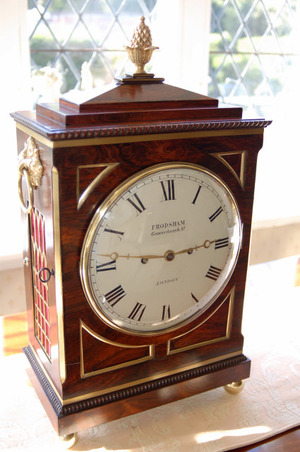
Posted on

Japanese Pillar Clocks


In my various blogs to date we have studied clockmaking in the UK in great depth, this is with due reason. London was the centre of the clock making during the 17th/18th and 19th centuries. In my later blogs I have looked at clock making in France and Germany. Clock decoration carried out by the Chinese, on lacquer clocks. I wish to end this year with a quick look at antique clocks and timekeeping in Japan. I will focus on the humble Japanese Pillar Clock.
 

Japanese Time

Japanese clocks were somewhat different to European antique clocks in the 17th,18th and 19th centuries. The earliest clocks to come to Japan from missionaries and merchants had to be adapted to Japanese time. The Japanese clock makers had many challenges adapting these clocks. They also had the problem as a nation they were very isolationist after the mid 17th century. Their technology in this regard somewhat lagged behind the western clocks of the period.

So what is Japanese time I hear you ask? Surely all time is measured the same, well no not for the Japanese culture in these early periods. In fact it was not until 1873 that the Japanese government adopted the 24 hour system used in the West and the Gregorian calendar.

Adjustable Clock Divisions

Japanese time required 6 hours in the daytime from sunrise to sunset and 6 hours at night, from sunset to sunrise. As a result of the seasons these time periods were unequal and the divisions on Japanese clocks had to be adjustable. This was called unequal temporal hours. Daylight hours were longer in the summer and shorter in the winter, with the opposite at night. Clearly this produced problems and the European system of equal hours that did not vary with seasons was far simpler.

Rare Clocks Shitan Wood

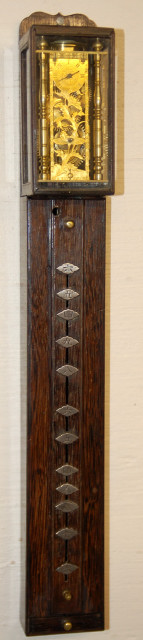
The Japanese pillar clock pictured here is a rare example that is a striking example, most are timepiece. It is also weight driven. It has a verge escapement, beautifully turned pillars and a foliot escapement. As the clock winds out the indicator tells the time by the scales on the door. Typical clocks had six numbered hours from 9 to 4 which counted backwards from noon to midnight. The dials did not have the numbers 1 to 3 for religious reasons. Dawn and dusk were marked as the sixth hour in Japanese timekeeping. A list of the strange dials for the hours is given on Wikipedia, please take a look.

The name pillar clocks comes from the fact they used to hang from the pillars or posts of the Japanese houses. These clocks were generally made from a wood called Shitan. Clearly because of the fragile nature of the construction only a few have survived and they are highly sought after. The movements go for just 1 day on a wind.

Summary

I hope you all have a happy and most important of all healthy Christmas and New Year. Soon restarting my antique clock blog in the New Year. I hope you have enjoyed and hopefully learned something from them. Again have a lovely holiday and see you soon.


Posted on

Carriage Clocks

In my many antique clock blogs to date,  I have talked about the rise of clockmaking in England and London being the centre of clock manufacture in the 17th and 18th centuries. The tide starts to turn though through the 19th century. You will then see more makers from France and Germany exporting their products to the UK.

The Rise of Continental Clock Making

The French clock makers became very adapt at clock making during the start of the 19th century. I will look at the introduction of the French carriage clocks here and its impact on the market. The carriage clock above further details are found by on small carriage clock.

Abraham-Louis Breguet

It was Abraham Louis Breguet (1747-1823) that was in my opinion the finest of all the continental horologists. Breguet is classified as the inventor of the French carriage clock. He gave one of these clocks to Emperor Napoleon in 1812. A.L.Breguet although born in Switzerland spent almost his entire productive life in Paris. His career began with a series of new inventions in the field of watches.

The era of Balance Wheel Clocks

He invented the self winding perpetual watch for example. During the French Revolution Breguet took refuge back in Switzerland but he soon returned to Paris with further new groundbreaking horological ideas. He came up with the Breguet spring balance which was fundamental to the invention of the carriage clock. After his death in 1823 many would mention this great inventor and horologist as one of the greatest pioneers of  scientific achievements in the field of time-keeping in France.

Carriage clocks are usually made of brass or gilt brass have numerous glass windows to see the mechanism. These clocks have a platform escapement visible through the top glass window. These clocks use a balance and balance spring to control the timekeeping. This balance effectively made the clock very transportable, the way other clocks were not at the time.

Easy transportation – clocks on the move

Clocks were thus made smaller by not having to have a pendulum. These clocks were spring driven and could have a repeat function to show the last hour/half hour. These clocks were exported in vast numbers from C 1860 to C 1920. I suppose production was at his height around C 1860/80 in France. Many of these carriage clocks were made in France and retailed in the UK. The makers normally had some mark or feature engraved on the back of the movement. This you can normally decipher in a good French carriage clock makers book.

Conclusion

These French carriage clock are generally of ‘8-day’ duration. They are very good Christmas presents. Prices go from £300 or £400 upwards for timepiece examples. Repeating carriage clocks tend to go from around £1,500 upwards. Some porcelain panel carriage clocks and champleve enamel carriage clocks were also made. These are rarer and tend to be alot more money. It is important when purchasing these French carriage clocks to check the clock has an original escapement. Many have been changed over the years.

Posted on

Antique Bracket Clocks


The purpose of this blog is to trace the antique bracket clock from its beginnings. This started at the latter end of the 17th century up until the mid 19th century or Regency Period in England.

Best Clocks in the World

During the entire period that I have mentioned above, clock making in Britain was acknowledged to be the best anywhere in the world. Clock makers in the UK maintained this position until at least the mid 19th century. Then imports arrived on our shores from France, Germany and eventually the USA. Clock makers in the UK refused to lower standards and change to the manufacturing methods used by our continental neighbors and those further afield.

Fusee Mechanisms

I have mentioned in my previous blog about lots of different antique clocks. These were manufactured in the UK during our supremacy in the field of clockmaking. I have only really touched on antique bracket clocks. Examples of such clocks can be found on our clocks site by clicking here. I only mentioned these in my piece in antique clock descriptions.Touching on them, describing the differences between mantel clocks and bracket clocks.

During the 18th century,’ the great Georgian period of clockmaking’, many thousands of lovely bracket clocks were manufactured. These at the time were actually costlier to produce than the equivalent longcase clock.

More Expensive making Fusee Bracket than Longcase Clocks

It was expensive making the springs and the fusee’s. The fusee was an ingenious invention. The spring slackens off over the week and before the invention of the fusee, timekeeping would become more eratic. The clock would thus go slower. On fusee clocks however the power delivery is evened out over the course of the week.


Bracket Clocks were only produced by the top clock makers

Bracket clocks were thus only really manufactured by the top makers in the 17th/early to mid 18th century During this time you will find most manufactured in and around London. Clearly the skills were available in London and the customers were there that could afford them. Bracket clocks were also made in the large towns of the UK, but you will not find many provincial bracket clocks, especially early in the 18th century. You will find most provincial bracket clocks dating from the end of the 18th century and on into the 19th century. There are always exceptions though.

Balance Wheel Escapement

The earliest form of escapements were called the balance wheel. Only a handful of these type of clocks still exist. The vast majority of the bracket clocks up to about C1760 were controlled by a ‘verge’ escapement. You will see on lots of these clocks a window on the dial This is where you can see the pendulum swinging by means of a circular brass disc. This brass disc has a connecting rod to the verge bob pendulum at the rear of the clock.

Different woods used

The bracket clocks made up to the mid 18th century, tend to be ebonized. Actual ebony (rare) or walnut veneered, sometimes even marquetry on walnut. In the following years mahogany is used. After 1800 you will see the introduction of more exotic woods like rosewoods and other fruit woods. You will also see the introduction around C1760 of the anchor escapement.

Verge Escapement

The verge escapement was great in so much that the crown wheel was at right angles to other wheels in the train. Therefore and was far easier to put and stay in beat. i.e. not so temperamental to being knocked. The disadvantage of the verge escapement is that the timekeeping is far less accurate than the later anchor escapements. For this reason some original verge escapements are later converted to anchor. This needs to be checked when buying as it is nice to get an original example of either.

Engraved Backplates

The other big difference with the verge earlier clocks, many have profusely engraved backplates. Some anchor escapements have these around C 1760 as well but the later you go through the 18th century, the fine detailing and engraving gets less and less. Around C1800 only a border of engraving is common on the bracket clocks. After C 1800 most bracket clocks have no engraving and at best only the makers name engraved to the backplate.

Conclusion

I will finish this by mentioning the name bracket clocks. I am sure you will assume they all stood on a seperate bracket, but this is not the case. Only a very few had a purpose made bracket. Most were just to be placed on your sideboard or chest of drawers or fireplace. The back door of many 18th century bracket clocks is glazed Meaning you can see the finely engraved backplate on your fireplace, by putting a mirror behind the clock. Clocks commonly have a pull repeat feature to let you know the hours and sometimes the quarters. This was important with no electricity. A string could be put by your bed that was connected to the clocks rack mechanism this would let you know either the last hour or next hour, or on some like I say the hour and the quarter. i.e. 4.15.

Highly Sought After Clocks

Genuine Bracket clocks are highly sought after, especially smaller original examples. Larger examples are easier to find and are less commercial as a rule. All bracket clocks tend to go for a minimum of ‘8-days’. Longer duration examples are also possible. Visit our homepage at www.pendulumofmayfair.co.uk for more information.

Posted on

Lacquer- Chinese Decorated Clocks

East India Company

When talking about antique lacquer clocks and their cases we need to discuss the China trade and the formation of the East India Company.

People today see the trade with China as a route for cheap goods or services. They also probably believe this trade route is a relevantly new process. This is far from the truth though on both counts. We have traded with China and areas of the world like this for many centuries. The ability to trade came about with our nation making huge advancements in marine technology that I have discussed in previous blogs.

Role of our Great Navy in Trade

We were undoubtedly a great sea power. Merchants in the 16th and 17th and 18th centuries were amazed at the many treasures and skills the Chinese people possessed. It was not until 1672 that the famous East India Company secured a trading post in Taiwan. This was ten years or so later than their counterpart, the Dutch East India Company which was expelled from the country by the Chinese. At the start of 1700, the company’s base was changed from Taiwan to Canton. With its Royal Charter the company was granted a monopoly of trade in the East Indies until 1833.

As I have discussed in previous blogs about the Clockmakers Company. London and the UK was the centre of the world’s clock making in the 17th and 18th centuries.

Trade With China

The China trade expanded many different skill sets though, and cabinets from English clockmakers were sent out to China to be decorated. True lacquering originated from Asia and it is obtained by applying many coats of the sap of the lac tree with polishing between coats. The colour or surface dye is mixed with this lacquer. (Black, blue, red, green and many other colours) Then the lacquered cabinet is decorated with raised gold leaf decoration. These skills are thought to have been employed in Japan and China as early as the third century BC. Clearly its importation into Europe came at a much later time and was facilitated by the East India Company described above.

Lacquer Decoration

Furniture, boxes and antique clock cases were all decorated in this way. They were then transported back to homes in the UK. It is suggested that very few clock cases were sent out to the Far East for decorating. I do not agree with this. If you look closely at the records of the East India Company. Many clocks and pieces of furniture are clearly listed, with the lacquered description clearly evident. I am not saying some lacquer production does not start up in the UK. Any that does I believe to be not of the same quality as the clock cases decorated out in the Far East. Later 18th and 19th century clocks with have been lacquered sometimes show an inferior quality. These from UK decorators trying to copy the highly skilled Chinese in this regard.

UK versus Chinese Quality in Lacquer Work

No lacquer cabinets have a decorators mark so we will never know for sure which is which. The records of the East India Company do show a large importation of lacquered products throughout this period, this is for sure. We have a great history in this country in the UK but it is amazing what countries like China manufactured many centuries earlier. The East India Company imported fantastic Chinese porcelain and many other items into the UK during this time. These were not inferior cheap products at all. UK Porcelain Factories in places like Stoke set up off the back of this. We need to remember the great contribution of the Chinese nation. This development is carried out far earlier than in the UK. https://www.pendulumofmayfair.co.uk

Posted on

Clocks – UK / USA

It is Ryder Cup weekend again. Great sporting battles between Europe and America at golf come to a head. These are friendly sporting battles but lets not forget the close ties between our great nations.


Exporting clocks

In the 17th and 18th century clock manufacture was the UK’s greatest export. The Clockmaker’s Company was formed as one of the UK’s oldest learned professions by Royal Charter in 1631. This started two centuries of UK dominance in this field. It was just before this in 1620 that the famous Mayflower set sail for America.

The Mayflower Boston Journey

The Mayflower has a famous place in American history. It is a symbol of early European colonization of the future United States. This ship set off from Plymouth, England to arrive at the now Plymouth, Massachusetts. It is the same reason why Boston, Massachusetts is called so today. John Cotton, a Puritan,who served as a Minster of the church in Boston, Lincolnshire England fled persecution. He moved to Massachusetts in 1633 as a leader of the settlers already there and some of his own people. He was instrumental in founding and naming Boston, Massachusetts.

American Clockmaking

Clock makers from the UK arrived in America, William Davis for instance is one of the earliest clock makers in America. He arrived in 1683 from the UK. Many of the oldest clocks on US public buildings were made by UK clock makers. These had fled for mostly religious reasons. New England had thus developed and the English community was strong here as thousands emigrated to the emerging America.

Ban Importation of Clocks

During the 18th century many English clocks were still imported to the US. One of the first things the new independent government did in US was to ban the importation of clocks. It is still the case though that many of the earliest American clock makers were English. They still imported dials etc from the new painted dial works (set up in 1771) in Birmingham, England and movements from the UK.

Rise of American Clock making

The rise of the American clock making industry from about 1850 to 1920’s coincided with the decline of the same in the UK.  Generally as quality went down and mass production rose, the US factories now churned out clocks better than anywhere else. Many famous 19th century American companies were set up, many of them in Conneticut. The Ansonia Company was founded in 1851 and thrived until its decline in the 1920’s. There was the Gilbert Company in the second half of the 19th century The famous Seth Thomas Company and many many more. The Waterbury Clock Company is one I will finish with.

Waterbury Clock Company

This company started in 1857, eventually became the Time Corporation, that made Timex watches. As a collector, I am only really interested in the first 200 years of clockmaking. Items were then handmade and were alot higher quality. There are always exceptions though and we have a clock made by the Waterbury Clock Company. This I believe is a one off, made for Christchurch Cathedral in Dublin. Its movement is of good quality and shows little signs of wear. It is a really rare and interesting example. This is pictured below. I suppose it also shows the strong Irish / American links that existed during the 19th century.
 

Conclusion

Visit our shop in London, if you love 18th century antique grandfather clocks like me. We have a large selection of genuine fantastic examples all fully restored. These clocks will keep ticking for generations to come. If you consider the painstaking hours in the manufacture. They represent amazing value for money by todays standards. Remember London was the centre of clock making from 1631 to the start of the 19th century century, some outstanding pieces were produced. 80% of our clocks from our shop in London, Pendulum of Mayfair Ltd,  are still exported to America. Owning your piece of history is easier than you think. We use a specialist antique shipping company that ships antique clocks to you door. Please visit our website for more information www.pendulumofmayfair.co.uk

Posted on

Antique Barometers


Evangelista Torricelli

Evangelista Torricelli is widely credited with the invention of the first barometer. Torricelli studied the workings of the great Galileo. He worked in the field of vacuum theory. Torricelli noticed weather changes effected the height of the liquid in Galileo’s water vacuum apparatus. These weather changes were related to air pressure fluctuations. One problem Torricelli had was the water vacuum apparatus required a tube 35ft long at sea level.

An era of suspicious people

This meant on his home the apparatus he built was taller than his roof. People were very suspicious of strange experiments at the time and being accused of witchcraft was commonplace. He therefore needed to do something to keep his experiments more secretive. Discussion with Galileo before his untimely death in 1642 convinced Torricelli on the need to use a heavier material the water.

Use of Mercury

Mercury or Quicksilver as it was then called was used. Mercury is 14 times or thereabouts heavier than water. Torricelli found he only required a tube 32 inches long to keep his experiments going. It was therefore in 1643 the first working publicized barometer was invented. Torricelli died in 1647. Some of our barometers can be found by clicking here. https://www.pendulumofmayfair.co.uk/category/antiques-furnuture-clocks-rare-items .

Lots of Experiments on Pressure

Many people copied and perfected Torricelli’s experiments. Blaise Pascal and in September 1648 Florin Perier who was the brother-in-law to Pascal. At his request he took his barometer to the top of mountain. He lived here to see what effect it had on the height of the mercury. Pascals predictions were correct, the mercury was lower the higher one went.

Weather instruments for general sale

It was not until about 1670 that barometers were starting to be sold and used in private homes. Lower pressures are associated with poorer weather and vice versa. It was found on fine sunny days the mercury stood at above 30 inches. On dull rainy days it stood at below 29 inches.  It was decided anywhere in-between was changeable weather. A scale of 28 to 31 inches was decided upon and Fair. Changeable and Rain was engraved to the scale to correspond to the pressures. Later Stormy and Very Dry was added to the charts to correspond to 28 and 31 in Hg

Robert Boyle

Robert Boyle seems to be the first person to introduce the barometer to England. He was a writer and a student in Italy at the time of Torricelli’s experiments and studied the writings of Galileo. On his return to England he conducted various experiments of his own in this regard and came up with the famous Boyle’s Law deduction.

Daniel Clements

Posted on

The most famous clock in the world – Big Ben

Big Ben


The worlds most photographed antique clock has been standing proudly to dominate London’s skyline for over 150 years. Big Ben is how everyone has come to call it,  is the nickname for the great bell of the clock. Now everyone refers to Big Ben as the overall clock and tower. The tower as it so happens is to be renamed the Elizabeth Tower in honour of the Queen. This is to celebrate the Queen’s 60 year reign.

Great Tom

The clock tower as we know today as ‘Big Ben’ is not the first clock tower to stand in Parliament’s grounds. The first tower nicknamed ‘Great Tom’ was built in 1288-90. A second tower replaced the first in 1367 and this was the first chiming public clock in England. In 1707 this tower had fallen into a state of disrepair and was demolished. When a terrible fire destroyed most of the Palace of Westminster in 1834, architects submitted designs for the new Palace. Of the 97 designs submitted, Sir Charles Barry’s was picked. His design did not originally have a clock tower but this was added to his design in 1836. Construction of this tower began in 1843.

Dent Clockmaker

Clearly the manufacture of the mechanism for the clock needed to be done by a specialist. The Queens clockmaker at the time was Vulliamy and he wanted to design and make the clock. Other specialist clockmakers also believed they should make the clock. A series of disputes therefore resulted and it was decided to appoint a referee to make the decision on who made the clock. The decision was left to the Astronomer Royal, Sir George Airy. He set the standards by which the clock must keep, Denision a barrister and gitfted amateur clockmaker assisted in this decision.

Delays in Building Big Ben

All this led to delays in the decision. It was not until Feb 1852 that it was decided that Dent was to  build the clock to Denison’s own design. Dent died in 1853 and so the clock was completed by Dents stepson, Frederick in 1854. It cost £2,500 to make. The tower itself was still not finished though and so the clock was kept at Dents factory in the meantime.

Denison Design

Denison made refinements to the clock while waiting for the clock tower to be finished (1859). He invented a ‘Double Three-legged Gravity Escapement’. This was a revolutionary and an ingenious invention and refinement. It made sure the pendulum was unaffected by external factors, such as wind pressure on the clock hands. A constant impulse was always applied to the pendulum. This escapement won worldwide acclaim, it is now known as the ‘ Grimthorpe escapement’, and Denision was later made Baron Grimthorpe in 1886 as a result.

Long Pendulum of Big Ben

The pendulum to the clock is 13 feet long and installed in a windproof box, it beats every 2 seconds. On top of this pendulum there are old coins. Adding weight to the top of the pendulum will lift the pendulum’s centre of gravity and thus shorten the effective length of the pendulum. This has the effect of speeding the clock up by just under half a second a day.

Symbol of London Big Ben

The clock has become one of the main symbols for the United Kingdom and London in particular. From the news programs like ITN to New Year celebrations, to General Election’s end of voting. Big Ben is the centre of our life. It stands proud and has had numerous years superb service. It has sted the test of time and London would not be the same without it. A truly remarkable achievement. The clocks Westminster Chime is typical of clocks after C.1860 and is found on many modern clocks. Most Georgian antique clocks just strike the hour on a single bell.

Daniel Clements – www.pendulumofmayfair.co.uk


Posted on

Public clocks

Chester Eastgate Clock

In this piece I will be carrying on from researching antique clock makers. I suggested visiting the 17th/18th century church in the town your grandfather clock was built. Clock makers often repaired the local church clock. These public clocks used what we call Turret clock movements to operate a series of dials in the church tower.

Turret Clocks

Most churches generally had a clock in the tower. A turret clock is the technical name for any large exterior public clock. These clocks can be in churches, town halls, banks, stable blocks, pretty much anywhere. We have installed these in homes and shops as a centre piece.

Outside Clocks Mechanical or Electric

Modern day clocks like this may use electric motors to drive the hands. All antique turret clocks have a large mechanical movement, the frame is normally made of cast iron. The movement is driven by large weights and a large pendulum. Normally the escapement will beat 1 1/4 seconds or more, this is why you will not normally see seconds hands on these public clocks.  The public only ever normally see the clock dial, which again is normally a cast iron dial, with counter balanced clock hands. The hands will need to be counter balanced to stop them swinging down to the six o’clock position and stopping the clock. For more information e.mail mePendulumClocks@aol.com.

Timepiece or Striking Public Clocks

The clocks movements can be timepiece or they can normally strike the hour on a single bell. Maintenance is required every 20 years or so and oiling every year. They are built basically along the same lines as a grandfather clock movement but everything is on a larger scale. Information about turret clocks can be found in various places on the internet. The company Smiths of Derby are still in existence and they still make and repair turret clocks today.

Chester Eastgate Clock

The clock pictured on my blog is a famous clock from the town of Chester. Chester a lovely northern city, the clock is called the Eastgate Clock. The mechanism was manufactured by the famous clockmakers Joyce of Whitchurch. Chester’s Eastgate Clock has 4 dials. The time can be seen from Chesters famous Roman walls and from the streets from the other two sides. This clock is one of the most photographed in the world. I think we all know what the no.1 photographed clock is in the world. In my blog next week we will look at this clock, the one and only Big Ben.


Posted on

Antique Clock Descriptions

Antique Bracket Clock
Antique Mantel Clock


Alot of people get confused why there are so many names to describe certain antique clocks. I noticed recently on Wikipedia for a search for Longcase clocks you will see they also get regularly called grandfather or tall-case clocks.

Grandfather, Longcase or Tallcase Clocks

Tall-case is a name commonly used for a grandfather clock in the USA. On the Wikipedia site it also mentions the terms grandmother and grand-daughter clocks. It informs us that the difference is as a result of the height. This is true to some extent as clearly grand-daughter clocks are smaller than their larger counterpart, the grandfather. It would be to simplistic to take this as the only reason for the name change though.

Apprentice Piece or Grand-daughter Clock

For instance if you had a small 18th century oak longcase clock under 6ft, you would not call this a grandmother clock. All 17th and 18th century clocks can only really be described as either a longcase , grandfather or as people from USA like to say tall-case clocks.

The date of manufacture and height is important

The date is also important when describing antique clocks. Grandmother and grand-daughter clocks were really smaller examples produced post C1880. We have some very small C1790 floor standing clocks. I would call these miniature longcase clocks or apprentice pieces. The wording can get blurred here to some extent. It would not be unheard of to call these 18th grand-daughter clocks but I think period grand-daughter clocks (18th century) need to be differentiated from the later counterparts. (19th and 20th century).

Bracket or Mantel Clocks

I would like to finish this blog about the differences between what I call bracket clocks and mantel clocks. Again the easy difference is an age thing. 17th / 18th and clocks up to about C1850 will be commonly called antique bracket clocks. Later clocks from about C1850 to modern day examples are called mantel clocks. All bracket clocks will have English quality fusee movements.

English, German or French Movements

The mantel clocks can have going barrel English, German movement or possibly French movements. From the term bracket clocks you will assume no doubt that the difference is the earlier clocks had a seperate wall bracket that they stood on. This is not the case as only some bracket clocks were produced with actual brackets. Most were put on the large Georgian fireplaces. From a simplistic point of view if the clock has a fusee movement it would normally be called a bracket clock. Most mantel clocks do not have fusee movements.

Fusee Movements

17th ,18th and early 19th  century fusee antique bracket clocks are highly sought after. When they were introduced they were a real technological achievement. They actually were more expensive than the equivalent grandfather, only the top 5% of gentry could afford such clocks.

Daniel R Clements


Posted on

Shipping Fine Clocks

At present our family antiques business probably ships about 60% of its total sales of antique clocks. They go abroad to countries like USA , Canada, Australia and China. For shipments to these countries antique clocks need to be professionally packed.  So what does this entail?

Packing Clocks For Export

After you have purchased your antique clock we offer a full door to door shipping service. This is provided at present by a superb company that we have used for many years called the British Shop. They will pick the clock up from our shop in London or our premises in Cheshire and arrange for a crate to be made. This is for the trunk, hood and movement. They export and deliver to your home. The timber crate is necessary when export packing. The clock with have tissue/bubble wrap all around the polished surfaces, and then the trunk will be held down in the crate by battons. Further layers of bubble wrap and packing will then be used to fill the voids and further the item further.

Good packing minimizes transport risk

The parts of the clock will usually be kept seperate to ensure they can not damage one another. The crate will then be screwed down and be ready for transport either by air or sea freight. I always recommend air freight as it is far quicker.

Setting Up Instructions

All documentation will be provided with the antique clocks to ensure they pass customs. Full setting up instructions are always available on our website or included with the crate.

It is important in my opinion to use a specialist antique shipper to minimize the possibility of any damage during transport. Accidents do happen from time to time though and so make sure you take out the proper insurance for your peace of mind.

On delivery of your crate, please check all items have arrived in perfect condition as the shipper normally has a time frame in which he requires any damage to be noted and the insurance company informed. When the clock arrives always make sure you keep the antique clock in the correct humidity conditions. Above 40% to about 65% R.H is about ideal.

Value for Money

Clearly the UK was the centre of antique clock manufacture and the best clocks made in the 17th and 18th centuries were in the UK. If you are from the USA or other countries around the world, visiting the UK on holiday. Then choosing your very own antique clock is a special experience. We welcome our foreign customers and can provide them with special export prices. On antique grandfather clocks we are running a special promotion at the moment. This normally means we can discount the clock for you to effectively cover the cost of export shipping door to door.