Posted on

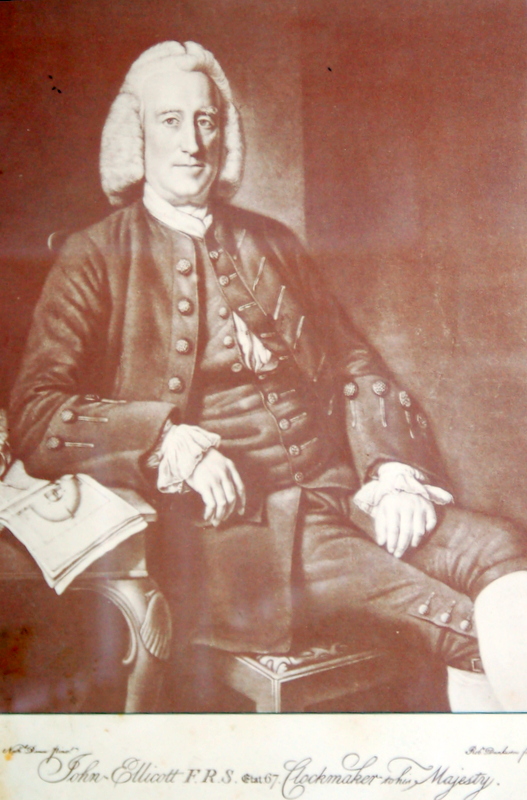
John Ellicott Clockmaker

John Ellicott , father, son and grandsons were amongst the finest antique clock makers of the 18th century.As a result I am going to dedicate this blog to them. We are lucky to have 2 amazing examples in stock by these great clockmakers. One of them an outstanding GIII mahogany bracket clock signed John Ellicott London. This dates from just before C1760. In 1760 John Ellicott FRS took into partnership his son Edward. Edward also was a fantastic clockmaker and the way they signed their names then changed. Edward Ellicott also became Master of the Clockmakers Company.

Master of the Clock Maker’s Company

Prior to 1760 Ellicott clocks were signed John Ellicott London. 1760 to 1769 Ellicott clocks were signed just Ellicott. From 1769 to 1788 this was changed to John Ellicott and Son. These facts you can see this outstanding grandfather clock dates from 1760-1769 as it is signed just Ellicott. I would expect it to date from the start of the partnership between John and his son Edward, probably around 1760. The cabinet is of beautiful burr walnut and wonderfully decorated.

Royal Exchange London

This clock above is by John Ellicott’s son probably the most famous of all the Ellicott family of clockmakers, John, FRS. John’s father also John came to work in London around C1690. He started his apprentaship and subsequently moved to the Royal Exchange, St. Swithins Alley. He set up shop around the beginning of the 18th century. John Senior was a very fine clockmaker, he worked in St Swithins Alley until his death in 1733.  His father must of passed considerably knowledge to his son. In 1728 John FRS was seen to be working with his father at these premises.

Academically Brilliant

John’s son was reportedly academically brilliant and also very highly skilled with his hands. It is remarked in many text books that there were few men of his equal in this regard. Just after his fathers death in 1733, in 1738 he was elected to the Royal Society. This was an immense achievement. He had some really important and influential sponsors for this position.

Fellow of the Royal Society

Ellicott carried out some important work and research in this role. He looked at various things like the effect of two pendulums upon each other. Also the variability of the length of a pendulum with latitude. It is without doubt though many people who remember Ellicott will remember him for designing what I call the ‘Ellicott Pendulum’. An amazing compensated compensated pendulum. He worked to try and eliminate the disadvantages of the grid iron pendulum, Harrison invented.

Ellicott Pendulum

Ellicott pendulums were an amazing feat of engineering. They worked to very high standards. As a result far exceeding anything else of the day. These pendulums were very complex to make though and therefore expensive. Not many clocks still exist today with one of these pendulums. Ellicott’s work was always to the highest of standards and the antique bracket clocks pictured here is of the finest quality workmanship. Superb verge escapement, delightful engraved backplate and three train quarter striking fusee movement.

The link to this clock on our antique clocks website can be found here, Fantastic Ellicott Mahogany Bracket Clock

Family Clock Business

In 1760 this famous clockmaker John Ellicott FRS , took his son Edward into the business. Working together until his fathers death in 1772. Edward ended up being a special clockmaker in his own right. He became the Kings watchmaker and was Master of the Clockmakers Company. Edward died in 1791 and the business continued with Edward’s son, Edward. An entire century of Ellicott’s, a clockmaking dynasty. Clockmaking did run in familys’ but none left their mark as great as the achievements of this family. They always strived to better on what had been achieved before.

Clock Making Dynasty

Can I think of a clockmaking family as well regarded. I do not think so, as a result an entire century of the finest antique clocks. The antique grandfather clock pictured below is an example of the partnership set up with John FRS and his son Edward in C 1760, as the dial is signed just Ellicott. The cabinet is the finest decorated cabinet I have ever seen.

The link to this clock on our antique clocks website is here , Outstanding Ellicott Walnut Grandfather Clock

I hope you have loved reading about the clockmaking family Ellicott of London , they were truly great and made some of the finest antique clocks ever built. A clockmaking dynasty that will never be repeated.

Daniel R Clements

Posted on

Enamel Dials

We have been in the antique clock business for over 40 years. It is true to say enamel dial antique clocks are rare. You can see them occasionally on bracket clocks in the 18th century. Searching for examples is hard. It is like finding a needle in a haystack however finding a true enamel dial on a grandfather clock.

True Enamel or Painted Dials

If you undertook a search for enamel dial grandfather clock you will find lots of listings. Dealers loosely apply the term to a standard white painted dial. These clocks with white painted dials started manufacture in Birmingham with Wilson and Osborne from around C1772. It was true to say the Clockmakers Company in the early days frowned on achievements outside London. Clock makers tried and most times failed to make alternatives. One alternative was a true enamel dial. True enamel dials such as the superb example pictured here was made from a mixture of glass, tin oxide, borax, peat ashes and salt.

Hard to fire large pieces of enamel

A complex mix of substances was then melted and turned into moulds to harden. This mixture was then ground to a powder and mixed with water. The enamel was then mixed with lavender oil to make it adhere to the copper dial plate. This mixture was applied to the dial and then the dial was fired at high temperatures in a clay oven. The temperature was carefully monitored and then the dial was cooled very slowly to prevent any cracking.

Time Consuming Process

I hope you agree a process that was very time consuming and complex. To get this to work on a large dial it was very hard. That is why in this case you will see the arch is fired separately. I am sure the risks of cracking with a 12 inch piece of square enamel was a large enough risk. The lovely painted work and decoration you will see on this dial is the result of further firings. Rose Vermillion being one of the hardest colours to apply.

Conclusion

This is an outstanding and very rare clock with a true enamel dial. It has been mentioned the maker of these rare enamel dials was the brother of the famous clockmaker James Tregent. He was called Anthony Tregent. For further information please view the book Theelke, Anthony; Faces of Mystery. This is a lovely flame mahogany veneered grandfather clock with strike silent feature to the arch. The movement is of ‘8-day’ duration and strikes the hours on a single bell. Superb London quality case and typical high quality movement features.

Daniel Clements

Pendulum of Mayfair Ltd

Posted on

Servicing mechanical clocks

I have wrote a few blogs that I hope you enjoyed about antique cabinet restoration. Clearly antique cabinet restoration once carried out properly is a once in a lifetime operation as a rule. Antique clock movements meanwhile need to be cleaned and serviced at least every ten years.


Horology Department

All antique clock movements at Pendulum of Mayfair are properly serviced by trained high quality horologists. The movements are completely taken apart, cleaned and any necessary bushing & pallets re-facing carried out. Normally there will also be other repairs to undertake. Especially if the movement has not been properly services in the last 20 years.

Many clients believe if the clock is running and has been doing s,o this is sufficient. Dried out oil tends to mix with dust and other foreign bodies to become a grinding paste. Unless the movement is cleaned every 10 years or so this grinding paste can cause undue wear. This will also mean that when the next service is carried out extra work is required.

Service your clock every 10-15 years

It will normally take our horologists a couple of days to complete an overhaul of a grandfather clock mechanism. This only needs to be done every 10-15 years. Therefore a small price to pay to keep your antique clock in full working order and in tip top condition. Please only entrust your antique clock to the finest horologists. We have had our own workshop for over 40 years and all our staff are trained to the highest standards. We undertake work for Embassy’s, major London hotels and for many vip’s. Many clients have shipped their grandfather clock cases and movements back from the States. Then this work can be carried out by us. Poor quality restoration and repairs not to the highest standard can effect the value of your antique clock.

For more information Coppelia Antiques

Posted on

Better Together Campaign


I have been a passionate writer on my blog about all aspect of antique clocks over the last few years. I have tried to give the general public much needed information. They can then understand about various different horological matters. Never have I entered any political debates. This blog is to plead with the Scottish people not to give up on our longstanding Union. On 1st May 1707 our two great countries formed the Act of Union. This was passed by the Parliament of England and Scotland following negotiations agreed the previous year.

Act Union 1707

We have stood together in good times and bad. It is better together than apart I believe. Yes I am English, but I am British as well. I love Scotland and the Scottish people. Is their rivalry when England play Scotland ? Yes there is and I would not expect anything different. Maybe I am different but when Scotland are playing in any tournament to most people. I give my full support to them. I am sure the majority of other proud Englishmen do as well.

I stand with our great Union

You only need to see Andy Murray’s support at Wimbledon. He is a proud Scot, but English people still love him and cheer him on.  We have rivalry on a city basis with Manchester United and Manchester City. Like Glasgow has, but we stand together for our national teams. I stand by our great union and I hope the great nation of Scotland wakes up and sends Alex Salmond and this Independence vote packing.

It is worth standing up for

To destroy something so easily that lasted centuries would be a sad reflection on modern day society.  Scotlands voice, England voice in the world will be louder together. Further details of this special antique grandfather clock by John Smith.

I could not resist but end this by adding a special antique clock image that brings all this home. It is a lovely clock from a small town in Scotland called Pittenweem. Pittenweem is a small and secluded fishing village tucked away in the corner of Fife on the east coast of Scotland. Look how the clockmaker signed this clock ‘ NORTH BRITAIN ‘. I am sure he was a proud Scot, but he also, a proud Brit as well. This clock dates from around C1790

Daniel Clements

PendulumClocks@aol.com Antique Clocks Twitter


Posted on

Wood Identification Guide

For antique furniture and clocks different types of wood were used in their manufacture. In this handy guide I am going to cover some of the main woods used. These woods can be of solid form but most flamboyant grained woods are used as hand cut veneers. The carcass is generally made from oak or pine in the provinces or oak generally in London.

Woods Used in London and Provinces

In London oak is only used as a carcas material in the 17th and 18th centuries. Whereas in the provinces you will find antique grandfather clocks being made of oak as the finished wood. Clearly oak was veneered on as well, especially in London by English Walnut up to say C1750 . Then from this date fine Honduras and Cuban mahogany veneers are found. On some clocks you will find very early examples to be of ebony construction or ebonized (black stained fruitwood generally)

Chinoiserie Clocks

You can also get oak grandfather clocks in London that were painted and decorated by Chinoiserie or lacquer work. The finest examples were sent out on boats and decorated in China.  On some later clocks you will see these veneered in more exotic woods. Rosewood or maple or even ewe wood. I suppose the smaller size means you can use veneers of the more slow growing and smaller trees.  With early clocks these exotic woods were used as well in small pieces and matched. We have owned a lovely walnut burr oyster veneered grandfather clock.

Below is a selection of woods used for antique clocks and furniture during the 17th and 18th and 19th centuries in England. A brief insight into each wood pictured is given. I hope from this blog you will discover what type of wood your clock or piece of furniture is manufactured from.

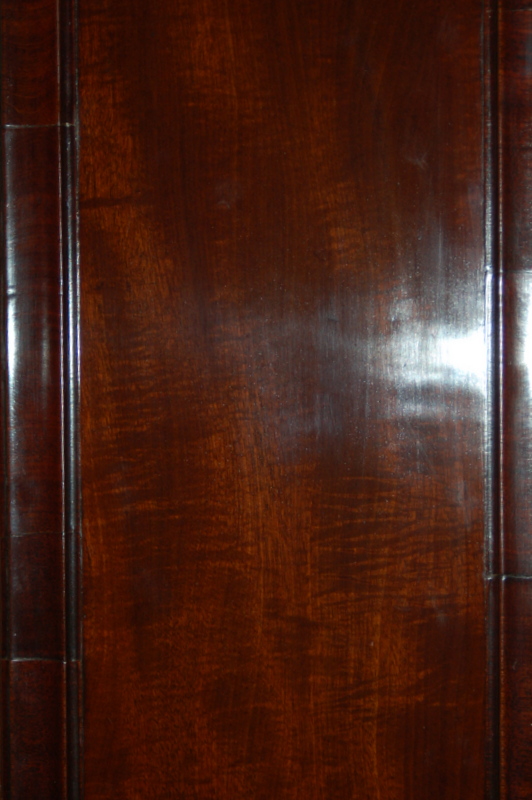
Honduras Mahogany


Cuban mahogany
Plum Pudding (spotted) mahogany

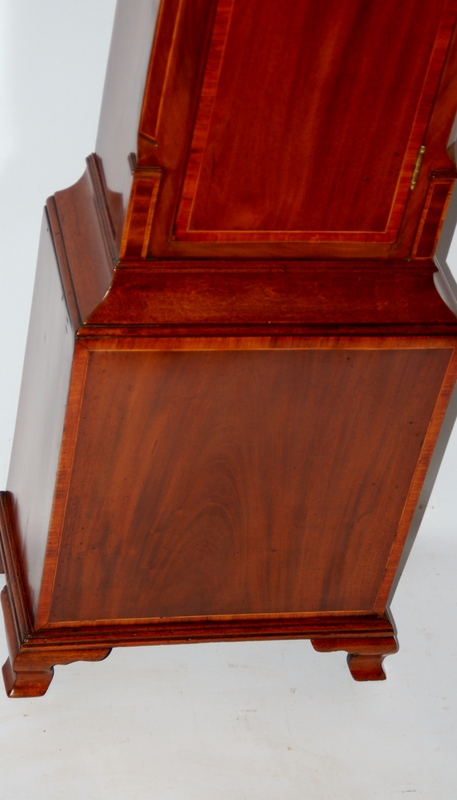
Mahogany can be a beautiful wood, it starts in the UK being used around C1750 and continues being used throughout the 18th and 19th centuries. Two most common variants are Honduras (lighter) and Cuban mahogany (darker). It is a close grain hardwood coming commonly from the South America or the West Indies type regions. This tree can be found quite wide and so large sections could be veneered with this wood.

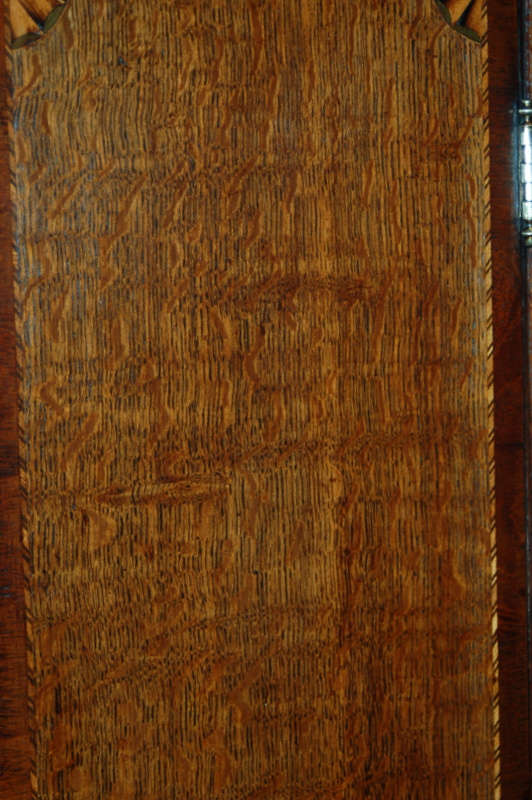
Quarter Cut or star-fleck figured oak
Solid English Oak

English Oak

English oak is a slow growing and so very heavy wood. Used in construction and veneered some of the time, but it is a beautiful wood in its own right. Oak being so heavy and close grained it is good at preventing things like wood worm. It is one of the reasons why London used it in the construction of its clock cases ahead of pine. Pine is used in the provinces as a rule for carcases as it is cheaper. You will notice the weight difference between an antique clock veneered on oak and an antique clock veneered on pine. Oak just gets better with age and polishing, we call this the patina. Less close grain oak can come from countries like Japan. This wood although called oak, is a far poorer wood to the slower growing English oak.

The climate effects the grain of the wood

English Burr Walnut
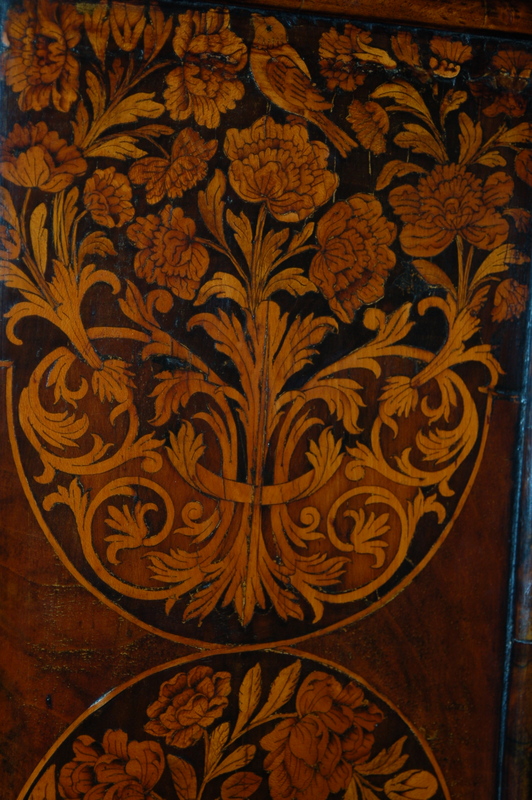
Marquetry inlay on English Walnut
Marquetry on Walnut
Continental walnut


Walnut is a lovely wood and English walnut gets used as veneers in antique furniture and clock manufacture up until C1750. After this date most walnut used is Continental walnut. Continental walnut is a quicker growing tree and so the grain is never as fine as English burr walnut. Again English walnut is a very heavy wood with a close grain. The tighter the burr or knot in the walnut the better. Walnut can range in colour from quite light if the sun has taken it, to quite dark. Walnut is used on all of the German wall regulators or commonly called ‘Vienna  style’ wall clocks  etc through the 19th century.

Satinwood

Satinwood used as a blank canvass to artists

Satinwood being a very light wood was used towards the end of the 18th centuries and early 19th centuries in the main. Many expensive pieces are manufactured with Satinwood veneers. We have some Pergolesi painted tables with satinwood veneers. I suppose the light colour makes the painting stand out better.

Pine

Pine, many of you will be familiar with this wood. It is rare to see a surviving antique grandfather clock made in this wood like the above. It was prone to woodworm unfortunately. Some were painted and this helped preserve them.Many provincial cabinets were constructed out of pine and then veneered. Pine is also used alot today as it is a relatively cheap wood, unlike oak. Clearly as you can see from the grain and if you lifted it from the weight , it is a fairly quick growing tree.

Lacquer or Chinoiserie

Oak can be veneered or painted

Oak was only used on internal construction of cabinets of English London clocks. When this wood was used and if it is not veneered in London you will find it sometimes decorated with lacquer work or Chinoiserie. This is gold leaf and gesso. The best types of these works are seen when they were sent out to China in the early/mid 18th century and decorated their.

I think I have covered the majority of main woods used in English cabinet making. There are others like ewe wood, maple , elm, fruitwood and rosewood. These are not covered as they are used alot less. I hope this blog has been of help to you. If you are still struggling with finding out what wood your clock or piece of furniture is made from, please send me a picture to PendulumClocks@aol.com

Daniel Clements – Pendulum of Mayfair


Posted on

How to properly repair a longcase clock cabinet

From the very onset of our business we have always had our own highly skilled staff employed in Cheshire. They undertake skilled antique clock and furniture repairs for our London shop. Antique clock repair is something that can only be carried out by highly qualified and time-served skilled staff. It is important to know what they are doing. In my latest blog I will be looking at the restoration of a badly damaged antique clock cabinet. This clock was damaged by a very hungry owners dog ! You can see from the pictures below, taken prior to restoration, the damage to the base and trunk door areas on the clock.

One very hungry pet dog

Clock Cabinet Repair Restoration


As you will notice damage was to the sides of the base and the bottom of the door in the main. This is very intricate antique clock restoration. Our skilled cabinet restorer carefully restored this clock to its former glory. Whilst the restoration of the antique clock was ongoing. We noticed the two sides of the base banding had been replaced with mahogany veneers over the years. We took this away and replaced the mahogany with the banding to match the trunk door. This being tulip wood.


Furniture Repairs

As you will see from the finished restored pictures. Close up pictures of the damage from the clock, the skills of a craftsman. All repairs were carried out in hand cut veneers of wood. This was a like for like match. Animal glues were used like in the original. After all the antique clock repairs were carried out at our base here in Cheshire. The clock was redelivered back to very happy owners.


Repairs Done Sympathetically

Restoring antique clocks like we have done for over 40 years here at Pendulum of Mayfair or Coppelia Antiques is vital to be done properly. Do not have a clock that has been poorly restored. This would take away from the value of the clock. Restoring your antique clock sympathetically can add thousands of pounds to the value. If the clock is genuine and basically all there. Spending £3,000 or so to restore your clock can be money in the bank.

Don’t cut costs in repairs

Spending £1500 for restoring your clock badly you may think you are saving money but do not be misled. Poor restoration can actually reduce the value of the clock, your £1,500 may well be lost. We charge out at competitive rates for unrivalled quality workmanship I believe. For a quote please send pictures of the item needed to be restored to the contact at the bottom of this piece.


Seldom seen damage

Can I point out before I go on, damage due to canines I have only ever encountered twice in all my time. I believe this was done by overexcited puppy’s with teething issues, you need not worry to much ! Basically antique clock cabinet repairs are much more standard. Loose moulding, little pieces of veneer lost, or he odd scratch here or there. Sometimes years of dirt to the surface of the case just needs carefully taking back and then the true colour of the cabinet can be achieved.


Colour of piece

The colour of every clock tends to be different and dependant on the wood and how this had reacted with the sunlight over the years. Hopefully if you choose a restorer he will preserve the colour and not just splash the stain of the day all over your clock. To many times I have seen furniture restorer throw shellac french polish to high gloss standards. Then stain whatever colour they were using that day on items. Rather than building up the finish underneath the years of grime, and basically wax finishing.

Wax finish is vital

Soft finish of wax, rather than the ploughed field of a poorly french polished and stripped surface is required. The grain on any antique clock takes years to fill with many years waxing. You do not want an open grain sticky finish, like what you will see on lots of modern furniture today.


Conclusion

I hope the three pictures included and the pictures of the clock now restored show what can be done by sympathetic highly skilled craftsman. We have undertaken repairs for Museums , a very important Embassy , and lots of major hotels in central London. We also undertake repairs for the general public. We have highly skilled staff specifically now just undertaking outside repairs.

Antique furniture and clock repair

It is a growing side of our business. Put your family heirlooms in safe hands and contact the specialist today. All public enquiries for antique clock repairs for a limited time will receive our special offer trade daily rate. You will need to quote ” antique clocks blog special offer” on your e.mail. Please hurry this is for a limited time only and applies to cabinet work.
We also have two full time horologists on staff to repair your antique clock movements. These are also highly skilled professionals. I suggest you should have a major overhaul of your clock every 40 years. If you have had this carried out properly a clean every 10 years or so. This will keep wear on any pivots etc to a minimum.

I hope you will agree the finish restored antique clock below looks stunning. The total time was approx 10 working days to restore movement and cabinet.

Any questions to

Daniel Clements

Manager: Pendulum of Mayfair- London  -0207 629 6606/ Coppelia Antiques Ltd – Cheshire 01565722197


Posted on

British Summer Time – clocks change

I am an antique clock fanatic and have loved antique clocks and everything about time all my life. I presently run our family business Pendulum of Mayfair Ltd in central London and Cheshire. Various people have looked at changing the clocks time over the years. Most have been unsuccessful in convincing enough people. Either because the changes affect Northern England or Scotland or by people not understanding the major benefits. The system below would benefit pretty much everyone I believe.

Changing time

My proposal is very clear and easy, and will greatly improve most people’s lives. In understanding GMT it is very simple. The hours of daylight are roughly split into the same hours before midday as after. I believe this is fine when there are shorter hours of the day in winter and GMT should remain during the Winter.

Winter and Summer Time

I do believe it works when there are around 16 and ¾ hours of daylight in summer. This spread of time equally between morning and afternoon no longer works for modern living. This is why we have British Summer Time. I believe this should be further enhanced . Sunday March 31st and Sunday October the 27th should remain as the allotted days for changes but British Summer Time should be +2 not +1 (you can call it Double British Summer Time) We will be at the same time as Europe for these months. If you look at the sunrise times for middle England under GMT on the 18th June it is 03.46 under +1 at present this would be 04.46 under my system this would be 05.56. Still early for sunrise, but we will gain by an extra 2 hours of daylight throughout the summer (instead of 1), saving on electricity, enhancing peoples lives.

The need to change

The latest sunset would be 22.31 under this proposal. The economic benefits and peoples health benefits from the extra daylight are considerable. I am sure this would gain the massive support of the majority of the population if this was put to them under a referendum.
Daniel Clements from our London antique clock business , I would welcome your views. Follow my antique clock tweets on twitter.

Posted on

European Clocks

I have been on a sort of busman’s holiday around the world looking at antique clocks. It is amazing how this country has literally pulled the world together or connected it through our history. I examined the close ties with Australia and antique clocks in my last blog. I have also written about the cloc kmakers that headed to USA for a new life. In both countries this meant the setting up production of a new industry in clockmaking. This will be one of my last blogs concerning clocks from around the world. I will look at antique clocks that were made for a particular market. Two countries spring to mind instantly.

Turkish and Portugese Market For Clocks

In the 18th century antique clocks manufactured in London were being sent to countries like Turkey and to another one of our close allies, Portugal. It is our connection with Portugal I will consider here. We have just restored a fantastic London mahogany grandfather clock. This is pictured above that has spent its entire life in Lisbon, I believe, until we purchased it at the end of last year. The superb example is pictured above.

Spencer and Perkins Lisbon Clock

You will see the clock is made by the great clockmakers Spencer and Perkins in London.Built around C1770. It has a strike/silent to the arch saying Repite and Surdo, clearly in Portuguese. This clock was exhibited in Lisbon in 1986 to commemorate the Battle of Aljubarrota in 1385. It was then 600 years since this historic battle. Right so what exactly is our connection with Portugal. The Anglo-Portugese Treaty of 1373 was signed between King Edward III of England and King Ferdinand and Queen Eleanor of Portugal. This is I believe the oldest treaty in the world. It was a treaty established between two great seafaring nations, a treaty of, “perpetual friendships, unions [and] alliances”.

Close Bonds With Portugal

This little heard of treaty has been reinforced throughout history, including in 1386 in this Battle of Aljubarrota. Here the English sent 100 longbowmen, veterans from the Hundred Years wars to honour this alliance in 1373. There were about 6,500 men on the Portuguese and English side against a force from the Crown of Castile, Kingdom of France and Arogonese allies and Italian allies of over 31,000 men. The Portuguese with the help of the English managed to win against overwhelming odds. In 1386, the closeness of the relations between Portugal and England resulted in a permanent military alliance, with the Treaty of Windsor, the eldest still active in existence. This treaty came into play again in 1643,1654,1660,1661,1703,1815,1899. It was also recognized in the Treaties of Arbitration in 1904 and 1914. This Treaty was also used during the Second World War and was also cited during the 1982 Falklands War.

Rise of Clockmaking

During the rise of the clockmaking in the UK in the 18th century under King George II and III we were at war with or on opposite sides with France many times. Supply of wine after French ports were blockaded became a problem. Our alliances with Portugal made British merchants look further afield. Port was invented as in order to stabilize the wines during their long journey at sea. Merchants added a bucket or two or brandy to the barrels before sending them off.  Britain and Portugal signed the Methuen Treaty providing for, among other things, bolts of cloth from England for pipes of wine from Portugal. This paved the way for the enormous expansion of port trade in the 18th and 19th-centuries.

Port Trade

King George III was rather partial it was believed to this drink, and he helped his allies from Portugal during many occasions. It was believed fine antiques and clocks and other items were sent after various disastrous earth quakes in Portugal. The 1755 Lisbon earthquake was one of the most deadly earthquakes in history.

Lisbon Earthquakes

The pictures above show one such clock that was manufactured in London. This was sent out to Lisbon, Portugal in the 18th century. It has spent, I believe,  all but the last few months overseas. It has a very unusual packing block behind the movement that looks original to the case. This appears to be the way the movement was bolted down for shipment in the 18th century. A really rare feature which you can see below. There is also an 18th century brass plate on the back of the movement that attaches to this block.

It is a fantastic antique clock and it can be viewed on our website, please contact me for any further information.

Daniel R Clements

Posted on

Australia’s First Clock Maker

Antique clocks as we have looked at in my many blogs centered around London in the 17th and 18th centuries. The UK exported many of these clocks to different parts of the world. Pendulum of Mayfair website sells many of these fine clocks.

Fleeing UK to set up a new life overseas

Clock production only really set up in places like America, as a result of people fleeing persecution on religious grounds. It was slightly different how clock production was setup in places like Australia. Hundreds of convict ships sailed during the 18th and 19th centuries to Australia. As mentioned in my previous blog Henry Lane the clockmaker from London and Bristol was a prisoner on board the Perseus.  Clearly other convicts arrived in Australia who were also clockmakers in the UK. James Oatley was born in Warwickshire in 1770 but was found guilty of stealing bed linen. He was a horologist who arrived in Sydney in 1815. His talents also were noted and he became a highly regarded clock and watch maker. He was pardoned in 1821 and he was appointed Keeper of the Town Hall Clock by Governor Macquarie.

Sydney Clocks

It is Henry Lane Clock maker who I will be looking at here though. It is found a year after his arrival he had set up his business in Sydney in 1803. Clearly with no competetion to speak of, he was not short of work. He he is mentioned soon after his arrival advertising for an apprentice and a clock case manufacturer. In April 1804 he advertises for sale a ships chronometer and through these adverts you can tell he also manufactured watches at the time. Sydney was founded in 1788 . Again convict ships set sail from Portsmouth. The Town Hall clock that Henry Lane was asked to repair after it collapsed in 1806 was probably brought on one of these ships from the UK. The first tower clock in the UK to compare was at Salisbury Cathedral and it was made in 1386, over 400 years earlier !

Conditional Pardon Henry Lane 1808

In 1808 Henry Lane has been given a conditional pardon and by 1811 Henry was appointed Government Clock Keeper. He held this position until his death on the 15th April 1815. The earliest editions of the Sydney Gazette gives lots more information about Henry Lane. He has grandfather clocks and watches advertised for sale. It is an interesting history that I suggest readers delve deeper.

Close Bonds Between UK and Australia

Australia and the UK have a unique history from 1788. It is probably one of the closest international relationships in existence. It has a shared history, culture, institutions and language. The only change is that people go to live in Australia freely from the UK today ! Even the current Australian Prime Minister was born in the UK in Wales. There has always been a fierce rivalry especially in sport between our two nations but we have always had a special bond. Many of the people who live in Australia today have some connection with the UK, either in past or present history.


Posted on

The story of the Bristol UK clockmaker Henry Lane.

I will be looking at the start of clockmaking in Australia. The interesting story of the 18th century antique clock specialist Henry Lane. I need to pay special thanks to John Houstone, Kevin Fahy and Bill Bradshaw. The Australian Antique Collector and the Power House Museum in Australia for their help.

From Bristol to Australia making Clocks

I have been associated with antique clocks all my life and I learnt about the story of Henry Lane from one of our clients. Many years ago we had for sale a stunning Bristol antique clock by this maker at our retail antique clock shop in London, Pendulum of Mayfair Ltd. The power of the internet made it possible for a client in Australia to notice this clock and travel all the way from Australia to London, UK. He viewed and eventually purchase this magnificent clock. The clock itself is pictured below.

I hope you will agree it is a fantastic and rare 3 train musical mahogany Longcase clock of ‘8-day’ duration. Lovely typical high quality Bristol cabinet with fretwork beneath swan neck pediments to hood. Reeded chamfered sides with brass stringing to trunk and base.  The dial with high quality matted centre, chapter ring/spandrels, recessed polished and engraved seconds and calendar, strike/silent to arch. Movement of high quality playing 6 different possible tunes every hour.

Henry Lane Started Clockmaking in Australia

As many of my readers are aware there are literally thousands of antique clockmakers. Some you know and some you don’t. Henry Lane was one I did not know anything about, clearly he was not a prolific clockmaker. You could tell though from the quality of this clock, he was a fantastic maker.  The workmanship was of the highest order, and it included some very unusual features. It is rare for one to get a genuine 18th century musical example. Anyone capable of such work, had to be of the highest order. There is nothing really listed in the main clock reference books about him, other than he worked in Bristol and London.  Our client opened my eyes to this interesting story though and I give him special thanks.

Henry Lane Arrested

Saturday, 4th Jan 1800 was the day when Henry Lane’s life changed for ever. He arrived with his companion Mrs Charlotte Holland in Chipping Sodbury on the morning coach from Bristol. Henry paid the fare with a one pound Bank of England bill. He paid another bill with a five pound bill, on both occasions he received change. His companion Charlotte went on a shopping trip, she made payments with similar five pound bills in three different shops. Likewise receiving change in each shop. It was in the last shop that the husband of the last shopkeeper noticed something strange about the bill and correctly deduced it to be a forgery.

Forged Five Pound Notes

She seemed ‘all in a tremor’ , Charlotte was put in custody of a policeman who escorted her to the Swan Inn. Henry walked past this place and was recognized as Charlotte’s companion on the coach. He decided to run but he was caught. Henry tried to dispose of other bills by eating them. One pursuer forced Henry to open his mouth, he found two more forged bills inside. Henry was taken to the inn where Charlotte was kept.

Henry stood trial on the 5th April 1800 and Charlotte on the 30th July 1800. Interest in the trial was large in Bristol at the time and a full transcript of the trial is on public records. This will be given as a reference at the end of this piece. At his trial Henry gave a statement that he had received these notes as a settlement of a debt and he did not know they were forged. His evidence was weakened by the fact he booked the coach in a false name and he had tried to eat the notes when caught, and the fact he had tried to flee.

Sentencing

The judge adjourned and returned by pronouncing a sentence of death.  The Bristol Journal of 19th April 1800 announced ‘the execution of Henry Lane will take place at St Michael’s Hill on Friday next’. The issue of the 26th April reported the sentence had been commuted to transportation for life by Royal clemency. I am not sure what connection Henry Lane had to the Royal family but a crown is engraved to the centre of the arch to this dial !

At Charlotte’s trial in Gloucester on the 30th July 1800 she was also sentenced for transportation for life. Henry left Spithead on the Perseus with 112 other male prisoners on the 12th February 1802 and he arrived in Sydney cove on the 4th August. Charlotte left on the Glatton on the 23rd September, 1802 and arrived on the 11th March, 1803.

Journey To Australia

Henry who at his trial was 50 years of age and had a wife and family. Not much was known about the relationship with Charlotte but it is clear by 1806 Charlotte was living with Henry in Sydney. Charlotte is described to the Governor in 1810 as a ‘housekeeper’. In Rev Samuel Marsden’s Female Muster of 1806, she is described as a ‘concubine’. That is  a woman in an ongoing, marriage-like relationship with a man to whom she cannot be married for a specific reason! Eventually on the 27th October 1813, they married at St John’s Parramatta. The assumption is made Henry’s wife in Bristol, England had died by that time.

I will look at Henry work and life in Australia in my next blog. This is a compelling story I hope you agree. More can be found about the trial by reading the following.

1.The Only Genuine Trial of Henry Lane taken by a Short Hand Writer – Rosser and Co., Bristol 1800