late 19th century German mantel clock

german mantel main

A good German Mantel clock. Late 19th century. Featuring two train movement striking quarters and of 8 day duration. Dial with chapter ring and spandrels. Furthermore the case of good shaped design and small size. Movement striking hours and quarters on two gongs.

Bracket Clocks

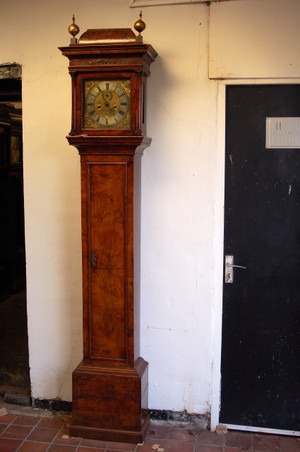
Antique Grandfather Clock by William Barrow – london C.1740

William Barrow main

A superb 12 inch ‘8 day’ duration London walnut Longcase clock. Arched brass dial musical movement by William Barrow of London. The dial with chapter ring and spandrels Also with finely matted and engraved centre. Another lovely feature being the ‘wheat-ear’ decoration to the dial. Featuring musical 3 tune selector to the arch. Stunning burr walnut veneered cabinet. With long trunk door and caddy top. Fine colour and patination. In conclusion a superb collectors clock.

Antique Grandfather Clocks

Posted on

Great Christmas Gift Ideas

Silver looking around for that ideal stocking filler.

Have you ever been completely lost over what to get your loved one at Christmas?

If so you are one of millions of us rushing around at the last minute with no clue of what to get?
We usually spend hundreds of pounds on something that will be forgotten within a few days. How about some suggestions that will be a memorable present for many years to come ?

Everyone has a budget at Christmas. I will be looking a various options from a few hundred pounds to a few thousands pounds for those with bigger pockets. Maybe for ones like me that tend to save up and buy something really special once a year as a special treat.

Under 500£ Presents

Lovely Art Nouveau Balloon Clock C1900

Swan Neck Balloon Clock C1900

Lovely Art Nouveau Balloon clocks can be a wonderful Christmas gift. Fully restored examples in top condition and of the best quality can be found at under 500£. These lovely little clocks will give years of superb service. Always reminding the person of the day they receive this lovely gift.

Under £1,500 Presents

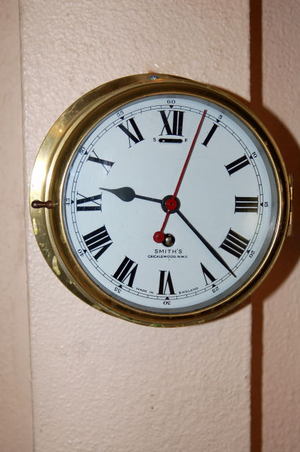
Ships wall clock

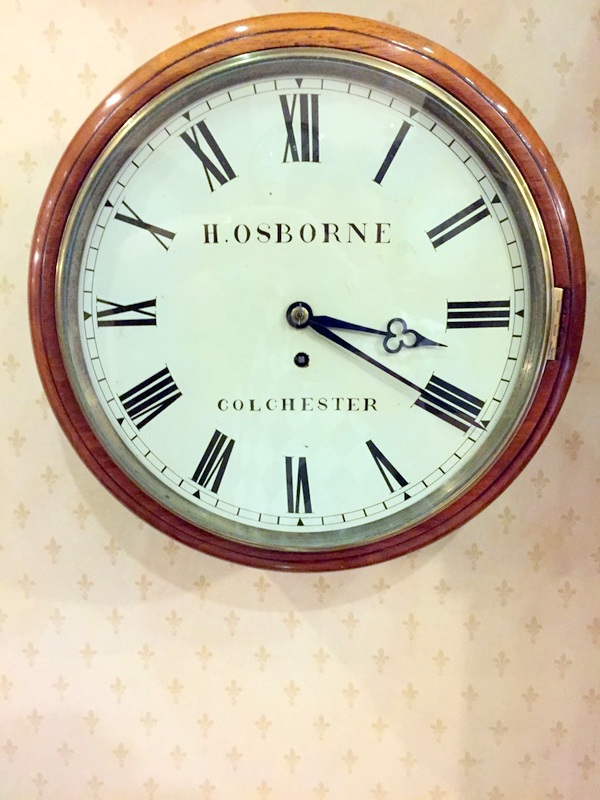
Osborne of Colchester Dial Clock

Antique pre c1900 Fusee wall clocks that have been overhauled and are in showroom condition are fantastic gifts. The earlier type can go from around £1,000 to £1,600. If you want to stretch the budget you can go for a smaller dial example. Convex dials or even rarer large face dials with fusee movement which all are more expensive.

Under £3,000 Presents

Joyce Bracket clock with round convex dial

skeleton clock C1860

For under or around £3,000 you can get a large selection of early or mid 19th century fusee timepiece bracket or skeleton clocks.

Under £7,500 Presents

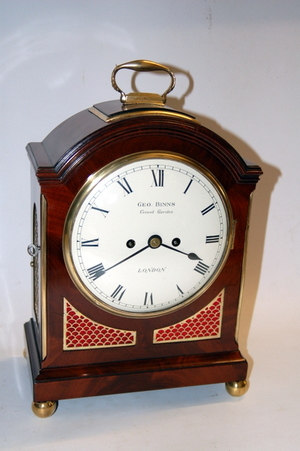
George Binns Bracket Clock C1820

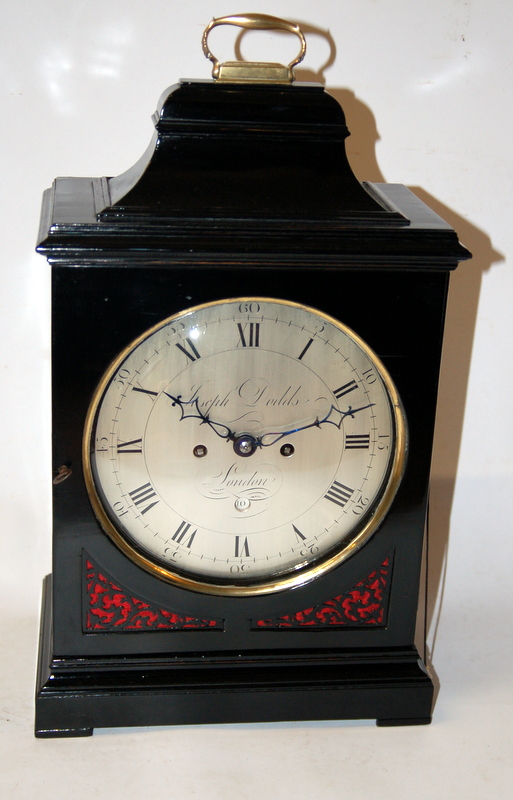
Dodds ebonized bracket clock

These superb fusee bracket clocks would be a lovely addition to any home. Woods from mahogany to walnut to ebonized fruitwood can be found on these examples. Most movements are of 8 day fusee type.

From £3,000-£30,000 Presents

porthouse grandfather clock

Old Deer Davidson Grandfather Clock

Pewsey London Grandfather Clock

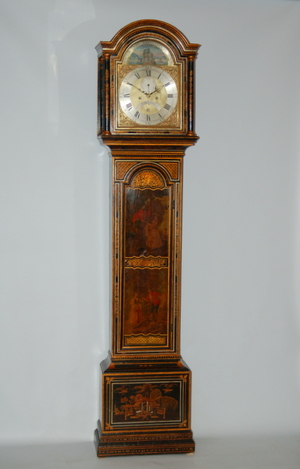
Automaton Lacquer Grandfather Clock

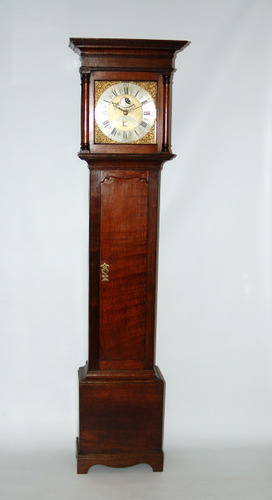
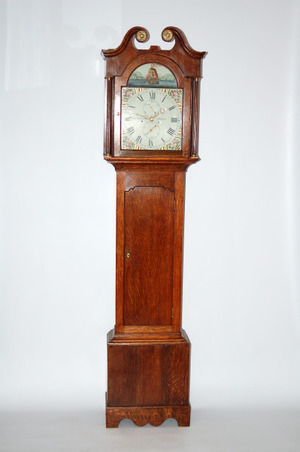
Antique grandfather clocks form an amazing addition to any home. They truly are the centre piece. Owning a lovely restored ticking antique grandfather clock is like having someone nice coming to stay with you.

I hope some of these pictures give you the inspiration this Christmas for that really special gift. If not for Christmas then for that special anniversary. Have a part of our nations history ticking away in your home very soon, you won’t regret it.

Daniel Clements

Posted on

London Mahogany Moon-Phase Grandfather Clocks

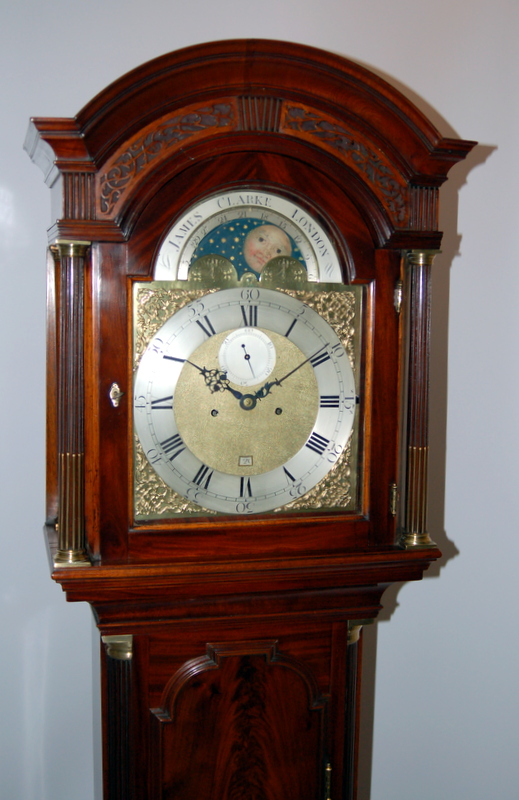
Moon-Phase antique grandfather clock by James Clarke of London
James Clarke London Grandfather Clock with Moon feature

A while back now I wrote a blog about moon-phase antique clocks. We restored this superb antique grandfather clock by James Clarke of London. I thought it was important to write a little more. More about London mahogany moon-phase clocks in particular and why they are so rare and sought after.

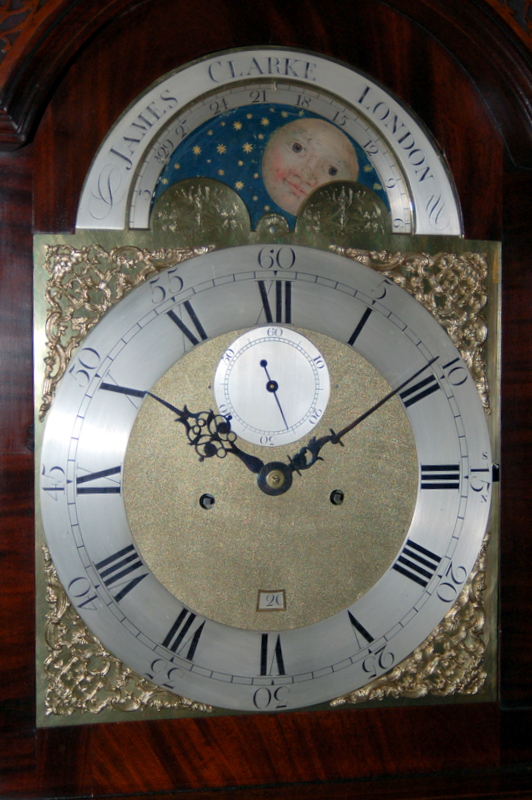
A fine 12 inch chapter ring and spandrels brass dial with moon and strike silent feature to the 3 o clock position on the dial
Lovely moon-phase James Clarke dial

London clocks with Moons

This clock above is a simply beautiful example of a London moon-phase clock. You will notice the high quality matted centre to the cast brass dial. Chapter ring and spandrels and subsidiary calendar. Recessed seconds feature and lovely engraving to the moon discs to the arch. The name is prominently engraved to the cartouche around the arch. It has beautiful painted moon disc and a special extra feature of strike/silent lever to the three o’clock position on the dial.

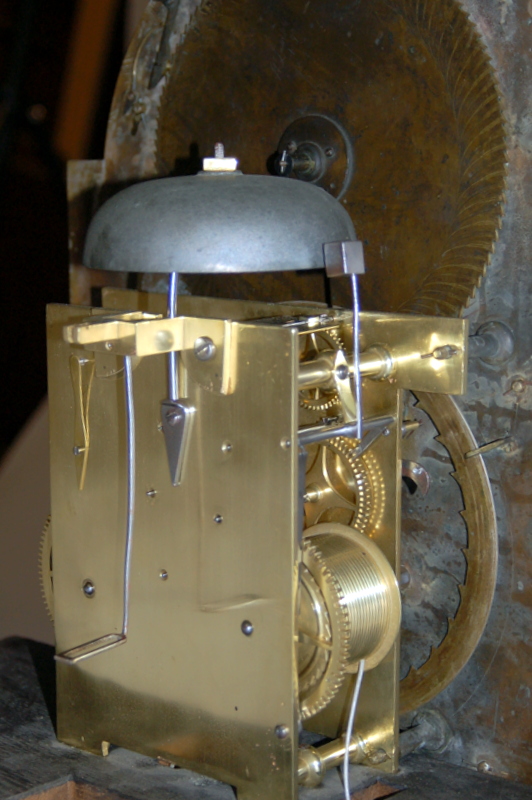
Lovely movement view of Clarke of London 8 day clock
Lovely 8 day moon movement by James Clarke of London C1770

Moon Workings

The picture above shows the beautiful workings of this James Clarke 8 day antique clock. You will notice one large extending piece of brass for the front plate top. This is so that the dial feet can miss the moon disc. Lovely high quality 5 pillar London movement, all now beautifully restored back to showroom condition.

I will now return to why so few London clocks have moon features.

Reasons why there so few London clocks with Moons

I suppose there are two main reasons. The first reason which is an important point to start from is the size of the London dials. Provincial 12 inch dials tend to be 17 inches high which would allow for a full semi circle to the arch. Easily enough space for a feature like a rotating moon disc. On a London clock the height is 1 inch less. That means on a 12 inch wide dial, the height of the dial is only 16 inches. The space to the arch is now no longer a full semi-circle and far more restricting. On the dial above you will notice the arch is not a semi-circle. The cartouche around the arch tapers to the centre.

Trading outside London

The second reason is centred around the fact that London is London. Trading in the UK outside London was not really required back then There were plenty of wealthy clients in and around London. Moons generally were required to check when to travel. Generally merchants would travel on and around full moons, so the risk of the Highwayman was not so great. Clearly some clocks like those with high tide, will also occur sometimes with moons.

High Water Tidal Clocks

Knowing when your high tide in your local port like London bridge was also important for the merchants. Travelling around London with the fact they had good street lighting fired by oil lamps after 1750 was not so hazardous. Knowing when the next full moon was, was not really as important.

As discussed in my other blog about moon phase clocks, there were lots of different types of moon. It is the rolling moon like that on the James Clarke clock that was the most popular. Two moons appear on these discs, but only one can be visible at any one time. Generally on London clocks the moon is accompanied by a starry sky rather than country scenes on provincial clocks.

29 and a half days in a lunar month

There are, as previously discussed, 29 and a half days in a lunar month. We divide up the 12 months into either 31, 30,29 or 28 days to compensate. The exact lunar cycle is 29 days, 12 hours, 44 minutes and 2.8 seconds I believe, I hope my memory is right ! The clocks moon as it is 29 and a half days and is therefore fairly accurate, once set !

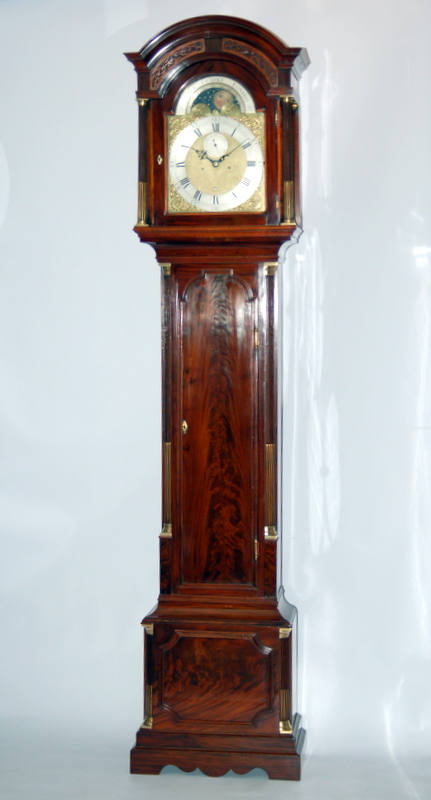
Lovely mahogany veneers and case features of this top quality London clock by James Clarke
Full length picture of the James Clarke London mahogany clock

James Clarke Clock

The James Clarke antique grandfather clock picture above shows what a top quality clock should look like. The dial and movement show amazing high quality features and detailing. The case shows only the finest London case making features of the late 18th century. Quarter columns and brass capitals to the base. Moulding to bridge top door and base and 2 plinths are but some of these lovely features. To view this clock please visit our shop in London, Pendulum of Mayfair or contact us through our website https://www.pendulumofmayfair.co.uk . James Clarke is listed as working in Newgate Street, London and was apprentice in 1760 and a member of the Clockmakers Company from 1768-78.

Daniel R Clements

#SBS Theo Paphitis Winner August 2014 : Antique Clocks Twitter

Posted on

Duration of Grandfather Clocks

Antique grandfather clocks tend to be weight driven and go for a specific amount of time on a wind. I will cover the standard examples in this blog. For examples of different types of grandfather clocks please visit our grandfather clock stock page by clicking this link:  Antique Clocks For Sale.

1 Day to 1 Year Duration

The most basic of antique grandfather clocks is the simple 30 hour duration antique grandfather clock. These were made generally for simple cottages in the country. They have simple mechanisms with one weight that drives both the striking mechanism and the going side mechanism of the clock. Since the weight drives both sides of the clock is has more work to do and thus it winds out far quicker. The weight is normally about 8lbs in weight driving this clock.

Lovely 30 hour grandfather clock in oak case
30 Hour Grandfather Clock – Bowfield

Bowfield of Melton Antique Grandfather Clock.

Most common is the 8 day clock

The most standard of all antique grandfather clocks is the ‘8-day’ grandfather clock. These clocks have a movement split into two separate sides. One weight driving each side. There is a striking side weight and a going side weight. Each weight has its own separate job to do. The movements tend to be 4 wheel train and the weight of the weight is usually around 13lb each. Sometimes higher quality movements run on a slightly smaller weight, as there is less friction involved. An example of a standard ‘8-day’ grandfather clock is found below.

Lovely London mahogany '8-day' grandfather clock
Henry Jenkins Grandfather Clock C1770

Henry Jenkins Grandfather Clock C1770

Long duration clocks

We are now moving into the realms of the rarer clocks. Every so often you come across a month duration or maybe a 3 or 6 month duration grandfather clock. Months duration grandfather clocks have like the ‘8-day’ grandfather clocks two trains for the mechanism. Usually one weight for the striking side and one for the going side. The movements tend to be 5 wheel trains and tend to wind anti-clockwise. The driving force tends to increase dramatically as well. The weights tend to be around 30lbs in weight each one. That is over the double the weight of an ‘8-day’ example. A lovely month clock can be found below.

Cabinet gets thicker construction on long duration clocks

One important point to note is as the duration of the clock increases the structure of the case gets more robust. This is required to cope with this extra weight. The sides of the case get thicker and construction gets all round slightly better to cope. A month case should be heavier than the equivalent ‘8-day’ example.

Long duration marquetry clock C1690
Lovely Month Duration Marquetry Grandfather Clock

Year Duration Clocks

Finally on very rare occasions you will find year duration antique grandfather clocks. We have only ever owned a handful of these very rare clocks. Some examples use the power from two weights to drive the clock. Alot of power is required to keep the clock running. You can also find some examples that will strike. These are generally on the earlier examples. The later Georgian examples tend to more about timekeeping and precision movements. Weights are very heavy in these clocks. Generally they need steel cable to support the weights. Each weight can be over 60lb. A minimum of 6 wheel train and high pinion counts are found of these types of grandfather clock. Clearly only the top makers produced such clocks.

Daniel Clements

Follow my Antique Clock Tweets on Twitter

Posted on

British Automaton Clocks

Daniel Clements – www.pendulumofmayfair.co.uk

Antique clocks with automaton features, have been built for many thousands of years. You can go back back as far as Roman times to get a mention. The engineer Vitrivius describing alarm clocks with a gong or trumpet feature. From the these primitive automaton’s I am heading for some of the earliest automaton features on antique grandfather clocks.

John Lamborne Cambridge

This superb ‘8-day’ early 18th century burr walnut veneered antique grandfather clock with automaton is by a Cambridge maker called John Lamborne. Further details of this special antique grandfather clock by John Lamborne can be seen by clicking on the link.

This clock dates from around C1720 and is a very rare example of an early automaton on a grandfather clock. The soldiers in the arch move and ring the bell when the clock strikes the hour. This automaton like some of the earliest automatons known works from the striking mechanism.

Clearly the heavy figures to the arch require the power driven from the weight of the clock when striking. An interesting feature on the dial of this clock, is the plaque by the order of the Patentee No. 5. This clocks feature automaton must have been patented.

Cuckoo Clocks

When most people think of automatons they probably will first think of cuckoo clocks.These became fashionable in the 19th century and most examples manufactured were from around C1860. These types of clocks are still manufactured today. The earliest cuckoo clock can be seen around the mid 18th century. Not many from this period still survive today. The automaton bird will again work off the striking mechanism of the clock.  It takes alot of power to drive this type of automaton and so most cuckoo clocks are only of 1 day duration.

I am now going to look at what most people will see or understand by automaton. Automatons work from the pendulum on antique clocks. These type of automaton features swing back and forth with the movement of the pendulum. They can be directly off the pendulum or off the anchor which is driven by the pendulum. These automatons therefore work continually and not just on the hour.

Edwards of London Automaton

More details of this stunning C1790 automaton antique grandfather clock by Edwards can be found here, Edwards Automaton Antique Grandfather Clock . The automaton features a man chopping down the ‘tree of life. The axe moves back and forward as the clock ticks. Various other automaton features you can also find to the arch. I have seen see-saws, rocking swans, rarer badminton automatons like the one pictured below. Adam and eve depictions are found. Others like rocking ships are the most common form of automaton on a clock.

British Naval Power

The British were clearly an important naval power. Many owners like to have a depiction of a rocking boat to the arch. Some depicting famous sea battles. The clock below represents one of these very battles.

The clock above is a superb C1790 Scottish antique grandfather clock and more details again can be found but clicking on this link, Scott Edinburgh Automaton Grandfather Clock .

Grantham Automaton Clock

More details of this exceedingly rare automaton antique grandfather clock here. Grantham Automaton Antique Grandfather Clock .  This clock features an automaton game of Badminton. It is very rare and is again working from the pendulum / anchor. It is a glorious antique clock with wonderful mahogany veneers and of 8 day duration.

Adam and eve Automatons

The clock above is a superb arched painted dial with ‘Adam and Eve’ automaton to the arch.  Adam and Eve depictings usually involve automaton arms holding the apple. Sometimes even the serpent moving on the tree. This clock dates from C1780 and is in a lovely mahogany cabinet.

It is important to note automaton antique clocks of any sort, especially on pre C1800 clocks are rare. I have seen many examples that are faked. Care must be taken if purchasing one of these. I would only recommend buying from a dealer who will give you a money back guarantee that the clock is genuine.

Conclusion

Rare features like automatons can be found on clocks sold at Pendulum of Mayfair. This can add alot to the price. It is relatively simple in some cases to add this feature on a standard clock. Unscrupulous dealers will do this for profit. I have seen many such examples on the market. My advice is to only buy from a long established expert like ourselves. Willing to offer a guarantee that the clock is genuine.

Daniel Clements Follow me on Twitter

Posted on

Is it a music box or is it a grandfather clock ? No its both !

18th century musical grandfather clocks are very rare examples. I will only see a genuine fine example once every few years. In this blog I will be looking at two late 18th century examples. One fine grandfather clock by Joseph Herring of London C1770. Also a superb rare provincial musical clock by Edward Bilbie of Chewstoke C1780 pictured below.

After discussions and research on the Bilbie family of clockmakers. You can see the example on the left is one of the finest provincial musical clocks by this maker. It bears all the hallmarks of what a Bilbie clock should look like. The lovely polished and engraved dial, with the doric columns superbly engraved to the dial centre. The name on a cartouche to the arch finely engraved and either side, a strike/silent feature and 4 different tunes.

Multiple Tunes

The tunes being ‘ Lincoln Time ‘ , ‘ Bath Time ‘ , ‘ 104th Psalme ‘ , ‘ 23 rd Psalme ‘. Why Lincoln Time, Bath Time I can understand as it is 20 miles away from Chewstoke, but Lincoln Time I do not know the reason. Maybe these were customer selections in the 18th century. The delightful engraving to the centres and outer edges of the arch show what fine craftsman Bilbie was. Bear in mind this is a provincial clock, it really is top quality workmanship.

Lovely quality Bilbie Clock

The dial also shows seconds and further delicate engraving around the edge. A calendar to the dial centre, chapter ring and fine gilded spandrels to the corners of the dial. All dials of this period are cast brass, and all the hands etc are worked on by hand. These are lovely quality iron hands which are eventually protected by being blued.

High quality musical movement

The fine music played by this immense high quality movement is played by means of 12 hammers on 10 bells. This is on a intricate pin wheel barrel. Finding all the right notes for the differing tunes is  so complex. The bells would of been cast by hand. I believe Bilbie did this himself, he had his own foundry , which was very rare. To get the bells so well sounding is a real credit to his talent. You will see a casting mark on the largest bell, but all bells play superbly.

Three train movements

The movement as I have described has 3 trains. One is for the timekeeping , one is for the hours , and the final one is for the music. This plays once every 3 hours. Hence 8 times a day one can wonder at this clockmakers talent. This is not only a lovely furnishing piece but it is a horological work of art as well.

Work of Art

The 8 day movement is also lovely in lots of other ways, everything is built to precision and to a high quality. It is clear high quality pieces were not only built in London. In the pictures below I will show London quality construction, it is very similar to Bilbie’s work here.

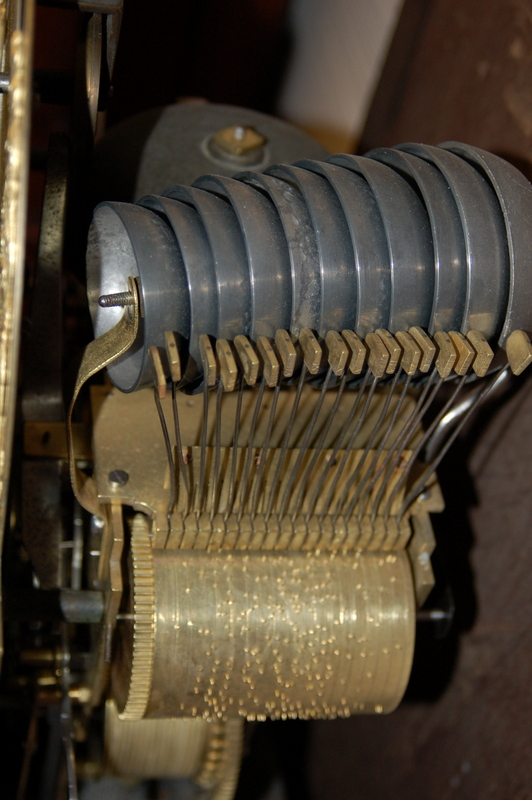
 

Joseph Herring Musical Clock

The pictures are of a Joseph Herring London musical Longcase clock. The only real differences between this and the Bilbie are one of two more hammers and an extra bell and a few more pins to the barrel. Very similar movements, both really high quality 8 day examples.You will see from both, the typical three train layout of the dial on these two genuine examples.

4 Tune Musical

The Herring plays 4 tunes as well, some strange 18th hits at that. ‘ Speed the Plough ‘ , ‘ March in Blue Beard ‘ , ‘ Beggar Girl ‘ , and finally one to top the lot off , ‘ Go to the Devil & Shake Yourself’. Maybe the last could come from a modern day rock song. It is definately a strange title for an 18th century tune. These as you can expect are not listed on Youtube. From this blog no doubt some of our clients, who are rock and pop stars, may make these 18th century classics into modern day hits. Watch this space !
Posted on

How to spot fakes – a brief guide

Buying Clocks Advice

So you have finally managed to take the plunge and purchase your antique clock. There are many antique clocks available on the market but not all are original examples. There is nothing worse than spending lots of hard earned money on something that you later find out to be not what you originally thought. Regularly you will only find out something is amiss when someone knowledgeable visits your home. I have had to break bad news when asked for my comments on many occasions.

When buying an antique clock to purchase from someone you can trust. Finding someone like this is never easy. Try and find someone who is long established and are specialists in this field. Maybe they will offer you a money back guarantee. You should then have peace of mind.

Some restoration will have been carried out on all antique clocks. This should be sympathetic restoration though and not major surgery. I have devised some basic things to look out for below.

Genuine London Antique Clock C.1770

Look. Smell. Feel.

  • Probably the most common part of an antique grandfather clock to have been replaced is the base of the clock. Clocks used to stand on cold, damp floors, and many bases simply rotted away or were attacked by the dreaded woodworm. Clearly the bottom feet or plinth is an acceptable part of restoration but not the entire base section. Easy signs of new bases are when the wood does not match the trunk door. If the figuring of the wood and colour is different be-ware.

    On London and south country clocks the backboard should be old and full length. If the backboard is rotted at the bottom and stops way short of the bottom, this is something to be careful of. If the backboard has rotted away, how much of the base has been rebuilt? In North country clocks, backboards can be made in two pieces from the later part of the 18th century.

  • Style Issues

  • Movements have sometimes been replaced. Make sure the case style corresponds to the makers location. i.e. London mahogany clocks do not have swan neck pediments but dome or pagoda tops. You can look at some good reference clock books for information on what clock cases should look like for different areas of the country. Each area of the UK in the 18th century had a distinctly different style of cabinet feature. For instance London clocks do not use simple oak cases but these are either veneered in walnut, ebony, mahogany or decorated with chinoiserie.
  • Look for Spare Holes

  • Does the dial belongs to the movement? Are there any spare holes in the front plate where another dial has been ? If the clock has a brass dial, this is attached directly to the front plate. Not by means of an iron false plate. (as used on white painted dial clocks) The winding holes on ‘8-day’ clocks are well placed within the centre of the dial These do not spoil the engraving or chapter ring.
  • Dial Features

  • If the clock is an ‘8-day’ example that the clock has a second hand. 99% of all ‘8 day’ clocks should have a second hand to just below the 12 0’clock position. If there is an obvious reason why a second hand cannot be fitted like a ‘penny moon’ feature then this is OK. As a rule though ’30Hr’ clocks do not usually have second hands, and so if the clock has had a later ‘8-day’ movement fitted this is why you should wonder why there is no second hand.
  • Does the age of the movement corresponds to the age of the cabinet? All dials have dating features, for instance inside quarter divisions, type of spandrels. You can date these very easily with good reference books. English walnut cases date from the 17th century up to about 1760. Mahogany cabinets date from about 1750 onwards. Oak cabinets tend to run straight through the 17th and 18th and 19th century’s.
  • Any Packing Under Seatboard?

  • Look for any obvious packing under the seat-board that cannot be accounted for? If the seat-board is old and warped ? A small piece of packing may be necessary.
  • Prior to 1820 all English antique clocks movements should strike on a bell and not a gong. Gong striking is popular around C1900.
  • Look for rub marks from where the weights and pendulum have banged over the years. If you see 1 smooth rub on inside under trunk door and your clock has 2 weights, this is not a good sign. If there are marks on backboard far away from where pendulum is hanging, and the clock is keeping time. Ask what would have caused these marks.

    If the pendulum feather has been changed for a stiffer example, the pendulum height can change slightly This should only be a slight change.

  • Fitting Issues?

  • Investigate whether the dial fits the mask correctly and there are no large gaps. The size of glass should be similar to the size of the dial.
  • Is the face made from 1 piece of brass? This brass prior to C1800 will be cast brass and so thick and thin. The arch section of the dial should be from the same section of brass. If a square dial is later converted to an arch dial case, this is why some dials are made of two pieces.
  • Carved Cases?

  • Finally I have never seen an original fully carved pre C.1820 Longcase clock. The Victorians loved later carving GIII clocks though, and so beware buying one of these examples. Later carving would dramatically effect the clocks value.
  • Conclusion

    I wish you luck in your search. Buying from a recognized antique clock dealer may be slightly more expensive but you will get peace of mind. You should aim to get a money back guarantee that your clock is a genuine antique and a fully working example. It is easy to spend your good money buying a clock with a chequered history. Please take your time and not rush into a decision you will later regret.

    As they say an antique clock is for life and not just for Christmas. In our business we say, hard to find easy to sell. Original examples will provide you will years of pleasure and a good solid investment, Pendulum of Mayfair only sells top quality examples.

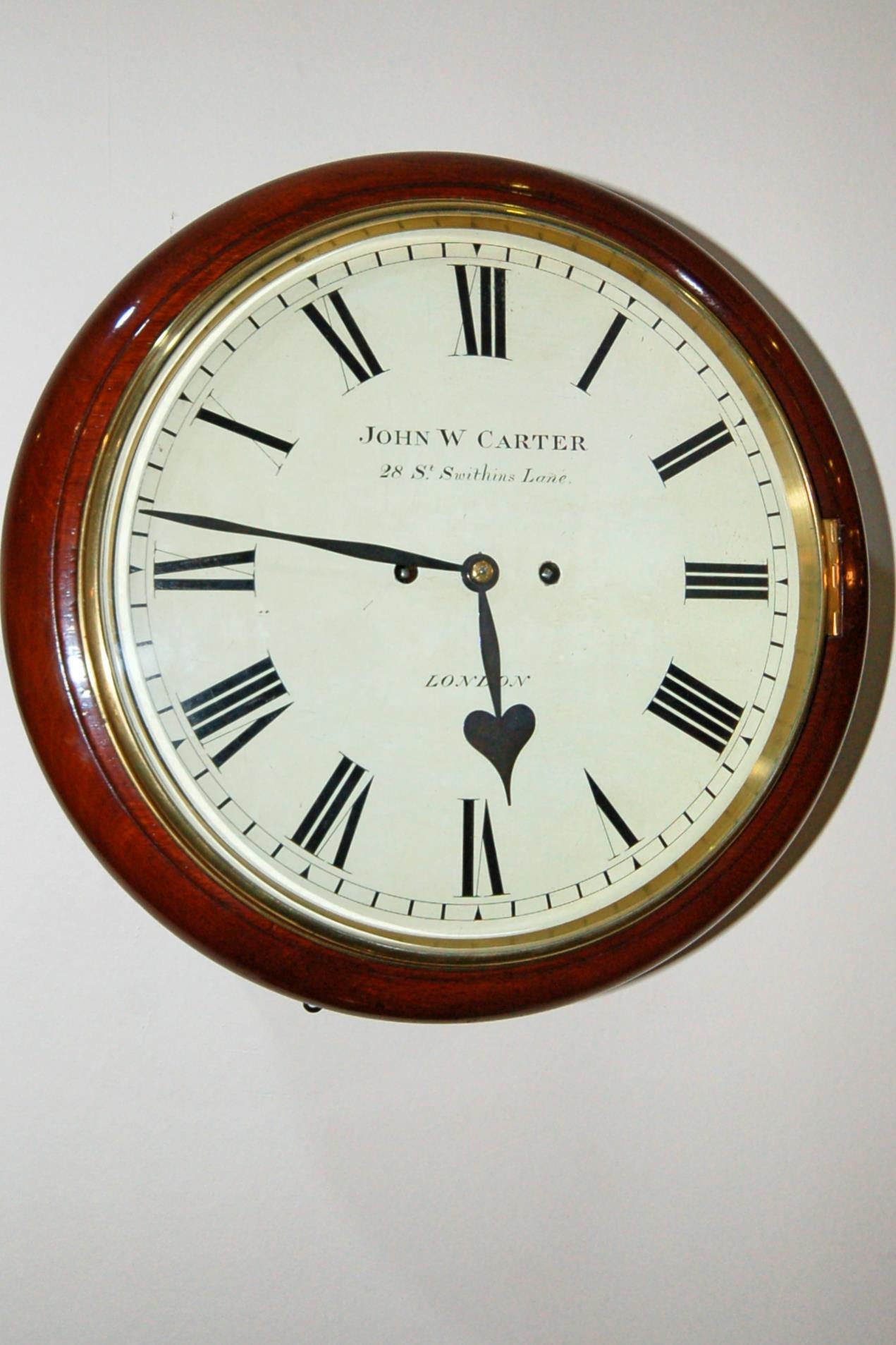
    Antique Wall Clock by John.W.Carter – London mid 19th century

    twin fusee hour strike wall clock 18th century

    A rare 12 inch round white dial ‘8-day’ duration twin fusee striking on the hour wall clock by this superb clock-maker John W Carter.

    John Carter was Master of the Clockmakers Company in London in 1856,59 and 64 and in the clockmakers company from 1829.

    This superb clock has a wonderful mahogany case, cast brass bezel, side and bottom doors to the case.

    The fantastic quality spring driven movement striking the hours on a single bell.

    A lovely example collector’s clock.