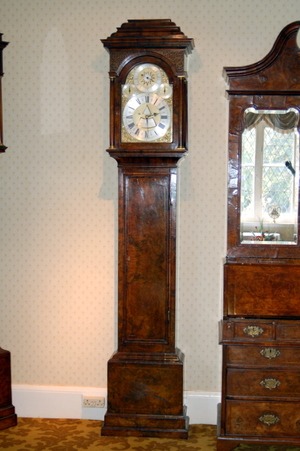
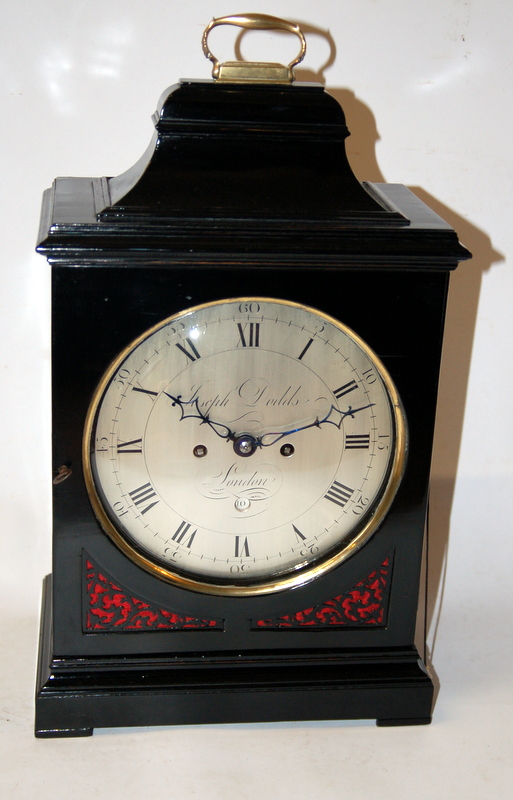
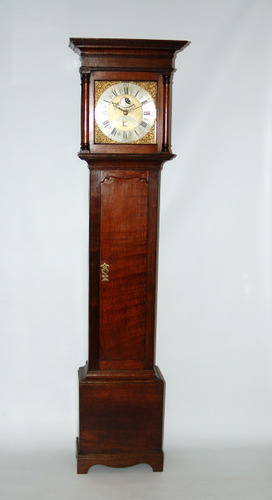
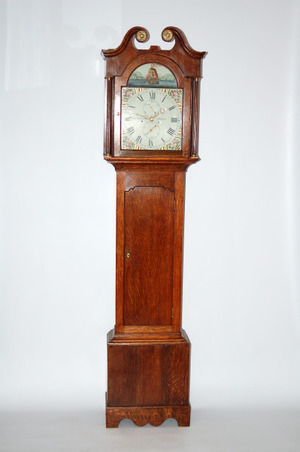
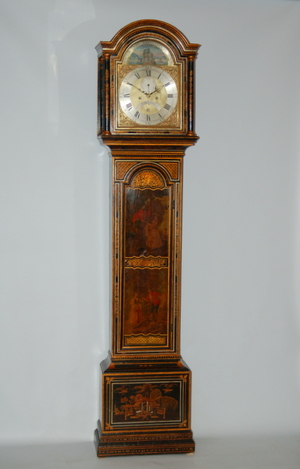
‘Equation of Time’ year calendar clock. Featuring the finest quality movement by John Topping of London. Also with superb London burr walnut figured cabinet. Showing high quality London features. The complex month duration movement with chapter ring and spandrels. Additionally unusual large seconds to the arch. Year calendar with equation of time calculations to the engraved silvered dial.
Lovely quality finely matted centre. also with rise and fall of pendulum dial and strike/silent dials to the arch. Amazing movement design striking the hours on a single bell.
I have had the pleasure to come across this amazing early 18th century ‘equation of time’ clock by John Topping of London. John Topping is not a household name in today’s clock world but he really should be. He built some of the most fantastic complex antique clocks during his time working in London.
Complex Clocks
He started as an apprentice to William Grimes in 1691 and he worked up until his death in 1747. He always described himself as ‘Memory Master’. I am not sure if this was a honour bestowed on him or if it was like a sales and marketing slogan. Either way he produced some exceptional clocks.
Further details of month duration ‘Equation of Time’ John Topping Clock.
Figure 1: Equation of Time John Topping Clock C1730
Equation clocks
The clock above is a fine example by John Topping. A superb early 18th century antique clock manufacturer in London. It is a most desirable combination of a superb and interesting complex movement and a beautiful veneered walnut cabinet. The dial is 12 inch and is signed to a recessed triangular sector, ‘John Topping Memory Master.’ The dial is of a specific elongated dimension to fit the extra large seconds. The rise and fall of pendulum and strike/silent dials is to the arch.
Year Calendars
If you continue down from where the makers name is signed and above the six o’clock position on the dial, you will see a revolving year calendar. On this year calendar there is an equation table allowing you to set ‘true time’ in the 18th century. I will come to what ‘true time’ is later in this piece. The top line of this year calendar is engraved ‘Sun Slower’ or ‘Sun Faster’. The next line gives the months divided into days which are numbered 5,15 etc for each month. The equation and calendar dial is set by a winding square next to the 60 and midday position on the clock.
True Time
You will notice that the winding holes are located above the centre position rather than below centre on most clocks This allows enough room for the equation of time year calendar ring. The thin blued iron strip marks the day of the mont. Then so many minutes faster or slower than a sundial can be read off for calculating actual time. The dial has superbly matted centre, chapter ring, specifically made spandrels and engraving to small sections within the arch.
The seconds feature to the arch is large which is a really nice feature. It also has a sunburst feature cut in the dial to the top centre section. A superbly laid out and designed dial by this wonderful clockmaker. In the picture below you will see how complex the movement requires to be in developing a dial like this.
Fantastic Quality Movement
The movement has a brass centre section and two side sections. From the picture above you can see the cam which lifts and lowers the pendulum for small adjustments to time. You can also see the many pillars used in this high quality movement.
18th century ‘Equation of Time’ table
Equation Table
The table above was sometimes pasted inside some special London clocks when they did not have a proper year calendar. Owners could work out the calculation manually. Clearly full year calendar equation clocks are exceedingly rare. Most likely these cost huge amounts of money. As such probably only a very small amount of these clocks were ever manufactured.
So what is ‘true time’ then ? In the 18th century finding out what midday was was relatively easy, a sundial could be used. The problem comes as this is not ‘actual time.’ As a result of the elliptical rotation of the earth. Clocks were sometimes slower or sometimes ahead of this sundial time. A good explanation and for the science minded of us can be found on the Wikpedia Equation of Time Page.
Antique clocks with automaton features, have been built for many thousands of years. You can go back back as far as Roman times to get a mention. The engineer Vitrivius describing alarm clocks with a gong or trumpet feature. From the these primitive automaton’s I am heading for some of the earliest automaton features on antique grandfather clocks.
John Lamborne Cambridge
This superb ‘8-day’ early 18th century burr walnut veneered antique grandfather clock with automaton is by a Cambridge maker called John Lamborne. Further details of this special antique grandfather clock by John Lamborne can be seen by clicking on the link.
This clock dates from around C1720 and is a very rare example of an early automaton on a grandfather clock. The soldiers in the arch move and ring the bell when the clock strikes the hour. This automaton like some of the earliest automatons known works from the striking mechanism.
Clearly the heavy figures to the arch require the power driven from the weight of the clock when striking. An interesting feature on the dial of this clock, is the plaque by the order of the Patentee No. 5. This clocks feature automaton must have been patented.
Cuckoo Clocks
When most people think of automatons they probably will first think of cuckoo clocks.These became fashionable in the 19th century and most examples manufactured were from around C1860. These types of clocks are still manufactured today. The earliest cuckoo clock can be seen around the mid 18th century. Not many from this period still survive today. The automaton bird will again work off the striking mechanism of the clock. It takes alot of power to drive this type of automaton and so most cuckoo clocks are only of 1 day duration.
I am now going to look at what most people will see or understand by automaton. Automatons work from the pendulum on antique clocks. These type of automaton features swing back and forth with the movement of the pendulum. They can be directly off the pendulum or off the anchor which is driven by the pendulum. These automatons therefore work continually and not just on the hour.
Edwards of London Automaton
More details of this stunning C1790 automaton antique grandfather clock by Edwards can be found here, Edwards Automaton Antique Grandfather Clock . The automaton features a man chopping down the ‘tree of life. The axe moves back and forward as the clock ticks. Various other automaton features you can also find to the arch. I have seen see-saws, rocking swans, rarer badminton automatons like the one pictured below. Adam and eve depictions are found. Others like rocking ships are the most common form of automaton on a clock.
British Naval Power
The British were clearly an important naval power. Many owners like to have a depiction of a rocking boat to the arch. Some depicting famous sea battles. The clock below represents one of these very battles.
The clock above is a superb C1790 Scottish antique grandfather clock and more details again can be found but clicking on this link, Scott Edinburgh Automaton Grandfather Clock .
Grantham Automaton Clock
More details of this exceedingly rare automaton antique grandfather clock here. Grantham Automaton Antique Grandfather Clock . This clock features an automaton game of Badminton. It is very rare and is again working from the pendulum / anchor. It is a glorious antique clock with wonderful mahogany veneers and of 8 day duration.
Adam and eve Automatons
The clock above is a superb arched painted dial with ‘Adam and Eve’ automaton to the arch. Adam and Eve depictings usually involve automaton arms holding the apple. Sometimes even the serpent moving on the tree. This clock dates from C1780 and is in a lovely mahogany cabinet.
It is important to note automaton antique clocks of any sort, especially on pre C1800 clocks are rare. I have seen many examples that are faked. Care must be taken if purchasing one of these. I would only recommend buying from a dealer who will give you a money back guarantee that the clock is genuine.
Conclusion
Rare features like automatons can be found on clocks sold at Pendulum of Mayfair. This can add alot to the price. It is relatively simple in some cases to add this feature on a standard clock. Unscrupulous dealers will do this for profit. I have seen many such examples on the market. My advice is to only buy from a long established expert like ourselves. Willing to offer a guarantee that the clock is genuine.
I have been asked many times over the years which clocks I would choose. Also which period of clockmaking I consider to be the finest in the last 200 or 300 hundred years. I will be considering these points in my brief outline of the Monarchs of Britain since 1689. Most grandfather clocks are made after this period and so it seems like a good place to start.
William and Mary were offered the throne of the British Isles in Feb 1689 after the overthrow of King James II of England. This period was called the Glorious Revolution of 1688.
William and Mary – Feb 1689- March 1702
Lots of special walnut, marquetry and ebony grandfather clocks were manufactured during this period, many of the dials were of only 10 inches across.
Queen Anne – 8th March 1702 -1st August 1714
The stand out date within Queen Anne’s reign was 1st May 1707. This is when The Act of Union was signed. The Kingdom’s of England and Scotland were united under one sovereign state. The Kingdom of Great Britain. With the clock world this date has an influence on the brass dials produced around this time. You will see brass dials with the Maltese Cross spandrels symbolising the Act of Union.
It is now we come to the greatest period of clockmaking within these Isles in my opinion. The Georgian Period, stretching from 1714 to 1820. The last 9 years of which were classified as Regency, as the good old George III went slightly mad.
George I – 1st Aug 1714 – 11th August 1727
A continuation of the lovely walnut, marquetry and lacquer grandfather clocks produced earlier. The introduction of the arched dial grandfather clock in this period around C1715
George II – 11th June 1727- 25th October 1760
At the end of this period we see the introduction of the fine mahogany veneers. Cuban and Honduras mahogany clocks being a particular favourite of mine.
George III – 25th October 1760 – 29th Jan 1820
So much happens in this period of clockmaking. It really is the golden age in my opinion. The white dial was introduced, these started in Birmingham. By the end of the 18th century over 50% of the clocks manufactured had a white dial. The brass dial that had dominated clocks for the preceeding 100 years production. They were in sharp decline.
From 1811 to 1820 another important period in antiques is called the Regency Period. Many fine clocks were made in this period, particularly bracket and wall clocks. You see the introduction of things like brass inlays etc.
George IV – 29th Jan 1820 – 26th June 1830
The end of the Georgian period of clockmaking in the golden age.
William IV – 26th June 1830- 20 June 1837
In my opinion most grandfather clocks made for the mass market were of inferior quality of construction by this date. Compared to the previous 100 years, many were wider and of poorer quality construction. It is now that the clockmaker sells to retailers more and more. The name to the dial is increasingly the retailer of the clock not the actual clockmaker. Movements are still of good quality but the cabinets tend to be not to everyones tastes.
Victoria – 20th June 1837 – 22 Jan 1901
I think this is an appropriate place to end my look back of a few hundred years of clockmaking. Victoria’s reign oversaw a massive period in Britain’s history. The advent of industrialization. The furniture made during this period is always more elaborate. Many pieces of furniture are highly carved. For me though clockmaking in the UK is in further decline for the mass market. The individual brilliance of the clockmaker is being, in most cases, turned into a production line where very few special items are produced. When they were produced they were knockout but in general this was not the case. I suppose as labour costs and mechanization increased, quality unfortunately took a back seat. Clocks were more affordable to the mass market though. There were clearly exceptions to the above statements, especially when items were made specially to order.
Antique grandfather clock cabinet production was separate from the clock maker. The clock maker just produced the fine antique clock movements. As you can imagine communities stayed very much together during the early years and people did not travel long distances. As a result you will notice every area of the country in the 18th century had a very different case style. It is very easy to place the manufacture of an antique clock cabinet from just a very few features on the case.
London cabinet designs changed only slightly during the 18th century. You will see after C 1720 and up to C 1800 usually two plinths, moulding to trunk door and high quality walnut, mahogany veneers or fine lacquer work cases. Examples of this can be seen below. After about C 1800 London clocks can lose the second plinth and the moulding to the door, but you will still see them being quite similar in design. You will also find these close similarities in cases of clocks within 50 miles or so of London. Many clock makers actually bought London style cases in these areas.
London Case Styles
Scottish case styles
You will find many regional designs of cabinets. After looking for a while you will get a good idea of where the clock maker was based from just looking a certain case features. In Scotland for example, especially the East Coast you get some wonderful cases from C1770 to c1810. They are all very slender, shaped top to the trunk door, high proportion base and standing on bracket feet. The most similar characteristic is the swan neck pediments to the hood.
North Western UK Case Styles
You will also find Manchester, Liverpool and Bristol cabinets to be quite distinctive. In the 18th century these areas were very wealthy, especially because of the trade going on with the West Indies and the USA. Manchester was the birth place for the industrial revolution. Cabinets in Manchester and Liverpool, tend to be quite large with quite imposing features, Og feet, Corinthian columns, fine veneers. You will see a typical high quality Liverpool case below.
Bristol was another very important port in the 18th century and the clocks made in this part of the country are very distinctive. Wobbly doors are very common and scenes engraved to dial are very popular, pierced swan neck pediments and OG bracket feet show the fine cabinet work. Again it is easy to see the wealth in this part of the country in the 18th century, the cases are very flambouyant. Understanding case design and the styles of the various parts of the UK cabinet design is important when looking to buy an antique grandfather clock. You can use this knowledge with further research to pinpoint all those important questions that you need reassurance with, when purchasing antique grandfather clocks. Our shop Pendulum of Mayfair takes all these worries away from you.
My last post was about my most special antique clock makers. I jumped to the support of a superb provincial clock maker at the expense of the hundreds of high quality London makers. In no way was I undermining the great London clockmakers though. We sell more London clocks than any others. I must say we all owe a great deal to the formation of the Clockmaker’s Company in London. The Clockmaker’s Company set standards high and as a result we have lots of special clocks. The UK and London became the centre of clock-making in the 18th century. It is something I am very proud of.
I do think there is a place though for the simple 30 hour clock produced in the provinces. London looked down on the simple 30 hour in the 18th century. No 30 hour grandfather clock examples I believe were produced here after the about C1700. They thought the same of oak cabinets. You will not see a genuine oak London longcase clock I believe, all these were veneered in walnut/marquetry or in figured mahogany, or decorated with chinese lacquer work.
Clockmakers Company
The Clockmaker’s Company kept standards in London high. Provincial 30 hour clocks though have a character of there own. In the 18th century you still had to be well off to own a grandfather clock. They were normally the most expensive item in the household.
lovely 30 hour dial
30 hours clocks can have a single hand or two hands to tell the time. Most examples do not have a second hand. For a 30 Hour clock to have a second hand it would need a extra wheel in its train or it would run backwards.
Original 18th century 30 hour oak or pine clocks that have not been altered or have not suffered from the dreaded rot or worm infestation are rare though, many have lost parts of their bases over the years or had their movements converted from 30 hour to ‘8-day’ examples. Both of these dramatically effects the value and I would not recommend purchasing one of these.
wilson 30 hour clock
If you own a cottage though there is nothing better than a simple oak ’30-hour’. You will find they will be very reliable and will fit in with the low ceilings in a cottage much better. Most collectible ’30-hour’ grandfather clocks will have either 10 or 11inch dials, this makes them smaller and slimmer than their standard ‘8-day’ equivalent.
Most of these clocks are wound with a rope or chain, since this rope or chain is on a continious loop, the clocks weight is always engaged when winding. This means that the clock will not stop or lose time during winding. This is effectively the same as ‘maintaining power’ on the fine regulator clocks. They will strike on the hour and it is the same weight that drives the time or going side and the striking side. This is partly why the clock will only last one day on a wind. If you put a clothes peg on the flywheel of the strike mechanism, a 30 hour clock would normally last for about 3 days before needing to be wound.
Conclusion
If you do decide to take the plunge and buy a collectible 30 hour after reading this. Make sure you buy from a recognised dealer. They will give you a money back guarantee that the clock is genuine. Remember to enjoy your search for your grandfather clock whether that be a simple 30 hour clock or a ‘8-day’ example.
As with all antique clocks you are only a custodian of them for future generations. They with live long beyond us if cared for properly.
The clock featured here by John Topping is an extremely rare example of the ‘Equation of Time’ calculation. Shown here on an early 18th century Longcase Clock. It is pictured here purely for research within Wikipedia. In addition it is not for sale or any other commercial purposes. People can ask me questions relating to the ‘Equation of Time’ but the clock is not for sale.
We are all aware of the passage of time. Yet we can not see it. Many inventors have tried to measure time. But it was not until the invention of the pendulum that considerable increased the accuracy of clocks. That the calculation of the ‘Equation of Time’ became very relevant to clocks. Before the advent of the long pendulum in the early days. The clocks were very inaccurate and so calculating the difference between ‘solar’ and ‘our time’ would have been of little consequence.The long pendulum was first invented by Christian Huygens. A Dutch scientists in 1656.The oscillations of the pendulum reduced error to less than 1 minute per day. This eventually came to less than 10 seconds per day.
Peter Clare Inscription
Peter Clare, a clockmaker in the 18th century, who worked in Manchester insisted his clocks were right and the Sun was wrong. A memorial to him reads.
Here’s the cottage of Peter, that cunning old fox. Who kept the sun right by the time of his clocks.
Many people might think Mr Clare’s observations foolhardy, but it would be folly to dismiss them.
The clock pictured here by a maker called John Topping of London. It is a superb month duration. Wwalnut Longcase clock with a dial showing the Equation of Time.With these increasingly more accurate clocks. The difference called the ‘Equation of Time’ became more relevant, and Mr Clare was right to some degree his clocks were more accurate than the sun.
The Equation of Time refers to the difference between the suns time and that shown by the clock. This varies by up to 16 minutes per day during the year. Only on four days in the year is there no difference between the suns time and the time shown by clocks. The days on which the clock and the sun should usually agree are: the 15th of April, 15th of june, 31st of August, and the 24th of December.
Effectively Peters Clare’s clocks were more accurate than the sun. Clearly this is a result of the elliptical rotation of our planet.
John Topping Clock
The clock by Topping shown below is one of the few clocks ever made showing this calculation on a year calendar. It lets the operator know just how many minutes less or more the clocks time is from the suns time. Effectively making it easy to set your clock in the 18th century by means of a sun dial.
This clock also has the special feature of a spherical moon. Also showing the true shape of the moon. In addition this is accompanied with a tidal times indicator. Also rise and fall of the pendulum. Thus making for changes of seconds to the timekeeping. It is housed in a superb elegant burr walnut cabinet.
Very few clock makers ever had the talent to make such complex clocks. Only the finest clockmakers have examples to their work. These are very few and far between. Thomas Tompion I believe made 3 equation clocks. Topping as listed here made a few, Williamson, who made several equation clocks for Quarre and the maker Gregg.Clearly very few are still surviving today. The complexity of the movement is mind blowing. To sum up a very rare and interesting clock.
Silver looking around for that ideal stocking filler.
Have you ever been completely lost over what to get your loved one at Christmas?
If so you are one of millions of us rushing around at the last minute with no clue of what to get?
We usually spend hundreds of pounds on something that will be forgotten within a few days. How about some suggestions that will be a memorable present for many years to come ?
Everyone has a budget at Christmas. I will be looking a various options from a few hundred pounds to a few thousands pounds for those with bigger pockets. Maybe for ones like me that tend to save up and buy something really special once a year as a special treat.
Under 500£ Presents
Lovely Art Nouveau Balloon clocks can be a wonderful Christmas gift. Fully restored examples in top condition and of the best quality can be found at under 500£. These lovely little clocks will give years of superb service. Always reminding the person of the day they receive this lovely gift.
Under £1,500 Presents
Antique pre c1900 Fusee wall clocks that have been overhauled and are in showroom condition are fantastic gifts. The earlier type can go from around £1,000 to £1,600. If you want to stretch the budget you can go for a smaller dial example. Convex dials or even rarer large face dials with fusee movement which all are more expensive.
Under £3,000 Presents
For under or around £3,000 you can get a large selection of early or mid 19th century fusee timepiece bracket or skeleton clocks.
Under £7,500 Presents
These superb fusee bracket clocks would be a lovely addition to any home. Woods from mahogany to walnut to ebonized fruitwood can be found on these examples. Most movements are of 8 day fusee type.
From £3,000-£30,000 Presents
Antique grandfather clocks form an amazing addition to any home. They truly are the centre piece. Owning a lovely restored ticking antique grandfather clock is like having someone nice coming to stay with you.
I hope some of these pictures give you the inspiration this Christmas for that really special gift. If not for Christmas then for that special anniversary. Have a part of our nations history ticking away in your home very soon, you won’t regret it.
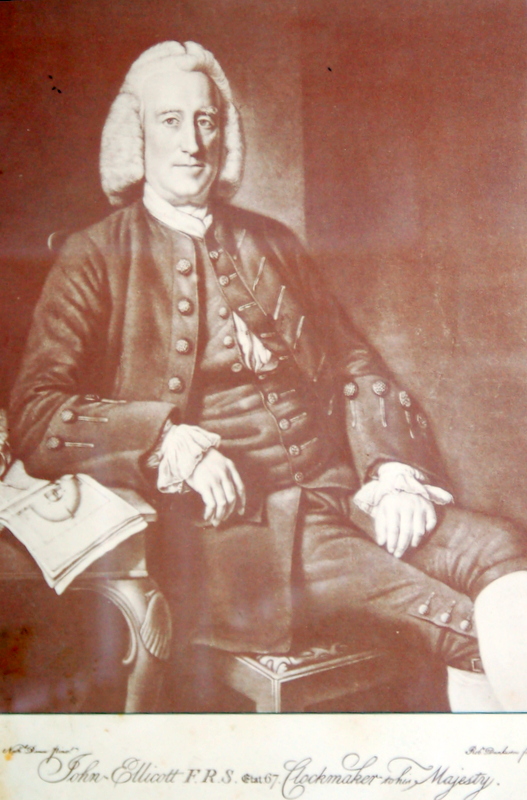
John Ellicott , father, son and grandsons were amongst the finest antique clock makers of the 18th century.As a result I am going to dedicate this blog to them. We are lucky to have 2 amazing examples in stock by these great clockmakers. One of them an outstanding GIII mahogany bracket clock signed John Ellicott London. This dates from just before C1760. In 1760 John Ellicott FRS took into partnership his son Edward. Edward also was a fantastic clockmaker and the way they signed their names then changed. Edward Ellicott also became Master of the Clockmakers Company.
Master of the Clock Maker’s Company
Prior to 1760 Ellicott clocks were signed John Ellicott London. 1760 to 1769 Ellicott clocks were signed just Ellicott. From 1769 to 1788 this was changed to John Ellicott and Son. These facts you can see this outstanding grandfather clock dates from 1760-1769 as it is signed just Ellicott. I would expect it to date from the start of the partnership between John and his son Edward, probably around 1760. The cabinet is of beautiful burr walnut and wonderfully decorated.
Royal Exchange London
This clock above is by John Ellicott’s son probably the most famous of all the Ellicott family of clockmakers, John, FRS. John’s father also John came to work in London around C1690. He started his apprentaship and subsequently moved to the Royal Exchange, St. Swithins Alley. He set up shop around the beginning of the 18th century. John Senior was a very fine clockmaker, he worked in St Swithins Alley until his death in 1733. His father must of passed considerably knowledge to his son. In 1728 John FRS was seen to be working with his father at these premises.
Academically Brilliant
John’s son was reportedly academically brilliant and also very highly skilled with his hands. It is remarked in many text books that there were few men of his equal in this regard. Just after his fathers death in 1733, in 1738 he was elected to the Royal Society. This was an immense achievement. He had some really important and influential sponsors for this position.
Fellow of the Royal Society
Ellicott carried out some important work and research in this role. He looked at various things like the effect of two pendulums upon each other. Also the variability of the length of a pendulum with latitude. It is without doubt though many people who remember Ellicott will remember him for designing what I call the ‘Ellicott Pendulum’. An amazing compensated compensated pendulum. He worked to try and eliminate the disadvantages of the grid iron pendulum, Harrison invented.
Ellicott Pendulum
Ellicott pendulums were an amazing feat of engineering. They worked to very high standards. As a result far exceeding anything else of the day. These pendulums were very complex to make though and therefore expensive. Not many clocks still exist today with one of these pendulums. Ellicott’s work was always to the highest of standards and the antique bracket clocks pictured here is of the finest quality workmanship. Superb verge escapement, delightful engraved backplate and three train quarter striking fusee movement.
In 1760 this famous clockmaker John Ellicott FRS , took his son Edward into the business. Working together until his fathers death in 1772. Edward ended up being a special clockmaker in his own right. He became the Kings watchmaker and was Master of the Clockmakers Company. Edward died in 1791 and the business continued with Edward’s son, Edward. An entire century of Ellicott’s, a clockmaking dynasty. Clockmaking did run in familys’ but none left their mark as great as the achievements of this family. They always strived to better on what had been achieved before.
Clock Making Dynasty
Can I think of a clockmaking family as well regarded. I do not think so, as a result an entire century of the finest antique clocks. The antique grandfather clock pictured below is an example of the partnership set up with John FRS and his son Edward in C 1760, as the dial is signed just Ellicott. The cabinet is the finest decorated cabinet I have ever seen.
I hope you have loved reading about the clockmaking family Ellicott of London , they were truly great and made some of the finest antique clocks ever built. A clockmaking dynasty that will never be repeated.
For antique furniture and clocks different types of wood were used in their manufacture. In this handy guide I am going to cover some of the main woods used. These woods can be of solid form but most flamboyant grained woods are used as hand cut veneers. The carcass is generally made from oak or pine in the provinces or oak generally in London.
Woods Used in London and Provinces
In London oak is only used as a carcas material in the 17th and 18th centuries. Whereas in the provinces you will find antique grandfather clocks being made of oak as the finished wood. Clearly oak was veneered on as well, especially in London by English Walnut up to say C1750 . Then from this date fine Honduras and Cuban mahogany veneers are found. On some clocks you will find very early examples to be of ebony construction or ebonized (black stained fruitwood generally)
Chinoiserie Clocks
You can also get oak grandfather clocks in London that were painted and decorated by Chinoiserie or lacquer work. The finest examples were sent out on boats and decorated in China. On some later clocks you will see these veneered in more exotic woods. Rosewood or maple or even ewe wood. I suppose the smaller size means you can use veneers of the more slow growing and smaller trees. With early clocks these exotic woods were used as well in small pieces and matched. We have owned a lovely walnut burr oyster veneered grandfather clock.
Below is a selection of woods used for antique clocks and furniture during the 17th and 18th and 19th centuries in England. A brief insight into each wood pictured is given. I hope from this blog you will discover what type of wood your clock or piece of furniture is manufactured from.
Honduras Mahogany
Cuban mahoganyPlum Pudding (spotted) mahogany
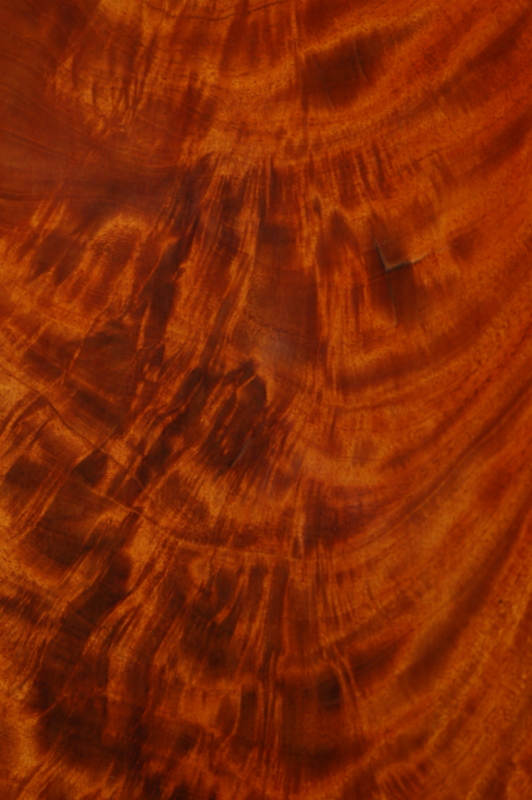
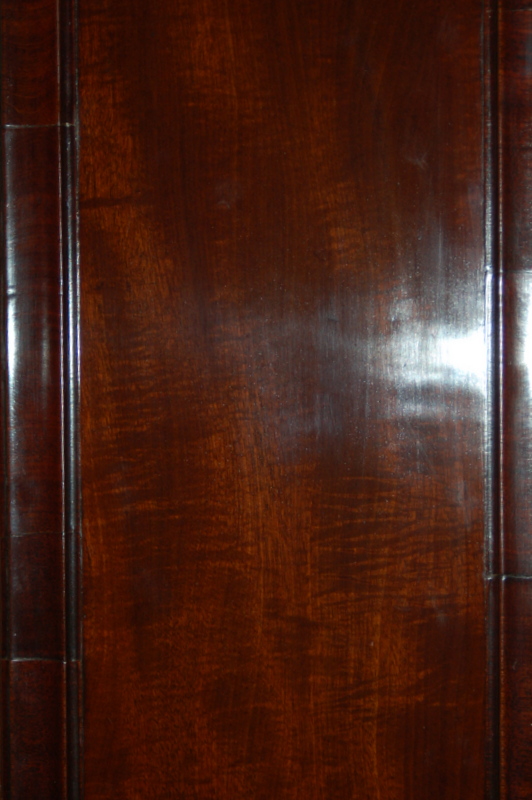
Mahogany can be a beautiful wood, it starts in the UK being used around C1750 and continues being used throughout the 18th and 19th centuries. Two most common variants are Honduras (lighter) and Cuban mahogany (darker). It is a close grain hardwood coming commonly from the South America or the West Indies type regions. This tree can be found quite wide and so large sections could be veneered with this wood.
Quarter Cut or star-fleck figured oakSolid English Oak
English Oak
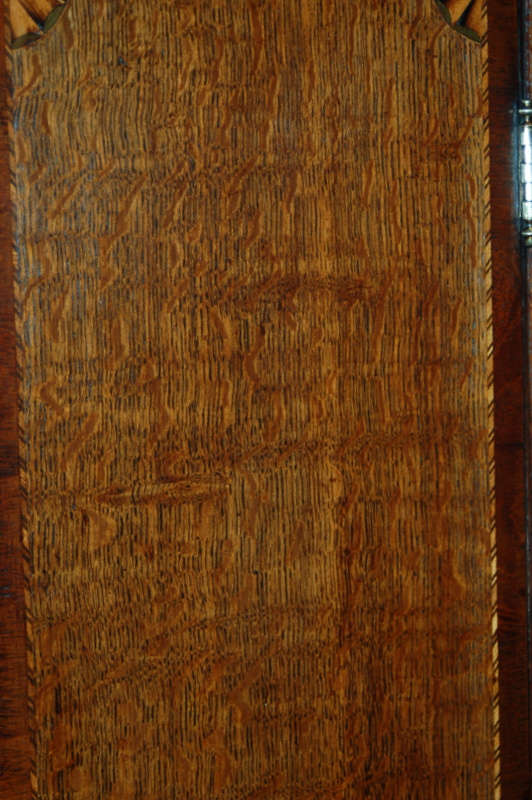
English oak is a slow growing and so very heavy wood. Used in construction and veneered some of the time, but it is a beautiful wood in its own right. Oak being so heavy and close grained it is good at preventing things like wood worm. It is one of the reasons why London used it in the construction of its clock cases ahead of pine. Pine is used in the provinces as a rule for carcases as it is cheaper. You will notice the weight difference between an antique clock veneered on oak and an antique clock veneered on pine. Oak just gets better with age and polishing, we call this the patina. Less close grain oak can come from countries like Japan. This wood although called oak, is a far poorer wood to the slower growing English oak.
The climate effects the grain of the wood
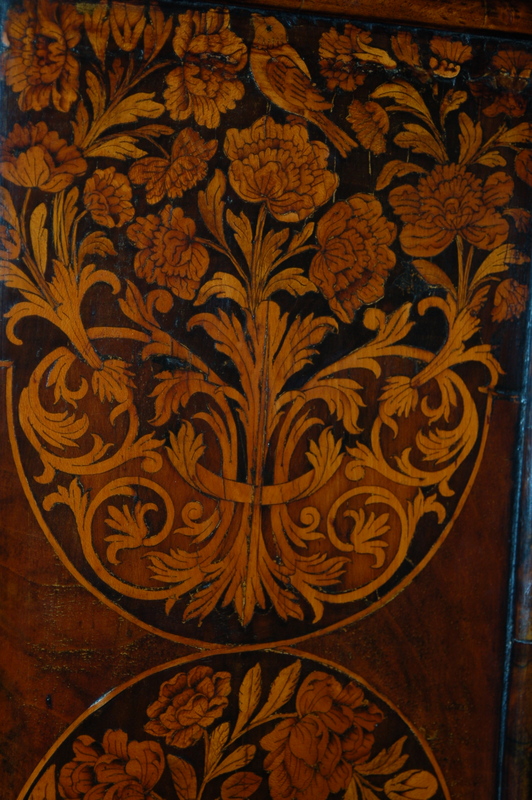
English Burr WalnutMarquetry inlay on English WalnutMarquetry on WalnutContinental walnut
Walnut is a lovely wood and English walnut gets used as veneers in antique furniture and clock manufacture up until C1750. After this date most walnut used is Continental walnut. Continental walnut is a quicker growing tree and so the grain is never as fine as English burr walnut. Again English walnut is a very heavy wood with a close grain. The tighter the burr or knot in the walnut the better. Walnut can range in colour from quite light if the sun has taken it, to quite dark. Walnut is used on all of the German wall regulators or commonly called ‘Vienna style’ wall clocks etc through the 19th century.
Satinwood
Satinwood used as a blank canvass to artists
Satinwood being a very light wood was used towards the end of the 18th centuries and early 19th centuries in the main. Many expensive pieces are manufactured with Satinwood veneers. We have some Pergolesi painted tables with satinwood veneers. I suppose the light colour makes the painting stand out better.
Pine
Pine, many of you will be familiar with this wood. It is rare to see a surviving antique grandfather clock made in this wood like the above. It was prone to woodworm unfortunately. Some were painted and this helped preserve them.Many provincial cabinets were constructed out of pine and then veneered. Pine is also used alot today as it is a relatively cheap wood, unlike oak. Clearly as you can see from the grain and if you lifted it from the weight , it is a fairly quick growing tree.
Lacquer or Chinoiserie
Oak can be veneered or painted
Oak was only used on internal construction of cabinets of English London clocks. When this wood was used and if it is not veneered in London you will find it sometimes decorated with lacquer work or Chinoiserie. This is gold leaf and gesso. The best types of these works are seen when they were sent out to China in the early/mid 18th century and decorated their.
I think I have covered the majority of main woods used in English cabinet making. There are others like ewe wood, maple , elm, fruitwood and rosewood. These are not covered as they are used alot less. I hope this blog has been of help to you. If you are still struggling with finding out what wood your clock or piece of furniture is made from, please send me a picture to PendulumClocks@aol.com