Posted on

British Summer Time – clocks change

I am an antique clock fanatic and have loved antique clocks and everything about time all my life. I presently run our family business Pendulum of Mayfair Ltd in central London and Cheshire. Various people have looked at changing the clocks time over the years. Most have been unsuccessful in convincing enough people. Either because the changes affect Northern England or Scotland or by people not understanding the major benefits. The system below would benefit pretty much everyone I believe.

Changing time

My proposal is very clear and easy, and will greatly improve most people’s lives. In understanding GMT it is very simple. The hours of daylight are roughly split into the same hours before midday as after. I believe this is fine when there are shorter hours of the day in winter and GMT should remain during the Winter.

Winter and Summer Time

I do believe it works when there are around 16 and ¾ hours of daylight in summer. This spread of time equally between morning and afternoon no longer works for modern living. This is why we have British Summer Time. I believe this should be further enhanced . Sunday March 31st and Sunday October the 27th should remain as the allotted days for changes but British Summer Time should be +2 not +1 (you can call it Double British Summer Time) We will be at the same time as Europe for these months. If you look at the sunrise times for middle England under GMT on the 18th June it is 03.46 under +1 at present this would be 04.46 under my system this would be 05.56. Still early for sunrise, but we will gain by an extra 2 hours of daylight throughout the summer (instead of 1), saving on electricity, enhancing peoples lives.

The need to change

The latest sunset would be 22.31 under this proposal. The economic benefits and peoples health benefits from the extra daylight are considerable. I am sure this would gain the massive support of the majority of the population if this was put to them under a referendum.
Daniel Clements from our London antique clock business , I would welcome your views. Follow my antique clock tweets on twitter.

Posted on

European Clocks

I have been on a sort of busman’s holiday around the world looking at antique clocks. It is amazing how this country has literally pulled the world together or connected it through our history. I examined the close ties with Australia and antique clocks in my last blog. I have also written about the cloc kmakers that headed to USA for a new life. In both countries this meant the setting up production of a new industry in clockmaking. This will be one of my last blogs concerning clocks from around the world. I will look at antique clocks that were made for a particular market. Two countries spring to mind instantly.

Turkish and Portugese Market For Clocks

In the 18th century antique clocks manufactured in London were being sent to countries like Turkey and to another one of our close allies, Portugal. It is our connection with Portugal I will consider here. We have just restored a fantastic London mahogany grandfather clock. This is pictured above that has spent its entire life in Lisbon, I believe, until we purchased it at the end of last year. The superb example is pictured above.

Spencer and Perkins Lisbon Clock

You will see the clock is made by the great clockmakers Spencer and Perkins in London.Built around C1770. It has a strike/silent to the arch saying Repite and Surdo, clearly in Portuguese. This clock was exhibited in Lisbon in 1986 to commemorate the Battle of Aljubarrota in 1385. It was then 600 years since this historic battle. Right so what exactly is our connection with Portugal. The Anglo-Portugese Treaty of 1373 was signed between King Edward III of England and King Ferdinand and Queen Eleanor of Portugal. This is I believe the oldest treaty in the world. It was a treaty established between two great seafaring nations, a treaty of, “perpetual friendships, unions [and] alliances”.

Close Bonds With Portugal

This little heard of treaty has been reinforced throughout history, including in 1386 in this Battle of Aljubarrota. Here the English sent 100 longbowmen, veterans from the Hundred Years wars to honour this alliance in 1373. There were about 6,500 men on the Portuguese and English side against a force from the Crown of Castile, Kingdom of France and Arogonese allies and Italian allies of over 31,000 men. The Portuguese with the help of the English managed to win against overwhelming odds. In 1386, the closeness of the relations between Portugal and England resulted in a permanent military alliance, with the Treaty of Windsor, the eldest still active in existence. This treaty came into play again in 1643,1654,1660,1661,1703,1815,1899. It was also recognized in the Treaties of Arbitration in 1904 and 1914. This Treaty was also used during the Second World War and was also cited during the 1982 Falklands War.

Rise of Clockmaking

During the rise of the clockmaking in the UK in the 18th century under King George II and III we were at war with or on opposite sides with France many times. Supply of wine after French ports were blockaded became a problem. Our alliances with Portugal made British merchants look further afield. Port was invented as in order to stabilize the wines during their long journey at sea. Merchants added a bucket or two or brandy to the barrels before sending them off.  Britain and Portugal signed the Methuen Treaty providing for, among other things, bolts of cloth from England for pipes of wine from Portugal. This paved the way for the enormous expansion of port trade in the 18th and 19th-centuries.

Port Trade

King George III was rather partial it was believed to this drink, and he helped his allies from Portugal during many occasions. It was believed fine antiques and clocks and other items were sent after various disastrous earth quakes in Portugal. The 1755 Lisbon earthquake was one of the most deadly earthquakes in history.

Lisbon Earthquakes

The pictures above show one such clock that was manufactured in London. This was sent out to Lisbon, Portugal in the 18th century. It has spent, I believe,  all but the last few months overseas. It has a very unusual packing block behind the movement that looks original to the case. This appears to be the way the movement was bolted down for shipment in the 18th century. A really rare feature which you can see below. There is also an 18th century brass plate on the back of the movement that attaches to this block.

It is a fantastic antique clock and it can be viewed on our website, please contact me for any further information.

Daniel R Clements

Posted on

Collecting Antiques

I get asked many times about what I would choose if I was starting a collection of antique grandfather clocks.  We feel privileged in helping many special customers and friends source their own private antique clock collections. The most important part if you are deciding to build your own antique clock collection is to purchase them somewhere you can get a guarantee they are genuine.  I would also take you time in building up this collection, it can not be achieved overnight.

What type of clocks to collect?

I believe the greatest antique grandfather clocks were produced between C1680 and C1820. I am now going to suggest a possible date and styles that you could choose to form this collection. It is true you might prefer a particular style of antique clock and then you could just collect this style. There is nothing wrong in doing this. You may prefer just famous London makers from the 17th and early 18th centuries like Thomas Thompion or Edward East or George Graham. I have no problem in collectors heading down this route.

Broad spectrum of clocks

A route I will suggest here is a broad spectrum of special antique clocks from the entire range of the period suggested above. The collection could be increased still further from what is listed below by different dial shapes or antique clocks from different towns also showing distinctive case features.

Examples of Interest

1)

I think it is important to start your collection with a special early example of a London marquetry brass square dial grandfather clock by a reknowned but not necessary ultra famous maker. This clock will date from around C1690 and be a good ‘8-day’ example, usually with a lentical to the trunk door.

2)

I think next on the list would be a good ‘8-day’ or ‘month’ duration English burr walnut square brass dial grandfather clock, again by a good London clockmaker.

3)

I think it is then important to source a good arch or square brass dial early lacquer clock from C1715. This again will be a London area example.

4)

A burr-walnut arched brass dial caddy top London grandfather clock is also essential to any collection. These tend to date from C1715 to C1750.

5)

A good early arched or square brass dial provincial oak grandfather clock should form part of any collection. These dating from early to mid 18th century. These will be good ‘8-day’ examples with maybe an early ‘penny’ moon feature or automaton to the arch or dial centre.

The clocks do not have to cost the earth.

6)

An early oak or maybe pine 30 hour duration clock with brass square dial would be nice in any collection.

7)

Moving on to my favourite period in antique clocks from C1760 onwards. A good C1770 London mahogany arched brass dial is vital.

8

A superb London mahogany arch white dial  ‘8-day’ grandfather clock.

9)/10)11)

Moon examples of 7 and 8 are also important to any collection, as is an automaton example.

12)

A good Manchester moonphase grandfather clock from around C1770

13)

A typical Liverpool moonphase grandfather clock from around C1770

14)

A typical Bristol tidal times moonphase mahogany grandfather clocks from around C1770

15)

A typical Hull pagoda top mahogany grandfather clock from around C1770/C1790

16)

A good Edinburgh grandfather clock from the end of the 18th century

17)

A good white dial Dundee or thereabouts mhaogany arch dial grandfather clock from C1790

18)

A good London with attached hood columns arched brass dial mahogany grandfather clock.

19)

A good London with attached hood columns square silvered brass dial mahogany grandfather clock.

20)

Various Precision Regulator examples with the differing means of pendulum compensation.


Conclusion

I have tried to form the basis of a wide ranging collection This could be a good tool for you to start building your own antique clock collection.  Clearly there are some great clocks from other provincial towns around the country that I have not mentioned. You can also throw in some special provincial makers like Barber or Ogden or Deacon to the mix. I suppose a wide ranging collection should encompace as many differing cabinet styles from all the areas of the UK. These may also include one from the west coast of Scotland, or Ireland, even though I am not a big fan of the typical 18th century case styles from the these areas.  This is just a personal taste though and one clock from each place as an example would not be out of place in any collection. I suppose this depends on space and finance though. I believe a minimum of 25 grandfather clocks would be required to be purchased to obtain a good overall wide ranging collection. This can then be bulked out if necessary be adding more towns or special collectible makers. Clock collecting can be quite addictive.

– Daniel Clements – Pendulum of Mayfair Ltd 51 Maddox street, London –


Posted on

Antique Tavern Clocks


Antique tavern clocks have been studied widely and many books have been written. I wish to correct the commonly held view that these clocks started life only as early as C.1720. You may know these antique clocks by another name, they are sometimes called ‘ Act of Parliament’ clocks.

Act of Parliament Clocks

They were later commonly called this as a result of the tax imposed on clocks and watches in July 1797. With the government being short of funds as a result of many years of war, extra ways to increase tax were thought out. The Act imposed a duty of 5 shillings on every clock, 10 shillings of every gold watch and 2s.6d on every silver or other watch. Assessors were sent round to take account of how many clocks you owned above a certain value.

Public Houses Exempt from the Clock Tax

There were certain exemptions to the Act, these included public houses. Alot of these tavern clocks as the name says were housed in public houses. They were exempt from this very unpopular tax. It led to a decline in the clock trade and luckily was repealed after only 9 months of it being in force.

Lacquer and Chinoiserie Decoration

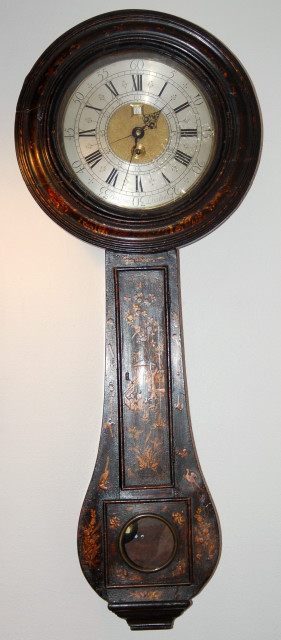
These tavern clocks were usually decorated in lacquer work. They had wooden dials that were made up from usually three sections. They also usually had simple single 5 wheel train movements. The extra wheel in the train generally makes them go for longer than a standard longcase clock, even though they actually have a shorter drop. They usually had brass hands so the time could easily be read against the black painted dial. The earliest dials known were wooden and shaped like a shield. Then later circular dials were introduced and tear drop shapes to the cabinets.

When did they start?

Many books on the subject commonly state the earliest examples of these clocks are from C1720. We have owned for over 10 years, a clock of this form that is pre 1700 in date. It is an amazing tavern clock, it is the only antique clock of this type I have ever seen with an original brass dial, instead of the usual wood form. The antique clock maker is from a family which emigrated to London from Augsburg in Germany. Bushman is a fantastic clock maker and by all accounts the finest clockmaker to come out of Germany! He is mentioned as being on a par with the great Thomas Tompion in some quarters.


Augsburg Influence

If I took a picture of the clock minus the hood it looks like a very early Augsburg table clock. I can see where the idea for the manufacture started. I believe this clock to be one of the first, if not the first,  tavern clock. John Bushman is provable in London between 1661 until just after 1692 ( date of death unknown). We do know he came from the Augsburg area, but you can see the influence from the design of the cabinet work on this clock. Bushman was admitted to the Clockmaker’s Company in 1662. You can see the huge pull of this Guild which I have talked about previously. The best clockmakers from all over Europe came to London. Everyone wanted to come to London and work in the 17th and 18th centuries. It truly was the centre for clock making in the world at the time.

Many people will ask if this clock has 5 wheel train, how does it have a second hand, a sweep centre seconds hand in this case. The movement has a one to one reversing wheel to enable for it to do this. You can see the amazing engraving to the unusual dial and superb unrestored lacquer work to the case. A very rare collectors clock, for more information please contact me direct.


Posted on

Antique Clock Cabinet Restoration


In this blog I wish to talk about the process of sympathetic restoration of a C.1770 antique bracket clock. I will show you the time consuming process that is generally carried out on most 18th century antique clocks at some part in their life.

Sympathetic Restoration Antiques

Sympathetic restoration done professionally is essential. It can literally transform a clock into a wonderful piece of art and bring it back to life. Restoration done poorly or done by an unqualified person can literally destroy the value of a clock.

Difference between Restoration Done Properly and Done Poorly

I also hope you can understand the difference in price of buying an unrestored antique clock from an auction and a carefully sympathetically restored guaranteed example from a respected antique clock dealer. Restoring an antique clock from what we call a ‘sleepy’ state to ‘showroom’ condition takes time. In today’s world labour costs are expensive and as a result can be costly.

How long does it take Restoration Done Properly ?

Restoration taking some 10/15 working days on a cabinet and 5 working days on any antique clock movement are very typical. 20 working days, nearly a month of a highly skilled persons wages, costs alot of money. Some clocks may not need as much work, maybe this will have been carried out at some time in the past, but how well has this been done?

Over Restored Items

On the antiques market there are lots of over restored items. I have seen examples that just make you want to shake your head, sticky french polish and open grain wood.

Antiques Sometimes Ruined

These are not beautiful antiques anymore. Our cabinet restorers have worked with us from school, they have about 20 years experience and have proper in house training. The antique clocks director of a major auction house once stated, ” no one in his opinion restores their antiques as sympathetically.”  The restoration process is a slow labour intensive process, it can not be rushed and corners must not be cut. Clocks or antique furniture do not leave our workshop until the owner himself is happy.

Some Examples of Restoration

Below are a series of pictures detailing the transformation of a bracket clock from a tired somewhat distressed state,  into a beautiful loving cared for example. This clock will now give many years joy to its new owners. Finding clock is such a ‘sleepy’ state is far better I it means they have not be ‘butchered’ by over enthusiastic workmen in the past.


Lots of Intricate Repairs

As you can see in the above pictures where mouldings or pieces are loose these need to be removed and adjusted/repaired and then refitted with animal glues. Animal glues are what 18th century cabinet makers used. They have a superb property that when heated they become unstuck and so repairs to veneers or mouldings can be carried out.  If modern pva wood glues were used to clock sections, repairs would have been more difficult.


As you can see all loose veneers on clock or damaged sections need to be removed and either replaced by wood of the same age and then carved to shape by hand or simply re-glued with animal glue.


Further pictures from a painstaking restoration to a beautiful C.1770 antique bracket clock. A clock might look immaculate as in the top picture prior to restoration but generally many weeks work are required to bring any clock into proper showroom condition.


All repairs can only be done when cabinet is structurally sound. Animal glue over many years can become brittle and mouldings can become loose or have been stuck on incorrectly over years.


Structural repairs to clock are now nearly complete. From now on, the clock will start looking like a clock again!


Repairs carried out, done properly with wood of the correct flame and age, are unnoticeable.


Antique bracket clock restoration perfectly carried out by an experienced cabinet restoration specialist.


The finished clock minus frets to door that need to be fitted. A transformation that is time consuming and can only be carried out be a fully qualified experienced cabinet restorer. For any futher information on antique clock restoration please contact me directly, I will be happy to help. Later in the year I will write on antique clock movement restoration. Please subscribe to my rss feed to received regular information. Pendulum of Mayfair can provide a full antique clock repair service, for more information visit www.pendulumofmayfair.co.uk.


Daniel R Clements


Posted on

Caring for your clocks

Clock Maintenance

It is important that your antique clock movement is properly serviced. A full movement overhaul , if carried out properly and correctly, can last a generation. If your movement requires cleaning this is a separate issue and should be carried out as and when necessary. This is usually every 15 years or so. This should always be carried out by a qualified horologist. I am going to advise on general maintenance in this blog, that can be undertaken by the owner. This general care should be carried out every year or 18 months.

Service every 10-15 Years

I am assuming your clock has had a proper service in the last 10/20 years. Running a dirty or worn clock movement can lead to further wear and is not advisable.

Oiling your clock movement

It is important to oil your clock movement every year or 18 months. I recommend using a good Swiss clock oil, like Moebius Clock Oil. This can be found at good clock part suppliers or on the Internet via companies like eBay. Do not use poor quality oil substitutes, as these can dry out and may require your movement to be cleaned to remove deposits.

Where to oil?

Correctly oil your antique clock movements. This will therefore extend the life of your movement before a major service will be required. The wheels of the movement do not require oiling. It is important to oil where the pivots go through the front plate and backplate of the movement. The wheels are fixed onto to arbors and at the ends of these arbors are called pivots. Tiny oil sinks are on the outer side of the front plate and backplate to hold the oil.

Little and Often

Apply a drop of oil using a fine artist brush. If you cannot oil the oil sink on the outer side of the plates, oil where the pivot goes through the plates on the inner side. At the top of the movement, there is the anchor. The pivot for this is attached to back-cock and is not on the backplate of the movement. It is also good to oil the anchor pallets, this is the part which goes tick / tock. At this service you can oil the pulleys, which the clock weights are attached and other places like hinges of the clock door etc.

Waxing

Customers should never use aerosol spray polish on your grandfather clocks cabinet. Furthermore only use beeswax polish as aerosols can have added chemical and propellants which can damage your patina. I have known customers use spray polish and this has literally stripped the wax finish of the cabinet. Use pure beeswax polish, this is essential, for proper care. You should contact us concerning antique clock repair.