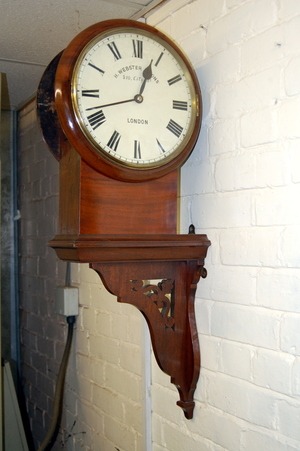
A very rare two sided dial clock. Round painted dials signed Henry Webster and Sons 840 City Road London. On a very nice shaped and decorated wall bracket. Good size clock with cast brass bezel.
A very rare two sided dial clock. Round painted dials signed Henry Webster and Sons 840 City Road London. On a very nice shaped and decorated wall bracket. Good size clock with cast brass bezel.
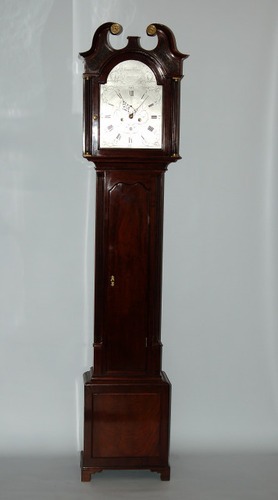
A lovely elegant mahogany ‘8-day’ arched silvered brass dial grandfather clock. James Gray of Edinburgh engraved to the dial. The movement striking the hours on a single bell. Lovely case with swan neck pediments and reeded quarter columns. Altogether standing on bracket feet. Finally the dial finely engraved and with seconds and calendar features.
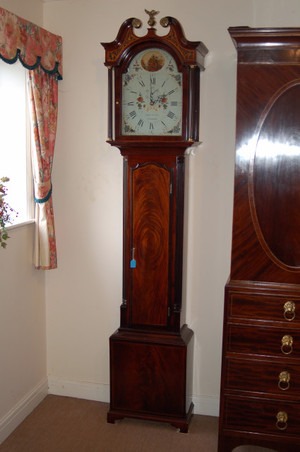
A superb, flame veneered mahogany Longcase clock. Featuring an ‘8-day’ duration movement by John Scott. The arched dial showing seconds and calendar and ship automaton to the arch. This also portraying the ‘Glorious 1st June 1794’. Delicately painted corners and arch. In addition the movement striking the hours on a single bell. The cabinet of wonderful colour and patination and superb delicate inlay work. The case standing on bracket feet and with ‘swan-neck’ pediment to the top.
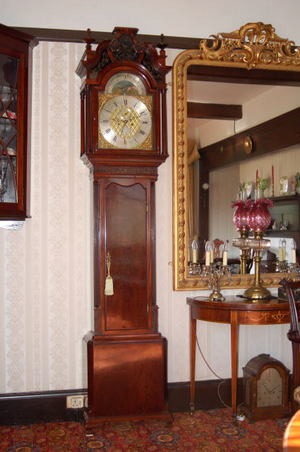
An outstanding north country flame mahogany veneered Longcase clock. Featuring an arch brass dial of ‘8-day’ duration by John Kaye. The cabinet showing the finest choice mahogany veneers. Also with long trunk door with reeded quarter columns. Including OG bracket feet and swan neck pediments with blue glass/gold leaf decoration beneath.
The dial with chapter ring and spandrels, moonphase with tidal times, seconds, centre calendar and superbly matted and engraved dial centre. Engraved above the moon is High water at Georges Dock. The movement striking the hours on a single bell. Well known Liverpool maker, this clock has huge significance.
It has engavings of places around the world so you can work out the corresponding times in these cities. The owner clearly was an important merchant. We purchased the clock from the famous Bibby family who had owned the clock for many years.

An outstanding quality ‘8-day’ duration flame mahogany Longcase clock. Featured here an arch brass dial by this superb Scottish maker James Cowan. The dial showing chapter ring and spandrels, seconds and calendar aperture. Also with finely matted centre. In addition the makers name being engraved on a cartouche to the arch. Also strike/silent feature to the arch.The high quality movement striking the hours on a single bell. The cabinet with wonderful colour and patination. Swan neck pediments and bracket feet. Long trunk door with choice mahogany veneers.
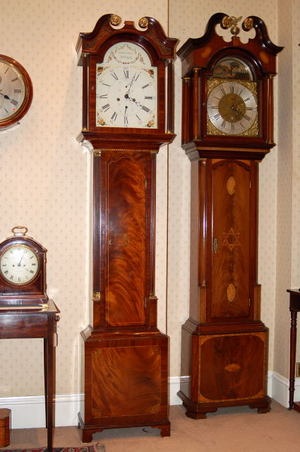
Featured here a good quality C.1790 ‘8-day’ duration flame mahogany veneered Longcase clock. Shown with arch white dial by Robert Green. First of all the elegant proportions Scottish cabinet with boxwood stringing and shell inlay to base. In addition the cabinet with swan neck pediments and bracket feet.The hood with reeded hood columns. Another feature is the fretwork below the swan neck pediments. Including brass paterae to the top of swan neck.
The cabinet showing good colour and patination.
Clearly a good quality eight day movement striking the hours on a single bell.
The delicately painted dial with gold leaf decoration and flowers to the corners. Makers name enclosed with flowers to the arch. Subsidiary seconds and calendar features to the dial. Furthermore the clock with matching ‘diamond’ blued iron hands. To sum up a fine Scottish clock.
‘Old Scottish Clockmakers’, by John Smith From 1453 to 1850 has Robert Green listed working from 1781-1834. On the 3rd November 1781, he was bound apprentice to James Howden. 17th January 1789 he was,’Discharged of his indentures.’ On the 4th May 1793 he,’Compeared and presented his essay. This being a watch movement, begun, made, and finished in presence of James Howden Landlord, Geo. Skelton, David Murray, and John Sibbald, essay masters as they declared, etc.’ E.H.Records. He listed a sale of ‘superior watches and clocks at reduced prices’ on 14th May 1832, as he retired from business.
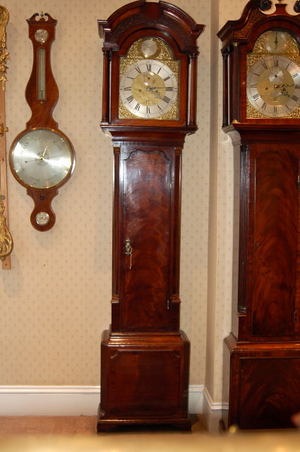
A good quality ‘8-day’ mahogany Longcase clock. Featuring an arch brass dial by Robert Johnson Woolton. The break arch top cabinet showing superb elegant design. Also with choice mahogany veneers. Including fantastic fretwork to the hood and the cabinet. Also standing on shaped bracket feet. The base with chamfered sides and raised shaped cross-banded panel. The long trunk door also with fine cross-banding. Lovely shaped top to the door. Quarter columns with wood capital to the trunk.
The dial with maker’s name in a boss to the arch, and the dial centre finely matted. Also with subsidiary seconds and calendar, chapter ring and ‘dolphin head spandrels’ to the arch. Fine shaped blued iron hands.
The fine quality brass movement striking the hours on a single bell.
Woolton is a prestigious middle class superb of Liverpool. Many Beatles landmarks can be found in Woolton, including ‘Mendips’ (Lennon’s childhood home at 251 Menlove Avenue) and Strawberry Field. Another one of Woolton’s claims to fame is that John Lennon and Paul McCartney first met at St. Peter’s garden fete on 6 July 1957.

If so you are one of millions of us rushing around at the last minute with no clue of what to get?
We usually spend hundreds of pounds on something that will be forgotten within a few days. How about some suggestions that will be a memorable present for many years to come ?
Everyone has a budget at Christmas. I will be looking a various options from a few hundred pounds to a few thousands pounds for those with bigger pockets. Maybe for ones like me that tend to save up and buy something really special once a year as a special treat.


Lovely Art Nouveau Balloon clocks can be a wonderful Christmas gift. Fully restored examples in top condition and of the best quality can be found at under 500£. These lovely little clocks will give years of superb service. Always reminding the person of the day they receive this lovely gift.
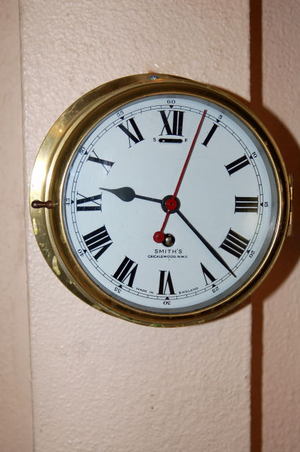
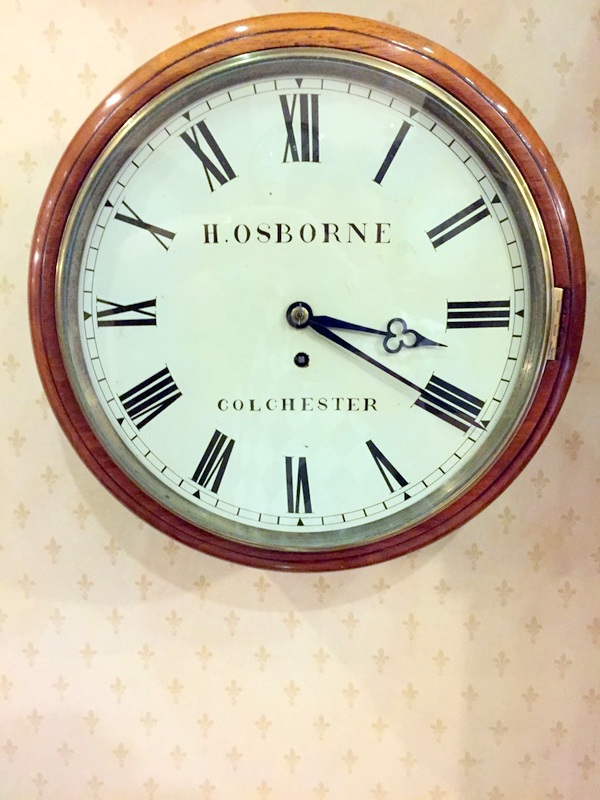
Antique pre c1900 Fusee wall clocks that have been overhauled and are in showroom condition are fantastic gifts. The earlier type can go from around £1,000 to £1,600. If you want to stretch the budget you can go for a smaller dial example. Convex dials or even rarer large face dials with fusee movement which all are more expensive.


For under or around £3,000 you can get a large selection of early or mid 19th century fusee timepiece bracket or skeleton clocks.
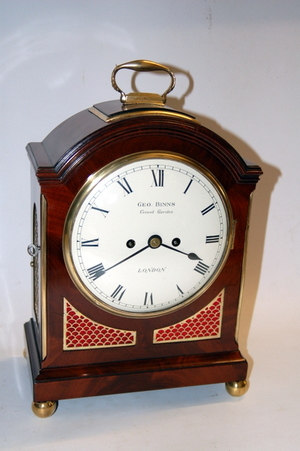
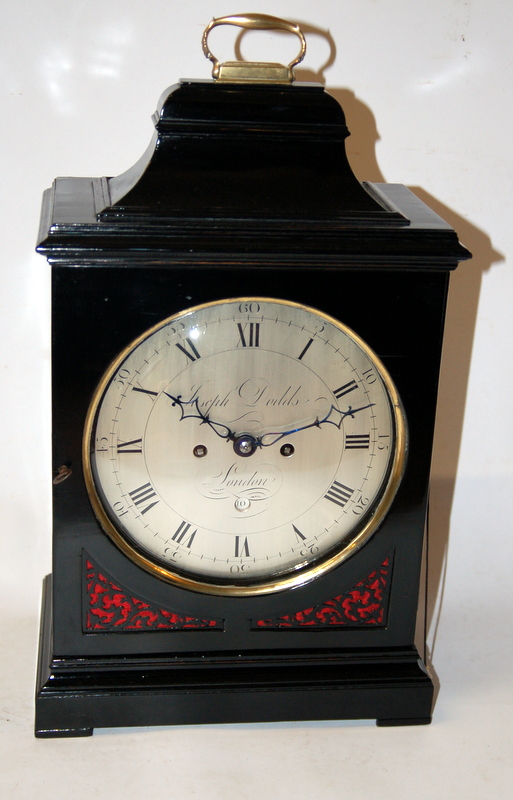
These superb fusee bracket clocks would be a lovely addition to any home. Woods from mahogany to walnut to ebonized fruitwood can be found on these examples. Most movements are of 8 day fusee type.
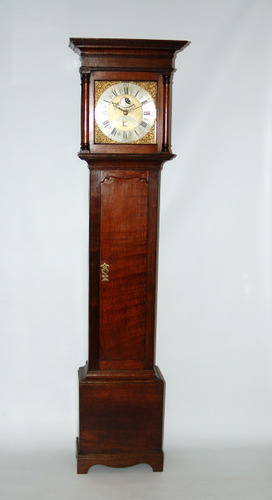
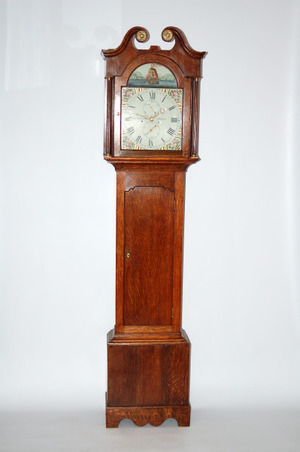

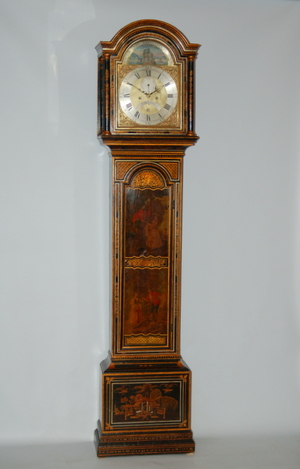
Antique grandfather clocks form an amazing addition to any home. They truly are the centre piece. Owning a lovely restored ticking antique grandfather clock is like having someone nice coming to stay with you.
I hope some of these pictures give you the inspiration this Christmas for that really special gift. If not for Christmas then for that special anniversary. Have a part of our nations history ticking away in your home very soon, you won’t regret it.
Daniel Clements
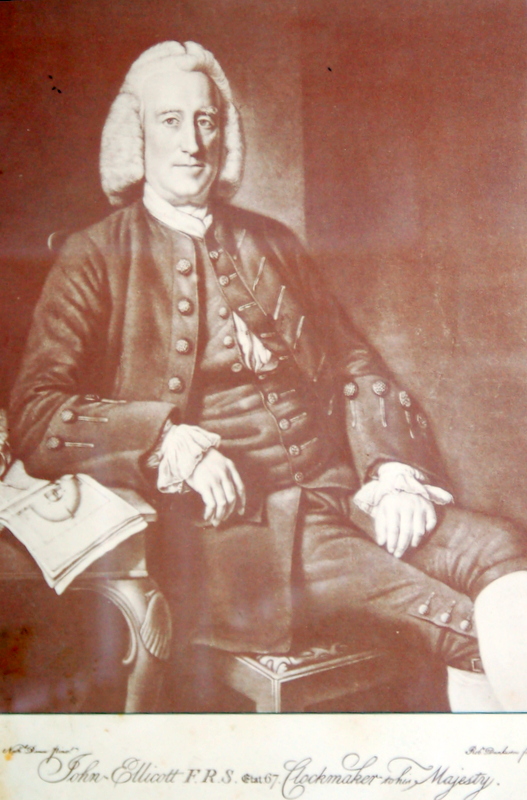
John Ellicott , father, son and grandsons were amongst the finest antique clock makers of the 18th century.As a result I am going to dedicate this blog to them. We are lucky to have 2 amazing examples in stock by these great clockmakers. One of them an outstanding GIII mahogany bracket clock signed John Ellicott London. This dates from just before C1760. In 1760 John Ellicott FRS took into partnership his son Edward. Edward also was a fantastic clockmaker and the way they signed their names then changed. Edward Ellicott also became Master of the Clockmakers Company.
Prior to 1760 Ellicott clocks were signed John Ellicott London. 1760 to 1769 Ellicott clocks were signed just Ellicott. From 1769 to 1788 this was changed to John Ellicott and Son. These facts you can see this outstanding grandfather clock dates from 1760-1769 as it is signed just Ellicott. I would expect it to date from the start of the partnership between John and his son Edward, probably around 1760. The cabinet is of beautiful burr walnut and wonderfully decorated.

This clock above is by John Ellicott’s son probably the most famous of all the Ellicott family of clockmakers, John, FRS. John’s father also John came to work in London around C1690. He started his apprentaship and subsequently moved to the Royal Exchange, St. Swithins Alley. He set up shop around the beginning of the 18th century. John Senior was a very fine clockmaker, he worked in St Swithins Alley until his death in 1733. His father must of passed considerably knowledge to his son. In 1728 John FRS was seen to be working with his father at these premises.
John’s son was reportedly academically brilliant and also very highly skilled with his hands. It is remarked in many text books that there were few men of his equal in this regard. Just after his fathers death in 1733, in 1738 he was elected to the Royal Society. This was an immense achievement. He had some really important and influential sponsors for this position.
Ellicott carried out some important work and research in this role. He looked at various things like the effect of two pendulums upon each other. Also the variability of the length of a pendulum with latitude. It is without doubt though many people who remember Ellicott will remember him for designing what I call the ‘Ellicott Pendulum’. An amazing compensated compensated pendulum. He worked to try and eliminate the disadvantages of the grid iron pendulum, Harrison invented.
Ellicott pendulums were an amazing feat of engineering. They worked to very high standards. As a result far exceeding anything else of the day. These pendulums were very complex to make though and therefore expensive. Not many clocks still exist today with one of these pendulums. Ellicott’s work was always to the highest of standards and the antique bracket clocks pictured here is of the finest quality workmanship. Superb verge escapement, delightful engraved backplate and three train quarter striking fusee movement.
The link to this clock on our antique clocks website can be found here, Fantastic Ellicott Mahogany Bracket Clock


In 1760 this famous clockmaker John Ellicott FRS , took his son Edward into the business. Working together until his fathers death in 1772. Edward ended up being a special clockmaker in his own right. He became the Kings watchmaker and was Master of the Clockmakers Company. Edward died in 1791 and the business continued with Edward’s son, Edward. An entire century of Ellicott’s, a clockmaking dynasty. Clockmaking did run in familys’ but none left their mark as great as the achievements of this family. They always strived to better on what had been achieved before.
Can I think of a clockmaking family as well regarded. I do not think so, as a result an entire century of the finest antique clocks. The antique grandfather clock pictured below is an example of the partnership set up with John FRS and his son Edward in C 1760, as the dial is signed just Ellicott. The cabinet is the finest decorated cabinet I have ever seen.
The link to this clock on our antique clocks website is here , Outstanding Ellicott Walnut Grandfather Clock


I hope you have loved reading about the clockmaking family Ellicott of London , they were truly great and made some of the finest antique clocks ever built. A clockmaking dynasty that will never be repeated.
Daniel R Clements

We have been in the antique clock business for over 40 years. It is true to say enamel dial antique clocks are rare. You can see them occasionally on bracket clocks in the 18th century. Searching for examples is hard. It is like finding a needle in a haystack however finding a true enamel dial on a grandfather clock.
If you undertook a search for enamel dial grandfather clock you will find lots of listings. Dealers loosely apply the term to a standard white painted dial. These clocks with white painted dials started manufacture in Birmingham with Wilson and Osborne from around C1772. It was true to say the Clockmakers Company in the early days frowned on achievements outside London. Clock makers tried and most times failed to make alternatives. One alternative was a true enamel dial. True enamel dials such as the superb example pictured here was made from a mixture of glass, tin oxide, borax, peat ashes and salt.
A complex mix of substances was then melted and turned into moulds to harden. This mixture was then ground to a powder and mixed with water. The enamel was then mixed with lavender oil to make it adhere to the copper dial plate. This mixture was applied to the dial and then the dial was fired at high temperatures in a clay oven. The temperature was carefully monitored and then the dial was cooled very slowly to prevent any cracking.
I hope you agree a process that was very time consuming and complex. To get this to work on a large dial it was very hard. That is why in this case you will see the arch is fired separately. I am sure the risks of cracking with a 12 inch piece of square enamel was a large enough risk. The lovely painted work and decoration you will see on this dial is the result of further firings. Rose Vermillion being one of the hardest colours to apply.

This is an outstanding and very rare clock with a true enamel dial. It has been mentioned the maker of these rare enamel dials was the brother of the famous clockmaker James Tregent. He was called Anthony Tregent. For further information please view the book Theelke, Anthony; Faces of Mystery. This is a lovely flame mahogany veneered grandfather clock with strike silent feature to the arch. The movement is of ‘8-day’ duration and strikes the hours on a single bell. Superb London quality case and typical high quality movement features.

Daniel Clements