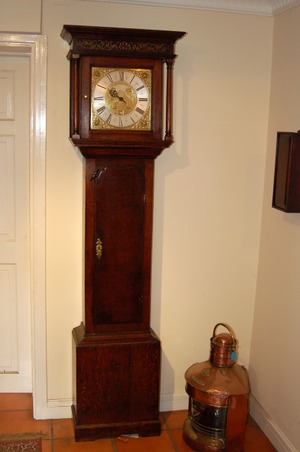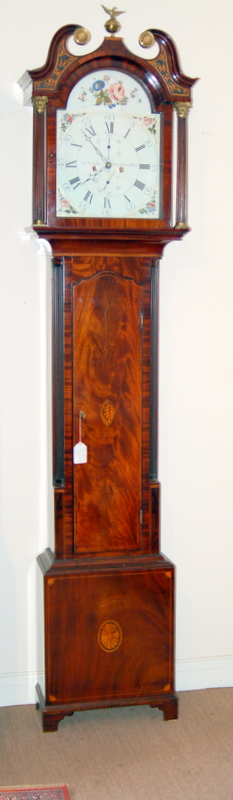
Antique Grandfather Clock by Simon Thorne – Tiverton C.1705

Simon Thorne main

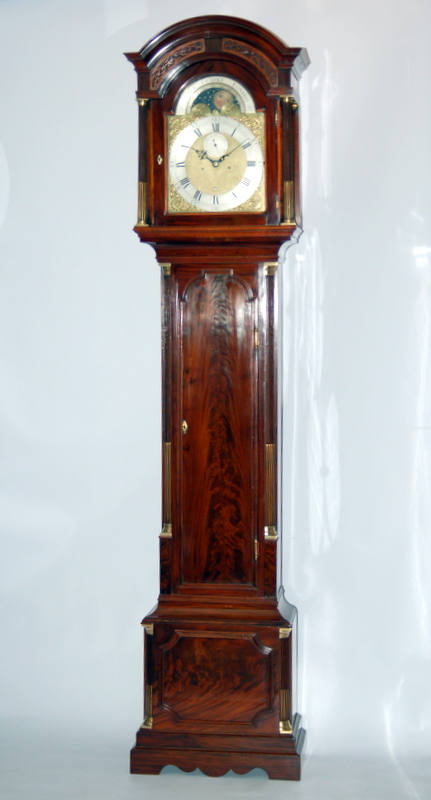
A good oak ’30HR’ Longcase clock. Shown with square brass dial by Simon Thorne of Tiverton. The brass dial with chapter ring/spandrels. Also finely matted centre, and single hand. The movement striking the hours on a single bell. The oak cabinet of lovely colour and patination. In addition long trunk door, single plinth and flat top to the hood. Very early and collectible clock.

Antique Grandfather Clocks

Repairs

All the Antique Clocks and furniture sold at Pendulum of Mayfair are restored sympathetically to a high standard at our own workshops. It gives us great pleasure and satisfaction working with antiques and understanding the skills and methods used by these 17th and 18th century craftsmen. Very few of the clocks that we make today will be in working order in 20 years time, let alone 200 years. Our legacy of the 20th century is basically a throwaway society.

When these Longcase clocks were produced in the 17th and 18th centuries, I wonder if their makers understood that these clocks would last virtually for ever. They were made then to a quality and not to a cost, and designed to last; I only wish their makers could see them still ticking in many homes today.

One would think as a nation our skills would have increased; have they? The skill industries are declining. In the 18th century one of the highest skilled and respected professions was the local clockmaker. We are truly honoured to work on these master timepieces!

Cabinet Restoration
All the basic skills and methods were developed in house by the company’s owner. Just like the olden days we believe it is best to start young and give our youth of society a highly skilled trade and a better future. We consult local schools careers masters and handpick the most conscientious and caring students around. Training lasts for a period of approx. 5/6 years. We take great pride in the finished output of our workshop, even if the item in question is 500, or 50,000,we take the utmost care in trying to produce the best work possible, irrespective of how long it takes.

We do not cut corners; goods only leave our workshop when the owner himself is happy with them. If any part is not to the required standard, the item is sent back and finished to his satisfaction. At the opening of our London shop in November 1995, the head of Sothebys clock department was quoted as saying, ” no business restores their antiques as sympathetically.”

He was able to say this on good authority, because he was shown one clock that he had previously sold unrestored at his auction.

Our methods that we use in our workshop are special; we try and maintain the original colour and patination to give a soft finish. All repairs are carried out with wood of a similar age to the article being restored. We buy distressed antiques to saw up for veneers; this wood is then graded in to types and age, to provide as near as match as possible.

Over the last 20 years we have amassed considerable stocks of material for restoration.

Antique bracket clocks in restoration
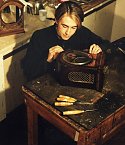
We have extensive stocks of over 200 Antique Longcase Clocks available unrestored awaiting restoration. All stock both restored and unrestored is kept in controlled environments for both temperature and humidity. If antiques are bought that have not been previously stored in the correct conditions as above, they are more likely to warp or split, whenever they are subject to central heating. It is advisable to keep antique furniture in R.H. between 40 and 65%.

Movement Restoration

Be very careful with whom you entrust your antique clock movement. Most of our time in the clock department is taken putting right what other so called restorers have done in the past. Because of this we like to work on untouched antiques in so called sleepy condition.

Again the work we do on this side of the antiques business is of utmost importance to us. We ship antique clocks to all corners of the world. They have to work properly; all movements are pre cleaned, then all the necessary work is carried out. We do the pivots/bushes, all to close tolerances. The bushes are of the Swiss bergeon type or are made by us out of cast brass, to match the colour of the movement. The pallets are restored with high-grade material, and then all the other necessary work is carried out. There is a final cleaning/polishing stage where we use gloves.

The dials are lacquered using a special colourless lacquer to keep them as clean as possible for years to come. Finished movements are then tested and regulated for timekeeping for 7-21 days. Longcase movements should not need maintenance after we have serviced them for wear for the next 40 years.

They will require oiling every 1-2 years and may require cleaning if kept in dusty atmospheres. Oiling takes 5-10 minutes and is easily carried out by the owner.

Conclusion
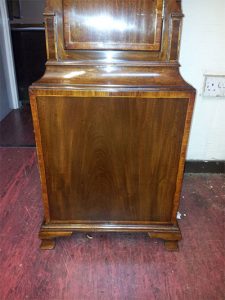
High quality restoration of antique grandfather clocks and longcase clocks

Buying an antique clock( be it longcase / grandfather / tallcase / wall / bracket clock) is a decision you should not take lightly. Whereas you normally buy a car for 3-5 years, a house for 10 years, one of our clocks will still hopefully be in your family in the next Millennium. You will not understand, unless you have owned one of our clocks, the pleasure they bring. Many of our customers have testified that it is like a nice person coming to live with you!

View our antique clocks available online and if you require any further information or references of our work, please contact me.

Daniel.R.Clements

Posted on

‘The Father of English Clockmaking’ – Thomas Tompion

Thomas Tompion
Thomas Tompion

Clockmaking in the UK has a long and celebrated past right from the set-up of the Worshipful Company of Clockmakers. Commonly called the Clockmakers Company this was founded way back in 1631 when King Charles I set it up by Royal Charter.

Oldest Horological Institution in the World

This is the oldest surviving horological institution in the world. Its moto is ‘Tempus Rerum Imperator’ , Time is the ruler of (all) things. Throughout the nearly four centuries since then one clock maker stands out in a group of some amazing clock makers. The question is who is the most famous of all clockmakers? The person would be the person known as ‘The Father of English Clockmaking’, the great Thomas Tompion. Thomas Tompion was Master of the Clockmakers Company in 1704.

Amazing Works of Tompion

Thomas Tompion produced some amazing works, often quite diverse and some very complex. It is definately the fact individuals like this raised the standards of clockmaking throughout the horological profession. This meant England was the foremost country for the production of clocks in the 18th century.

Thomas life and work is studied in a book by R.W.Symonds. Anyone interested in reading more about this great clock maker I would ask your library to try and source you a copy of this great book.

Outstanding Thomas Tompion clock C1680

Start of the Journey

The journey to be known as the most influential and most respected clock maker throughout history starts from the tiny hamlet of Ickfield Green in Northill, Bedfordshire. Thomas was the eldest son of Thomas Tompion , a blacksmith and his wife Margaret. Thomas was baptized on the 25th July 1639. Some 32 years later he was admitted into the Clockmakers Company as a ‘Brother’ on 4th September 1671.

Apprentaship Dues

He paid his fee for doing so of 30 shillings. Very little is known about these growing up years or where he learnt his formidable clock-making skills. It is assumed though he was taught through working with his father at home in his blacksmiths.

Father was a Blacksmith

Blacksmiths at the time were known to have made the ‘Great Clocks’, or what we know today as turret clocks for places like churches. It is also assumed Thomas had loved the idea of working directly in clocks. This can be seen by the fact his father who died in 1665 gave his tools to his younger son James. We can take from this Thomas already had acquired his own tools in clock making and his father tools were not necessary. If we look at many other famous clock makers like Harrison many of them are self taught.

Water Lane Clock Business

We do know for a fact that in 1674 Tompion moved into Water Lane where he continued his clock-making business for the rest of his years.It is amazing the rise to fame of Thomas, even from the very start of his new business he met people like Dr. Robert Hooke.

Dr Robert Hooke

Hooke was a leading gentleman of the day specializing in physics and mathematics. He was a great intellect and undoubtedly a real inventive genius. Hooke commissioned Thomas Tompion to make a quadrant for the Royal Society.News must of quickly spread of Tompions talent. The working relationship of Tompion and Hooke was the real catalyst for this massive rise in fame and prestige for Tompion.

Technological Advancements

I am of the belief these two collaborated closely on a number of great technological advancements. For instance in 1675 Hooke asked Tompion for help in proving he and not Huygens had invented the spiral spring balance for watches. The result ended up that Tompion was the first to actually apply this spring balance to a watch. Many people see Tompion as a maker of larger clocks but it was the success in watches with the huge demand at the time that really brought dividends.

Royal Observatory Clocks

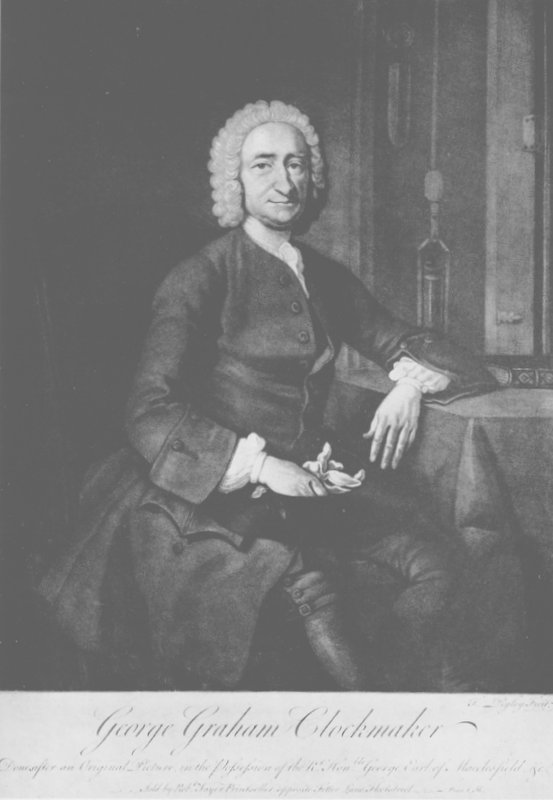
Tompion’s name was mentioned in all the important corridors of the day. Just two years after he moved into Water Lane he was commissioned by Sir Jonas Moore to build two clocks for the new observatory in Greenwich. These clocks were of a year duration and very accurate. These clocks were testament to this clock-makers talent. Another famous clock maker George Graham joined Tompion at his Water Lane premises. In 1696, he married Tompion’s niece Elizabeth. Edward Banger also joined Tompion between 1701-08 but when Banger left from 1710-1713 when Tompion died, his clocks were signed ‘Tompion and Graham’.

George Graham
George Graham

Westminster Abbey Burial

Thomas Tompion and George Graham have the honour of being both buried in Westminster Abbey and Tompion’s graveyard can still be seen today. He left his business and most of his estate to George Graham and his wife. Graham continued Tompions high standards. In the book by R.W.Symonds I believe there is an account where someone comes into Tompions shop in Water Lane with a watch. Tompion looks at it, goes into the back and smashes it with a hammer. He remarks this is not a proper Tompion and he gives him a genuine watch in return.

Fakes Around Even in the 18th century

This shows even way back then Tompion was so famous people were copying his work. There are lots of clocks signed Tompion but always be careful in buying to check the clock is a genuine item. Genuine clocks by Tompion are rare and often fetch in the hundreds of thousands of pounds. If you would like to contact us about acquiring a Thomas Tompion or any other famous clock-maker  please visit here for antique clocks for sale.

Posted on

What is my Antique Clock Worth ?

I must get asked numerous times every day the question, What is my clock worth ? Well to answer this it depends on a variety of factors before even looking at the clock in question. It depends on whether you want a replacement or insurance value. You may want to know what I will get for my antique clock in an ‘as is’, un-restored condition. These values will be significantly different.

Insurance, As Is or replacement Value?

For an insurance valuation. It will be a value of what you would need to spend if you had to replace the clock with a similar example from a dealer. Clearly buying an antique clock from a dealer like ourselves is completely different than buying a clock from an auction. Reputable dealers give guarantees to the clock condition, it will have been examined, cleaned, restored and put into showroom condition. The clock will be in good working order and it will come with a guarantee.

Huge Difference in Values

Dealers will sometimes deliver and setup the clocks in your home. None of these guarantees or working order or showroom condition factors come with clocks sold in auction or most times on ebay. On average it takes 3-5 days to restore a grandfather clock movement. 5-10 days to restore a cabinet. When you add up this restoration, you will realise clocks in auction are not necessarily that cheap. They are not restored but also they are not guaranteed genuine most of the time.

Buyer Beware at Auctions

It is buyer beware for buying at auction. Normally the conditions in the backs of the catalogues give the auctioneer a massive get out clause. Reputable dealer does not have this. So expect a valuation for insurance to be several times the rate of a simple buy it now valuation. Also it is good to remember auctioneer valuations does not mean you will get that for the item. You will have to take into account auctioneer fees for selling. These can mount up. You could receive 1/3 or even less than what the buyer paid for the goods. You may also have to wait several weeks for your money.

Family Heirloom

It may be the case your antique clock is a family heirloom and the value of it is not really the issue. You may be dividing your family estate out and need to know a rough price for the estate. You may want to more about the clock and any information on the maker that is available. I will endevour to help you with any research on your clocks value and information. Contact me directly at Pendulum of Mayfair Ltd. Please send reduced sized images and do not expect a formal valuation. I will try and do this for free of charge for you. My love is for antique clocks and I will go out of my way to help individuals as much as I can. Clearly these valuations I will carry out for you are only to give you an idea. You may need formal valuations, these are chargeable however.

Fluctuating Valuations

When I undertake valuations, yes I will need to know the type of valuation you require. Valuations as described above these can differ greatly. There are lots of criteria when performing a valuation of a clock. The most important factor for me is the clock is genuine and in good but honest condition. Value would be significantly reduced if the dial is not original to the movement or the movement is not original to the cabinet. Some clocks have led a very chequered life.

Condition

Either damp homes or central heated homes have sometimes meant clock cases have been ruined. These will then be furnishing clocks but not have as great an ‘as is’ value. Clearly some times important makers add to the value of the clock, but on valuing you must be sure the clock maker is genuine to the clock.

As you can see the valuation is not an easy one but if you want to contact me now, if you have always wondered about your clock, feel free to do so. What is your antique clock worth find out now ?

Posted on

Painted Antique Furniture and Clocks

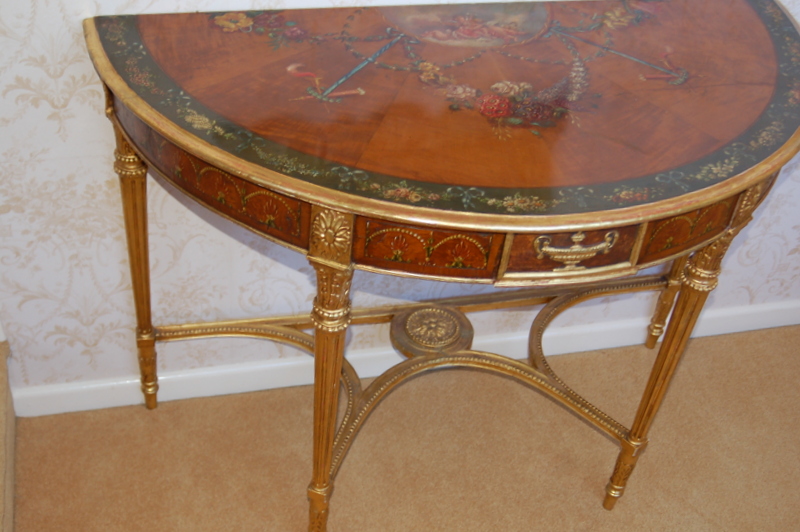
Georgian table decorated in the manner of great artist Pergolesi

Famous Names in Furniture

When I come to think of 18th century antique furniture design, I think primarily of 4 names. There is the great Thomas Chippendale, George Hepplewhite, Thomas Sheraton and last but by no means least Robert Adam. Robert Adam was probably better known for his influence on architecture in the 18th century but he also designed lovely pieces of furniture.

Famous Floral Designs, Pergolesi

It was on one of his trips to the Continent to study foreign designs he came across Michael Angelo Pergolesi. Pergolesi was one of the main characters in the start of painted antique furniture. Designs on antique furniture up to this point had been inlaid into the wood surface.

Fine GIII Satinwood painted decorated side table

Pergolesi trip to UK

Pergolesi stayed in the UK until the end of the 18th century. He worked with the celebrated Adelphi firm. He designed and painted beautiful pieces of furniture and the occasional antique clock. Many of these works decorated with fine figures, flowers and classical urns. He published a book of these designs taken between 1777 and 1801. He worked with other leading figures at he time, many were members of the Royal Academy. These individuals revolutionized the decoration applied to antique furniture.

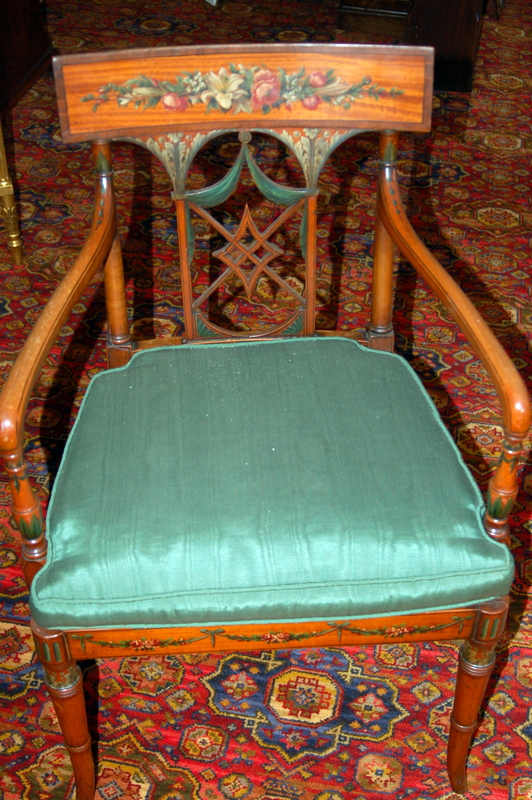
Lovely delicate armchair  with fine designs in manner of celebrated artist Pergolesi

Pergolesi Designs

Pergolesi designs on antique furniture are rare by the fact he worked only a sort period of time in the UK. Those who worked with him in this area left London to work overseas before the end of the 18th century. With this short window of opportunity, very few pieces were made by these celebrated artists and designers, making them highly sought after. Later work like this can be seen in the late 19th century. This is when this type of work hit a revival in the fashion moods at the time.

A link to the clock decorated below can be found by clicking here Gill of Rye Grandfather Clock.

Lovely longcase clock in satinwood with white dial and painted scenes

DSC_0530

Age of Satinwood

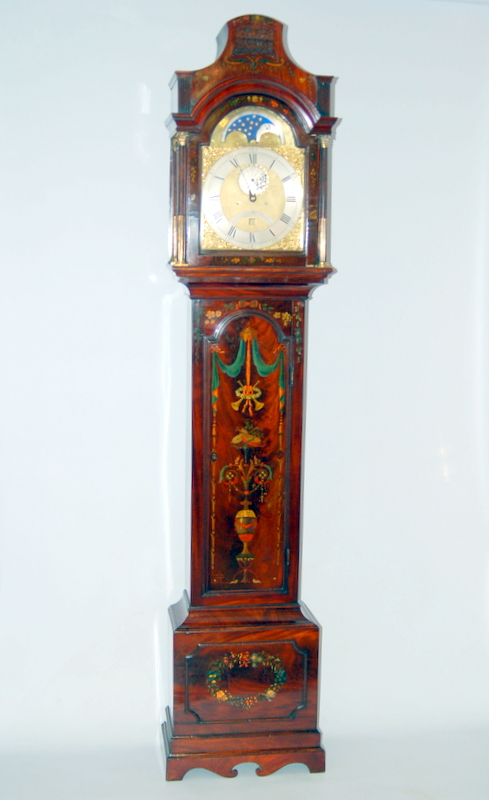
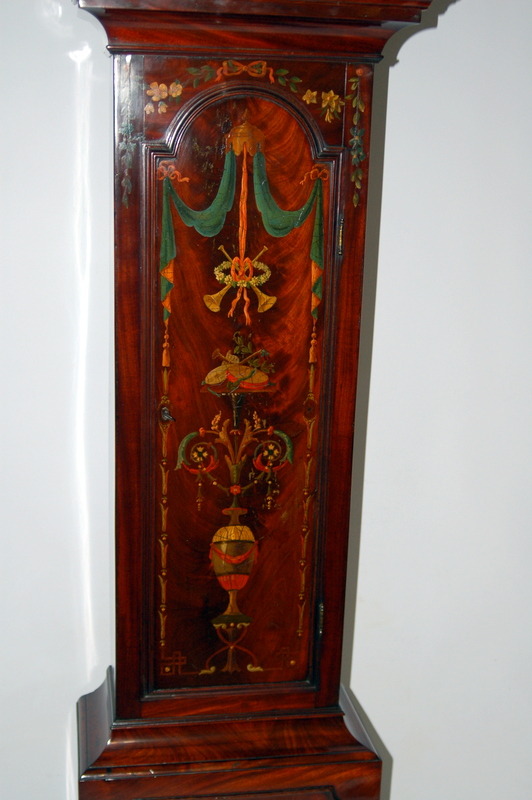
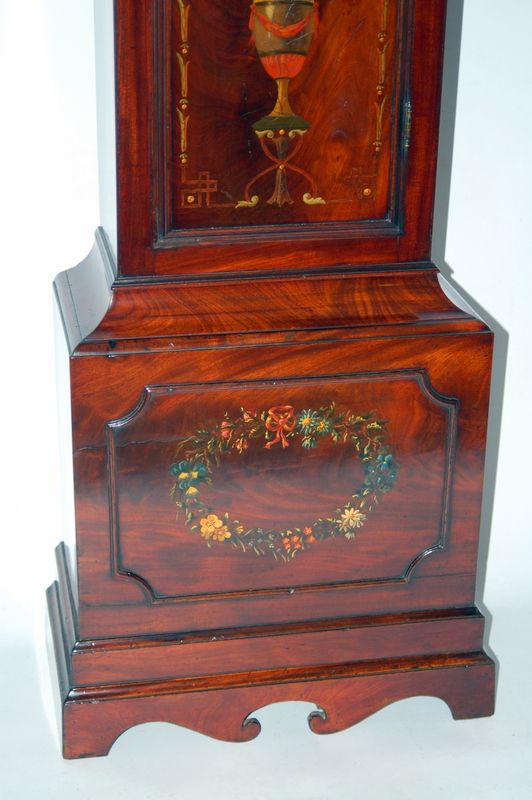
Most of written information on this subject can be found by reading books on the ‘Age of Satinwood’. Many pieces were decorated on this wood surface as satinwood offers a ‘plain canvas’ so to speak for the artists work. It is also true though you will see works decorated on mahogany cabinets in the last quarter of the 18th century. One outstanding such painted decorated clock is seen below.

Ached brass dial moon longcase clock with case of London design but finely decorated with flowers and  urns

DSC_0517

DSC_0518

Posted on

How to Repair a Grandfather Clock ?

Garnet grandfather clock dial after cleaning

Bringing back to life an old dusty and somewhat dilapidated antique grandfather clock into a stunning clock fit for any home is a skill that few people can master. Our workshop here in Cheshire has many years of experience in repairing and restoring antique clocks and furniture. Each having differing respective challenges. I must first say I would only recommend in undertaking such a complex and painstaking restoration if you have the necessary skills and knowledge to achieve this.

Value After Restoration

Poor quality restoration can reduce the value of any fine antique. Sympathetic restoration by highly skilled craftsmen is really important in this respect. Some of our repairs that we have to carry out on clocks is to take away old poor quality repairs. It is usually the case a ‘sleepy’ grandfather clock can actually be easier to repair in may ways than an over restored example.

It is easy to over restore

Once something has been ‘over restored’ it is very hard to correct. The lovely patina in many cases has been stripped off. The beautiful colour underneath the years of grime has been ruined Generally by whatever pot of stain the culprit has used. It is the case restoring sympathetically takes a lot longer, but the end result is far far superior.

We have lots of superb restored North West or Liverpool clocks for sale, you will see a lovely examples if you can visit our search facilty on our website to see various Liverpool clocks here.

North West Clocks

In this blog I will be looking at a lovely North West clock that we have just restored here in Cheshire. To give you some idea of the time taken, the cabinet required just short of 9 full days work. The movement about 2 and a half days.

If only the maker William Garnett of Bold could see the clock now. The clock looking probably even lovelier than it did when it was new back in C1770

    Before – After Restoration Images

Back to life the Bold movement now cleaned and overhauled

As you can view from the pictures above, the Garnett of Bold antique clock movement has been cleaned and overhauled. It has been brought back to life so to speak. 2 and a half days in the critical A and E department of our Cheshire antique clock workshop and now its heartbeat is working strongly again.

antique cabinet being repaired before restoration

Bold Garnet antique clock cabinet requiring professional restoration

Pictures pre and post Restoration

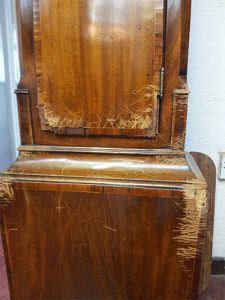
As you can see from the various pictures taken prior to the restoration taking place, the clock cabinet was in a poor state of affairs. It required some difficult sympathetic restoration to bring this past master back to life. The base panel was warped and twisted and another issue was the wood that was veneered on was all shapes. The hood door mask was smashed and various mouldings and feet to the clock needed attention. The cleat to the trunk door was also loose and the clock had numerous places of small repairs to be completed.

Time consuming work

All time consuming and meticulous work. It is vital for any of these repairs to be undertaken with wood of the same age and colour and grain. A good match can then be obtained. Replacing a foot or moulding with new wood will make it impossible for the repair to match correctly.

Humidity controlled environment

We have a store (all humidity controlled) of 17th ,18th and 19th century woods so a good match can be achieved. Animal glues are used in repairs just like in the past. Animal glues have a great quality that is pretty much unmatched by modern glues. The veneer stuck down with animal glue can be reheated if necessary and unstuck. This meant performing repairs, like was necessary to the base panel of the clock, was possible.

Careful work to base panel of Bold of Garnett clock

Difficult Repairs

In the pictures above very difficult repairs had to be carried out on the base panel. The base panel was warped and their was no way the wood the the veneers to the front had been veneered on could be saved. It had multiple splits and was really rough chopped. We had to remove all the veneer from the base panel. Upmost care has to be taken here. The mentioned veneer is stuck down traditionally with animal glues. An iron and wet rag can therefore be used to steam the veneers off the damaged back panel. A 18th century flat piece of mahogany was used to glue the original veneers back down and straps were used. The twisting of the base panel is reduced in the future.

Period wood Used

All wood used in this process is wood of the correct age of the clock. The veneer is clamped and glued with animal glue as before. The outside of the clock now has a perfectly flat base panel.This will be structurally sound for the years ahead.

Lots of small and more complex repairs on this Garnett of Bold clock

Above you will see lots of tasks carried out by our antique furniture restoration department. The top of the mask was replaced in 18th century wood and various other smaller repairs all over the cabinet. In the next series of pictures you will see the final completed restoration. All work carried out sympathetically and preserving the beautiful colour and patina of this clock. I hope you will agree a repair carried out to the highest standards and making the clock sound for future generations.

Lovely colour and patination Garnett of Bold clock

Conclusions

I could give you many references on the quality of our restoration. Our antique clock and furniture repair and restoration department has carried out many complex tasks. We have undertaken repairs for major Embassy’s in London. Important Hotels and for influential private individuals. I remember a Sotheby’s director who attended our shop opening many years ago of Pendulum of Mayfair in London, said he had never seen as sympathetic restoration before. We pride oursleves on this.

Come see for yourself

You can view items on our website to see our standards or even better still drop by our shop in London. Also visit our antique repair and restoration workshop premises in Cheshire where this work is carried out.
If you want any information or prices on having your clock professionally overhauled and repaired. You can also follow my antique clocks tweets on twitter. Alternatively please read and like my antique clocks page on Facebook.
Daniel.R.Clements

Posted on

London Mahogany Moon-Phase Grandfather Clocks

Moon-Phase antique grandfather clock by James Clarke of London
James Clarke London Grandfather Clock with Moon feature

A while back now I wrote a blog about moon-phase antique clocks. We restored this superb antique grandfather clock by James Clarke of London. I thought it was important to write a little more. More about London mahogany moon-phase clocks in particular and why they are so rare and sought after.

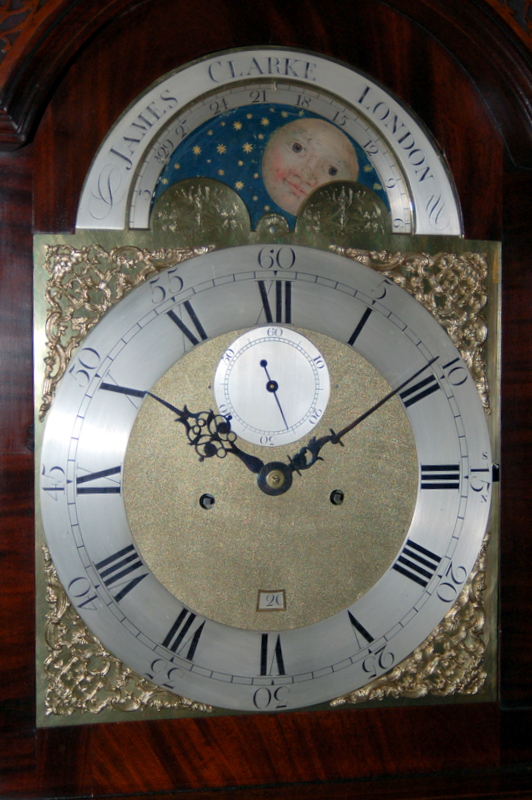
A fine 12 inch chapter ring and spandrels brass dial with moon and strike silent feature to the 3 o clock position on the dial
Lovely moon-phase James Clarke dial

London clocks with Moons

This clock above is a simply beautiful example of a London moon-phase clock. You will notice the high quality matted centre to the cast brass dial. Chapter ring and spandrels and subsidiary calendar. Recessed seconds feature and lovely engraving to the moon discs to the arch. The name is prominently engraved to the cartouche around the arch. It has beautiful painted moon disc and a special extra feature of strike/silent lever to the three o’clock position on the dial.

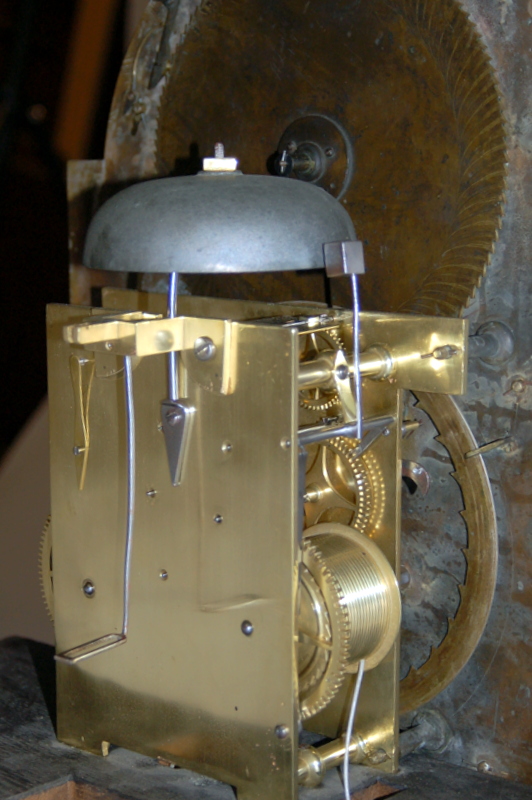
Lovely movement view of Clarke of London 8 day clock
Lovely 8 day moon movement by James Clarke of London C1770

Moon Workings

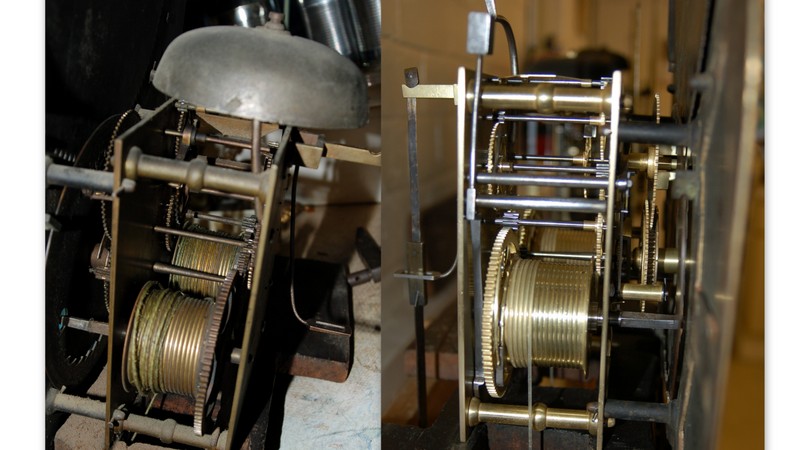
The picture above shows the beautiful workings of this James Clarke 8 day antique clock. You will notice one large extending piece of brass for the front plate top. This is so that the dial feet can miss the moon disc. Lovely high quality 5 pillar London movement, all now beautifully restored back to showroom condition.

I will now return to why so few London clocks have moon features.

Reasons why there so few London clocks with Moons

I suppose there are two main reasons. The first reason which is an important point to start from is the size of the London dials. Provincial 12 inch dials tend to be 17 inches high which would allow for a full semi circle to the arch. Easily enough space for a feature like a rotating moon disc. On a London clock the height is 1 inch less. That means on a 12 inch wide dial, the height of the dial is only 16 inches. The space to the arch is now no longer a full semi-circle and far more restricting. On the dial above you will notice the arch is not a semi-circle. The cartouche around the arch tapers to the centre.

Trading outside London

The second reason is centred around the fact that London is London. Trading in the UK outside London was not really required back then There were plenty of wealthy clients in and around London. Moons generally were required to check when to travel. Generally merchants would travel on and around full moons, so the risk of the Highwayman was not so great. Clearly some clocks like those with high tide, will also occur sometimes with moons.

High Water Tidal Clocks

Knowing when your high tide in your local port like London bridge was also important for the merchants. Travelling around London with the fact they had good street lighting fired by oil lamps after 1750 was not so hazardous. Knowing when the next full moon was, was not really as important.

As discussed in my other blog about moon phase clocks, there were lots of different types of moon. It is the rolling moon like that on the James Clarke clock that was the most popular. Two moons appear on these discs, but only one can be visible at any one time. Generally on London clocks the moon is accompanied by a starry sky rather than country scenes on provincial clocks.

29 and a half days in a lunar month

There are, as previously discussed, 29 and a half days in a lunar month. We divide up the 12 months into either 31, 30,29 or 28 days to compensate. The exact lunar cycle is 29 days, 12 hours, 44 minutes and 2.8 seconds I believe, I hope my memory is right ! The clocks moon as it is 29 and a half days and is therefore fairly accurate, once set !

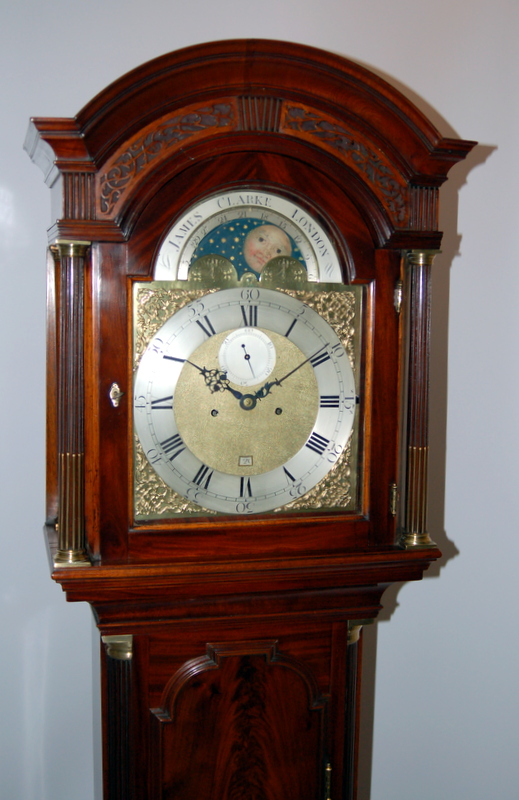
Lovely mahogany veneers and case features of this top quality London clock by James Clarke
Full length picture of the James Clarke London mahogany clock

James Clarke Clock

The James Clarke antique grandfather clock picture above shows what a top quality clock should look like. The dial and movement show amazing high quality features and detailing. The case shows only the finest London case making features of the late 18th century. Quarter columns and brass capitals to the base. Moulding to bridge top door and base and 2 plinths are but some of these lovely features. To view this clock please visit our shop in London, Pendulum of Mayfair or contact us through our website https://www.pendulumofmayfair.co.uk . James Clarke is listed as working in Newgate Street, London and was apprentice in 1760 and a member of the Clockmakers Company from 1768-78.

Daniel R Clements

#SBS Theo Paphitis Winner August 2014 : Antique Clocks Twitter

Posted on

Pendulum of Mayfair Joins Theo Paphitis #SBS Winners Club

 Exclusive Club of Theo Paphitis #SBS Winners

The 11th August 2014 was a special day for Pendulum of Mayfair. We managed to receive the prized retweet from Dragon’s Den entrepreneur, Theo Paphitis. Pendulum now joins the ranks of the exclusive club of Small Business Sunday (#SBS) winners. For Theo to pick our business amongst the thousands that tweet to him every Sunday. We are deeply honoured.

Theo Paphitis Loves Antique Clocks

A very successful businessman. The owner of various major retailers Ryman the Stationers. Robert Dyas, Red Letter Days and Boux Avenue. He also has many other business interests and is still working on many tv programs. Even after his sad retirement from Dragons Den. There are many millions of fans of that program. His input to this series was amazing.

Theo Paphitis is a champion of Small Business

Theo is also a champion of small business’s. His initiative to help small business promote themselves. This was the formation on twitter of #SBS, standing for Small Business Sunday. Each Sunday between 5-7:30pm, business owners tweet Theo. They explain in no more than 140 characters why they would make worthy winners. The best 6 businesses are chosen from the hundreds of entries to retweet to his over 440,000 followers. These business’s can then join the growing #SBS family. Winning businesses then complete an entry on Theo’s SBS website, promoting their services through the directory of winners. Our new listing can be found here: Theo Paphitis Small Business Sunday Winners

What does it mean?

“I’m feeling so proud of what we’ve achieved. Although winning the Theo Paphitis #SBS award has come as a complete shock.” says Daniel Clements. “We’ve been overwhelmed by the messages of support received on Twitter and the huge number of new followers we’ve attracted already. It’s an amazing honour to join such a wonderful group of businesses and a lovely new community of friends.”

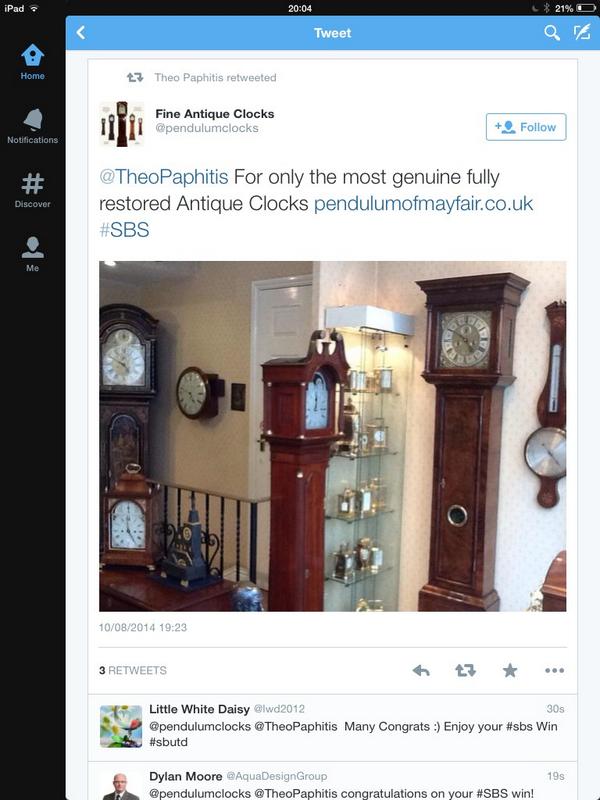
I decided to post our tweet alongside our lovely antique clocks in our London shop, the winning tweet was short and sweet – @TheoPaphitis – For only the most genuine fully restored antique clocks – pendulumofmayfair.co.uk #SBS

The moment I realized Theo Paphitis had chose Pendulum of Mayfair as one of 6 businesses to retweet
The moment I realized Theo Paphitis had chosen Pendulum of Mayfair as one of 6 businesses to retweet

Some of the finest antique clocks available

Genuine and fully restored antique clocks are the cornerstone of our business ever since we started 20 years ago Pendulum of Mayfair and for over 40 years with Coppelia Antiques. Furthermore we have grown year on year from a small base to now stocking some of the finest antique clocks. Also fine pieces of furniture. We employ all our own restoration staff for both the horology and cabinet departments. All repairs are carried out sympathetically and to the highest standards. Preservation of the originality of the piece is foremost in our minds.

Why us?

My father Roy Clements was one of the first I believe of all the clocks editors of the famous Millers Antiques Price Guide up to 1984. His considerable knowledge has rubbed off on me. Ever since I was a small boy I used to travel with my father. This was on business trips and to major auctions in the pursuit of the finest antiques. Learning everything about what to look for. How these pieces that had not been touched in years, could be transformed into showroom condition. My father was one who pointed out to me to cover every aspect within the business. I have worked in both the furniture restoration and clock movement repair departments. Every day is different for me. No clock movement is exactly the same, we are always learning.

Love for Antiques

The antique business has taken over my life full time since leaving university over 20 years ago. To tell you the truth even during those three years I was more interested in what was happening back in the business. My love of antique clocks has never diminished. I am just so happy that someone of the stature of Theo, whom I very much admire, gave time to this SBS venture. Also to chose us as one of his 6 businesses he clearly thought was special enough to re-tweet.

Many VIP Customers

Our shop has now become one of the foremost antique clocks businesses in the world. We have an impressive array of accolades. As a hugely well-respected dealer, Pendulum has featured in leading newspapers. Such as The Sunday Times and appeared many times on national television in the UK.  They were highly commended in the category of ‘ Best Interiors Boutique’ at The Mayfair Awards 2012. In association with The Mayfair Magazine, Small Luxury Hotels of the World and Perrier-Jouet. Pendulum also received congratulations from the Secretary of State for Trade and Industry for Business and was listed in the prestigious Who’s Who of Business Elite for 2002.

Clocks Exported to For Corners of the World

We have sold our antique clocks all around the world,meeting many vip’s in the process. Repairs are carried out and we look after the antique clocks for many famous London institutions. The last few years we have restored back to their former glory the antique clocks in the Russian Embassy in London. The Ambassador, His Excellency Alexander Yakovenko, and his staff were absolutely amazing with us. It was a special honour being entrusted with this work.

For further information please call 0207 629 6606 or email Daniel at pendulumclocks@aol.com.

Out now increasing Twitter following can be found here, please follow for upcoming antique clocks news: Pendulum Clocks Twitter

Posted on

Scottish Clocks and Clockmakers

John Scott Edinburgh C1790

I have written many pieces about different types of antique clocks. In my next few blogs, I would like to concentrate on clockmaking from different parts of the British Isles. My first port of call is to the great country of Scotland. As I speak this great country is still part of the United Kingdom. Fingers crossed after over 300 years of being together, it will still be part of the United Kingdom come September 2014.

Clock Makers from North Britain

A great reference book on this topic is Scottish Clockmakers. This is written by John Smith, this charts the development of clockmaking in Scotland from 1453 to 1850. In this book it shows the importance of the Hammermen in Scotland. An organization governing antique clocks and various other trades. In London, clocks were produced by the rules governed by the Clockmakers Company. By 1650 clockmakers started increasing in Scotland.

Hammermen

This was when the clockmakers started being recognized by this branch of the locksmith trade, the various Hammermen Incorporations. The clockmakers were recognized as a branch of the Hammermen in Aberdeen.

Below I have given some but by no means all of the leading lights of Scottish antique clockmaking in the 17th and 18th and 19th centuries. Apologies to those makers I have left out, as the list is very long.

Quality Clock Makers in Scotland

There were a number of very distinguished Scottish makers: such men as Humphrey Milne Edinburgh; Andrew Brown,1665-1712 Edinburgh; Alexander Brownlie 1710-39 Edinburgh;James Cowan, 1744-81 Edinburgh;John Smith Pittenweem unknown-1814; Thomas Gordon; Thomas Reid 1762-1823 Edinburgh; James Howden and son 1764-1842 Edinburgh;Laurence Dalgleish; Alexander Dickie 1762-1808 Edinburgh; Alexander Cumming 1733-1814 Edinburgh /London; finally Dallaway and sons Edinburgh 1785-1812 being but a few of them.

Dial Painters in Scotland

The last entry on this list deserves a mention even though they are not strictly clockmakers. Dallaway produced nearly all the white dial grandfather clock dials in Edinburgh during the end of the 18th century. In England this was carried out in Birmingham by Wilson and Osborne.

John Smith Pittenweem

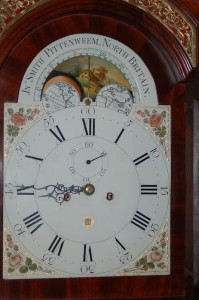
There are some very special names on the list above, John Smith produced some amazing clocks from a tiny fishing village called Pittenweem in the 18th century. You will notice most of the other top makers come from the major towns like Edinburgh. To produce the spectacular clocks that John Smith did in such a tiny place miles from anywhere is astonishing. He deserves special mention. He has clocks in Royal collections and there is a superb example pictured below. The case I believe was purchased from a London case maker on John Smiths only recorded visit to London. A really rare example.

John Smith Pittenweem Antique Clock

Lovely Scottish Cabinet Work

The finest Scottish Grandfathers clocks from the middle to the end of the 18th century had there very own distinctive elegant case style as shown by the clock pictured by the top clockmaker below.

Lauder of PrestonPans

You will notice superb case design on the Pre C1800 antique clocks from the east coast of Scotland. The clock above is from Prestonpans is a small town to the east of Edinburgh, but for all account is classical Edinburgh case design for the period.

East Versus West Coast Scotland Case Making Style

Antique Clocks from Edinburgh and further through Perth and Dundee to Aberdeen case design is really good. I must admit in over 40 years of seeing clocks to the west coast of Scotland though the case design is not the finest in this vicinity. Whereas we have owned and sold hundreds of clocks from Edinburgh, Perth and Dundee, we have only wanted to own one clock from Glasgow in all that time. Most of the time the grandfather clocks from the west coast are not so elegant. The hoods tend to be not greatly proportioned. It is in my opinion clocks from cities like Edinburgh and the east coast of Scotland managed to find some of the best proportions in case design of all clocks, and Glasgow case design some of the worst.

Case style changed in every town

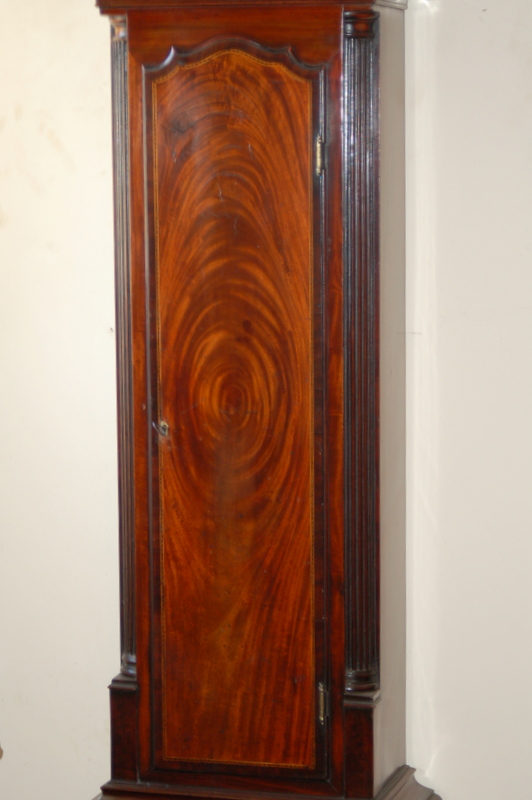
The contrast in design is very large but I suppose everyone’s taste is different! In the picture below you will see the lovely figuring of the mahogany to the trunk door. Many Scottish examples have this twirl to the trunk door from the tree veneers. A lovely feature, quarter columns etc make the elegance of the Scottish cabinets even better. You will not go far wrong in choosing an antique grandfather clock from Scotland, especially if it was made pre C1800 and from the east coast of Scotland.

Lovely Trunk Door from a Edinburgh Clock C1790

Conclusion

We also stock a superb selection of Scottish antique clocks. Most of them pre C1800 but occasionally we have a lovely later Scottish clock like this one from a small town called Old Deer. You can find this clock by clicking here: Old Deer Scottish Antique Grandfather Clock.

Daniel Clements – Pendulum of Mayfair London