Antique Grandfather Clock by Henry Jerard – Hindon C.1750

Henry Jerard main

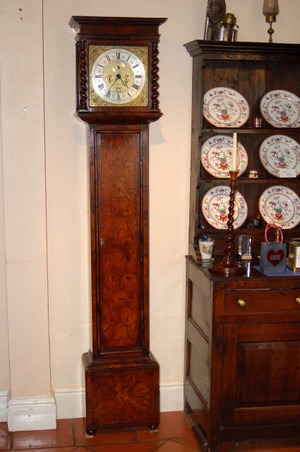
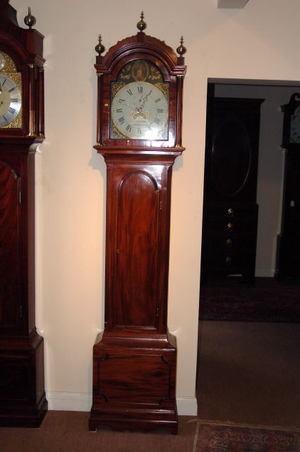
A interesting 8inch dial oak cabinet Longcase clock. Manufactured by Henry Jerard of Hindon. Featuring a small brass square dial with chapter ring and spandrels. Also with inside quarters and matted centre. The movement striking the hours on a single bell. The cabinet with long trunk door, flat top to the hood. Good colour and patination.

Antique Grandfather Clocks

Antique Grandfather Clock by John Scott – Edinburgh C.1795

John Scott main

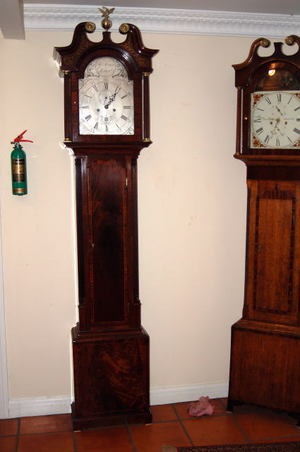
A superb, flame veneered mahogany Longcase clock. Featuring an ‘8-day’ duration movement by John Scott. The arched dial showing seconds and calendar and ship automaton to the arch. This also portraying the ‘Glorious 1st June 1794’.  Delicately painted corners and arch. In addition the movement striking the hours on a single bell. The cabinet of wonderful colour and patination and superb delicate inlay work. The case standing on bracket feet and with ‘swan-neck’ pediment to the top.

Antique Grandfather Clocks

Antique Grandfather Clock by Ellicott – London C1765

Ellicott main

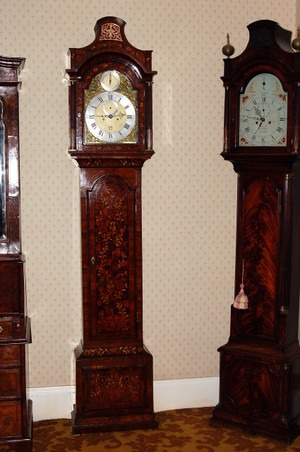
An outstanding ‘8-day’ walnut veneered Longcase clock. |Featuring an arched brass dial by Ellicott of London. The dial showing chapter ring and spandrels. Also with seconds and calendar features & finely matted centre. The 5 pillar movement of outstanding quality with ‘dead-beat’ escapement. The going side running on a 3lb weight only!

The cabinet of typical London design but made using fine figured walnut veneers. Outstanding inlays of various woods. One of the first clocks we have seen to be inlaid so profusely and so finely. Absolutely stunning example, the colour and patination are also superb. A real collector’s clock by an eminent clockmaker. Master of the Clockmaker’s Company. Clockmaker to King George III.

Antique Grandfather Clocks

Antique Grandfather Clock by John Cotton – London C.1700

John Cotton main

A superb early Longcase clock of ‘8-day’ duration. Featuring 11 inch square brass dial by John Cotton of London. Fantastic quality cabinet made with choice veneers. Also with long trunk door and flat top to the hood.The 5 pillar movement striking the hours on a single bell.Superb matted and engraved centre. Together with seconds and calendar features, chapter ring and spandrels. Superb clock of good colour and patination.

Antique Grandfather Clocks

Antique Grandfather Clock by Daniel Dickerson – Framlingham C.1790

Daniel Dickerson main

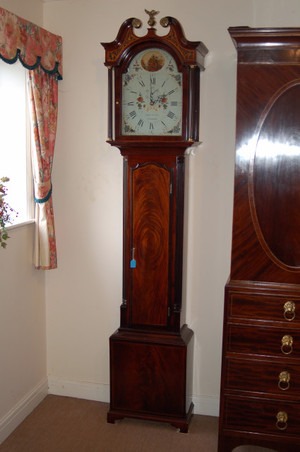
Featured here a good ‘8-day’ duration mahogany Longcase clock.Case of good proportions. Arched white painted dial by Daniel Dickerson of Framlingham. The cabinet showing South Country design. Also with long trunk door with reeded sides. 2 plinths, moulding to door and dome top. In addition with solid fretwork to hood and finished with three finials.

The movement striking the hours on a single bell. The painted dial with green and gold leaf corners. Also with a painted figure to the arch. Seconds and calendar features to dial centre. Cabinet of good colour and patination. Daniel Dickerson was reportedly locked up in Framlingham castle. This was for swindling several persons out of their watches under the pretense of mending them.

Antique Grandfather Clocks

WIKIPEDIA RESEARCH – EQUATION OF TIME CLOCK – JOHN TOPPING C.1720

John Topping main

EQUATION OF TIME – JOHN TOPPING C.1720

The clock featured here by John Topping is an extremely rare example of the ‘Equation of Time’ calculation. Shown here on an early 18th century Longcase Clock. It is pictured here purely for research within Wikipedia. In addition it is not for sale or any other commercial purposes. People can ask me questions relating to the ‘Equation of Time’ but the clock is not for sale.

We are all aware of the passage of time. Yet we can not see it. Many inventors have tried to measure time. But it was not until the invention of the pendulum that considerable increased the accuracy of clocks. That the calculation of the ‘Equation of Time’ became very relevant to clocks. Before the advent of the long pendulum in the early days. The clocks were very inaccurate and so calculating the difference between ‘solar’ and ‘our time’ would have been of little consequence.The long pendulum was first invented by Christian Huygens. A Dutch scientists in 1656.The oscillations of the pendulum reduced error to less than 1 minute per day. This eventually came to less than 10 seconds per day.

Peter Clare Inscription

Peter Clare, a clockmaker in the 18th century, who worked in Manchester insisted his clocks were right and the Sun was wrong. A memorial to him reads.

Here’s the cottage of Peter, that cunning old fox. Who kept the sun right by the time of his clocks.

Many people might think Mr Clare’s observations foolhardy, but it would be folly to dismiss them.

The clock pictured here by a maker called John Topping of London. It is a superb month duration. Wwalnut Longcase clock with a dial showing the Equation of Time.With these increasingly more accurate clocks. The difference called the ‘Equation of Time’ became more relevant, and Mr Clare was right to some degree his clocks were more accurate than the sun.

The Equation of Time refers to the difference between the suns time and that shown by the clock. This varies by up to 16 minutes per day during the year. Only on four days in the year is there no difference between the suns time and the time shown by clocks. The days on which the clock and the sun should usually agree are: the 15th of April, 15th of june, 31st of August, and the 24th of December.

Effectively Peters Clare’s clocks were more accurate than the sun. Clearly this is a result of the elliptical rotation of our planet.

John Topping Clock

The clock by Topping shown below is one of the few clocks ever made showing this calculation on a year calendar. It lets the operator know just how many minutes less or more the clocks time is from the suns time. Effectively making it easy to set your clock in the 18th century by means of a sun dial.

This clock also has the special feature of a spherical moon. Also showing the true shape of the moon. In addition this is accompanied with a tidal times indicator. Also rise and fall of the pendulum. Thus making for changes of seconds to the timekeeping. It is housed in a superb elegant burr walnut cabinet.

Very few clock makers ever had the talent to make such complex clocks. Only the finest clockmakers have examples to their work. These are very few and far between. Thomas Tompion I believe made 3 equation clocks. Topping as listed here made a few, Williamson, who made several equation clocks for Quarre and the maker Gregg.Clearly very few are still surviving today. The complexity of the movement is mind blowing. To sum up a very rare and interesting clock.

Antique Grandfather Clocks
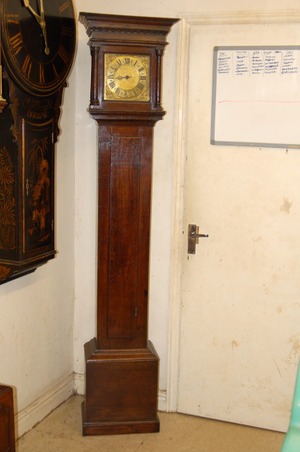
Antique Grandfather Clock by Thos Morgan – Edinburgh C.1790

Thos Morgan main

A  good slim mahogany Longcase clock of ‘8-day duration. Featuring arched silvered brass dial by Thos Morgan of Edinburgh. The cabinet with quarter reeded columns and long trunk door. Also with cross-banding and inlay. Furthermore the base also being delicately strung and with cross-banding in mahogany. The silvered dial with seconds and calendar and with superbly engraved centre. Together with engraving to the corners and arch. The movement striking hours on a single bell.

Antique Grandfather Clocks