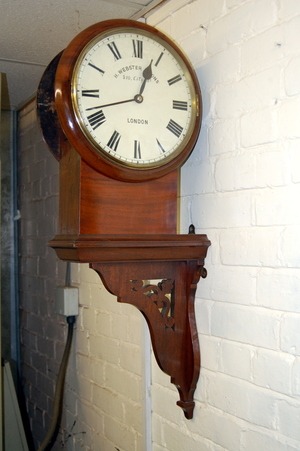
A very rare two sided dial clock. Round painted dials signed Henry Webster and Sons 840 City Road London. On a very nice shaped and decorated wall bracket. Good size clock with cast brass bezel.
A very rare two sided dial clock. Round painted dials signed Henry Webster and Sons 840 City Road London. On a very nice shaped and decorated wall bracket. Good size clock with cast brass bezel.
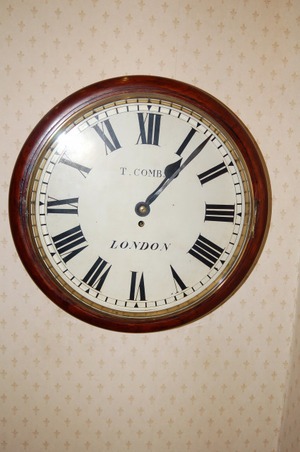
A good large fusee mahogany dial wall clock. The movement being of ‘8day’ duration. Together with large 18 inch painted dial by To Combs of London. Finally an imposing clock suitable for any kitchen or office.
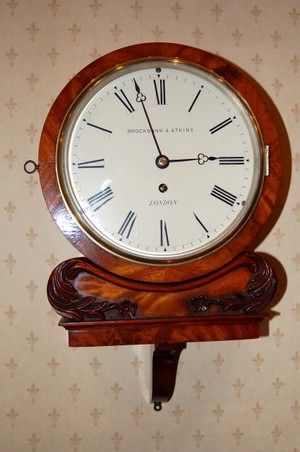
A good mahogany fusee wall clock by Brockbank & Atkins – London. Featuring a white circular 8 inch dial. Together with a drop dial case.
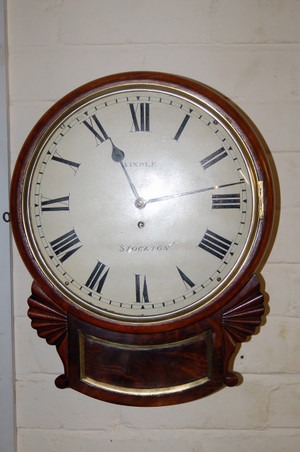
Featuring a superb 12 inch drop dial mahogany wall clock. Together with fusee movement by Windle of Stockton. ‘8-day duration. C.1860
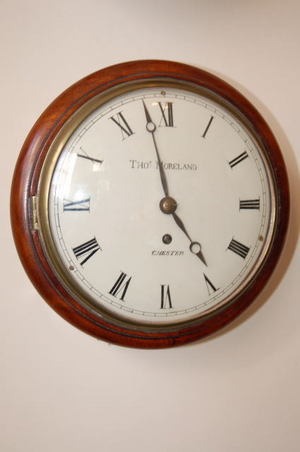
A good mahogany fusee dial clock. Featuring ‘8-day’ duration movement by Moreland of Chester. Also the 8 inch convex dial with Roman numeral. Furthermore the cabinet with cast brass bezel. To sum up a lovely collectible timepiece clock.
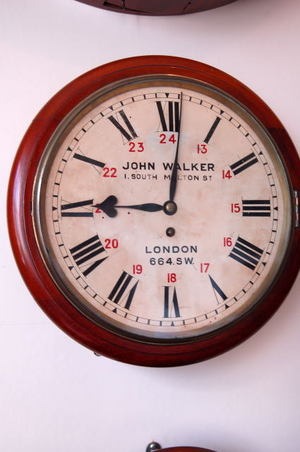
A very collectible 24hr dial John Walker London clock. Featuring 12 in fusee white dial, also of ‘8-day’ duration. To sum up fine mahogany cabinet of good colour.
The following piece ,’The Swing of the Pendulum’, is taken from April 2014 edition of Antique Collecting. It is based on John Andrews interview and discussions with myself Daniel Clements. Manager of Pendulum of Mayfair Ltd.

It takes courage to come from a business in the provinces and open up in the West End of London. Especially when so many antiques concerns have been doing precisely the opposite. But this is what Pendulum did twenty years ago Taking Fred Perry’s shop and residence at 51, Maddox Street by buying the freehold. We then had control over the rent as one important cost element. This having been achieved as a deliberate long-term measure. The costs of converting the shop were a safe investment and Pendulum of Mayfair was launched.


Many businesses in this field have come about as a result of what was a part-time hobby. A source of incidental income becoming so absorbing that the plunge to launching into full time was taken. Daniel Clements says that his father is a classic example. He used to say that he became a dealer in 1974 to pay for his vice of collecting. As a qualified mechanical engineer he was engaged in building factories. Designing new machines all over the world, acting as engineering director at Pilkington’s. But his love of clocks, playing with and restoring them, became a passion. This provided relaxation from the stresses of work. Eventually bringing about the decision to leave his job and set up as a dealer full time.
When he did this 40 years ago it was considered to be a crazy thing to do. Like many who have entered the antiques business after years of dealing on the fringes of it. The impulse was too strong to resist. Even now, in his seventies, Mr Clements love of clocks is still as powerful as it was when he set up the business of Coppelia Antiques in Cheshire forty years ago. This passion has led to the establishment of a highly regarded business with a worldwide field of activity.


Throughout the 40 years since its start, Daniel Clements says the greatest pleasure the business has provided is in finding special antique clocks. Then restoring them as sympathetically as possible. Over the years they have developed the skills of lots of young people in their care. Trying to instill a love of old things and learning about their origins along the way. Touching old things, smelling them, and getting under ‘their skin’ is a long process and needs patience and understanding.
The clock workshop is the hub of the entire operation and nothing is allowed to leave until Mr Clements is satisfied with the result. A familiar motto of the business is the saying ‘well bought, is half sold’. The special type of antique clocks Pendulum look for are so hard to find, selling them is the easiest part.


Over the years many special pieces have come into their hands and customers have become friends.Examples of this provide instances of expertise combining with history to provide the customer with a truly remarkable acquisition. One particular clock sold to an Australian client was by the clockmaker Henry Lane. This was a superb musical Bristol Longcase clock from c.1790. Henry Lane, as it happens,was the first clockmaker in Australia. The story of how this comes about was a compelling one.
Henry was sentenced to death for forging money.This sentence was later changed by an act of clemency to transportation to Australia. He left Spithead on the Perseus with 112 other male prisoner son the 12th February 1802. This is what Clements feels is so special about antique clocks: they have a history and you can research more about the clockmaker’s life. They are a living working museum to the past and attractive pieces of furniture as well. How proud master clockmakers would feel if they could see their clocks still working perfectly in many homes today.

With the Pendulum shop being situated right in the heart of London they have sold and restored clocks to many VIPs. Large companies like Asprey’s and Garrard’s, and major hotels like the Conaught. Recently they had the pleasure of restoring some really complex antique clocks for the Russian Embassy in London. Clements states that ‘the Ambassador and his assistants have shown us great kindness and consideration. We have lovely presents from them and also were delighted to attend their special day earlier this year. This was another of the fantastic memories we have built up over the years. The clocks were a challenge but they now look wonderful and are now fully functioning & proudly taking up their prestigious places at the Embassy. It was a real honour for us, and it shows how far we have come as a business over the years.’

Another entertaining example comes from their local specialist auction house in Chester. They had a lovely little clock for sale at auction about 20 years ago. There were four clocks in the sale,of which one was of great interest: it was catalogued as an ‘electric clock‘. When the hood was taken off the clock, the movement looked as though it was in a salmon tin, because it was enclosed. ‘We instantly knew what this clock was,and so, says Clements, my mother and father decided to split up in the room.My father said to my mother: you bid; if the other dealers see me bidding they will twig. My mother started bidding on the clock but she was very laid back. So much so that the auctioneer asked her are you bidding Ma’am? She said yes and the auctioneer slammed the hammer down.
One dealer who was standing by my father noticed it was his wife bidding. He asked what the clock that she had just bought was. My father said, ‘oh, my wife collects electric clocks.’ Of course it was not an electric clock at all. The clock’s movement had been dust encased. It was a fantastic clock by John Holmes of London. The cartouche had been reversed on the dial and engraved electric clock. It clearly had been used as a ‘slave clock’ in the early 20th century, to drive other clocks around a factory.

‘Daniel Clements says ‘I wish these bargains happened more often but it is not the case. Everyone thinks they have a master piece under their pillow or in their garage. The guy who purchased this ‘electric’ clock was told the story. He laughed; luckily he did not mind paying a handsome profit at the time.
This clock will have appreciated many times in price since then though. Investing in antique clocks is just about as safe as houses. These master timekeepers come from an age where intrinsic labour costs are built in. Movements are handmade and built to exacting standards; they will continue telling the time in peoples’ homes for hundreds of years to come. Even throughout the recession, good genuine clocks have always appreciated in price.’

‘I also remember when we purchased a lovely regulator clock with a painted dial. This clock was made for Catherine the Great of Russia. She was the most renowned and long ruling female leader of Russia. The clock came from the Winter Palace.It was brought out on a horse and cart just before the Russian Revolution at the start of the 20th century. I wish we had kept this clock, but then I wish we had kept many clocks we have sold over the years. We are in a business where we only buy what we love and we grow very attached to all our clocks. They are like extended branches of our family. Once you have restored the clocks, you feel part of them.Like selling puppies etc., the potential owners of our clocks, all get proper vetting! Luckily the people who love clocks are generally lovely people.’

‘Every clock we buy and sell has its own story. You realize you are always learning new things; a lifetime is not nearly long enough. We can be proud of restoring and bringing back to life some lovely antique clocks. Yesterday’s craftsman’s work will live on at our shop in London, Pendulum of Mayfair Ltd. We stock some of the finest antique clocks anywhere in the UK. All these are fully restored and come with a year’s guarantee. All antique grandfather clocks are delivered free of charge anywhere in the UK. We have a full export shipping service to all four corners of the world. The USA is one of our biggest markets.’

At a time when there are so many stories of retrenchment in the antiques business it is a pleasure to find one of sturdy optimism.Pendulum of Mayfair at 51 MaddoxStreet, London W1S 2PH
Tel: 0207 629 6606
Are you interested in buying a new wall clock for your house? Have you thought about maybe making your new clock an old clock, and buying a classic wall clock? Pendulum of Mayfair have a great stock of antique clocks. We have plenty of beautiful wall clocks that will enhance any home, modern or older, contemporary or traditional in style.
Wall clocks have been around since at least the late 1700s, and Pendulum even have an early wall clock for sale, from around 1795. It has a lovely 12 inch brass dial, and was made by William Mills in London. Imagine owning a clock that has been working since around the time of the French Revolution. Perhaps it even graced the walls of an escaped aristocrat! It’s worth paying a bit extra to buy that little bit of history, even if you have to imagine the story for yourself. And If you’d like a clock from slightly later, there are plenty available from the mid-nineteenth century, in sizes ranging from 8 inches to 16 inches in diameter, many with mahogany cases, but some with oak. You’ll be spoilt for choice!
Browse the selection of beautiful antique clocks available online, or for more information, call 0207 629 6606 or email pendulumclocks@aol.com.

I have been asked many times over the years which clocks I would choose. Also which period of clockmaking I consider to be the finest in the last 200 or 300 hundred years. I will be considering these points in my brief outline of the Monarchs of Britain since 1689. Most grandfather clocks are made after this period and so it seems like a good place to start.
William and Mary were offered the throne of the British Isles in Feb 1689 after the overthrow of King James II of England. This period was called the Glorious Revolution of 1688.
Lots of special walnut, marquetry and ebony grandfather clocks were manufactured during this period, many of the dials were of only 10 inches across.
The stand out date within Queen Anne’s reign was 1st May 1707. This is when The Act of Union was signed. The Kingdom’s of England and Scotland were united under one sovereign state. The Kingdom of Great Britain. With the clock world this date has an influence on the brass dials produced around this time. You will see brass dials with the Maltese Cross spandrels symbolising the Act of Union.
It is now we come to the greatest period of clockmaking within these Isles in my opinion. The Georgian Period, stretching from 1714 to 1820. The last 9 years of which were classified as Regency, as the good old George III went slightly mad.
A continuation of the lovely walnut, marquetry and lacquer grandfather clocks produced earlier. The introduction of the arched dial grandfather clock in this period around C1715
At the end of this period we see the introduction of the fine mahogany veneers. Cuban and Honduras mahogany clocks being a particular favourite of mine.
So much happens in this period of clockmaking. It really is the golden age in my opinion. The white dial was introduced, these started in Birmingham. By the end of the 18th century over 50% of the clocks manufactured had a white dial. The brass dial that had dominated clocks for the preceeding 100 years production. They were in sharp decline.
From 1811 to 1820 another important period in antiques is called the Regency Period. Many fine clocks were made in this period, particularly bracket and wall clocks. You see the introduction of things like brass inlays etc.
The end of the Georgian period of clockmaking in the golden age.
In my opinion most grandfather clocks made for the mass market were of inferior quality of construction by this date. Compared to the previous 100 years, many were wider and of poorer quality construction. It is now that the clockmaker sells to retailers more and more. The name to the dial is increasingly the retailer of the clock not the actual clockmaker. Movements are still of good quality but the cabinets tend to be not to everyones tastes.
I think this is an appropriate place to end my look back of a few hundred years of clockmaking. Victoria’s reign oversaw a massive period in Britain’s history. The advent of industrialization. The furniture made during this period is always more elaborate. Many pieces of furniture are highly carved. For me though clockmaking in the UK is in further decline for the mass market. The individual brilliance of the clockmaker is being, in most cases, turned into a production line where very few special items are produced. When they were produced they were knockout but in general this was not the case. I suppose as labour costs and mechanization increased, quality unfortunately took a back seat. Clocks were more affordable to the mass market though. There were clearly exceptions to the above statements, especially when items were made specially to order.

In my last post I talked about tavern clocks. These are really the start and a branch of English dial clocks. In this post I would like to focus on the more standard wooden dial clocks or drop dial clocks. These run from about C 1770 to right up until modern day. I will focus up until WWII. High quality fusee wall clock were made for station clocks and post offices etc up until the advent of radio controlled quartz clocks.
The Act of Parliament in 1797 imposed a tax on clocks and watches. This forced many clock making factories to close or cut back production or swap production to these wall clocks. Many which could escape the tax. When the tax was repealed many factories that swapped over production to dial clocks. They increased production to take advantage of the more favourable conditions.
During the 19th century movement factories making fusee movements for these dial clocks were becoming increasingly successful. The later you go through the 19th century more and more movements for these dial clocks are made by larger established firms. It was found increasingly that the clockmaker bought in movements for his clocks during the 19th century and fewer and fewer clocks were made by the clockmaker on the dial. Production had turned to a form of assembly. In fact from the middle of the 19th century onwards more and more clocks were signed by the retailer of the clock and not the actual maker.
The earliest round dial wall clocks are very collectible and they are found with silvered brass dials, verge movements and ‘salt box cases’. It is rare to find these types of clocks. Most dial clocks will be from C 1820 in date and typically the most I see on my travels date from around C1860/80. These clocks will usually have mahogany cases and anchor escapements. 99% of these clocks will not be striking and have only one train, just for the timekeeping. The dials can either be flat or convex as will be the glass.
The most popular size for manufacture was 12 inches across the dial, using a flat white painted dial. More collectible dial clocks tend to have 8 inch or 10 inch dials and the very large 18inch dials are also very hard to find. Most of the best spring driven wall clocks throughout the 19th and even 20th centuries will have fusee movements. These are far better movements than the typical French movements made throughout the 19th century. The French may have excelled in design with interesting mystery clocks etc but the British still excelled in the quality of the movements made through this period.

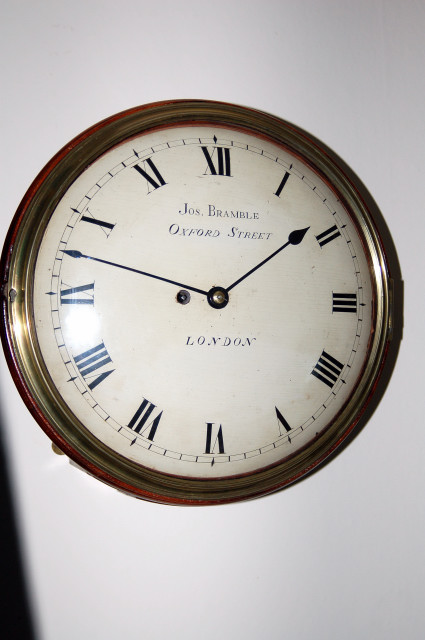
As I have pointed out the earliest dials were silvered brass dials. Most of the dials produced after C1820 are iron white painted dials, but you will sometimes find a rare example of a wooden dial dial clock like pictured above right.


During the 20th century dial clocks still had an important role to play in the emerging factories. In the post offices and stations many were used in the UK. RAF sector clocks are very rare and were used during WWII and the Battle of Britain. These wall clocks are very collectible and so be very careful when purchasing. Many have repainted dials and are made to look like original sector clocks. RAF sector clocks commonly had 14 inch dials and movements were generally made by the Elliot company and they were dated. The cases usually had a RAF log on the back and a date as well. The finest examples had fusee movements whereas some cheaper examples had going barrel movements. These sector clocks allowed you to see which squadron was in the air at any one time.
There were normally three colours painted to the dial in triangles by the side of the numerals. see picture below. Our London store www.pendulumofmayfair.co.uk sometimes has one of these rare antique clocks in stock.
