Posted on

Scottish Clocks and Clockmakers

John Scott Edinburgh C1790

I have written many pieces about different types of antique clocks. In my next few blogs, I would like to concentrate on clockmaking from different parts of the British Isles. My first port of call is to the great country of Scotland. As I speak this great country is still part of the United Kingdom. Fingers crossed after over 300 years of being together, it will still be part of the United Kingdom come September 2014.

Clock Makers from North Britain

A great reference book on this topic is Scottish Clockmakers. This is written by John Smith, this charts the development of clockmaking in Scotland from 1453 to 1850. In this book it shows the importance of the Hammermen in Scotland. An organization governing antique clocks and various other trades. In London, clocks were produced by the rules governed by the Clockmakers Company. By 1650 clockmakers started increasing in Scotland.

Hammermen

This was when the clockmakers started being recognized by this branch of the locksmith trade, the various Hammermen Incorporations. The clockmakers were recognized as a branch of the Hammermen in Aberdeen.

Below I have given some but by no means all of the leading lights of Scottish antique clockmaking in the 17th and 18th and 19th centuries. Apologies to those makers I have left out, as the list is very long.

Quality Clock Makers in Scotland

There were a number of very distinguished Scottish makers: such men as Humphrey Milne Edinburgh; Andrew Brown,1665-1712 Edinburgh; Alexander Brownlie 1710-39 Edinburgh;James Cowan, 1744-81 Edinburgh;John Smith Pittenweem unknown-1814; Thomas Gordon; Thomas Reid 1762-1823 Edinburgh; James Howden and son 1764-1842 Edinburgh;Laurence Dalgleish; Alexander Dickie 1762-1808 Edinburgh; Alexander Cumming 1733-1814 Edinburgh /London; finally Dallaway and sons Edinburgh 1785-1812 being but a few of them.

Dial Painters in Scotland

The last entry on this list deserves a mention even though they are not strictly clockmakers. Dallaway produced nearly all the white dial grandfather clock dials in Edinburgh during the end of the 18th century. In England this was carried out in Birmingham by Wilson and Osborne.

John Smith Pittenweem

There are some very special names on the list above, John Smith produced some amazing clocks from a tiny fishing village called Pittenweem in the 18th century. You will notice most of the other top makers come from the major towns like Edinburgh. To produce the spectacular clocks that John Smith did in such a tiny place miles from anywhere is astonishing. He deserves special mention. He has clocks in Royal collections and there is a superb example pictured below. The case I believe was purchased from a London case maker on John Smiths only recorded visit to London. A really rare example.
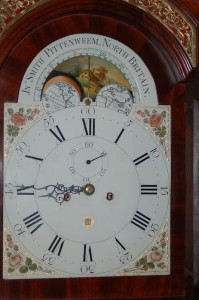
John Smith Pittenweem Antique Clock

Lovely Scottish Cabinet Work

The finest Scottish Grandfathers clocks from the middle to the end of the 18th century had there very own distinctive elegant case style as shown by the clock pictured by the top clockmaker below.
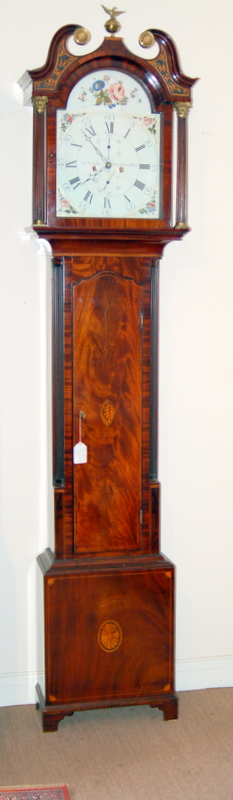
Lauder of PrestonPans

You will notice superb case design on the Pre C1800 antique clocks from the east coast of Scotland. The clock above is from Prestonpans is a small town to the east of Edinburgh, but for all account is classical Edinburgh case design for the period.

East Versus West Coast Scotland Case Making Style

Antique Clocks from Edinburgh and further through Perth and Dundee to Aberdeen case design is really good. I must admit in over 40 years of seeing clocks to the west coast of Scotland though the case design is not the finest in this vicinity. Whereas we have owned and sold hundreds of clocks from Edinburgh, Perth and Dundee, we have only wanted to own one clock from Glasgow in all that time. Most of the time the grandfather clocks from the west coast are not so elegant. The hoods tend to be not greatly proportioned. It is in my opinion clocks from cities like Edinburgh and the east coast of Scotland managed to find some of the best proportions in case design of all clocks, and Glasgow case design some of the worst.

Case style changed in every town

The contrast in design is very large but I suppose everyone’s taste is different! In the picture below you will see the lovely figuring of the mahogany to the trunk door. Many Scottish examples have this twirl to the trunk door from the tree veneers. A lovely feature, quarter columns etc make the elegance of the Scottish cabinets even better. You will not go far wrong in choosing an antique grandfather clock from Scotland, especially if it was made pre C1800 and from the east coast of Scotland.
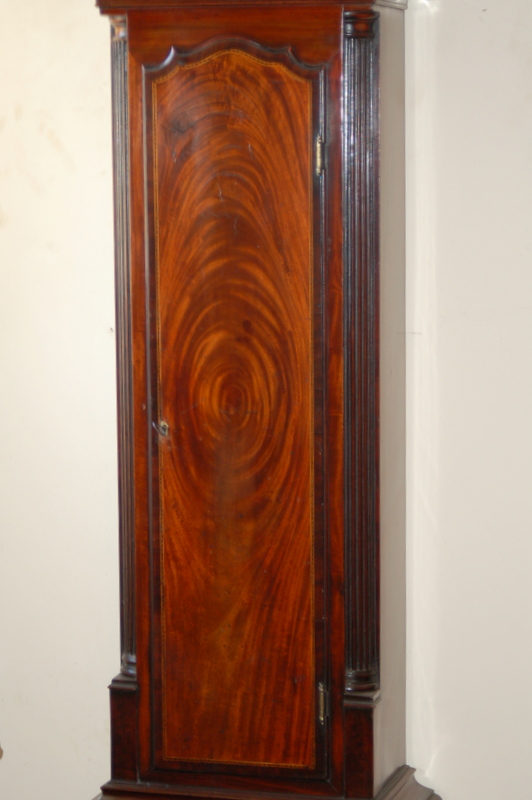
Lovely Trunk Door from a Edinburgh Clock C1790

Conclusion

We also stock a superb selection of Scottish antique clocks. Most of them pre C1800 but occasionally we have a lovely later Scottish clock like this one from a small town called Old Deer. You can find this clock by clicking here: Old Deer Scottish Antique Grandfather Clock.

Daniel Clements – Pendulum of Mayfair London

Posted on

Silvered Brass Dial Clocks


DSC_0237


 1771 Clock by Cranmer of Birmingham
1771 Clock by Cranmer of Birmingham

A couple of years ago I wrote an informative post on painted dial grandfather clocks. Their history and development. I have written this piece in conjunction with that post as the two really go hand in hand. Right I hear you all ask, well how are they connected?

Engraved Brass Dials

The rise of the white dial grandfather clock dials in Birmingham made the brass dial manufacturers sit up and take notice. This new technology could easily take over and this was centered in Birmingham. Dial painters would really have a monopoly over the supply. The clock makers who had specialist engravers and relied on the brass cast dials clearly had to do something. The white dials were pretty and they served a purpose of being easier to read the time on the clocks face.

A challenge to the white dial dominance

White dials with blued iron hands were really easy to read, even from a distance. The clock above is so significant as it is dated 1771 and is an all over brass silvered dial clock. The painted dials were recorded as starting in pretty much the same time as silvered brass dials. It is probably of a great deal of significance that the clock above was made in the same town as where the white dials started production in Birmingham. I believe Mr Cranmer has his ear to the ground so to speak.

First of its kind

He developed the dial above as one of the first of its kind, to compete with these new painted dials coming on the market. You will notice the unusual painted scene to the arch and the slightly strange thick engraving to the dial.  Further examples of silvered dial white dial grandfather clocks. These can be found on our website of Pendulum of Mayfair or by clicking here: Pendulum of Mayfair Ltd.


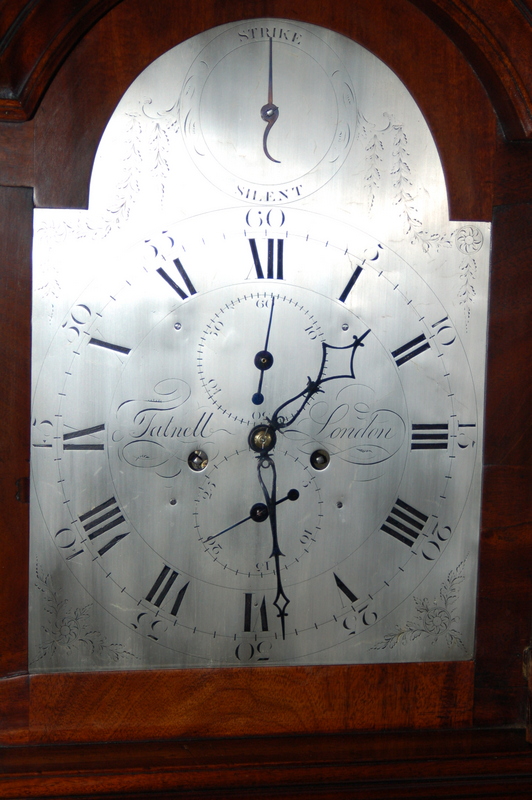
London silvered brass dial clock by Tatnell C1790

Tatnell London clock

You will see a later more standard London silvered brass dial clock by Tatnell of London. With an all over silvered brass dial, the dial is cast brass in the 18th century. this is then made to look like silver by rubbing with a white powder called silver chloride. This leaves deposits of silver on the dial. It gives it its silver look. In most cases the dial is then lacquered to make it slightly harder wearing. Generally though a silver coating on the dial will wear over time and needs re-silvering every generation.

Temporary Solution to White Dial Dominance

In the 20 years after the development of the painted dial grandfather clock dials sales boomed. The sales on the other hand of the standard grandfather clock dial decreased. The brass dial with chapter ring and spandrels started to become less popular. Up to 1790 as a result of the development of the silvered brass dials sales were running about equal. After C1790 though the sales of white dial continued at a pace. By C1820 you were looking at a market that was dominated with painted dial clocks. The painted dial manufacture set up in other places around the country. Not just in Birmingham. The brass dial clocks were on the decline. The silvered brass dial saved the production for 20/30 years. The decline of brass dials and rise of painted dials had taken hold.

Posted on

Leicestershire Clocks

When it comes to Melton Mowbray, I suppose everyone thinks of one thing. Yes the town is famous for pork pies. Back in the 18th century the town of Melton in Leicestershire had some very good clock makers.

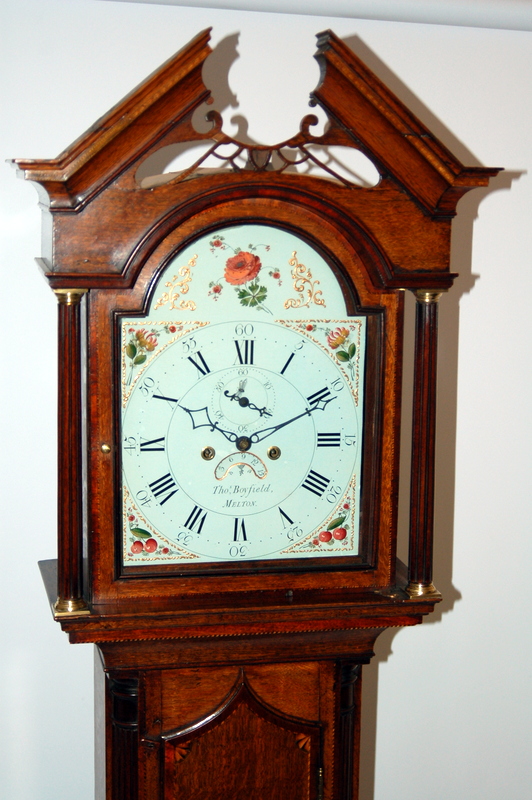
Thomas Boyfield Melton Mowbray

Thomas Boyfield was one of those very able watch and clock makers. The cabinet design is very similar to those cases known manufactured by Deacon of Barton. His records were found and are now situated in Leicester Museum. Samuel Deacon being a famous antique clock maker to come from this area.

Samuel Deacon

Clearly alot of information is known about Deacon through finding all his records. However, I am listing here a clock by Boyfield of Melton. Researchers can see the similarities in case design and the dial design. The dials were decorated in Birmingham. Unless you knew alot of information about Deacon clocks, you would think the clock I have pictured here is by Deacon himself.

Centre for Clock making

Leicestershire has always been recognised as an important centre for clockmaking in the 18th and early 19th centuries. I would recommend a visit to Samuel Deacons preserved clock workshop in Barton Leicestershire. It is a real eye opening experience. Leiecestershire museum also has alot of extra information of the clockmakers from this area. Therefore I would recommend a trip here. From my knowledge I can not remember many spring driven clocks from the county of Leicestershire. Deacon and other makers really only produced weight driven clocks.

Case Designs Leicestershire

You will notice the typical Leicestershire top to the door that you will see on clocks from this area. It is true that pretty much every area of the country had its own particular case design. Features like this top to the door are distinctive. Experts will only need to see this, to tell you where the clock was manufactured. This clock is of a lovely colour oak and with mahogany cross-banding and box wood fan inlays and chequer-board stringing. Quarter columns to the trunk and the typical hood design used on clocks like Deacon sold can also be seen.

Posted on

Antique Clocks – Which Monarch Ruled ?

I have been asked many times over the years which clocks I would choose. Also which period of clockmaking I consider to be the finest in the last 200 or 300 hundred years. I will be considering these points in my brief outline of the Monarchs of Britain since 1689. Most grandfather clocks are made after this period and so it seems like a good place to start.

William and Mary were offered the throne of the British Isles in Feb 1689 after the overthrow of King James II of England. This period was called the Glorious Revolution of 1688.

William and Mary     –           Feb 1689- March 1702

Lots of special walnut, marquetry and ebony grandfather clocks were manufactured during this period, many of the dials were of only 10 inches across.

Queen Anne               –          8th  March 1702 -1st August 1714

The stand out date within Queen Anne’s reign was 1st May 1707. This is when The Act of Union was signed. The Kingdom’s of England and Scotland were united under one sovereign state. The Kingdom of Great Britain. With the clock world this date has an influence on the brass dials produced around this time. You will see brass dials with the Maltese Cross spandrels symbolising the Act of Union.

It is now we come to the greatest period of clockmaking within these Isles in my opinion. The Georgian Period, stretching from 1714 to 1820. The last 9 years of which were classified as Regency, as the good old George III went slightly mad.

George I             –            1st Aug 1714 – 11th August 1727

A continuation of the lovely walnut, marquetry and lacquer grandfather clocks produced earlier. The introduction of the arched dial grandfather clock in this period around C1715

George II         –             11th June 1727- 25th October 1760

At the end of this period we see the introduction of the fine mahogany veneers. Cuban and Honduras mahogany clocks being a particular favourite of mine.

George III       –          25th October 1760 – 29th Jan 1820

So much happens in this period of clockmaking. It really is the golden age in my opinion. The white dial was introduced, these started in Birmingham. By the end of the 18th century over 50% of the clocks manufactured had a white dial. The brass dial that had dominated clocks for the preceeding 100 years production. They were in sharp decline.

From 1811 to 1820 another important period in antiques is called the Regency Period. Many fine clocks were made in this period, particularly bracket and wall clocks. You see the introduction of things like brass inlays etc.

George IV      –           29th Jan 1820 – 26th June 1830

The end of the Georgian period of clockmaking in the golden age.

William IV     –          26th June 1830- 20 June 1837

In my opinion most grandfather clocks made for the mass market were of inferior quality of construction by this date. Compared to the previous 100 years, many were wider and of poorer quality construction. It is now that the clockmaker sells to retailers more and more. The name to the dial is increasingly the retailer of the clock not the actual clockmaker. Movements are still of good quality but the cabinets tend to be not to everyones tastes.

Victoria         –            20th June 1837 – 22 Jan 1901

I think this is an appropriate place to end my look back of a few hundred years of clockmaking. Victoria’s reign oversaw a massive period in Britain’s history. The advent of industrialization. The furniture made during this period is always more elaborate. Many pieces of furniture are highly carved. For me though clockmaking in the UK is in further decline for the mass market. The individual brilliance of the clockmaker is being, in most cases, turned into a production line where very few special items are produced. When they were produced they were knockout but in general this was not the case. I suppose as labour costs and mechanization increased, quality unfortunately took a back seat. Clocks were more affordable to the mass market though. There were clearly exceptions to the above statements, especially when items were made specially to order.

Posted on

Clocks – UK / USA

It is Ryder Cup weekend again. Great sporting battles between Europe and America at golf come to a head. These are friendly sporting battles but lets not forget the close ties between our great nations.


Exporting clocks

In the 17th and 18th century clock manufacture was the UK’s greatest export. The Clockmaker’s Company was formed as one of the UK’s oldest learned professions by Royal Charter in 1631. This started two centuries of UK dominance in this field. It was just before this in 1620 that the famous Mayflower set sail for America.

The Mayflower Boston Journey

The Mayflower has a famous place in American history. It is a symbol of early European colonization of the future United States. This ship set off from Plymouth, England to arrive at the now Plymouth, Massachusetts. It is the same reason why Boston, Massachusetts is called so today. John Cotton, a Puritan,who served as a Minster of the church in Boston, Lincolnshire England fled persecution. He moved to Massachusetts in 1633 as a leader of the settlers already there and some of his own people. He was instrumental in founding and naming Boston, Massachusetts.

American Clockmaking

Clock makers from the UK arrived in America, William Davis for instance is one of the earliest clock makers in America. He arrived in 1683 from the UK. Many of the oldest clocks on US public buildings were made by UK clock makers. These had fled for mostly religious reasons. New England had thus developed and the English community was strong here as thousands emigrated to the emerging America.

Ban Importation of Clocks

During the 18th century many English clocks were still imported to the US. One of the first things the new independent government did in US was to ban the importation of clocks. It is still the case though that many of the earliest American clock makers were English. They still imported dials etc from the new painted dial works (set up in 1771) in Birmingham, England and movements from the UK.

Rise of American Clock making

The rise of the American clock making industry from about 1850 to 1920’s coincided with the decline of the same in the UK.  Generally as quality went down and mass production rose, the US factories now churned out clocks better than anywhere else. Many famous 19th century American companies were set up, many of them in Conneticut. The Ansonia Company was founded in 1851 and thrived until its decline in the 1920’s. There was the Gilbert Company in the second half of the 19th century The famous Seth Thomas Company and many many more. The Waterbury Clock Company is one I will finish with.

Waterbury Clock Company

This company started in 1857, eventually became the Time Corporation, that made Timex watches. As a collector, I am only really interested in the first 200 years of clockmaking. Items were then handmade and were alot higher quality. There are always exceptions though and we have a clock made by the Waterbury Clock Company. This I believe is a one off, made for Christchurch Cathedral in Dublin. Its movement is of good quality and shows little signs of wear. It is a really rare and interesting example. This is pictured below. I suppose it also shows the strong Irish / American links that existed during the 19th century.
 

Conclusion

Visit our shop in London, if you love 18th century antique grandfather clocks like me. We have a large selection of genuine fantastic examples all fully restored. These clocks will keep ticking for generations to come. If you consider the painstaking hours in the manufacture. They represent amazing value for money by todays standards. Remember London was the centre of clock making from 1631 to the start of the 19th century century, some outstanding pieces were produced. 80% of our clocks from our shop in London, Pendulum of Mayfair Ltd,  are still exported to America. Owning your piece of history is easier than you think. We use a specialist antique shipping company that ships antique clocks to you door. Please visit our website for more information www.pendulumofmayfair.co.uk

Posted on

Dating Antique Painted Dial Clocks

Dating clocks

Longcase or grandfather clocks were made in Britain from about 1658 and during the first few years their production was confined almost exclusively to London. One of the earliest provincial grandfather clocks I have seen is dated 1689 by a maker called John Washbourn.

Painted dials on the other hand were brought out just after C.1770, these were made to compete with the single sheet dial or one-piece brass dial, that was introduced around C.1760.

I like to catagorize painted dial grandfather clocks into three seperate time periods.

Period 1 – 1770 – 1790

Painted dial manufacture and painting was started in Birmingham by two individuals called Osborne and Wilson. They were in partnership between 1772 and 1777, they later went there own ways producing dials on their own merit, Wilson died in 1809. White dial production became very popular in Birmingham in the 18th century. Towards the end of the 18th century there were a large number of dial painters situated in Birmingham. Most dial manufacturer’s stamp their names on the iron false plate behind the dial. It is true to say Birmingham dominated the market in painted grandfather clock dial production, but there were a few other areas that set-up dial painting and manufacture for example in Halifax and Edinburgh. 

Falseplate

The very earliest dials were attached to the front plate of the movement directly. After a short time, dials were attached by means of an iron false plate. This made it easy for the clock maker to attach his dials. It would not interfere with any part of his movement. Also it meant you could have smaller dial feet, which were therefore more stable and less prone to bending.


The two dials above are exceedingly early white dials and just have the gold leaf decoration to the corners. These type of dials date from about C.1772-1775

Below you will see the second stage of period 1 antique clock dials. Some colour is added to the gold leaf decoration to the corners and arch. These clock dials below date from C1775-C1785

You will notice in London gold leaf decoration and flower to the corners is earlier than the corresponding dials in the provinces. In London new advances were always ahead of their time. Even though dial painting originally started in Birmingham. Early London dials around C1775 will have gold leaf decoration and flowers to the corners. Sometimes London dials have no decoration at all. Also sometimes the chapter ring and the strike/silent ring are porcelain or painted with the rest of the dial left brass.


There is therefore three stages in my opinion of period 1 antique clock white dials. The last stage of period 1 is between C.1785 and C.1795. This is when the dial painter drops the gold to the corners and sometimes a scene is included or a bird.

Period 2 – 1790 – 1810

Period 2 can be mixed in certain ways with period 1 dials. They are certainly in no way inferior to period 1 dials. In fact the two dials I have included here are amazing works of art. I suppose it is the real height of dial design and some of the dials produced certainly in the C.1790-C1800 period are of the finest detailing.

Period 3 – 1810 onwards

I must admit  period’s 1 , 2 and the very start of period 3 white dials are the most collectable. These are of the highest value and my favourite. The two pictured below are very nice clocks both dating from start of the 19th century.  As the 19th century progresses the dials become larger and the scenes not so well painted. Generally if your dial is 13 inches or below and your clock is an antique and not a copy. Your clock will date from earlier than C.1820 as a rule of thumb.

Conclusion

You will also notice the dial progression, the very earliest white dial grandfather clocks are mostly white. As time progresses more of the dial becomes painted. The later you go, the painting gets quite dense. On the later mid 19th century ones, these sometimes are not of a very high quality or very appealing. The dials below are very good period 3 antique clock dials, and still very collectable. The clock dial on the left is a rare oval dial. You will notice most dials produced were either square and arched. Visit our homepage https://www.pendulumofmayfair.co.uk for further information.

Posted on

Enamel Dials

We have been in the antique clock business for over 40 years. It is true to say enamel dial antique clocks are rare. You can see them occasionally on bracket clocks in the 18th century. Searching for examples is hard. It is like finding a needle in a haystack however finding a true enamel dial on a grandfather clock.

True Enamel or Painted Dials

If you undertook a search for enamel dial grandfather clock you will find lots of listings. Dealers loosely apply the term to a standard white painted dial. These clocks with white painted dials started manufacture in Birmingham with Wilson and Osborne from around C1772. It was true to say the Clockmakers Company in the early days frowned on achievements outside London. Clock makers tried and most times failed to make alternatives. One alternative was a true enamel dial. True enamel dials such as the superb example pictured here was made from a mixture of glass, tin oxide, borax, peat ashes and salt.

Hard to fire large pieces of enamel

A complex mix of substances was then melted and turned into moulds to harden. This mixture was then ground to a powder and mixed with water. The enamel was then mixed with lavender oil to make it adhere to the copper dial plate. This mixture was applied to the dial and then the dial was fired at high temperatures in a clay oven. The temperature was carefully monitored and then the dial was cooled very slowly to prevent any cracking.

Time Consuming Process

I hope you agree a process that was very time consuming and complex. To get this to work on a large dial it was very hard. That is why in this case you will see the arch is fired separately. I am sure the risks of cracking with a 12 inch piece of square enamel was a large enough risk. The lovely painted work and decoration you will see on this dial is the result of further firings. Rose Vermillion being one of the hardest colours to apply.

Conclusion

This is an outstanding and very rare clock with a true enamel dial. It has been mentioned the maker of these rare enamel dials was the brother of the famous clockmaker James Tregent. He was called Anthony Tregent. For further information please view the book Theelke, Anthony; Faces of Mystery. This is a lovely flame mahogany veneered grandfather clock with strike silent feature to the arch. The movement is of ‘8-day’ duration and strikes the hours on a single bell. Superb London quality case and typical high quality movement features.

Daniel Clements

Pendulum of Mayfair Ltd

Posted on

Careers in Horology

It is this time of year when many students start thinking about careers. Working in the field of antique clocks as a horologist can be very rewarding.

The horologist was a top profession in the 18th century

In the 17th and 18th centuries it was one of the top professions. Now I suppose the doctors and dentists or bankers and accountants are today.  It is a shame that many colleges do not offer courses in horology but some still do.  West Dean College still provides excellent courses in horology. There is an excellent article in the Independant newspaper on these horology courses and ‘breathing life into old treasures’. It is possible to do home study courses in horology with the British Horological Intstitute. It is also possible to do a BA Hons course at Birmingham City University in horology.


Excellent Career Path

I believe it is an excellent career path for young students. What I have found in the last 20 years or so is many people retiring into studying horology. This is fine but if young people knew how rewarding learning and working with antique clocks was, they would gain a head start in the field. Many people retire to work in horology as it has many benefits. It brings enjoyment in bringing something special back to life. Many workshops can be setup at home and so it is a great way to work for yourself and be your own boss.


It is also a great career path to other forms of engineering or maybe working as a specialist auctioneer of clocks and watches. Working and repairing antique clocks brings you lots of knowledge along the way about the way things were made. Knowing how to date antique clocks for auctioneering. This is all valuable information and a great basis from which you can carve out a valuable and rewarding career in what ever you then may choose to do.

Specialize in clocks

There are fewer specialists in this field today and so a bigger chance to make a name for yourself. In the 17th and 18th century every little village had its own clockmaker and London was the centre of clockmaking with the Clockmaker’s Company. Today there are few world recognized horologists. George Daniels was a watchmaker who was regarded as a special talent, he died recently. He gave alot to his field and certainly made a difference. It is certainly possible with the right enthusiasm and drive for students who enter this field today. Make the same difference and to enjoy what they do. I suppose this is a rare in many jobs today. Most people go to work to earn a living, but to actually enjoy your job, this is what makes your job special.

Daniel R Clements – Pendulum of Mayfair Ltd