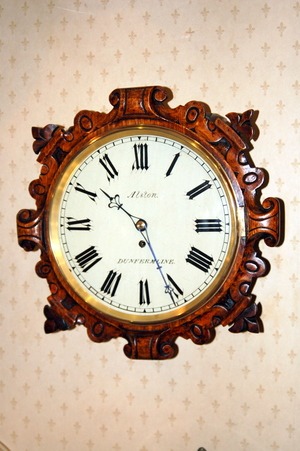
A fine and interesting shape oak with white round dial wall clock. The dial signed Alston of Dunfermline. 8 day fusee movement and cast brass bezel.
A fine and interesting shape oak with white round dial wall clock. The dial signed Alston of Dunfermline. 8 day fusee movement and cast brass bezel.
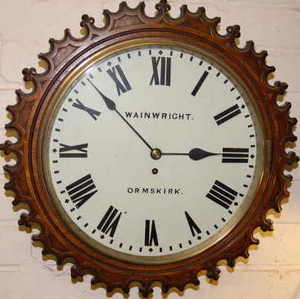
Showing here an interesting shape oak single fusee wall clock. Also with ‘8-day’ duration movement by Wainwright of Ormskirk.
Are you interested in buying a new wall clock for your house? Have you thought about maybe making your new clock an old clock, and buying a classic wall clock? Pendulum of Mayfair have a great stock of antique clocks. We have plenty of beautiful wall clocks that will enhance any home, modern or older, contemporary or traditional in style.
Wall clocks have been around since at least the late 1700s, and Pendulum even have an early wall clock for sale, from around 1795. It has a lovely 12 inch brass dial, and was made by William Mills in London. Imagine owning a clock that has been working since around the time of the French Revolution. Perhaps it even graced the walls of an escaped aristocrat! It’s worth paying a bit extra to buy that little bit of history, even if you have to imagine the story for yourself. And If you’d like a clock from slightly later, there are plenty available from the mid-nineteenth century, in sizes ranging from 8 inches to 16 inches in diameter, many with mahogany cases, but some with oak. You’ll be spoilt for choice!
Browse the selection of beautiful antique clocks available online, or for more information, call 0207 629 6606 or email pendulumclocks@aol.com.
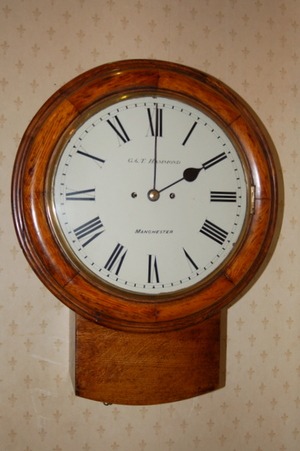
An oak drop dial wall clock. Featuring case of fine colour and patination. In addition 12 inch round painted dial by G and T Hammond of Manchester. Two train fusee movement striking hours.
For antique furniture and clocks different types of wood were used in their manufacture. In this handy guide I am going to cover some of the main woods used. These woods can be of solid form but most flamboyant grained woods are used as hand cut veneers. The carcass is generally made from oak or pine in the provinces or oak generally in London.
In London oak is only used as a carcas material in the 17th and 18th centuries. Whereas in the provinces you will find antique grandfather clocks being made of oak as the finished wood. Clearly oak was veneered on as well, especially in London by English Walnut up to say C1750 . Then from this date fine Honduras and Cuban mahogany veneers are found. On some clocks you will find very early examples to be of ebony construction or ebonized (black stained fruitwood generally)
You can also get oak grandfather clocks in London that were painted and decorated by Chinoiserie or lacquer work. The finest examples were sent out on boats and decorated in China. On some later clocks you will see these veneered in more exotic woods. Rosewood or maple or even ewe wood. I suppose the smaller size means you can use veneers of the more slow growing and smaller trees. With early clocks these exotic woods were used as well in small pieces and matched. We have owned a lovely walnut burr oyster veneered grandfather clock.
Below is a selection of woods used for antique clocks and furniture during the 17th and 18th and 19th centuries in England. A brief insight into each wood pictured is given. I hope from this blog you will discover what type of wood your clock or piece of furniture is manufactured from.
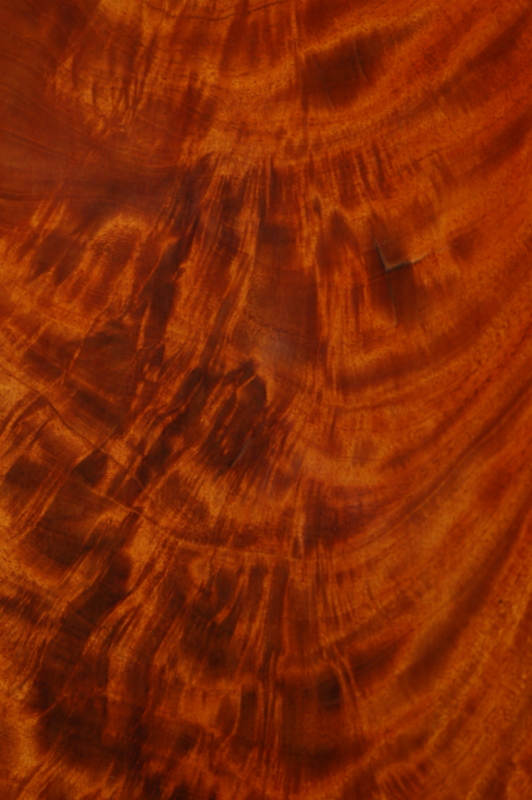
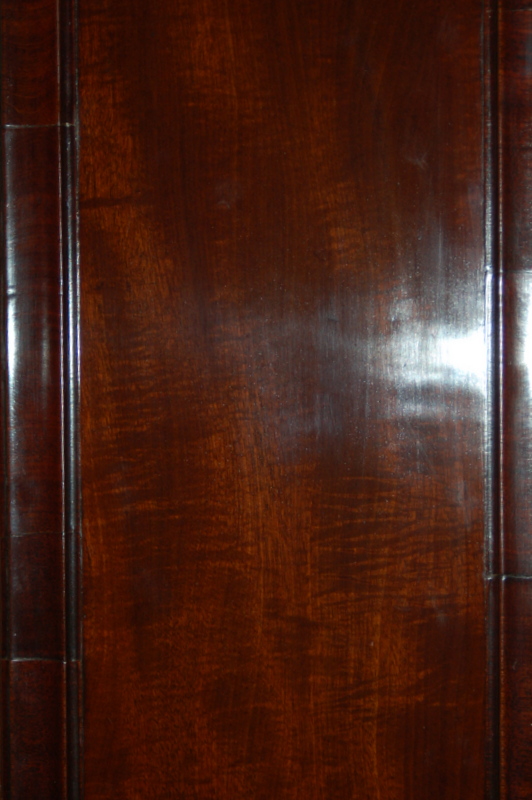

Mahogany can be a beautiful wood, it starts in the UK being used around C1750 and continues being used throughout the 18th and 19th centuries. Two most common variants are Honduras (lighter) and Cuban mahogany (darker). It is a close grain hardwood coming commonly from the South America or the West Indies type regions. This tree can be found quite wide and so large sections could be veneered with this wood.
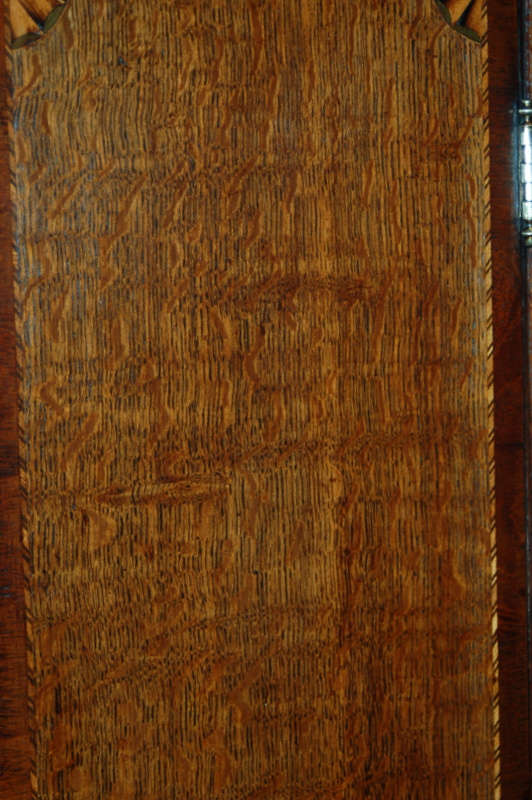

English oak is a slow growing and so very heavy wood. Used in construction and veneered some of the time, but it is a beautiful wood in its own right. Oak being so heavy and close grained it is good at preventing things like wood worm. It is one of the reasons why London used it in the construction of its clock cases ahead of pine. Pine is used in the provinces as a rule for carcases as it is cheaper. You will notice the weight difference between an antique clock veneered on oak and an antique clock veneered on pine. Oak just gets better with age and polishing, we call this the patina. Less close grain oak can come from countries like Japan. This wood although called oak, is a far poorer wood to the slower growing English oak.


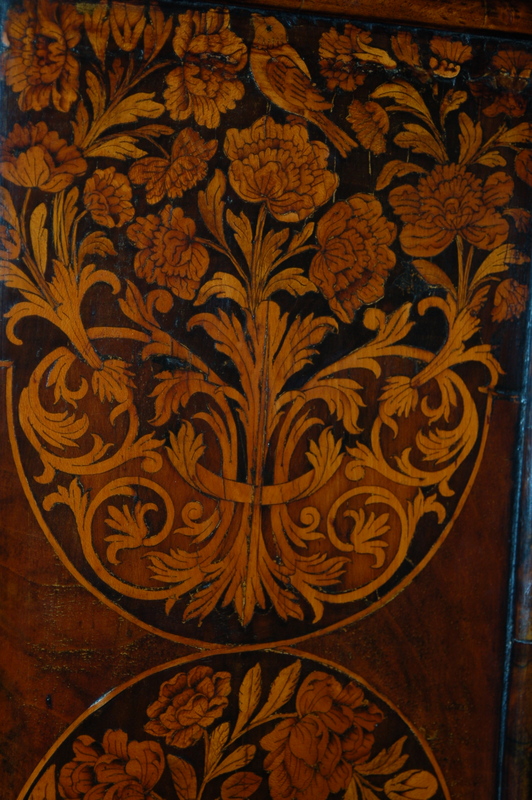

Walnut is a lovely wood and English walnut gets used as veneers in antique furniture and clock manufacture up until C1750. After this date most walnut used is Continental walnut. Continental walnut is a quicker growing tree and so the grain is never as fine as English burr walnut. Again English walnut is a very heavy wood with a close grain. The tighter the burr or knot in the walnut the better. Walnut can range in colour from quite light if the sun has taken it, to quite dark. Walnut is used on all of the German wall regulators or commonly called ‘Vienna style’ wall clocks etc through the 19th century.

Satinwood being a very light wood was used towards the end of the 18th centuries and early 19th centuries in the main. Many expensive pieces are manufactured with Satinwood veneers. We have some Pergolesi painted tables with satinwood veneers. I suppose the light colour makes the painting stand out better.

Pine, many of you will be familiar with this wood. It is rare to see a surviving antique grandfather clock made in this wood like the above. It was prone to woodworm unfortunately. Some were painted and this helped preserve them.Many provincial cabinets were constructed out of pine and then veneered. Pine is also used alot today as it is a relatively cheap wood, unlike oak. Clearly as you can see from the grain and if you lifted it from the weight , it is a fairly quick growing tree.

Oak was only used on internal construction of cabinets of English London clocks. When this wood was used and if it is not veneered in London you will find it sometimes decorated with lacquer work or Chinoiserie. This is gold leaf and gesso. The best types of these works are seen when they were sent out to China in the early/mid 18th century and decorated their.
I think I have covered the majority of main woods used in English cabinet making. There are others like ewe wood, maple , elm, fruitwood and rosewood. These are not covered as they are used alot less. I hope this blog has been of help to you. If you are still struggling with finding out what wood your clock or piece of furniture is made from, please send me a picture to PendulumClocks@aol.com
Daniel Clements – Pendulum of Mayfair

Alot of people get confused why there are so many names to describe certain antique clocks. I noticed recently on Wikipedia for a search for Longcase clocks you will see they also get regularly called grandfather or tall-case clocks.
Tall-case is a name commonly used for a grandfather clock in the USA. On the Wikipedia site it also mentions the terms grandmother and grand-daughter clocks. It informs us that the difference is as a result of the height. This is true to some extent as clearly grand-daughter clocks are smaller than their larger counterpart, the grandfather. It would be to simplistic to take this as the only reason for the name change though.
For instance if you had a small 18th century oak longcase clock under 6ft, you would not call this a grandmother clock. All 17th and 18th century clocks can only really be described as either a longcase , grandfather or as people from USA like to say tall-case clocks.
The date is also important when describing antique clocks. Grandmother and grand-daughter clocks were really smaller examples produced post C1880. We have some very small C1790 floor standing clocks. I would call these miniature longcase clocks or apprentice pieces. The wording can get blurred here to some extent. It would not be unheard of to call these 18th grand-daughter clocks but I think period grand-daughter clocks (18th century) need to be differentiated from the later counterparts. (19th and 20th century).
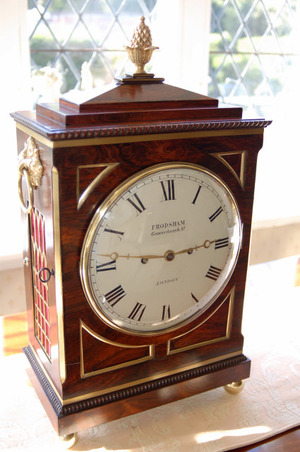
I would like to finish this blog about the differences between what I call bracket clocks and mantel clocks. Again the easy difference is an age thing. 17th / 18th and clocks up to about C1850 will be commonly called antique bracket clocks. Later clocks from about C1850 to modern day examples are called mantel clocks. All bracket clocks will have English quality fusee movements.
The mantel clocks can have going barrel English, German movement or possibly French movements. From the term bracket clocks you will assume no doubt that the difference is the earlier clocks had a seperate wall bracket that they stood on. This is not the case as only some bracket clocks were produced with actual brackets. Most were put on the large Georgian fireplaces. From a simplistic point of view if the clock has a fusee movement it would normally be called a bracket clock. Most mantel clocks do not have fusee movements.
17th ,18th and early 19th century fusee antique bracket clocks are highly sought after. When they were introduced they were a real technological achievement. They actually were more expensive than the equivalent grandfather, only the top 5% of gentry could afford such clocks.
Daniel R Clements