Posted on

Duration of Grandfather Clocks

Antique grandfather clocks tend to be weight driven and go for a specific amount of time on a wind. I will cover the standard examples in this blog. For examples of different types of grandfather clocks please visit our grandfather clock stock page by clicking this link:  Antique Clocks For Sale.

1 Day to 1 Year Duration

The most basic of antique grandfather clocks is the simple 30 hour duration antique grandfather clock. These were made generally for simple cottages in the country. They have simple mechanisms with one weight that drives both the striking mechanism and the going side mechanism of the clock. Since the weight drives both sides of the clock is has more work to do and thus it winds out far quicker. The weight is normally about 8lbs in weight driving this clock.

Lovely 30 hour grandfather clock in oak case
30 Hour Grandfather Clock – Bowfield

Bowfield of Melton Antique Grandfather Clock.

Most common is the 8 day clock

The most standard of all antique grandfather clocks is the ‘8-day’ grandfather clock. These clocks have a movement split into two separate sides. One weight driving each side. There is a striking side weight and a going side weight. Each weight has its own separate job to do. The movements tend to be 4 wheel train and the weight of the weight is usually around 13lb each. Sometimes higher quality movements run on a slightly smaller weight, as there is less friction involved. An example of a standard ‘8-day’ grandfather clock is found below.

Lovely London mahogany '8-day' grandfather clock
Henry Jenkins Grandfather Clock C1770

Henry Jenkins Grandfather Clock C1770

Long duration clocks

We are now moving into the realms of the rarer clocks. Every so often you come across a month duration or maybe a 3 or 6 month duration grandfather clock. Months duration grandfather clocks have like the ‘8-day’ grandfather clocks two trains for the mechanism. Usually one weight for the striking side and one for the going side. The movements tend to be 5 wheel trains and tend to wind anti-clockwise. The driving force tends to increase dramatically as well. The weights tend to be around 30lbs in weight each one. That is over the double the weight of an ‘8-day’ example. A lovely month clock can be found below.

Cabinet gets thicker construction on long duration clocks

One important point to note is as the duration of the clock increases the structure of the case gets more robust. This is required to cope with this extra weight. The sides of the case get thicker and construction gets all round slightly better to cope. A month case should be heavier than the equivalent ‘8-day’ example.

Long duration marquetry clock C1690
Lovely Month Duration Marquetry Grandfather Clock

Year Duration Clocks

Finally on very rare occasions you will find year duration antique grandfather clocks. We have only ever owned a handful of these very rare clocks. Some examples use the power from two weights to drive the clock. Alot of power is required to keep the clock running. You can also find some examples that will strike. These are generally on the earlier examples. The later Georgian examples tend to more about timekeeping and precision movements. Weights are very heavy in these clocks. Generally they need steel cable to support the weights. Each weight can be over 60lb. A minimum of 6 wheel train and high pinion counts are found of these types of grandfather clock. Clearly only the top makers produced such clocks.

Daniel Clements

Follow my Antique Clock Tweets on Twitter

Posted on

Antique Clocks – Which Monarch Ruled ?

I have been asked many times over the years which clocks I would choose. Also which period of clockmaking I consider to be the finest in the last 200 or 300 hundred years. I will be considering these points in my brief outline of the Monarchs of Britain since 1689. Most grandfather clocks are made after this period and so it seems like a good place to start.

William and Mary were offered the throne of the British Isles in Feb 1689 after the overthrow of King James II of England. This period was called the Glorious Revolution of 1688.

William and Mary     –           Feb 1689- March 1702

Lots of special walnut, marquetry and ebony grandfather clocks were manufactured during this period, many of the dials were of only 10 inches across.

Queen Anne               –          8th  March 1702 -1st August 1714

The stand out date within Queen Anne’s reign was 1st May 1707. This is when The Act of Union was signed. The Kingdom’s of England and Scotland were united under one sovereign state. The Kingdom of Great Britain. With the clock world this date has an influence on the brass dials produced around this time. You will see brass dials with the Maltese Cross spandrels symbolising the Act of Union.

It is now we come to the greatest period of clockmaking within these Isles in my opinion. The Georgian Period, stretching from 1714 to 1820. The last 9 years of which were classified as Regency, as the good old George III went slightly mad.

George I             –            1st Aug 1714 – 11th August 1727

A continuation of the lovely walnut, marquetry and lacquer grandfather clocks produced earlier. The introduction of the arched dial grandfather clock in this period around C1715

George II         –             11th June 1727- 25th October 1760

At the end of this period we see the introduction of the fine mahogany veneers. Cuban and Honduras mahogany clocks being a particular favourite of mine.

George III       –          25th October 1760 – 29th Jan 1820

So much happens in this period of clockmaking. It really is the golden age in my opinion. The white dial was introduced, these started in Birmingham. By the end of the 18th century over 50% of the clocks manufactured had a white dial. The brass dial that had dominated clocks for the preceeding 100 years production. They were in sharp decline.

From 1811 to 1820 another important period in antiques is called the Regency Period. Many fine clocks were made in this period, particularly bracket and wall clocks. You see the introduction of things like brass inlays etc.

George IV      –           29th Jan 1820 – 26th June 1830

The end of the Georgian period of clockmaking in the golden age.

William IV     –          26th June 1830- 20 June 1837

In my opinion most grandfather clocks made for the mass market were of inferior quality of construction by this date. Compared to the previous 100 years, many were wider and of poorer quality construction. It is now that the clockmaker sells to retailers more and more. The name to the dial is increasingly the retailer of the clock not the actual clockmaker. Movements are still of good quality but the cabinets tend to be not to everyones tastes.

Victoria         –            20th June 1837 – 22 Jan 1901

I think this is an appropriate place to end my look back of a few hundred years of clockmaking. Victoria’s reign oversaw a massive period in Britain’s history. The advent of industrialization. The furniture made during this period is always more elaborate. Many pieces of furniture are highly carved. For me though clockmaking in the UK is in further decline for the mass market. The individual brilliance of the clockmaker is being, in most cases, turned into a production line where very few special items are produced. When they were produced they were knockout but in general this was not the case. I suppose as labour costs and mechanization increased, quality unfortunately took a back seat. Clocks were more affordable to the mass market though. There were clearly exceptions to the above statements, especially when items were made specially to order.

Posted on

30 Hour Clocks

antique cottage clock - 30 hour

30 Hour Country Clocks

My last post was about my most special antique clock makers. I jumped to the support of a superb provincial clock maker at the expense of the hundreds of high quality London makers. In no way was I undermining the great London clockmakers though. We sell more London clocks than any others. I must say we all owe a great deal to the formation of the Clockmaker’s Company in London. The Clockmaker’s Company set standards high and as a result we have lots of special clocks. The UK and London became the centre of clock-making in the 18th century. It is something I am very proud of.

I do think there is a place though for the simple 30 hour clock produced in the provinces. London looked down on the simple 30 hour in the 18th century. No 30 hour grandfather clock examples I believe were produced here after the about C1700. They thought the same of oak cabinets. You will not see a genuine oak London longcase clock I believe, all these were veneered in walnut/marquetry or in figured mahogany, or decorated with chinese lacquer work.

Antique 30 hour clock

Clockmakers Company

The Clockmaker’s Company kept standards in London high. Provincial 30 hour clocks though have a character of there own. In the 18th century you still had to be well off to own a grandfather clock. They were normally the most expensive item in the household.

lovely 30 hour dial

30 hours clocks can have a single hand or two hands to tell the time. Most examples do not have a second hand. For a 30 Hour clock to have a second hand it would need a extra wheel in its train or it would run backwards.

Original 18th century 30 hour oak or pine clocks that have not been altered or have not suffered from the dreaded rot or worm infestation are rare though, many have lost parts of their bases over the years or had their movements converted from 30 hour to ‘8-day’ examples. Both of these dramatically effects the value and I would not recommend purchasing one of these.

wilson 30 hour clock

If you own a cottage though there is nothing better than a simple oak ’30-hour’. You will find they will be very reliable and will fit in with the low ceilings in a cottage much better. Most collectible ’30-hour’ grandfather clocks will have either 10 or 11inch dials, this makes them smaller and slimmer than their standard ‘8-day’ equivalent.

Most of these clocks are wound with a rope or chain, since this rope or chain is on a continious loop, the clocks weight is always engaged when winding. This means that the clock will not stop or lose time during winding. This is effectively the same as ‘maintaining power’ on the fine regulator clocks. They will strike on the hour and it is the same weight that drives the time or going side and the striking side. This is partly why the clock will only last one day on a wind. If you put a clothes peg on the flywheel of the strike mechanism, a 30 hour clock would normally last for about 3 days before needing to be wound.

Conclusion

If you do decide to take the plunge and buy a collectible 30 hour after reading this. Make sure you buy from a recognised dealer. They will give you a money back guarantee that the clock is genuine. Remember to enjoy your search for your grandfather clock whether that be a simple 30 hour clock or a ‘8-day’ example.

As with all antique clocks you are only a custodian of them for future generations. They with live long beyond us if cared for properly.

Posted on

Wood Identification Guide

For antique furniture and clocks different types of wood were used in their manufacture. In this handy guide I am going to cover some of the main woods used. These woods can be of solid form but most flamboyant grained woods are used as hand cut veneers. The carcass is generally made from oak or pine in the provinces or oak generally in London.

Woods Used in London and Provinces

In London oak is only used as a carcas material in the 17th and 18th centuries. Whereas in the provinces you will find antique grandfather clocks being made of oak as the finished wood. Clearly oak was veneered on as well, especially in London by English Walnut up to say C1750 . Then from this date fine Honduras and Cuban mahogany veneers are found. On some clocks you will find very early examples to be of ebony construction or ebonized (black stained fruitwood generally)

Chinoiserie Clocks

You can also get oak grandfather clocks in London that were painted and decorated by Chinoiserie or lacquer work. The finest examples were sent out on boats and decorated in China.  On some later clocks you will see these veneered in more exotic woods. Rosewood or maple or even ewe wood. I suppose the smaller size means you can use veneers of the more slow growing and smaller trees.  With early clocks these exotic woods were used as well in small pieces and matched. We have owned a lovely walnut burr oyster veneered grandfather clock.

Below is a selection of woods used for antique clocks and furniture during the 17th and 18th and 19th centuries in England. A brief insight into each wood pictured is given. I hope from this blog you will discover what type of wood your clock or piece of furniture is manufactured from.

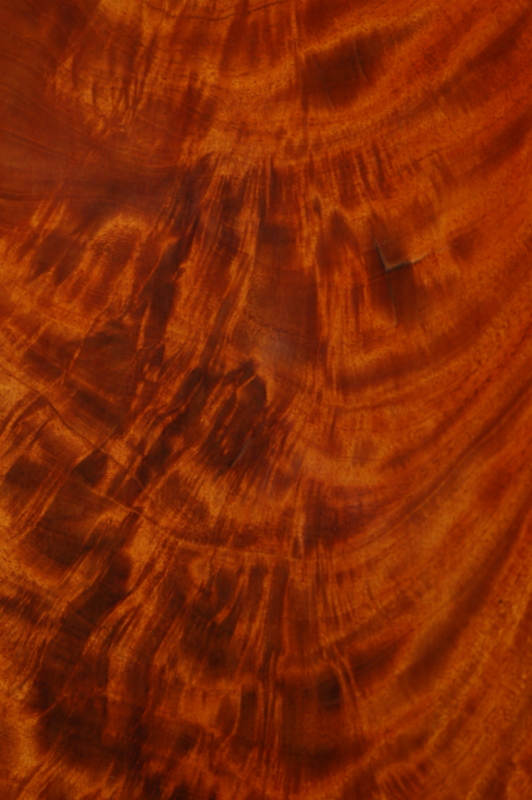
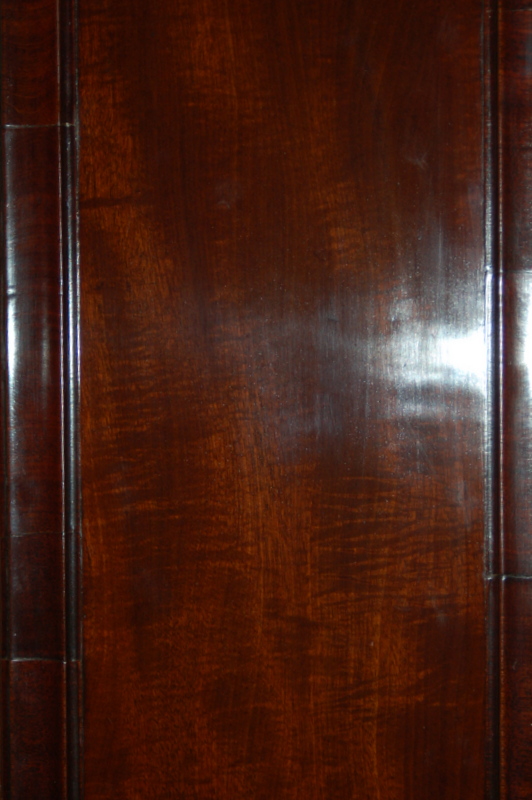
Honduras Mahogany


Cuban mahogany
Plum Pudding (spotted) mahogany

Mahogany can be a beautiful wood, it starts in the UK being used around C1750 and continues being used throughout the 18th and 19th centuries. Two most common variants are Honduras (lighter) and Cuban mahogany (darker). It is a close grain hardwood coming commonly from the South America or the West Indies type regions. This tree can be found quite wide and so large sections could be veneered with this wood.

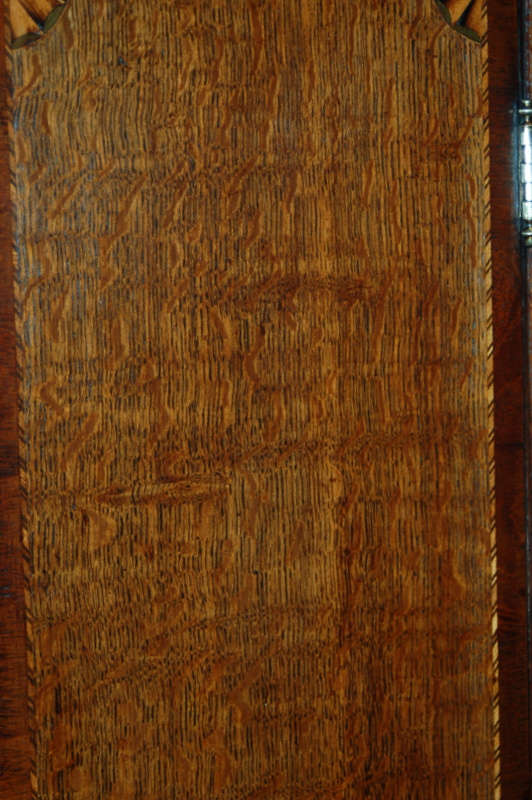
Quarter Cut or star-fleck figured oak
Solid English Oak

English Oak

English oak is a slow growing and so very heavy wood. Used in construction and veneered some of the time, but it is a beautiful wood in its own right. Oak being so heavy and close grained it is good at preventing things like wood worm. It is one of the reasons why London used it in the construction of its clock cases ahead of pine. Pine is used in the provinces as a rule for carcases as it is cheaper. You will notice the weight difference between an antique clock veneered on oak and an antique clock veneered on pine. Oak just gets better with age and polishing, we call this the patina. Less close grain oak can come from countries like Japan. This wood although called oak, is a far poorer wood to the slower growing English oak.

The climate effects the grain of the wood

English Burr Walnut
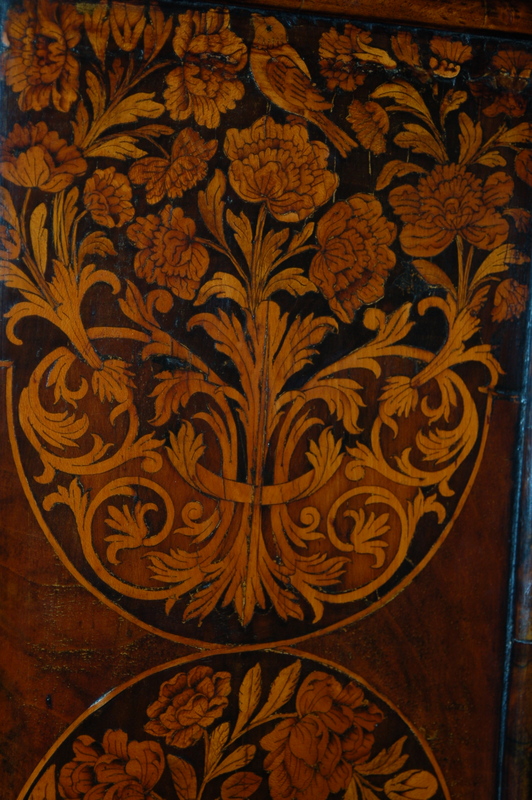
Marquetry inlay on English Walnut
Marquetry on Walnut
Continental walnut


Walnut is a lovely wood and English walnut gets used as veneers in antique furniture and clock manufacture up until C1750. After this date most walnut used is Continental walnut. Continental walnut is a quicker growing tree and so the grain is never as fine as English burr walnut. Again English walnut is a very heavy wood with a close grain. The tighter the burr or knot in the walnut the better. Walnut can range in colour from quite light if the sun has taken it, to quite dark. Walnut is used on all of the German wall regulators or commonly called ‘Vienna  style’ wall clocks  etc through the 19th century.

Satinwood

Satinwood used as a blank canvass to artists

Satinwood being a very light wood was used towards the end of the 18th centuries and early 19th centuries in the main. Many expensive pieces are manufactured with Satinwood veneers. We have some Pergolesi painted tables with satinwood veneers. I suppose the light colour makes the painting stand out better.

Pine

Pine, many of you will be familiar with this wood. It is rare to see a surviving antique grandfather clock made in this wood like the above. It was prone to woodworm unfortunately. Some were painted and this helped preserve them.Many provincial cabinets were constructed out of pine and then veneered. Pine is also used alot today as it is a relatively cheap wood, unlike oak. Clearly as you can see from the grain and if you lifted it from the weight , it is a fairly quick growing tree.

Lacquer or Chinoiserie

Oak can be veneered or painted

Oak was only used on internal construction of cabinets of English London clocks. When this wood was used and if it is not veneered in London you will find it sometimes decorated with lacquer work or Chinoiserie. This is gold leaf and gesso. The best types of these works are seen when they were sent out to China in the early/mid 18th century and decorated their.

I think I have covered the majority of main woods used in English cabinet making. There are others like ewe wood, maple , elm, fruitwood and rosewood. These are not covered as they are used alot less. I hope this blog has been of help to you. If you are still struggling with finding out what wood your clock or piece of furniture is made from, please send me a picture to PendulumClocks@aol.com

Daniel Clements – Pendulum of Mayfair


Posted on

Collecting Antiques

I get asked many times about what I would choose if I was starting a collection of antique grandfather clocks.  We feel privileged in helping many special customers and friends source their own private antique clock collections. The most important part if you are deciding to build your own antique clock collection is to purchase them somewhere you can get a guarantee they are genuine.  I would also take you time in building up this collection, it can not be achieved overnight.

What type of clocks to collect?

I believe the greatest antique grandfather clocks were produced between C1680 and C1820. I am now going to suggest a possible date and styles that you could choose to form this collection. It is true you might prefer a particular style of antique clock and then you could just collect this style. There is nothing wrong in doing this. You may prefer just famous London makers from the 17th and early 18th centuries like Thomas Thompion or Edward East or George Graham. I have no problem in collectors heading down this route.

Broad spectrum of clocks

A route I will suggest here is a broad spectrum of special antique clocks from the entire range of the period suggested above. The collection could be increased still further from what is listed below by different dial shapes or antique clocks from different towns also showing distinctive case features.

Examples of Interest

1)

I think it is important to start your collection with a special early example of a London marquetry brass square dial grandfather clock by a reknowned but not necessary ultra famous maker. This clock will date from around C1690 and be a good ‘8-day’ example, usually with a lentical to the trunk door.

2)

I think next on the list would be a good ‘8-day’ or ‘month’ duration English burr walnut square brass dial grandfather clock, again by a good London clockmaker.

3)

I think it is then important to source a good arch or square brass dial early lacquer clock from C1715. This again will be a London area example.

4)

A burr-walnut arched brass dial caddy top London grandfather clock is also essential to any collection. These tend to date from C1715 to C1750.

5)

A good early arched or square brass dial provincial oak grandfather clock should form part of any collection. These dating from early to mid 18th century. These will be good ‘8-day’ examples with maybe an early ‘penny’ moon feature or automaton to the arch or dial centre.

The clocks do not have to cost the earth.

6)

An early oak or maybe pine 30 hour duration clock with brass square dial would be nice in any collection.

7)

Moving on to my favourite period in antique clocks from C1760 onwards. A good C1770 London mahogany arched brass dial is vital.

8

A superb London mahogany arch white dial  ‘8-day’ grandfather clock.

9)/10)11)

Moon examples of 7 and 8 are also important to any collection, as is an automaton example.

12)

A good Manchester moonphase grandfather clock from around C1770

13)

A typical Liverpool moonphase grandfather clock from around C1770

14)

A typical Bristol tidal times moonphase mahogany grandfather clocks from around C1770

15)

A typical Hull pagoda top mahogany grandfather clock from around C1770/C1790

16)

A good Edinburgh grandfather clock from the end of the 18th century

17)

A good white dial Dundee or thereabouts mhaogany arch dial grandfather clock from C1790

18)

A good London with attached hood columns arched brass dial mahogany grandfather clock.

19)

A good London with attached hood columns square silvered brass dial mahogany grandfather clock.

20)

Various Precision Regulator examples with the differing means of pendulum compensation.


Conclusion

I have tried to form the basis of a wide ranging collection This could be a good tool for you to start building your own antique clock collection.  Clearly there are some great clocks from other provincial towns around the country that I have not mentioned. You can also throw in some special provincial makers like Barber or Ogden or Deacon to the mix. I suppose a wide ranging collection should encompace as many differing cabinet styles from all the areas of the UK. These may also include one from the west coast of Scotland, or Ireland, even though I am not a big fan of the typical 18th century case styles from the these areas.  This is just a personal taste though and one clock from each place as an example would not be out of place in any collection. I suppose this depends on space and finance though. I believe a minimum of 25 grandfather clocks would be required to be purchased to obtain a good overall wide ranging collection. This can then be bulked out if necessary be adding more towns or special collectible makers. Clock collecting can be quite addictive.

– Daniel Clements – Pendulum of Mayfair Ltd 51 Maddox street, London –