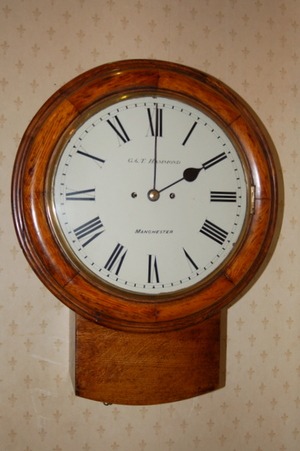
An oak drop dial wall clock. Featuring case of fine colour and patination. In addition 12 inch round painted dial by G and T Hammond of Manchester. Two train fusee movement striking hours.
An oak drop dial wall clock. Featuring case of fine colour and patination. In addition 12 inch round painted dial by G and T Hammond of Manchester. Two train fusee movement striking hours.
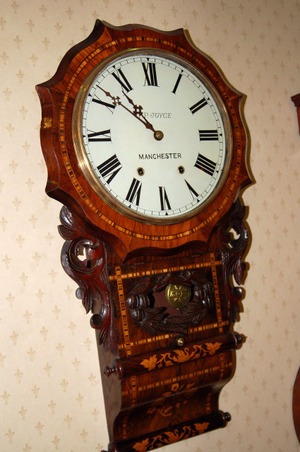
A good ‘8-day’ two train drop dial wall clock by T P Joyce of Manchester. Featuring inlaid American cabinet and painted dial.
Antique grandfather clock cabinet production was separate from the clock maker. The clock maker just produced the fine antique clock movements. As you can imagine communities stayed very much together during the early years and people did not travel long distances. As a result you will notice every area of the country in the 18th century had a very different case style. It is very easy to place the manufacture of an antique clock cabinet from just a very few features on the case.
Further case styles can be found by clicking here.
London cabinet designs changed only slightly during the 18th century. You will see after C 1720 and up to C 1800 usually two plinths, moulding to trunk door and high quality walnut, mahogany veneers or fine lacquer work cases. Examples of this can be seen below. After about C 1800 London clocks can lose the second plinth and the moulding to the door, but you will still see them being quite similar in design. You will also find these close similarities in cases of clocks within 50 miles or so of London. Many clock makers actually bought London style cases in these areas.


You will find many regional designs of cabinets. After looking for a while you will get a good idea of where the clock maker was based from just looking a certain case features. In Scotland for example, especially the East Coast you get some wonderful cases from C1770 to c1810. They are all very slender, shaped top to the trunk door, high proportion base and standing on bracket feet. The most similar characteristic is the swan neck pediments to the hood.


You will also find Manchester, Liverpool and Bristol cabinets to be quite distinctive. In the 18th century these areas were very wealthy, especially because of the trade going on with the West Indies and the USA. Manchester was the birth place for the industrial revolution. Cabinets in Manchester and Liverpool, tend to be quite large with quite imposing features, Og feet, Corinthian columns, fine veneers. You will see a typical high quality Liverpool case below.

Bristol was another very important port in the 18th century and the clocks made in this part of the country are very distinctive. Wobbly doors are very common and scenes engraved to dial are very popular, pierced swan neck pediments and OG bracket feet show the fine cabinet work. Again it is easy to see the wealth in this part of the country in the 18th century, the cases are very flambouyant. Understanding case design and the styles of the various parts of the UK cabinet design is important when looking to buy an antique grandfather clock. You can use this knowledge with further research to pinpoint all those important questions that you need reassurance with, when purchasing antique grandfather clocks. Our shop Pendulum of Mayfair takes all these worries away from you.


EQUATION OF TIME – JOHN TOPPING C.1720
The clock featured here by John Topping is an extremely rare example of the ‘Equation of Time’ calculation. Shown here on an early 18th century Longcase Clock. It is pictured here purely for research within Wikipedia. In addition it is not for sale or any other commercial purposes. People can ask me questions relating to the ‘Equation of Time’ but the clock is not for sale.
We are all aware of the passage of time. Yet we can not see it. Many inventors have tried to measure time. But it was not until the invention of the pendulum that considerable increased the accuracy of clocks. That the calculation of the ‘Equation of Time’ became very relevant to clocks. Before the advent of the long pendulum in the early days. The clocks were very inaccurate and so calculating the difference between ‘solar’ and ‘our time’ would have been of little consequence.The long pendulum was first invented by Christian Huygens. A Dutch scientists in 1656.The oscillations of the pendulum reduced error to less than 1 minute per day. This eventually came to less than 10 seconds per day.
Peter Clare, a clockmaker in the 18th century, who worked in Manchester insisted his clocks were right and the Sun was wrong. A memorial to him reads.
Here’s the cottage of Peter, that cunning old fox. Who kept the sun right by the time of his clocks.
Many people might think Mr Clare’s observations foolhardy, but it would be folly to dismiss them.
The clock pictured here by a maker called John Topping of London. It is a superb month duration. Wwalnut Longcase clock with a dial showing the Equation of Time.With these increasingly more accurate clocks. The difference called the ‘Equation of Time’ became more relevant, and Mr Clare was right to some degree his clocks were more accurate than the sun.
The Equation of Time refers to the difference between the suns time and that shown by the clock. This varies by up to 16 minutes per day during the year. Only on four days in the year is there no difference between the suns time and the time shown by clocks. The days on which the clock and the sun should usually agree are: the 15th of April, 15th of june, 31st of August, and the 24th of December.
Effectively Peters Clare’s clocks were more accurate than the sun. Clearly this is a result of the elliptical rotation of our planet.
The clock by Topping shown below is one of the few clocks ever made showing this calculation on a year calendar. It lets the operator know just how many minutes less or more the clocks time is from the suns time. Effectively making it easy to set your clock in the 18th century by means of a sun dial.
This clock also has the special feature of a spherical moon. Also showing the true shape of the moon. In addition this is accompanied with a tidal times indicator. Also rise and fall of the pendulum. Thus making for changes of seconds to the timekeeping. It is housed in a superb elegant burr walnut cabinet.
Very few clock makers ever had the talent to make such complex clocks. Only the finest clockmakers have examples to their work. These are very few and far between. Thomas Tompion I believe made 3 equation clocks. Topping as listed here made a few, Williamson, who made several equation clocks for Quarre and the maker Gregg.Clearly very few are still surviving today. The complexity of the movement is mind blowing. To sum up a very rare and interesting clock.

I have been a passionate writer on my blog about all aspect of antique clocks over the last few years. I have tried to give the general public much needed information. They can then understand about various different horological matters. Never have I entered any political debates. This blog is to plead with the Scottish people not to give up on our longstanding Union. On 1st May 1707 our two great countries formed the Act of Union. This was passed by the Parliament of England and Scotland following negotiations agreed the previous year.
We have stood together in good times and bad. It is better together than apart I believe. Yes I am English, but I am British as well. I love Scotland and the Scottish people. Is their rivalry when England play Scotland ? Yes there is and I would not expect anything different. Maybe I am different but when Scotland are playing in any tournament to most people. I give my full support to them. I am sure the majority of other proud Englishmen do as well.
You only need to see Andy Murray’s support at Wimbledon. He is a proud Scot, but English people still love him and cheer him on. We have rivalry on a city basis with Manchester United and Manchester City. Like Glasgow has, but we stand together for our national teams. I stand by our great union and I hope the great nation of Scotland wakes up and sends Alex Salmond and this Independence vote packing.
To destroy something so easily that lasted centuries would be a sad reflection on modern day society. Scotlands voice, England voice in the world will be louder together. Further details of this special antique grandfather clock by John Smith.
I could not resist but end this by adding a special antique clock image that brings all this home. It is a lovely clock from a small town in Scotland called Pittenweem. Pittenweem is a small and secluded fishing village tucked away in the corner of Fife on the east coast of Scotland. Look how the clockmaker signed this clock ‘ NORTH BRITAIN ‘. I am sure he was a proud Scot, but he also, a proud Brit as well. This clock dates from around C1790
Daniel Clements
PendulumClocks@aol.com Antique Clocks Twitter


I get asked many times about what I would choose if I was starting a collection of antique grandfather clocks. We feel privileged in helping many special customers and friends source their own private antique clock collections. The most important part if you are deciding to build your own antique clock collection is to purchase them somewhere you can get a guarantee they are genuine. I would also take you time in building up this collection, it can not be achieved overnight.
I believe the greatest antique grandfather clocks were produced between C1680 and C1820. I am now going to suggest a possible date and styles that you could choose to form this collection. It is true you might prefer a particular style of antique clock and then you could just collect this style. There is nothing wrong in doing this. You may prefer just famous London makers from the 17th and early 18th centuries like Thomas Thompion or Edward East or George Graham. I have no problem in collectors heading down this route.
A route I will suggest here is a broad spectrum of special antique clocks from the entire range of the period suggested above. The collection could be increased still further from what is listed below by different dial shapes or antique clocks from different towns also showing distinctive case features.
1)
I think it is important to start your collection with a special early example of a London marquetry brass square dial grandfather clock by a reknowned but not necessary ultra famous maker. This clock will date from around C1690 and be a good ‘8-day’ example, usually with a lentical to the trunk door.
2)
I think next on the list would be a good ‘8-day’ or ‘month’ duration English burr walnut square brass dial grandfather clock, again by a good London clockmaker.
3)
I think it is then important to source a good arch or square brass dial early lacquer clock from C1715. This again will be a London area example.
4)
A burr-walnut arched brass dial caddy top London grandfather clock is also essential to any collection. These tend to date from C1715 to C1750.
5)
A good early arched or square brass dial provincial oak grandfather clock should form part of any collection. These dating from early to mid 18th century. These will be good ‘8-day’ examples with maybe an early ‘penny’ moon feature or automaton to the arch or dial centre.
The clocks do not have to cost the earth.
6)
An early oak or maybe pine 30 hour duration clock with brass square dial would be nice in any collection.
7)
Moving on to my favourite period in antique clocks from C1760 onwards. A good C1770 London mahogany arched brass dial is vital.
8
A superb London mahogany arch white dial ‘8-day’ grandfather clock.
9)/10)11)
Moon examples of 7 and 8 are also important to any collection, as is an automaton example.
12)
A good Manchester moonphase grandfather clock from around C1770
13)
A typical Liverpool moonphase grandfather clock from around C1770
14)
A typical Bristol tidal times moonphase mahogany grandfather clocks from around C1770
15)
A typical Hull pagoda top mahogany grandfather clock from around C1770/C1790
16)
A good Edinburgh grandfather clock from the end of the 18th century
17)
A good white dial Dundee or thereabouts mhaogany arch dial grandfather clock from C1790
18)
A good London with attached hood columns arched brass dial mahogany grandfather clock.
19)
A good London with attached hood columns square silvered brass dial mahogany grandfather clock.
20)
Various Precision Regulator examples with the differing means of pendulum compensation.
Conclusion
I have tried to form the basis of a wide ranging collection This could be a good tool for you to start building your own antique clock collection. Clearly there are some great clocks from other provincial towns around the country that I have not mentioned. You can also throw in some special provincial makers like Barber or Ogden or Deacon to the mix. I suppose a wide ranging collection should encompace as many differing cabinet styles from all the areas of the UK. These may also include one from the west coast of Scotland, or Ireland, even though I am not a big fan of the typical 18th century case styles from the these areas. This is just a personal taste though and one clock from each place as an example would not be out of place in any collection. I suppose this depends on space and finance though. I believe a minimum of 25 grandfather clocks would be required to be purchased to obtain a good overall wide ranging collection. This can then be bulked out if necessary be adding more towns or special collectible makers. Clock collecting can be quite addictive.
– Daniel Clements – Pendulum of Mayfair Ltd 51 Maddox street, London –