Antique Grandfather Clock by Thomas Ogden – Halifax C.1740

Thomas Ogden main

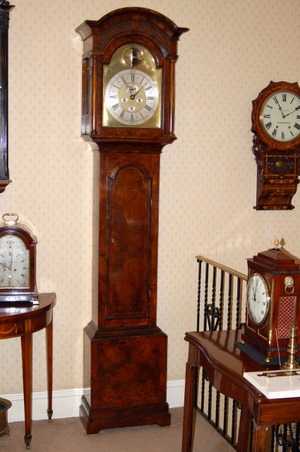
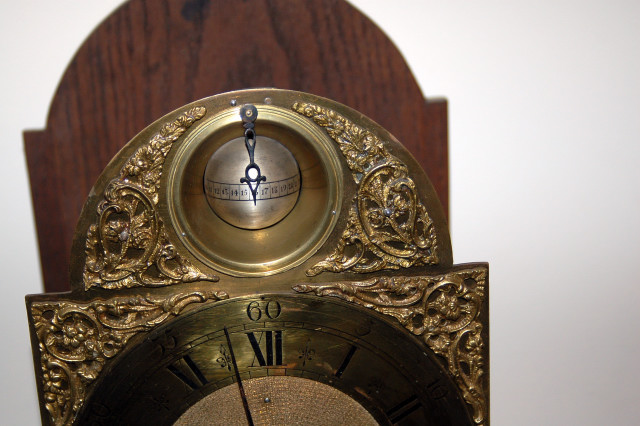
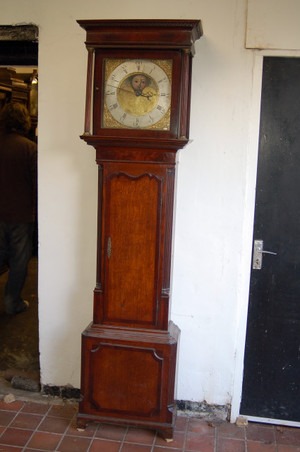
An outstanding ‘8-day’ walnut veneered Longcase clock. Rare clock by this eminent clockmaker Thomas Ogden of Halifax. The cabinet of the finest choice walnut veneers. Including dome top to the hood with fretwork beneath. Long trunk door and standing on two plinths.

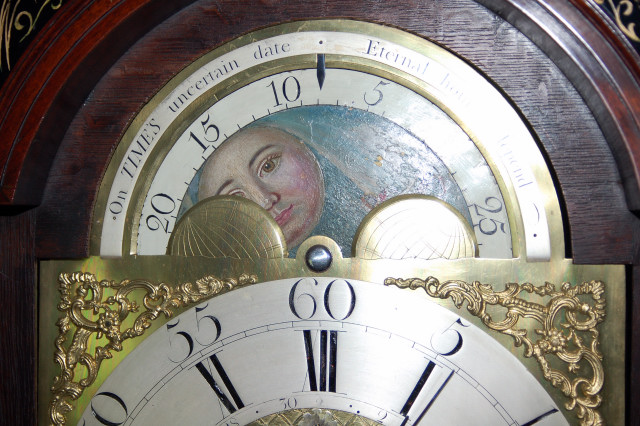
The dial with polished corners, chapter ring and spandrels. Also with spherical moon to arch, seconds and calendar and finely matted centre. Featuring typical high quality brass beading to the edge of dial. Outstanding decoration to winding and calendar apertures. The movement of the finest quality. Three bells for quarter repeat and single bell for hour strike.

This maker is in my opinion, the finest of all northern clockmakers. Many people think on a par with the finest of all clockmakers.

Antique Grandfather Clocks

Posted on

Moonphase Antique Clocks

Moonphase Clock With Tidal Times

We often get asked about moon phase grandfather clocks. Were they just a form of decoration or were they an important feature on clocks? The lunar moon repeats with a cycle of 29.5 days. This is shown on all antique clocks with a moon feature as a result the moon disc moves once or twice per day.

Moon Disc Use On Clocks

On early pre C.1800 examples they certainly were more of a feature that the owner required for a specific purpose. That purpose was first and foremost travel, whether you would be travelling by ship or travelling by road. Knowing when the next full moon was vital part of life back in the 18th century. A merchant might live near the coast and need to know when the next high tide was. This feature will also be accompanied by a moon disc and he could look at his clock. On that day it would say the high tide would be 7am /7pm etc.

Stationary or Fixed High Tide Indicator on clocks

Tidal times are sometimes stationary. i.e. set to the port of the clock. Bristol Key etc or variable by an indicator to the arch which can be set to your local port, high tide time.

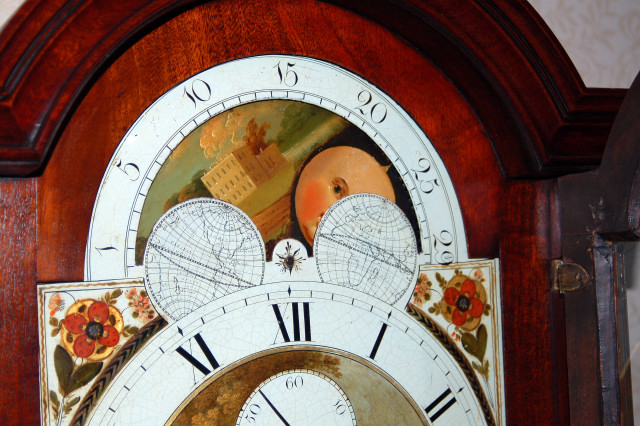
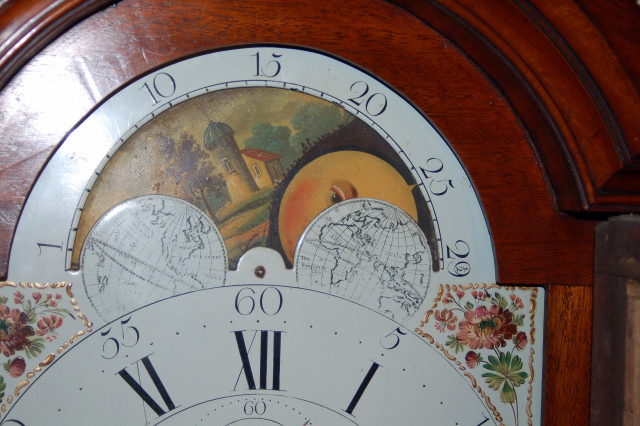
On an 18th century antique clock, a moon disc can either be a  circular disc to the arch or a globe moon to the arch, sometimes called a ‘Halifax Moon’. They also could be, or a small ‘penny moon’ normally to the dial centre. This is where the seconds disc normally would be. Clocks with moon discs and not accompanied with high tide indicators were for help when travelling by road.

Highwayman Higgins

The highwayman was always a risk for the merchant in the 18th century. Tt was always advisable to travel on days with the full moon and lots of light. Generally the highwayman did not work on such nights They were more likely to be recognised. The most famous of northern highwayman was a Edward ‘Highwayman’ Higgins, who was a gentleman by day and a thief by night. He resided on Gaskell Avenue in Knutsford. This is only 5 miles from where our antique clock workshop is based. Higgins was hanged for his crimes in 1767.

London longcase clocks with moon features are very collectible as London had street lighting in the 18th century. Also the arches on London clocks are slightly reduced and not a full semi-circle. They were not really designed for moons.  On provincial clocks you will notice the arch is a full semi-circle and alot more suited to a moon disc. It is for that reason finding a genuine London 18th century clock with a moon is highly sought after. Adding this feature to an 18th century London grandfather clock, can add up to £5,000 to the price on an equivalent clock.

Conclusion

I have been talking above about pre C.1800 clocks and clocks where the dials are 12 inches from side to side or less. Later clocks with dials of 13 inches or even larger are more likely to have moons and are not quite so rare. Clearly lots of later 19th century wider examples can have moons. These are more common and the moon disc on these is more for a form of decoration in my opinion than for any other purpose. We stock a few good examples at Pendulum of Mayfair of moon-phase clocks.

Pictures of different styles of moon dials below

Moonphase feature to square dialstandard moonphase C.1790


penny moon clock


Posted on

Dating Antique Painted Dial Clocks

Dating clocks

Longcase or grandfather clocks were made in Britain from about 1658 and during the first few years their production was confined almost exclusively to London. One of the earliest provincial grandfather clocks I have seen is dated 1689 by a maker called John Washbourn.

Painted dials on the other hand were brought out just after C.1770, these were made to compete with the single sheet dial or one-piece brass dial, that was introduced around C.1760.

I like to catagorize painted dial grandfather clocks into three seperate time periods.

Period 1 – 1770 – 1790

Painted dial manufacture and painting was started in Birmingham by two individuals called Osborne and Wilson. They were in partnership between 1772 and 1777, they later went there own ways producing dials on their own merit, Wilson died in 1809. White dial production became very popular in Birmingham in the 18th century. Towards the end of the 18th century there were a large number of dial painters situated in Birmingham. Most dial manufacturer’s stamp their names on the iron false plate behind the dial. It is true to say Birmingham dominated the market in painted grandfather clock dial production, but there were a few other areas that set-up dial painting and manufacture for example in Halifax and Edinburgh. 

Falseplate

The very earliest dials were attached to the front plate of the movement directly. After a short time, dials were attached by means of an iron false plate. This made it easy for the clock maker to attach his dials. It would not interfere with any part of his movement. Also it meant you could have smaller dial feet, which were therefore more stable and less prone to bending.


The two dials above are exceedingly early white dials and just have the gold leaf decoration to the corners. These type of dials date from about C.1772-1775

Below you will see the second stage of period 1 antique clock dials. Some colour is added to the gold leaf decoration to the corners and arch. These clock dials below date from C1775-C1785

You will notice in London gold leaf decoration and flower to the corners is earlier than the corresponding dials in the provinces. In London new advances were always ahead of their time. Even though dial painting originally started in Birmingham. Early London dials around C1775 will have gold leaf decoration and flowers to the corners. Sometimes London dials have no decoration at all. Also sometimes the chapter ring and the strike/silent ring are porcelain or painted with the rest of the dial left brass.


There is therefore three stages in my opinion of period 1 antique clock white dials. The last stage of period 1 is between C.1785 and C.1795. This is when the dial painter drops the gold to the corners and sometimes a scene is included or a bird.

Period 2 – 1790 – 1810

Period 2 can be mixed in certain ways with period 1 dials. They are certainly in no way inferior to period 1 dials. In fact the two dials I have included here are amazing works of art. I suppose it is the real height of dial design and some of the dials produced certainly in the C.1790-C1800 period are of the finest detailing.

Period 3 – 1810 onwards

I must admit  period’s 1 , 2 and the very start of period 3 white dials are the most collectable. These are of the highest value and my favourite. The two pictured below are very nice clocks both dating from start of the 19th century.  As the 19th century progresses the dials become larger and the scenes not so well painted. Generally if your dial is 13 inches or below and your clock is an antique and not a copy. Your clock will date from earlier than C.1820 as a rule of thumb.

Conclusion

You will also notice the dial progression, the very earliest white dial grandfather clocks are mostly white. As time progresses more of the dial becomes painted. The later you go, the painting gets quite dense. On the later mid 19th century ones, these sometimes are not of a very high quality or very appealing. The dials below are very good period 3 antique clock dials, and still very collectable. The clock dial on the left is a rare oval dial. You will notice most dials produced were either square and arched. Visit our homepage https://www.pendulumofmayfair.co.uk for further information.

Unrestored Grandfather Clock by Barry – Ormskirk

Barry main

Outstanding oak cabinet grandfather clock by Barry of Ormskirk. Late 18th century 30 hour clock. Featuring 30 HR with various special extras. The square dial with chapter ring and spandrels. Polished and engraved centre. Also with centre date and Halifax moon with tidal times. In conclusion a very rare collector’s clock.

Antique Grandfather Clocks

Posted on

What is my favourite antique clock maker?

So many times I get asked the question. When you have so many antique clocks, which one do you like best? It is a very difficult question to answer, as I love antique clocks. I have loved them all my life. There is no one set clock that I can opt for. One clock maker I truly respect amongst all others though.

Clockmaker Thomas Ogden

You might well expect me to go for a special London clockmaker, as so many names run off the tongue. We have Thomas Tompion, the father of English clockmaking. Fromanteel, a very special early clockmaker. Edward East another early and well respected clockmaker. George Graham, Daniel Quare, John Ellicott, a very special maker. Eardley Norton, John Knibb, wow the list is so long and I could include many many more. These are truly amazing clockmakers. You will notice though they are all London gentlemen. It was far easier to get on, produce wonderful clocks in London, than pretty much anywhere else in the 17th/18th centuries.

Why Thomas Ogden ?

After long thought I have decided the workmanship and talents of the Ogden family of clockmakers, and in particular Thomas Ogden Clock . Ogden produced amazing workmanship away from the centre of clock making and knowledge that was London. This makes him my no 1 choice, as a result he certainly has the X factor for me.

Quaker Clockmaking

Thomas Ogden was from a family of Quakers. He was born in C 1693. He initially worked in Ripponden, probably continuing his fathers business. Ogden then moved to Halifax, where he had a shop on the High Street and Upper Swift Place in Soyland. He died with no children in 1769 aged 77.

Superb Quality Workmanship

Thomas Ogden’s work is of the highest quality. He is one of the very few clock makers, that put a half round brass beed, as seen the pictures above, around his dial. No spandrels to the dial is a typical Quaker thing to do. I have been lucky to own a few of his antique clocks. Every one, like the one above, is exacting in every detail. The internal workmanship is not matched in my opinion, especially considering he is not from the establishment of clock makers, that was London in the 17th and 18th centuries.

Globe Moons

He produced some wonderful globe moons or ‘Halifax moons’ ,as they were later called and various world time dials. He is in my opinion the finest of all provincial clock makers and in some ways one of the finest of all clock makers. Pendulum of Mayfair has one such amazing example on its website.