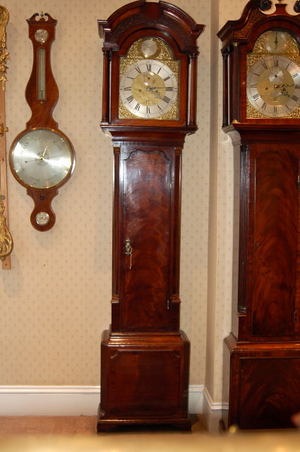
Antique Grandfather Clock by John Collins – Wattesfield C. 1780

John Collins main

A good flame mahogany veneered ‘8-day’ Longcase clock. Featuring arch silvered brass dial by John Collins. The cabinet shown with choice mahogany veneers. Also with quarter columns to the trunk. The single train movement with days of the week and sweep seconds feature. In addition calendar feature to the arch. The high quality movement with dead-beat escapement. A collector’s clock. Fine colour and patination.

Antique Grandfather Clocks

Antique Scottish Grandfather Clock by Robert Green – Edinburgh

Robert Green main

Featured here a good quality C.1790 ‘8-day’ duration flame mahogany veneered Longcase clock. Shown with arch white dial by Robert Green. First of all the elegant proportions Scottish cabinet with boxwood stringing and shell inlay to base. In addition the cabinet with swan neck pediments and bracket feet.The hood with reeded hood columns. Another feature is the fretwork below the swan neck pediments. Including brass paterae to the top of swan neck.

The cabinet showing good colour and patination.

Clearly a good quality eight day movement striking the hours on a single bell.

The delicately painted dial with gold leaf decoration and flowers to the corners. Makers name enclosed with flowers to the arch. Subsidiary seconds and calendar features to the dial. Furthermore the clock with matching ‘diamond’ blued iron hands. To sum up a fine Scottish clock.

‘Old Scottish Clockmakers’, by John Smith From 1453 to 1850 has Robert Green listed working from 1781-1834. On the 3rd November 1781, he was bound apprentice to James Howden. 17th January 1789 he was,’Discharged of his indentures.’ On the 4th May 1793 he,’Compeared and presented his essay. This being a watch movement, begun, made, and finished in presence of James Howden Landlord, Geo. Skelton, David Murray, and John Sibbald, essay masters as they declared, etc.’ E.H.Records. He listed a sale of ‘superior watches and clocks at reduced prices’ on 14th May 1832, as he retired from business.

Antique Grandfather Clocks

Antique Grandfather Clock by Rob. Johnson Woolton C.1760

Robert Johnson Woolton main

A good quality ‘8-day’ mahogany Longcase clock. Featuring an arch brass dial by Robert Johnson Woolton. The break arch top cabinet showing superb elegant design. Also with choice mahogany veneers. Including fantastic fretwork to the hood and the cabinet. Also standing on shaped bracket feet. The base with chamfered sides and raised shaped cross-banded panel. The long trunk door also with fine cross-banding. Lovely shaped top to the door. Quarter columns with wood capital to the trunk.

The dial with maker’s name in a boss to the arch, and the dial centre finely matted. Also with subsidiary seconds and calendar, chapter ring and ‘dolphin head spandrels’ to the arch. Fine shaped blued iron hands.

The fine quality brass movement striking the hours on a single bell.

Woolton is a prestigious middle class superb of Liverpool. Many Beatles landmarks can be found in Woolton, including ‘Mendips’ (Lennon’s childhood home at 251 Menlove Avenue) and Strawberry Field. Another one of Woolton’s claims to fame is that John Lennon and Paul McCartney first met at St. Peter’s garden fete on 6 July 1957.

Antique Grandfather Clocks

Posted on

Is it a music box or is it a grandfather clock ? No its both !

18th century musical grandfather clocks are very rare examples. I will only see a genuine fine example once every few years. In this blog I will be looking at two late 18th century examples. One fine grandfather clock by Joseph Herring of London C1770. Also a superb rare provincial musical clock by Edward Bilbie of Chewstoke C1780 pictured below.

After discussions and research on the Bilbie family of clockmakers. You can see the example on the left is one of the finest provincial musical clocks by this maker. It bears all the hallmarks of what a Bilbie clock should look like. The lovely polished and engraved dial, with the doric columns superbly engraved to the dial centre. The name on a cartouche to the arch finely engraved and either side, a strike/silent feature and 4 different tunes.

Multiple Tunes

The tunes being ‘ Lincoln Time ‘ , ‘ Bath Time ‘ , ‘ 104th Psalme ‘ , ‘ 23 rd Psalme ‘. Why Lincoln Time, Bath Time I can understand as it is 20 miles away from Chewstoke, but Lincoln Time I do not know the reason. Maybe these were customer selections in the 18th century. The delightful engraving to the centres and outer edges of the arch show what fine craftsman Bilbie was. Bear in mind this is a provincial clock, it really is top quality workmanship.

Lovely quality Bilbie Clock

The dial also shows seconds and further delicate engraving around the edge. A calendar to the dial centre, chapter ring and fine gilded spandrels to the corners of the dial. All dials of this period are cast brass, and all the hands etc are worked on by hand. These are lovely quality iron hands which are eventually protected by being blued.

High quality musical movement

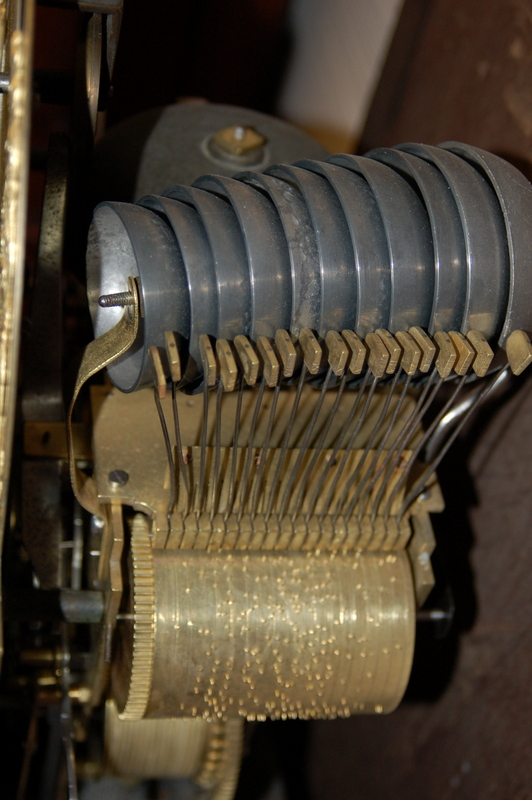
The fine music played by this immense high quality movement is played by means of 12 hammers on 10 bells. This is on a intricate pin wheel barrel. Finding all the right notes for the differing tunes is  so complex. The bells would of been cast by hand. I believe Bilbie did this himself, he had his own foundry , which was very rare. To get the bells so well sounding is a real credit to his talent. You will see a casting mark on the largest bell, but all bells play superbly.

Three train movements

The movement as I have described has 3 trains. One is for the timekeeping , one is for the hours , and the final one is for the music. This plays once every 3 hours. Hence 8 times a day one can wonder at this clockmakers talent. This is not only a lovely furnishing piece but it is a horological work of art as well.

Work of Art

The 8 day movement is also lovely in lots of other ways, everything is built to precision and to a high quality. It is clear high quality pieces were not only built in London. In the pictures below I will show London quality construction, it is very similar to Bilbie’s work here.


Joseph Herring Musical Clock

The pictures are of a Joseph Herring London musical Longcase clock. The only real differences between this and the Bilbie are one of two more hammers and an extra bell and a few more pins to the barrel. Very similar movements, both really high quality 8 day examples.You will see from both, the typical three train layout of the dial on these two genuine examples.

4 Tune Musical

The Herring plays 4 tunes as well, some strange 18th hits at that. ‘ Speed the Plough ‘ , ‘ March in Blue Beard ‘ , ‘ Beggar Girl ‘ , and finally one to top the lot off , ‘ Go to the Devil & Shake Yourself’. Maybe the last could come from a modern day rock song. It is definately a strange title for an 18th century tune. These as you can expect are not listed on Youtube. From this blog no doubt some of our clients, who are rock and pop stars, may make these 18th century classics into modern day hits. Watch this space !

Posted on

The story of the Bristol UK clockmaker Henry Lane.

I will be looking at the start of clockmaking in Australia. The interesting story of the 18th century antique clock specialist Henry Lane. I need to pay special thanks to John Houstone, Kevin Fahy and Bill Bradshaw. The Australian Antique Collector and the Power House Museum in Australia for their help.

From Bristol to Australia making Clocks

I have been associated with antique clocks all my life and I learnt about the story of Henry Lane from one of our clients. Many years ago we had for sale a stunning Bristol antique clock by this maker at our retail antique clock shop in London, Pendulum of Mayfair Ltd. The power of the internet made it possible for a client in Australia to notice this clock and travel all the way from Australia to London, UK. He viewed and eventually purchase this magnificent clock. The clock itself is pictured below.

I hope you will agree it is a fantastic and rare 3 train musical mahogany Longcase clock of ‘8-day’ duration. Lovely typical high quality Bristol cabinet with fretwork beneath swan neck pediments to hood. Reeded chamfered sides with brass stringing to trunk and base.  The dial with high quality matted centre, chapter ring/spandrels, recessed polished and engraved seconds and calendar, strike/silent to arch. Movement of high quality playing 6 different possible tunes every hour.

Henry Lane Started Clockmaking in Australia

As many of my readers are aware there are literally thousands of antique clockmakers. Some you know and some you don’t. Henry Lane was one I did not know anything about, clearly he was not a prolific clockmaker. You could tell though from the quality of this clock, he was a fantastic maker.  The workmanship was of the highest order, and it included some very unusual features. It is rare for one to get a genuine 18th century musical example. Anyone capable of such work, had to be of the highest order. There is nothing really listed in the main clock reference books about him, other than he worked in Bristol and London.  Our client opened my eyes to this interesting story though and I give him special thanks.

Henry Lane Arrested

Saturday, 4th Jan 1800 was the day when Henry Lane’s life changed for ever. He arrived with his companion Mrs Charlotte Holland in Chipping Sodbury on the morning coach from Bristol. Henry paid the fare with a one pound Bank of England bill. He paid another bill with a five pound bill, on both occasions he received change. His companion Charlotte went on a shopping trip, she made payments with similar five pound bills in three different shops. Likewise receiving change in each shop. It was in the last shop that the husband of the last shopkeeper noticed something strange about the bill and correctly deduced it to be a forgery.

Forged Five Pound Notes

She seemed ‘all in a tremor’ , Charlotte was put in custody of a policeman who escorted her to the Swan Inn. Henry walked past this place and was recognized as Charlotte’s companion on the coach. He decided to run but he was caught. Henry tried to dispose of other bills by eating them. One pursuer forced Henry to open his mouth, he found two more forged bills inside. Henry was taken to the inn where Charlotte was kept.

Henry stood trial on the 5th April 1800 and Charlotte on the 30th July 1800. Interest in the trial was large in Bristol at the time and a full transcript of the trial is on public records. This will be given as a reference at the end of this piece. At his trial Henry gave a statement that he had received these notes as a settlement of a debt and he did not know they were forged. His evidence was weakened by the fact he booked the coach in a false name and he had tried to eat the notes when caught, and the fact he had tried to flee.

Sentencing

The judge adjourned and returned by pronouncing a sentence of death.  The Bristol Journal of 19th April 1800 announced ‘the execution of Henry Lane will take place at St Michael’s Hill on Friday next’. The issue of the 26th April reported the sentence had been commuted to transportation for life by Royal clemency. I am not sure what connection Henry Lane had to the Royal family but a crown is engraved to the centre of the arch to this dial !

At Charlotte’s trial in Gloucester on the 30th July 1800 she was also sentenced for transportation for life. Henry left Spithead on the Perseus with 112 other male prisoners on the 12th February 1802 and he arrived in Sydney cove on the 4th August. Charlotte left on the Glatton on the 23rd September, 1802 and arrived on the 11th March, 1803.

Journey To Australia

Henry who at his trial was 50 years of age and had a wife and family. Not much was known about the relationship with Charlotte but it is clear by 1806 Charlotte was living with Henry in Sydney. Charlotte is described to the Governor in 1810 as a ‘housekeeper’. In Rev Samuel Marsden’s Female Muster of 1806, she is described as a ‘concubine’. That is  a woman in an ongoing, marriage-like relationship with a man to whom she cannot be married for a specific reason! Eventually on the 27th October 1813, they married at St John’s Parramatta. The assumption is made Henry’s wife in Bristol, England had died by that time.

I will look at Henry work and life in Australia in my next blog. This is a compelling story I hope you agree. More can be found about the trial by reading the following.

1.The Only Genuine Trial of Henry Lane taken by a Short Hand Writer – Rosser and Co., Bristol 1800


Posted on

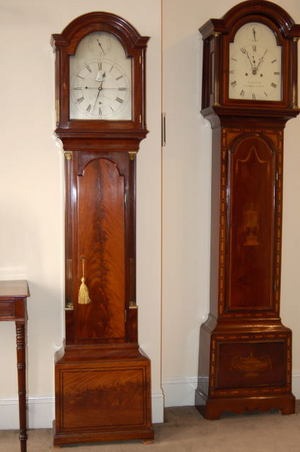
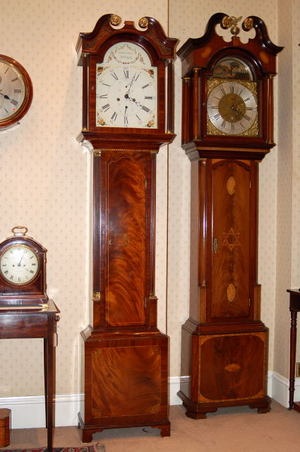
What is my favourite antique clock maker?

So many times I get asked the question. When you have so many antique clocks, which one do you like best? It is a very difficult question to answer, as I love antique clocks. I have loved them all my life. There is no one set clock that I can opt for. One clock maker I truly respect amongst all others though.

Clockmaker Thomas Ogden

You might well expect me to go for a special London clockmaker, as so many names run off the tongue. We have Thomas Tompion, the father of English clockmaking. Fromanteel, a very special early clockmaker. Edward East another early and well respected clockmaker. George Graham, Daniel Quare, John Ellicott, a very special maker. Eardley Norton, John Knibb, wow the list is so long and I could include many many more. These are truly amazing clockmakers. You will notice though they are all London gentlemen. It was far easier to get on, produce wonderful clocks in London, than pretty much anywhere else in the 17th/18th centuries.

Why Thomas Ogden ?

After long thought I have decided the workmanship and talents of the Ogden family of clockmakers, and in particular Thomas Ogden Clock . Ogden produced amazing workmanship away from the centre of clock making and knowledge that was London. This makes him my no 1 choice, as a result he certainly has the X factor for me.

Quaker Clockmaking

Thomas Ogden was from a family of Quakers. He was born in C 1693. He initially worked in Ripponden, probably continuing his fathers business. Ogden then moved to Halifax, where he had a shop on the High Street and Upper Swift Place in Soyland. He died with no children in 1769 aged 77.

Superb Quality Workmanship

Thomas Ogden’s work is of the highest quality. He is one of the very few clock makers, that put a half round brass beed, as seen the pictures above, around his dial. No spandrels to the dial is a typical Quaker thing to do. I have been lucky to own a few of his antique clocks. Every one, like the one above, is exacting in every detail. The internal workmanship is not matched in my opinion, especially considering he is not from the establishment of clock makers, that was London in the 17th and 18th centuries.

Globe Moons

He produced some wonderful globe moons or ‘Halifax moons’ ,as they were later called and various world time dials. He is in my opinion the finest of all provincial clock makers and in some ways one of the finest of all clock makers. Pendulum of Mayfair has one such amazing example on its website.

Posted on

How to spot fakes – a brief guide

Buying Clocks Advice

So you have finally managed to take the plunge and purchase your antique clock. There are many antique clocks available on the market but not all are original examples. There is nothing worse than spending lots of hard earned money on something that you later find out to be not what you originally thought. Regularly you will only find out something is amiss when someone knowledgeable visits your home. I have had to break bad news when asked for my comments on many occasions.

When buying an antique clock to purchase from someone you can trust. Finding someone like this is never easy. Try and find someone who is long established and are specialists in this field. Maybe they will offer you a money back guarantee. You should then have peace of mind.

Some restoration will have been carried out on all antique clocks. This should be sympathetic restoration though and not major surgery. I have devised some basic things to look out for below.

Genuine London Antique Clock C.1770

Look. Smell. Feel.

  • Probably the most common part of an antique grandfather clock to have been replaced is the base of the clock. Clocks used to stand on cold, damp floors, and many bases simply rotted away or were attacked by the dreaded woodworm. Clearly the bottom feet or plinth is an acceptable part of restoration but not the entire base section. Easy signs of new bases are when the wood does not match the trunk door. If the figuring of the wood and colour is different be-ware.

    On London and south country clocks the backboard should be old and full length. If the backboard is rotted at the bottom and stops way short of the bottom, this is something to be careful of. If the backboard has rotted away, how much of the base has been rebuilt? In North country clocks, backboards can be made in two pieces from the later part of the 18th century.

  • Style Issues

  • Movements have sometimes been replaced. Make sure the case style corresponds to the makers location. i.e. London mahogany clocks do not have swan neck pediments but dome or pagoda tops. You can look at some good reference clock books for information on what clock cases should look like for different areas of the country. Each area of the UK in the 18th century had a distinctly different style of cabinet feature. For instance London clocks do not use simple oak cases but these are either veneered in walnut, ebony, mahogany or decorated with chinoiserie.
  • Look for Spare Holes

  • Does the dial belongs to the movement? Are there any spare holes in the front plate where another dial has been ? If the clock has a brass dial, this is attached directly to the front plate. Not by means of an iron false plate. (as used on white painted dial clocks) The winding holes on ‘8-day’ clocks are well placed within the centre of the dial These do not spoil the engraving or chapter ring.
  • Dial Features

  • If the clock is an ‘8-day’ example that the clock has a second hand. 99% of all ‘8 day’ clocks should have a second hand to just below the 12 0’clock position. If there is an obvious reason why a second hand cannot be fitted like a ‘penny moon’ feature then this is OK. As a rule though ’30Hr’ clocks do not usually have second hands, and so if the clock has had a later ‘8-day’ movement fitted this is why you should wonder why there is no second hand.
  • Does the age of the movement corresponds to the age of the cabinet? All dials have dating features, for instance inside quarter divisions, type of spandrels. You can date these very easily with good reference books. English walnut cases date from the 17th century up to about 1760. Mahogany cabinets date from about 1750 onwards. Oak cabinets tend to run straight through the 17th and 18th and 19th century’s.
  • Any Packing Under Seatboard?

  • Look for any obvious packing under the seat-board that cannot be accounted for? If the seat-board is old and warped ? A small piece of packing may be necessary.
  • Prior to 1820 all English antique clocks movements should strike on a bell and not a gong. Gong striking is popular around C1900.
  • Look for rub marks from where the weights and pendulum have banged over the years. If you see 1 smooth rub on inside under trunk door and your clock has 2 weights, this is not a good sign. If there are marks on backboard far away from where pendulum is hanging, and the clock is keeping time. Ask what would have caused these marks.

    If the pendulum feather has been changed for a stiffer example, the pendulum height can change slightly This should only be a slight change.

  • Fitting Issues?

  • Investigate whether the dial fits the mask correctly and there are no large gaps. The size of glass should be similar to the size of the dial.
  • Is the face made from 1 piece of brass? This brass prior to C1800 will be cast brass and so thick and thin. The arch section of the dial should be from the same section of brass. If a square dial is later converted to an arch dial case, this is why some dials are made of two pieces.
  • Carved Cases?

  • Finally I have never seen an original fully carved pre C.1820 Longcase clock. The Victorians loved later carving GIII clocks though, and so beware buying one of these examples. Later carving would dramatically effect the clocks value.
  • Conclusion

    I wish you luck in your search. Buying from a recognized antique clock dealer may be slightly more expensive but you will get peace of mind. You should aim to get a money back guarantee that your clock is a genuine antique and a fully working example. It is easy to spend your good money buying a clock with a chequered history. Please take your time and not rush into a decision you will later regret.

    As they say an antique clock is for life and not just for Christmas. In our business we say, hard to find easy to sell. Original examples will provide you will years of pleasure and a good solid investment, Pendulum of Mayfair only sells top quality examples.