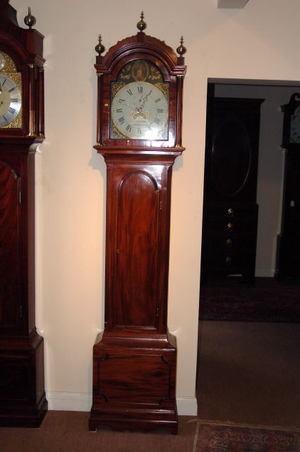
Posted on

30 Hour Clocks

antique cottage clock - 30 hour

30 Hour Country Clocks

My last post was about my most special antique clock makers. I jumped to the support of a superb provincial clock maker at the expense of the hundreds of high quality London makers. In no way was I undermining the great London clockmakers though. We sell more London clocks than any others. I must say we all owe a great deal to the formation of the Clockmaker’s Company in London. The Clockmaker’s Company set standards high and as a result we have lots of special clocks. The UK and London became the centre of clock-making in the 18th century. It is something I am very proud of.

I do think there is a place though for the simple 30 hour clock produced in the provinces. London looked down on the simple 30 hour in the 18th century. No 30 hour grandfather clock examples I believe were produced here after the about C1700. They thought the same of oak cabinets. You will not see a genuine oak London longcase clock I believe, all these were veneered in walnut/marquetry or in figured mahogany, or decorated with chinese lacquer work.

Antique 30 hour clock

Clockmakers Company

The Clockmaker’s Company kept standards in London high. Provincial 30 hour clocks though have a character of there own. In the 18th century you still had to be well off to own a grandfather clock. They were normally the most expensive item in the household.

lovely 30 hour dial

30 hours clocks can have a single hand or two hands to tell the time. Most examples do not have a second hand. For a 30 Hour clock to have a second hand it would need a extra wheel in its train or it would run backwards.

Original 18th century 30 hour oak or pine clocks that have not been altered or have not suffered from the dreaded rot or worm infestation are rare though, many have lost parts of their bases over the years or had their movements converted from 30 hour to ‘8-day’ examples. Both of these dramatically effects the value and I would not recommend purchasing one of these.

wilson 30 hour clock

If you own a cottage though there is nothing better than a simple oak ’30-hour’. You will find they will be very reliable and will fit in with the low ceilings in a cottage much better. Most collectible ’30-hour’ grandfather clocks will have either 10 or 11inch dials, this makes them smaller and slimmer than their standard ‘8-day’ equivalent.

Most of these clocks are wound with a rope or chain, since this rope or chain is on a continious loop, the clocks weight is always engaged when winding. This means that the clock will not stop or lose time during winding. This is effectively the same as ‘maintaining power’ on the fine regulator clocks. They will strike on the hour and it is the same weight that drives the time or going side and the striking side. This is partly why the clock will only last one day on a wind. If you put a clothes peg on the flywheel of the strike mechanism, a 30 hour clock would normally last for about 3 days before needing to be wound.

Conclusion

If you do decide to take the plunge and buy a collectible 30 hour after reading this. Make sure you buy from a recognised dealer. They will give you a money back guarantee that the clock is genuine. Remember to enjoy your search for your grandfather clock whether that be a simple 30 hour clock or a ‘8-day’ example.

As with all antique clocks you are only a custodian of them for future generations. They with live long beyond us if cared for properly.

Posted on

Dating Antique Painted Dial Clocks

Dating clocks

Longcase or grandfather clocks were made in Britain from about 1658 and during the first few years their production was confined almost exclusively to London. One of the earliest provincial grandfather clocks I have seen is dated 1689 by a maker called John Washbourn.

Painted dials on the other hand were brought out just after C.1770, these were made to compete with the single sheet dial or one-piece brass dial, that was introduced around C.1760.

I like to catagorize painted dial grandfather clocks into three seperate time periods.

Period 1 – 1770 – 1790

Painted dial manufacture and painting was started in Birmingham by two individuals called Osborne and Wilson. They were in partnership between 1772 and 1777, they later went there own ways producing dials on their own merit, Wilson died in 1809. White dial production became very popular in Birmingham in the 18th century. Towards the end of the 18th century there were a large number of dial painters situated in Birmingham. Most dial manufacturer’s stamp their names on the iron false plate behind the dial. It is true to say Birmingham dominated the market in painted grandfather clock dial production, but there were a few other areas that set-up dial painting and manufacture for example in Halifax and Edinburgh. 

Falseplate

The very earliest dials were attached to the front plate of the movement directly. After a short time, dials were attached by means of an iron false plate. This made it easy for the clock maker to attach his dials. It would not interfere with any part of his movement. Also it meant you could have smaller dial feet, which were therefore more stable and less prone to bending.


The two dials above are exceedingly early white dials and just have the gold leaf decoration to the corners. These type of dials date from about C.1772-1775

Below you will see the second stage of period 1 antique clock dials. Some colour is added to the gold leaf decoration to the corners and arch. These clock dials below date from C1775-C1785

You will notice in London gold leaf decoration and flower to the corners is earlier than the corresponding dials in the provinces. In London new advances were always ahead of their time. Even though dial painting originally started in Birmingham. Early London dials around C1775 will have gold leaf decoration and flowers to the corners. Sometimes London dials have no decoration at all. Also sometimes the chapter ring and the strike/silent ring are porcelain or painted with the rest of the dial left brass.


There is therefore three stages in my opinion of period 1 antique clock white dials. The last stage of period 1 is between C.1785 and C.1795. This is when the dial painter drops the gold to the corners and sometimes a scene is included or a bird.

Period 2 – 1790 – 1810

Period 2 can be mixed in certain ways with period 1 dials. They are certainly in no way inferior to period 1 dials. In fact the two dials I have included here are amazing works of art. I suppose it is the real height of dial design and some of the dials produced certainly in the C.1790-C1800 period are of the finest detailing.

Period 3 – 1810 onwards

I must admit  period’s 1 , 2 and the very start of period 3 white dials are the most collectable. These are of the highest value and my favourite. The two pictured below are very nice clocks both dating from start of the 19th century.  As the 19th century progresses the dials become larger and the scenes not so well painted. Generally if your dial is 13 inches or below and your clock is an antique and not a copy. Your clock will date from earlier than C.1820 as a rule of thumb.

Conclusion

You will also notice the dial progression, the very earliest white dial grandfather clocks are mostly white. As time progresses more of the dial becomes painted. The later you go, the painting gets quite dense. On the later mid 19th century ones, these sometimes are not of a very high quality or very appealing. The dials below are very good period 3 antique clock dials, and still very collectable. The clock dial on the left is a rare oval dial. You will notice most dials produced were either square and arched. Visit our homepage https://www.pendulumofmayfair.co.uk for further information.

Posted on

The Longcase Clock – Time Measurement

Equation of Time

Time is at the heart of life itself. From the moment we are born, to the moment we die, man has always been intrigued by time. From the earliest days on earth, even pre-historic man lived by a form of time. Life for them revolved around light and dark:  sleep, wake, hunt, eat,sleep again. Life and time are cycles that we cannot stop, we cannot slow. What the early mathematicians and astronomers tried to do was make time more exacting.

‘Water clocks’, ‘candle clocks’, and early ‘sundial clocks’  were developed, many of these in countries like China. It is amazing the evolution of countries over time, China played a huge part in the introduction of many new ideas and inventions, in the early world. It was in the UK that developed the measurement of time and put it in a more practical way.  All these early antique clocks show the passing of time and try and measure it.  Sundial clocks like Cleopatra’s Needle dating from about 1500 BC, was brought to England in 1877 and now stands on the Thames Embankment in London. Forms like Cleopatra’s needle and later sundials all use the elevation of the sun in the sky to tell the time.

Equation of Time

As society developed a more accurate way of measuring time was needed. Sundials, all well and good, are a pretty useless way of telling the time on a cloudy day. Also sundials are not accurate, because of the eliptical rotation of the earth. This inaccuracy is up to 15 minutes per day, sometimes slower, sometimes faster than sundial time. Mathematicians developed a yearly equation of time sheet for these inaccuracies. From this, is was possible to set your clock from these sheets.

Some amazing clockmakers produced this equation of time feature, on a year calendar, on their actual clocks.  Setting you clock in the 17th century was not easy though and many were still not accurate. It was not until the introduction of the long pendulum, invented by Christian Huygens in 1657 did both clocks accuracy increase and more widespread sale of clocks happened. Towards the end of the 17th and early 18th centuries clocks became more affordable.

As many will know as a result of the great book by Dava Sobel – ‘Longitude’, the problem of inaccuracy of clocks, was even more important at sea.

King Charles II founded the Royal Observatory in 1675 to solve the problems of Longitude of sea. The produced a Lunar method of telling time at sea. This could be inaccurate though and had many problems.

John Harrison

As a result in 1714, the British Government by Act of Parliament, gave a reward of £20,000 (a huge prize at the time) to solve the Longitude problem. John Harrison devoted his life’s work to solving this issue, and he produced various chromometers on display in Greenwich, London, these were called H1, H2, H3 and H4 dating from 1730 to 1760.

Longitude

These clocks were fantastic and clearly solved the problem. Harrison though was not part of the establishment at the time, he was a simple carpenter from Lincolnshire. It took him over 10 years to win his prize, and even then, only by the intervention of the King. Harrisons inventions led to the modern day ships chronometer, these were still widely used until the  middle of the 20th century. His inventions led the UK to become an important sea power, and saved countless sailors lives.

Antique clocks were crucial in the 17/18th centuries both on sea and land. During the 18th century accuracy came to within a few minutes a week. It was not until temperature compensated pendulums and other regulator features on the movements, that happened in the latter part of the 18th century, that accuracy came to within a few seconds a week for these precision clocks.

The quest for the measurement of time was in effect solved. Time is central to everyones life, like it was with these great ancestors of ours. Many sayings are taken from these antique clocks, time flies , time shows the path of mans decay, all very morbid, but it is fact. We might have learnt how to measure time, but we can not slow it.

Nothing is so important as time, it is fundamental to life itself. We at Pendulum of Mayfair care for all aspects of antique clocks, please contact me at https://www.pendulumofmayfair.co.uk.

Antique Grandfather Clock by Daniel Dickerson – Framlingham C.1790

Daniel Dickerson main

Featured here a good ‘8-day’ duration mahogany Longcase clock.Case of good proportions. Arched white painted dial by Daniel Dickerson of Framlingham. The cabinet showing South Country design. Also with long trunk door with reeded sides. 2 plinths, moulding to door and dome top. In addition with solid fretwork to hood and finished with three finials.

The movement striking the hours on a single bell. The painted dial with green and gold leaf corners. Also with a painted figure to the arch. Seconds and calendar features to dial centre. Cabinet of good colour and patination. Daniel Dickerson was reportedly locked up in Framlingham castle. This was for swindling several persons out of their watches under the pretense of mending them.

Antique Grandfather Clocks

Hello Duncan,
Just a quick note to let you know the clock arrived safely and soundly on our doorstep in Houston earlier this week and has been keeping perfect time ever since. It is a magnificent piece and we are most happy to have it amongst our growing family of longcase clocks.

Repairs

All the Antique Clocks and furniture sold at Pendulum of Mayfair are restored sympathetically to a high standard at our own workshops. It gives us great pleasure and satisfaction working with antiques and understanding the skills and methods used by these 17th and 18th century craftsmen. Very few of the clocks that we make today will be in working order in 20 years time, let alone 200 years. Our legacy of the 20th century is basically a throwaway society.
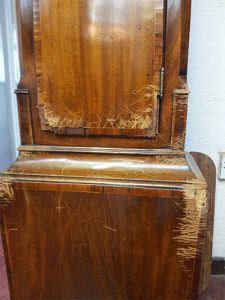
When these Longcase clocks were produced in the 17th and 18th centuries, I wonder if their makers understood that these clocks would last virtually for ever. They were made then to a quality and not to a cost, and designed to last; I only wish their makers could see them still ticking in many homes today.

One would think as a nation our skills would have increased; have they? The skill industries are declining. In the 18th century one of the highest skilled and respected professions was the local clockmaker. We are truly honoured to work on these master timepieces!

Cabinet Restoration

All the basic skills and methods were developed in house by the company’s owner. Just like the olden days we believe it is best to start young and give our youth of society a highly skilled trade and a better future. We consult local schools careers masters and handpick the most conscientious and caring students around. Training lasts for a period of approx. 5/6 years. We take great pride in the finished output of our workshop, even if the item in question is 500, or 50,000,we take the utmost care in trying to produce the best work possible, irrespective of how long it takes.

We do not cut corners; goods only leave our workshop when the owner himself is happy with them. If any part is not to the required standard, the item is sent back and finished to his satisfaction. At the opening of our London shop in November 1995, the head of Sothebys clock department was quoted as saying, ” no business restores their antiques as sympathetically.”

He was able to say this on good authority, because he was shown one clock that he had previously sold unrestored at his auction.

Our methods that we use in our workshop are special; we try and maintain the original colour and patination to give a soft finish. All repairs are carried out with wood of a similar age to the article being restored. We buy distressed antiques to saw up for veneers; this wood is then graded in to types and age, to provide as near as match as possible.

Over the last 20 years we have amassed considerable stocks of material for restoration.

Antique bracket clocks in restoration

We have extensive stocks of over 200 Antique Longcase Clocks available unrestored awaiting restoration. All stock both restored and unrestored is kept in controlled environments for both temperature and humidity. If antiques are bought that have not been previously stored in the correct conditions as above, they are more likely to warp or split, whenever they are subject to central heating. It is advisable to keep antique furniture in R.H. between 40 and 65%.
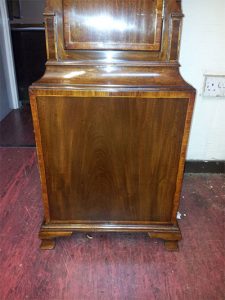
Movement Restoration

Be very careful with whom you entrust your antique clock movement. Most of our time in the clock department is taken putting right what other so called restorers have done in the past. Because of this we like to work on untouched antiques in so called sleepy condition.

Again the work we do on this side of the antiques business is of utmost importance to us. We ship antique clocks to all corners of the world. They have to work properly; all movements are pre cleaned, then all the necessary work is carried out. We do the pivots/bushes, all to close tolerances. The bushes are of the Swiss bergeon type or are made by us out of cast brass, to match the colour of the movement. The pallets are restored with high-grade material, and then all the other necessary work is carried out. There is a final cleaning/polishing stage where we use gloves.

The dials are lacquered using a special colourless lacquer to keep them as clean as possible for years to come. Finished movements are then tested and regulated for timekeeping for 7-21 days. Longcase movements should not need maintenance after we have serviced them for wear for the next 40 years.

They will require oiling every 1-2 years and may require cleaning if kept in dusty atmospheres. Oiling takes 5-10 minutes and is easily carried out by the owner.

Conclusion

High quality restoration of antique grandfather clocks and longcase clocks
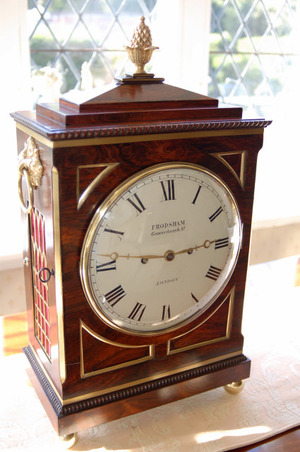
Buying an antique clock( be it longcase / grandfather / tallcase / wall / bracket clock) is a decision you should not take lightly. Whereas you normally buy a car for 3-5 years, a house for 10 years, one of our clocks will still hopefully be in your family in the next Millennium. You will not understand, unless you have owned one of our clocks, the pleasure they bring. Many of our customers have testified that it is like a nice person coming to live with you!

View our antique clocks available online and if you require any further information or references of our work, please contact me.

Daniel.R.Clements

Posted on

Create Your Pendulum Wish list for Christmas

If you could choose any Christmas present, what would it be? For many of us, it might be something beautiful or frivolous that we would never buy for ourselves. For others, perhaps something useful. Well, how about something that is both beautiful and useful, and will also, in due course, become a family heirloom? Have you considered putting an antique clock on your wish list? Pendulum of Mayfair have a range of beautiful antique clocks for sale, ranging from longcase clocks, otherwise known as grandfather clocks, through bracket clocks and wall clocks, to carriage clocks, so you can choose just the right clock for your home and the space available.

Do you want a large freestanding clock? Go for a grandfather clock. If you want a clock for your wall, you can choose either a longer case hanging clock or a round clock, rather like the modern wall clocks now available, but perhaps more beautiful. And if you want something to sit on a table or mantelpiece, have a look at the range of bracket clocks and carriage clocks available. You’ll be sure to find something that will fit the space you have in mind!

Posted on

Antique Clock Descriptions

Antique Bracket Clock
Antique Mantel Clock


Alot of people get confused why there are so many names to describe certain antique clocks. I noticed recently on Wikipedia for a search for Longcase clocks you will see they also get regularly called grandfather or tall-case clocks.

Grandfather, Longcase or Tallcase Clocks

Tall-case is a name commonly used for a grandfather clock in the USA. On the Wikipedia site it also mentions the terms grandmother and grand-daughter clocks. It informs us that the difference is as a result of the height. This is true to some extent as clearly grand-daughter clocks are smaller than their larger counterpart, the grandfather. It would be to simplistic to take this as the only reason for the name change though.

Apprentice Piece or Grand-daughter Clock

For instance if you had a small 18th century oak longcase clock under 6ft, you would not call this a grandmother clock. All 17th and 18th century clocks can only really be described as either a longcase , grandfather or as people from USA like to say tall-case clocks.

The date of manufacture and height is important

The date is also important when describing antique clocks. Grandmother and grand-daughter clocks were really smaller examples produced post C1880. We have some very small C1790 floor standing clocks. I would call these miniature longcase clocks or apprentice pieces. The wording can get blurred here to some extent. It would not be unheard of to call these 18th grand-daughter clocks but I think period grand-daughter clocks (18th century) need to be differentiated from the later counterparts. (19th and 20th century).

Bracket or Mantel Clocks

I would like to finish this blog about the differences between what I call bracket clocks and mantel clocks. Again the easy difference is an age thing. 17th / 18th and clocks up to about C1850 will be commonly called antique bracket clocks. Later clocks from about C1850 to modern day examples are called mantel clocks. All bracket clocks will have English quality fusee movements.

English, German or French Movements

The mantel clocks can have going barrel English, German movement or possibly French movements. From the term bracket clocks you will assume no doubt that the difference is the earlier clocks had a seperate wall bracket that they stood on. This is not the case as only some bracket clocks were produced with actual brackets. Most were put on the large Georgian fireplaces. From a simplistic point of view if the clock has a fusee movement it would normally be called a bracket clock. Most mantel clocks do not have fusee movements.

Fusee Movements

17th ,18th and early 19th  century fusee antique bracket clocks are highly sought after. When they were introduced they were a real technological achievement. They actually were more expensive than the equivalent grandfather, only the top 5% of gentry could afford such clocks.

Daniel R Clements


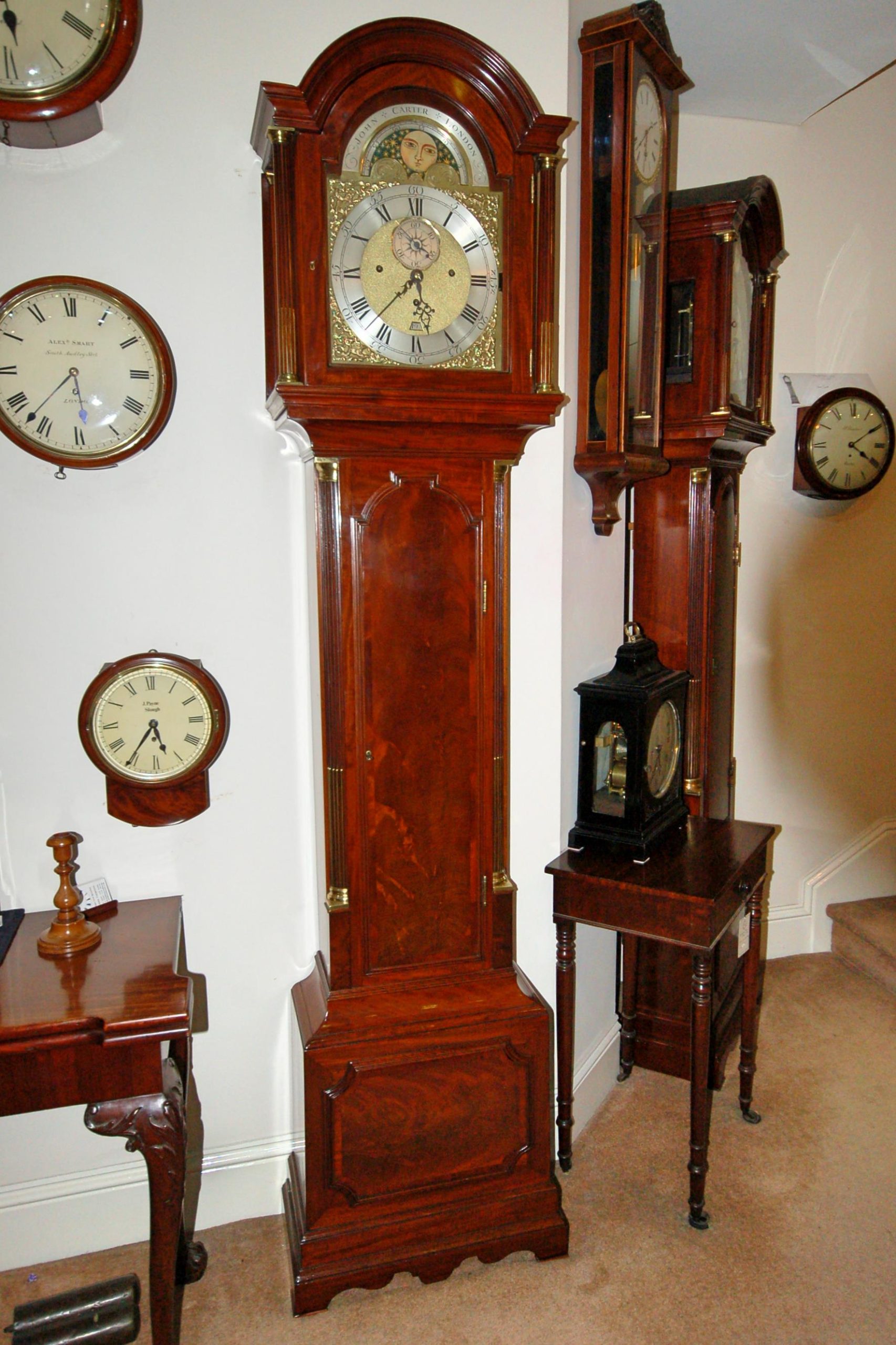
Antique Grandfather Clock by John Carter – London C1770

John Carter london mahogany moonphase to the arch grandfather clock

A superb London mahogany longcase clock with the dial signed by John Carter of London C1770.

The 8 day arched brass dial movement with three train mechanism. Striking the quarters on a peel of bells.

The lovely arched brass dial with chapter ring and spandrels, seconds and calendar features, finely matted centre and rare moon-phase feature to the arch.

The lovey quality cabinet with high quality London case features, quarter columns with brass strung and reeded and brass capitals, dome top to the hood and reeded and brass strung hood columns. Moulding to door and base panel. Standing on two plinths the lower shaped.

A London mahogany clock by John Carter shown in Fig 228/229/230 of the well known clock book Cescinsky and Webster- English Domestic Clocks.

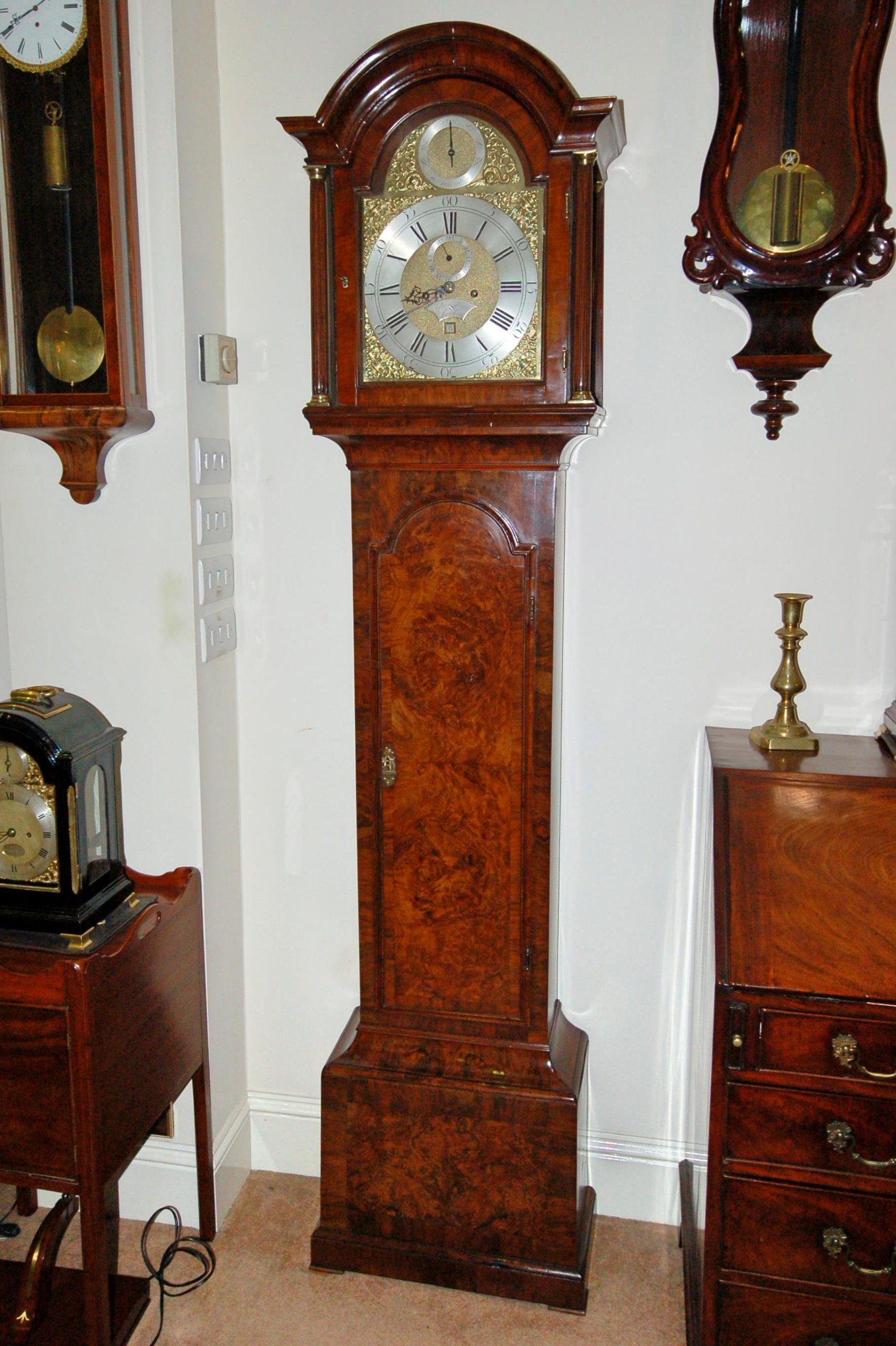
Antique Grandfather Clock by Elias Aylmer Stopes – 1730

stopes walnut clock

A superb example of an early 8 day duration 18th century walnut veneered grandfather clock with arches brass dial and strike silent.

The arch dial with urn and dolphin brass spandrels, finely matted centre, subsidiary seconds and calendar features and strike silent to the arch.

The superb quality 5 pillar movement striking the hours on a single bell.

The outstanding quality walnut veneered cabinet with dome top to the hood and reeded hood columns. Long book-matched veneered and moulded trunk door. Also with cross-banding to the base panel. All together standing on a walnut veneered single plinth.

A clock by this well regarded London clockmaker is listed on page 196 of the reference book English Domestic Clocks by Cescinsky & Webster.A fine choice collector’s clock of superb colour and patination.