Posted on

Shipping Clocks Around the Globe

Exporting our Antique Grandfather Clocks

As a family business we have been exporting antique clocks around the world for the last 40 years. Our main markets over that time have been to our friends in the USA, Canada and Australia. We have also experienced recently exports increasing to countries like China and Russia. Clearly shipping or exporting valuable antique clocks has to be carried out by a specialist firm. Here at Pendulum of Mayfair we use a company called, ‘The British Shop’. We have used them and found them to be absolutely excellent over the last 10 years. We have exported lots and lots of precious antiques with them.

Use a Specialist Antique Shipper

We have had many compliments both on our procedure and our after care support. These add to the wonderful comments about the quality of the shipping provided by the British Shop. I have flown out to the States on a few really high value sales and I have been there to unpack. I must say I have seen with my own eyes the extra care taken in packing.

The British Shop Team

High attention is always given to the crating and packing of your lovely new antique clocks purchase. Once cleared payment is received by us. The clock starts ticking on the process that will see your beautiful new clock purchase keeping time in your home. We first thoroughly check the movement. We wax and check the case. Then the clock is collected by the shipping company to be carefully packed.

Packing Process

The packing process is crucial. The trunk and movement will normally be packed separately in specially made ply-wood crates. These crates will be large, so that they can only be handled with care. The clock is encased in packaging material and then fixed in position within the crate. The clock will not be able to move within the case in transit. We go through the straight forward setting up process when the client is in the shop. Further to this we provide comprehensive setting up instructions. You can fall back on these. They cover ever conceivable aspect of set-up.

Easy Setting Up Process

Also we are always on hand on our Cheshire workshop number 01565722197. We aim to take any queries on set-up until late here in the UK.  Once the shipper collects the clock, all parts of the clock will be carefully listed on a manifest. The clocks trunk, the hood, the movement, the pendulum. The weights, the winding key and finally any door keys and finials are noted.

For our superb range of antique grandfather clocks  that can be in your own home, ticking on the other side of the world, generally within 3 weeks of cleared funds visit us.

Typical Prices

For typical export or shipping prices see below or contact www.pendulumofmayfair.co.uk.

USA – £700-£1,000

Australia £700-£1,400 (depending on sea or air freight)

Canada – £1,000

China – £1,200

For other places around the world please e.mail me for a quote, I will need the dimensions of the item you wish to purchase. I will then forward this information to our specialist shipper. I can also arrange special export discounts for our overseas clients on ticket prices, that will mean in most cases the shipping element will be effectively free.

Daniel Clements


Posted on

André Charles Boulle Clocks

I do not get much chance to look at clockmaking in France as I love 17th and 18th century English clockmaking. Today therefore I would like to concentrate on the great French cabinetmaker whose clock cabinet styles bear his name, André Charles Boulle 1642-1732.

Boulle Clocks

Boulle was considered to be the finest of all in the field of marquetry. He perfected the technique of inlaying brass on tortoiseshell. This became known as Boulle or in the 19th century in the UK as Buhl work. Boulle became chief cabinetmaker to the King of France. He produced all kinds of pieces of furniture for Louis XIV, his family and the court. Boulle was born in Paris and as mentioned trained as a cabinet-maker. He also trained as an architect, bronze worker and engraver. Boulle was not the only cabinet-maker who was working in this field, Jean Bérain also excelled in this area. Bérain designs tended to be more elaborate, both gentlemen were clearly well ahead of their time. During the late 17th century and early part of the 18th century it was very popular in Europe.

Typical Examples

Late 17th century Religeuse Boulle Clock

This superb Religeuse French clock by Pique Rennes can be viewed here. The case of this clock may be attributed to the workshops of Boulle. He was known to have made cases for all the prominent makers of the last quarter of the 17th century. André Charles Boulle was granted lodgings in the galleries of the Louvre by the age of 30. His skill was recognised at an early age. The importance of this honour cannot be underestimated Boulle was granted special Royal favour and this included the important privilege of freedom from the trammels of the trade guilds.

Versailles

He was employed for many years at Versailles. Here the mirrored walls, wood mosaic floors, inlaid panelling and marquetry furniture were amongst his fine work. He had many royal commissions to work on for great nobles. Also government figures vips and many wealthy people in his own country. He was nonetheless always lacking in funds, I suppose his collecting vices always made this be the case. He was always in debt and he died in 1732 full of fame yes but also full of debt.

Boulle clock from late 19th century

DSC_0179
DSC_0180

Superb detailing of Boulle clocks

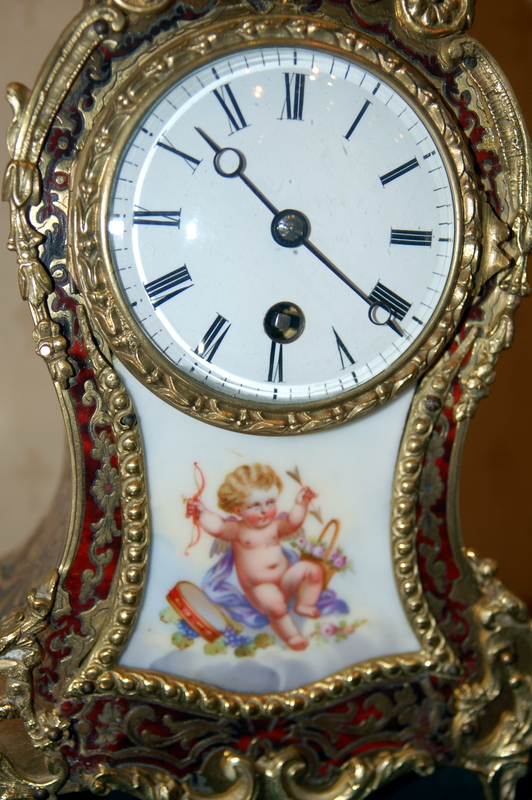
This is a superb example of a late 19th century Antique Boulle Clock . It is a superb example of the very same technique employed by André Boulle two centuries earlier. His name lives on in French clockmaking. They are wonderful collectible antique clocks, this example shows a wonderful porcelain panel with painted cupid.

For further details visit our website.
Pendulum of Mayfair or connect to me on twitter, antique clocks twitter Daniel Clements.

Posted on

Duration of Grandfather Clocks

Antique grandfather clocks tend to be weight driven and go for a specific amount of time on a wind. I will cover the standard examples in this blog. For examples of different types of grandfather clocks please visit our grandfather clock stock page by clicking this link:  Antique Clocks For Sale.

1 Day to 1 Year Duration

The most basic of antique grandfather clocks is the simple 30 hour duration antique grandfather clock. These were made generally for simple cottages in the country. They have simple mechanisms with one weight that drives both the striking mechanism and the going side mechanism of the clock. Since the weight drives both sides of the clock is has more work to do and thus it winds out far quicker. The weight is normally about 8lbs in weight driving this clock.

Lovely 30 hour grandfather clock in oak case
30 Hour Grandfather Clock – Bowfield

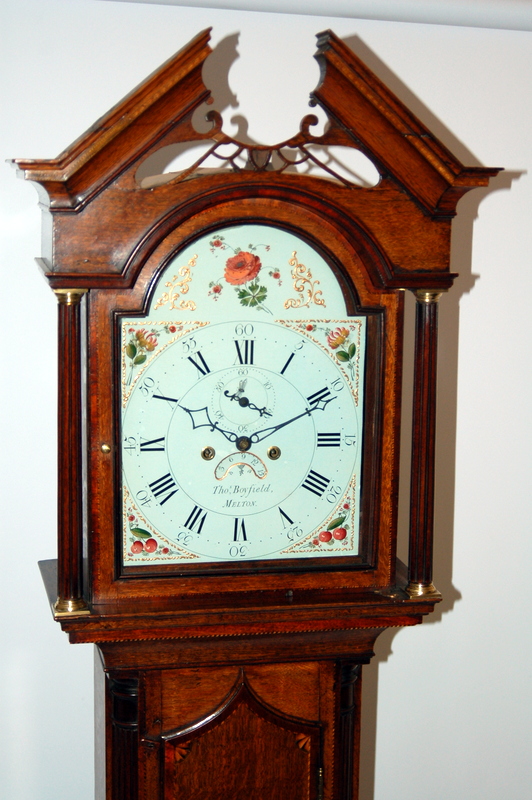
Bowfield of Melton Antique Grandfather Clock.

Most common is the 8 day clock

The most standard of all antique grandfather clocks is the ‘8-day’ grandfather clock. These clocks have a movement split into two separate sides. One weight driving each side. There is a striking side weight and a going side weight. Each weight has its own separate job to do. The movements tend to be 4 wheel train and the weight of the weight is usually around 13lb each. Sometimes higher quality movements run on a slightly smaller weight, as there is less friction involved. An example of a standard ‘8-day’ grandfather clock is found below.

Lovely London mahogany '8-day' grandfather clock
Henry Jenkins Grandfather Clock C1770

Henry Jenkins Grandfather Clock C1770

Long duration clocks

We are now moving into the realms of the rarer clocks. Every so often you come across a month duration or maybe a 3 or 6 month duration grandfather clock. Months duration grandfather clocks have like the ‘8-day’ grandfather clocks two trains for the mechanism. Usually one weight for the striking side and one for the going side. The movements tend to be 5 wheel trains and tend to wind anti-clockwise. The driving force tends to increase dramatically as well. The weights tend to be around 30lbs in weight each one. That is over the double the weight of an ‘8-day’ example. A lovely month clock can be found below.

Cabinet gets thicker construction on long duration clocks

One important point to note is as the duration of the clock increases the structure of the case gets more robust. This is required to cope with this extra weight. The sides of the case get thicker and construction gets all round slightly better to cope. A month case should be heavier than the equivalent ‘8-day’ example.

Long duration marquetry clock C1690
Lovely Month Duration Marquetry Grandfather Clock

Year Duration Clocks

Finally on very rare occasions you will find year duration antique grandfather clocks. We have only ever owned a handful of these very rare clocks. Some examples use the power from two weights to drive the clock. Alot of power is required to keep the clock running. You can also find some examples that will strike. These are generally on the earlier examples. The later Georgian examples tend to more about timekeeping and precision movements. Weights are very heavy in these clocks. Generally they need steel cable to support the weights. Each weight can be over 60lb. A minimum of 6 wheel train and high pinion counts are found of these types of grandfather clock. Clearly only the top makers produced such clocks.

Daniel Clements

Follow my Antique Clock Tweets on Twitter

Posted on

John Topping Equation of Time Clocks

I have had the pleasure to come across this amazing early 18th century ‘equation of time’ clock by John Topping of London. John Topping is not a household name in today’s clock world but he really should be. He built some of the most fantastic complex antique clocks during his time working in London.

Complex Clocks

He started as an apprentice to William Grimes in 1691 and he worked up until his death in 1747. He always described himself as ‘Memory Master’. I am not sure if this was a honour bestowed on him or if it was like a sales and marketing slogan. Either way he produced some exceptional clocks.

Further details of month duration ‘Equation of Time’  John Topping Clock.

Figure 1: Equation of Time John Topping Clock C1730

Equation clocks

The clock above is a fine example by John Topping. A superb early 18th century antique clock manufacturer in London. It is a most desirable combination of a superb and interesting complex movement and a beautiful veneered walnut cabinet. The dial is 12 inch and is signed to a recessed triangular sector, ‘John Topping Memory Master.’  The dial is of a specific elongated dimension to fit the extra large seconds. The rise and fall of pendulum and strike/silent dials is to the arch.

Year Calendars

If you continue down from where the makers name is signed and above the six o’clock position on the dial, you will see a revolving year calendar. On this year calendar there is an equation table allowing you to set ‘true time’ in the 18th century. I will come to what ‘true time’ is later in this piece. The top line of this year calendar is engraved ‘Sun Slower’ or ‘Sun Faster’. The next line gives the months divided into days which are numbered 5,15 etc for each month. The equation and calendar dial is set by a winding square next to the 60 and midday position on the clock.

True Time

You will notice that the winding holes are located above the centre position rather than below centre on most clocks This allows enough room for the equation of time year calendar ring. The thin blued iron strip marks the day of the mont. Then so many minutes faster or slower than a sundial can be read off for calculating actual time. The dial has superbly matted centre, chapter ring, specifically made spandrels and engraving to small sections within the arch.

The seconds feature to the arch is large which is a really nice feature. It also has a sunburst feature cut in the dial to the top centre section. A superbly laid out and designed dial by this wonderful clockmaker. In the picture below you will see how complex the movement requires to be in developing a dial like this.

Fantastic Quality Movement

The movement has a brass centre section and two side sections. From the picture above you can see the cam which lifts and lowers the pendulum for small adjustments to time. You can also see the many pillars used in this high quality movement.

18th century ‘Equation of Time’ table

Equation Table

The table above was sometimes pasted inside some special London clocks when they did not have a proper year calendar. Owners could work out the calculation manually. Clearly full year calendar equation clocks are exceedingly rare. Most likely these cost huge amounts of money. As such probably only a very small amount of these clocks were ever manufactured.

So what is ‘true time’ then ? In the 18th century finding out what midday was was relatively easy, a sundial could be used. The problem comes as this is not ‘actual time.’ As a result of the elliptical rotation of the earth. Clocks were sometimes slower or sometimes ahead of this sundial time. A good explanation and for the science minded of us can be found on the Wikpedia Equation of Time Page.

Daniel Clements

Follow my antique clock tweets.

Posted on

British Automaton Clocks

Daniel Clements – www.pendulumofmayfair.co.uk

Antique clocks with automaton features, have been built for many thousands of years. You can go back back as far as Roman times to get a mention. The engineer Vitrivius describing alarm clocks with a gong or trumpet feature. From the these primitive automaton’s I am heading for some of the earliest automaton features on antique grandfather clocks.

John Lamborne Cambridge

This superb ‘8-day’ early 18th century burr walnut veneered antique grandfather clock with automaton is by a Cambridge maker called John Lamborne. Further details of this special antique grandfather clock by John Lamborne can be seen by clicking on the link.

This clock dates from around C1720 and is a very rare example of an early automaton on a grandfather clock. The soldiers in the arch move and ring the bell when the clock strikes the hour. This automaton like some of the earliest automatons known works from the striking mechanism.

Clearly the heavy figures to the arch require the power driven from the weight of the clock when striking. An interesting feature on the dial of this clock, is the plaque by the order of the Patentee No. 5. This clocks feature automaton must have been patented.

Cuckoo Clocks

When most people think of automatons they probably will first think of cuckoo clocks.These became fashionable in the 19th century and most examples manufactured were from around C1860. These types of clocks are still manufactured today. The earliest cuckoo clock can be seen around the mid 18th century. Not many from this period still survive today. The automaton bird will again work off the striking mechanism of the clock.  It takes alot of power to drive this type of automaton and so most cuckoo clocks are only of 1 day duration.

I am now going to look at what most people will see or understand by automaton. Automatons work from the pendulum on antique clocks. These type of automaton features swing back and forth with the movement of the pendulum. They can be directly off the pendulum or off the anchor which is driven by the pendulum. These automatons therefore work continually and not just on the hour.

Edwards of London Automaton

More details of this stunning C1790 automaton antique grandfather clock by Edwards can be found here, Edwards Automaton Antique Grandfather Clock . The automaton features a man chopping down the ‘tree of life. The axe moves back and forward as the clock ticks. Various other automaton features you can also find to the arch. I have seen see-saws, rocking swans, rarer badminton automatons like the one pictured below. Adam and eve depictions are found. Others like rocking ships are the most common form of automaton on a clock.

British Naval Power

The British were clearly an important naval power. Many owners like to have a depiction of a rocking boat to the arch. Some depicting famous sea battles. The clock below represents one of these very battles.

The clock above is a superb C1790 Scottish antique grandfather clock and more details again can be found but clicking on this link, Scott Edinburgh Automaton Grandfather Clock .

Grantham Automaton Clock

More details of this exceedingly rare automaton antique grandfather clock here. Grantham Automaton Antique Grandfather Clock .  This clock features an automaton game of Badminton. It is very rare and is again working from the pendulum / anchor. It is a glorious antique clock with wonderful mahogany veneers and of 8 day duration.

Adam and eve Automatons

The clock above is a superb arched painted dial with ‘Adam and Eve’ automaton to the arch.  Adam and Eve depictings usually involve automaton arms holding the apple. Sometimes even the serpent moving on the tree. This clock dates from C1780 and is in a lovely mahogany cabinet.

It is important to note automaton antique clocks of any sort, especially on pre C1800 clocks are rare. I have seen many examples that are faked. Care must be taken if purchasing one of these. I would only recommend buying from a dealer who will give you a money back guarantee that the clock is genuine.

Conclusion

Rare features like automatons can be found on clocks sold at Pendulum of Mayfair. This can add alot to the price. It is relatively simple in some cases to add this feature on a standard clock. Unscrupulous dealers will do this for profit. I have seen many such examples on the market. My advice is to only buy from a long established expert like ourselves. Willing to offer a guarantee that the clock is genuine.

Daniel Clements Follow me on Twitter

Posted on

Leicestershire Clocks

When it comes to Melton Mowbray, I suppose everyone thinks of one thing. Yes the town is famous for pork pies. Back in the 18th century the town of Melton in Leicestershire had some very good clock makers.

Thomas Boyfield Melton Mowbray

Thomas Boyfield was one of those very able watch and clock makers. The cabinet design is very similar to those cases known manufactured by Deacon of Barton. His records were found and are now situated in Leicester Museum. Samuel Deacon being a famous antique clock maker to come from this area.

Samuel Deacon

Clearly alot of information is known about Deacon through finding all his records. However, I am listing here a clock by Boyfield of Melton. Researchers can see the similarities in case design and the dial design. The dials were decorated in Birmingham. Unless you knew alot of information about Deacon clocks, you would think the clock I have pictured here is by Deacon himself.

Centre for Clock making

Leicestershire has always been recognised as an important centre for clockmaking in the 18th and early 19th centuries. I would recommend a visit to Samuel Deacons preserved clock workshop in Barton Leicestershire. It is a real eye opening experience. Leiecestershire museum also has alot of extra information of the clockmakers from this area. Therefore I would recommend a trip here. From my knowledge I can not remember many spring driven clocks from the county of Leicestershire. Deacon and other makers really only produced weight driven clocks.

Case Designs Leicestershire

You will notice the typical Leicestershire top to the door that you will see on clocks from this area. It is true that pretty much every area of the country had its own particular case design. Features like this top to the door are distinctive. Experts will only need to see this, to tell you where the clock was manufactured. This clock is of a lovely colour oak and with mahogany cross-banding and box wood fan inlays and chequer-board stringing. Quarter columns to the trunk and the typical hood design used on clocks like Deacon sold can also be seen.

Posted on

Servicing mechanical clocks

I have wrote a few blogs that I hope you enjoyed about antique cabinet restoration. Clearly antique cabinet restoration once carried out properly is a once in a lifetime operation as a rule. Antique clock movements meanwhile need to be cleaned and serviced at least every ten years.


Horology Department

All antique clock movements at Pendulum of Mayfair are properly serviced by trained high quality horologists. The movements are completely taken apart, cleaned and any necessary bushing & pallets re-facing carried out. Normally there will also be other repairs to undertake. Especially if the movement has not been properly services in the last 20 years.

Many clients believe if the clock is running and has been doing s,o this is sufficient. Dried out oil tends to mix with dust and other foreign bodies to become a grinding paste. Unless the movement is cleaned every 10 years or so this grinding paste can cause undue wear. This will also mean that when the next service is carried out extra work is required.

Service your clock every 10-15 years

It will normally take our horologists a couple of days to complete an overhaul of a grandfather clock mechanism. This only needs to be done every 10-15 years. Therefore a small price to pay to keep your antique clock in full working order and in tip top condition. Please only entrust your antique clock to the finest horologists. We have had our own workshop for over 40 years and all our staff are trained to the highest standards. We undertake work for Embassy’s, major London hotels and for many vip’s. Many clients have shipped their grandfather clock cases and movements back from the States. Then this work can be carried out by us. Poor quality restoration and repairs not to the highest standard can effect the value of your antique clock.

For more information Coppelia Antiques

Posted on

Superb antique restoration projects over the years

We have restored lots of special pieces of antique clocks and furniture over the years. Many of these fine pieces can be viewed at our London antique clock shop, Pendulum of Mayfair in London. We have also restored many grandfather clocks and smaller clocks. These for large banks, famous hotels and various other institutions in central London. The lovely thing about restoring antiques whether it is a grandfather clock or a smaller item, is every repair is different.

Every clock repair is different

The only thing that remains the same if it is an intricate repair is the lovely comments you receive when the repairs have been carried out properly. The transformation of an item into showroom condition makes restoring very rewarding.

It is with great shame over the years there are hardly any proper courses on restoring. There are few antique movements or cabinets courses available in our great universities. These courses used to give a great grounding for young students.

Appeal for more Technical Courses

I now can only recall a couple of courses available in which you can study horology. In this country, one of them being at West Dean. It is with this in mind that all our staff have had to be taught in house by our owner Roy Clements. From humble beginning in a small village in Cheshire, we now have one of the foremost restoration facility’s in the UK. This has mean over the last few years we have even undertaken the restoration of many clocks. For special places like the Russian Embassy in London.

Famoous Places we have been asked to restore for

The Russian Embassy Residence clocks were great projects for us. More important was to meet such wonderful new people. His Excellency the Ambassador Alexander Vladimirovich Yakovenko and his wife were amazing with us and so were his staff. We will always treat them as friends and thank them for being so hospitable to us. It is very hard in one generation to meet important people like this and be honoured with the responsibility. To be entrusted with the restoration and repair of important clocks, but it shows this can be done. Nothing is not achievable if you work hard enough and are dedicated in what you do.

Examples of Cabinet Restoration

I have listed a lovely piece of antique cabinet restoration below. I wrote some time back but it is a clear idea of what needs to be done in restoring items properly. Always give you items to be restored to a professional. Sometimes poor repairs and restoration can destroy the value of any antique.

Daniel Clements

Posted on

British Summer Time – clocks change

I am an antique clock fanatic and have loved antique clocks and everything about time all my life. I presently run our family business Pendulum of Mayfair Ltd in central London and Cheshire. Various people have looked at changing the clocks time over the years. Most have been unsuccessful in convincing enough people. Either because the changes affect Northern England or Scotland or by people not understanding the major benefits. The system below would benefit pretty much everyone I believe.

Changing time

My proposal is very clear and easy, and will greatly improve most people’s lives. In understanding GMT it is very simple. The hours of daylight are roughly split into the same hours before midday as after. I believe this is fine when there are shorter hours of the day in winter and GMT should remain during the Winter.

Winter and Summer Time

I do believe it works when there are around 16 and ¾ hours of daylight in summer. This spread of time equally between morning and afternoon no longer works for modern living. This is why we have British Summer Time. I believe this should be further enhanced . Sunday March 31st and Sunday October the 27th should remain as the allotted days for changes but British Summer Time should be +2 not +1 (you can call it Double British Summer Time) We will be at the same time as Europe for these months. If you look at the sunrise times for middle England under GMT on the 18th June it is 03.46 under +1 at present this would be 04.46 under my system this would be 05.56. Still early for sunrise, but we will gain by an extra 2 hours of daylight throughout the summer (instead of 1), saving on electricity, enhancing peoples lives.

The need to change

The latest sunset would be 22.31 under this proposal. The economic benefits and peoples health benefits from the extra daylight are considerable. I am sure this would gain the massive support of the majority of the population if this was put to them under a referendum.
Daniel Clements from our London antique clock business , I would welcome your views. Follow my antique clock tweets on twitter.

Posted on

Classic Wall Clocks

Are you interested in buying a new wall clock for your house? Have you thought about maybe making your new clock an old clock, and buying a classic wall clock? Pendulum of Mayfair have a great stock of antique clocks. We have plenty of beautiful wall clocks that will enhance any home, modern or older, contemporary or traditional in style.

Wall clocks have been around since at least the late 1700s, and Pendulum even have an early wall clock for sale, from around 1795. It has a lovely 12 inch brass dial, and was made by William Mills in London. Imagine owning a clock that has been working since around the time of the French Revolution. Perhaps it even graced the walls of an escaped aristocrat! It’s worth paying a bit extra to buy that little bit of history, even if you have to imagine the story for yourself. And If you’d like a clock from slightly later, there are plenty available from the mid-nineteenth century, in sizes ranging from 8 inches to 16 inches in diameter, many with mahogany cases, but some with oak. You’ll be spoilt for choice!

Browse the selection of beautiful antique clocks available online, or for more information, call 0207 629 6606 or email pendulumclocks@aol.com.