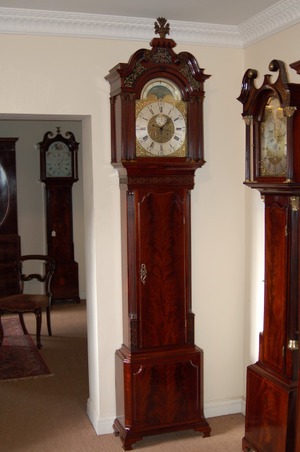
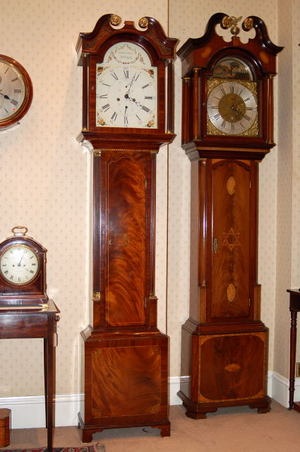
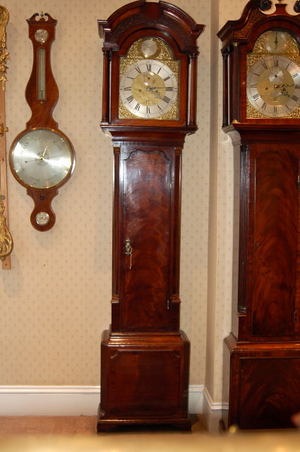
Shown here an outstanding mahogany Longcase clock. Featuring here a 13 in arched brass dial example by Joseph Finney. Clearly of the finest quality by this eminent maker. The dial showing sweep seconds and centre calendar. In addition polished and engraved centre, chapter ring and spandrels. Also with moon feature to the arch. The superb quality ‘8 day’ movement with a magnificent and rare ‘pin wheel’ escapement. Beautiful quality flame veneered mahogany cabinet. Superb colour and of the highest quality construction. Joseph Finney is highly regarded. Furthermore he is probably the finest maker to come out of Liverpool in the 18th century. To sum up a superb collector’s clock.
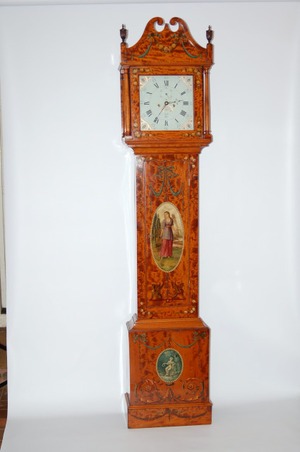
A lovely and rare finely painted satinwood grandfather clock. Featuring an arched white dial by Gill of Rye. Decorated in the manner of Michael Angelo Pergolesi. The square white painted dial showing gold leaf decoration to the corners. Also seconds and calendar to the dial centre. In addition the movement striking the hours on a single bell. ‘8-day’ duration movement.
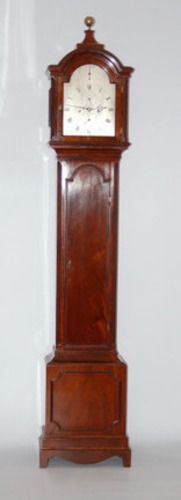
A special ’10inch’ dial ‘8-day’ longcase clock with high quality movement. Shown with arched silvered by London maker Josiah Emery. The movement with dead-beat escapement and maintaining power. The dial with seconds and calendar. In addition strike silent feature to the arch. Clearly lovely flame mahogany veneered cabinet. Also with typical London high quality design. Good colour and patination. To sum up a rare collector’s clock.
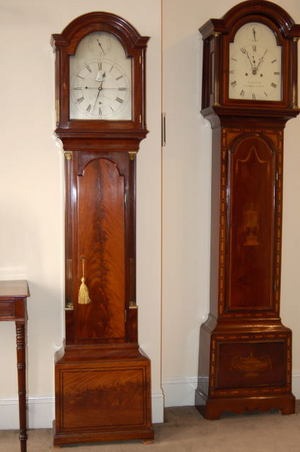
A good flame mahogany veneered ‘8-day’ Longcase clock. Featuring arch silvered brass dial by John Collins. The cabinet shown with choice mahogany veneers. Also with quarter columns to the trunk. The single train movement with days of the week and sweep seconds feature. In addition calendar feature to the arch. The high quality movement with dead-beat escapement. A collector’s clock. Fine colour and patination.
Featured here a good quality C.1790 ‘8-day’ duration flame mahogany veneered Longcase clock. Shown with arch white dial by Robert Green. First of all the elegant proportions Scottish cabinet with boxwood stringing and shell inlay to base. In addition the cabinet with swan neck pediments and bracket feet.The hood with reeded hood columns. Another feature is the fretwork below the swan neck pediments. Including brass paterae to the top of swan neck.
The cabinet showing good colour and patination.
Clearly a good quality eight day movement striking the hours on a single bell.
The delicately painted dial with gold leaf decoration and flowers to the corners. Makers name enclosed with flowers to the arch. Subsidiary seconds and calendar features to the dial. Furthermore the clock with matching ‘diamond’ blued iron hands. To sum up a fine Scottish clock.
‘Old Scottish Clockmakers’, by John Smith From 1453 to 1850 has Robert Green listed working from 1781-1834. On the 3rd November 1781, he was bound apprentice to James Howden. 17th January 1789 he was,’Discharged of his indentures.’ On the 4th May 1793 he,’Compeared and presented his essay. This being a watch movement, begun, made, and finished in presence of James Howden Landlord, Geo. Skelton, David Murray, and John Sibbald, essay masters as they declared, etc.’ E.H.Records. He listed a sale of ‘superior watches and clocks at reduced prices’ on 14th May 1832, as he retired from business.
A good quality ‘8-day’ mahogany Longcase clock. Featuring an arch brass dial by Robert Johnson Woolton. The break arch top cabinet showing superb elegant design. Also with choice mahogany veneers. Including fantastic fretwork to the hood and the cabinet. Also standing on shaped bracket feet. The base with chamfered sides and raised shaped cross-banded panel. The long trunk door also with fine cross-banding. Lovely shaped top to the door. Quarter columns with wood capital to the trunk.
The dial with maker’s name in a boss to the arch, and the dial centre finely matted. Also with subsidiary seconds and calendar, chapter ring and ‘dolphin head spandrels’ to the arch. Fine shaped blued iron hands.
The fine quality brass movement striking the hours on a single bell.
Woolton is a prestigious middle class superb of Liverpool. Many Beatles landmarks can be found in Woolton, including ‘Mendips’ (Lennon’s childhood home at 251 Menlove Avenue) and Strawberry Field. Another one of Woolton’s claims to fame is that John Lennon and Paul McCartney first met at St. Peter’s garden fete on 6 July 1957.
I must get asked numerous times every day the question, What is my clock worth ? Well to answer this it depends on a variety of factors before even looking at the clock in question. It depends on whether you want a replacement or insurance value. You may want to know what I will get for my antique clock in an ‘as is’, un-restored condition. These values will be significantly different.
Insurance, As Is or replacement Value?
For an insurance valuation. It will be a value of what you would need to spend if you had to replace the clock with a similar example from a dealer. Clearly buying an antique clock from a dealer like ourselves is completely different than buying a clock from an auction. Reputable dealers give guarantees to the clock condition, it will have been examined, cleaned, restored and put into showroom condition. The clock will be in good working order and it will come with a guarantee.
Huge Difference in Values
Dealers will sometimes deliver and setup the clocks in your home. None of these guarantees or working order or showroom condition factors come with clocks sold in auction or most times on ebay. On average it takes 3-5 days to restore a grandfather clock movement. 5-10 days to restore a cabinet. When you add up this restoration, you will realise clocks in auction are not necessarily that cheap. They are not restored but also they are not guaranteed genuine most of the time.
Buyer Beware at Auctions
It is buyer beware for buying at auction. Normally the conditions in the backs of the catalogues give the auctioneer a massive get out clause. Reputable dealer does not have this. So expect a valuation for insurance to be several times the rate of a simple buy it now valuation. Also it is good to remember auctioneer valuations does not mean you will get that for the item. You will have to take into account auctioneer fees for selling. These can mount up. You could receive 1/3 or even less than what the buyer paid for the goods. You may also have to wait several weeks for your money.
Family Heirloom
It may be the case your antique clock is a family heirloom and the value of it is not really the issue. You may be dividing your family estate out and need to know a rough price for the estate. You may want to more about the clock and any information on the maker that is available. I will endevour to help you with any research on your clocks value and information. Contact me directly at Pendulum of Mayfair Ltd. Please send reduced sized images and do not expect a formal valuation. I will try and do this for free of charge for you. My love is for antique clocks and I will go out of my way to help individuals as much as I can. Clearly these valuations I will carry out for you are only to give you an idea. You may need formal valuations, these are chargeable however.
Fluctuating Valuations
When I undertake valuations, yes I will need to know the type of valuation you require. Valuations as described above these can differ greatly. There are lots of criteria when performing a valuation of a clock. The most important factor for me is the clock is genuine and in good but honest condition. Value would be significantly reduced if the dial is not original to the movement or the movement is not original to the cabinet. Some clocks have led a very chequered life.
Condition
Either damp homes or central heated homes have sometimes meant clock cases have been ruined. These will then be furnishing clocks but not have as great an ‘as is’ value. Clearly some times important makers add to the value of the clock, but on valuing you must be sure the clock maker is genuine to the clock.
As you can see the valuation is not an easy one but if you want to contact me now, if you have always wondered about your clock, feel free to do so.
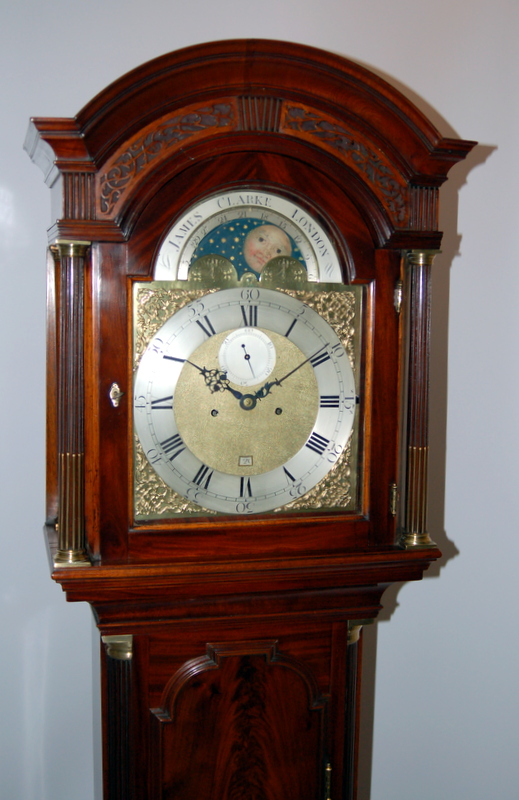
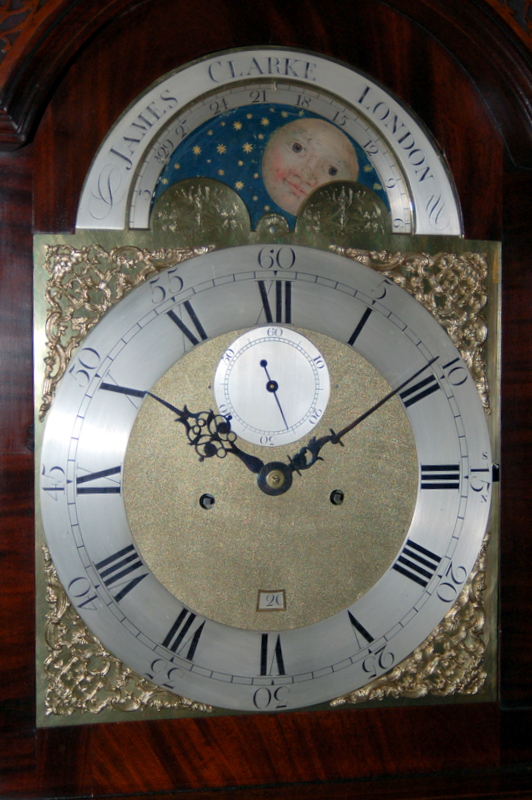
James Clarke London Grandfather Clock with Moon feature
A while back now I wrote a blog about moon-phase antique clocks. We restored this superb antique grandfather clock by James Clarke of London. I thought it was important to write a little more. More about London mahogany moon-phase clocks in particular and why they are so rare and sought after.
Lovely moon-phase James Clarke dial
London clocks with Moons
This clock above is a simply beautiful example of a London moon-phase clock. You will notice the high quality matted centre to the cast brass dial. Chapter ring and spandrels and subsidiary calendar. Recessed seconds feature and lovely engraving to the moon discs to the arch. The name is prominently engraved to the cartouche around the arch. It has beautiful painted moon disc and a special extra feature of strike/silent lever to the three o’clock position on the dial.
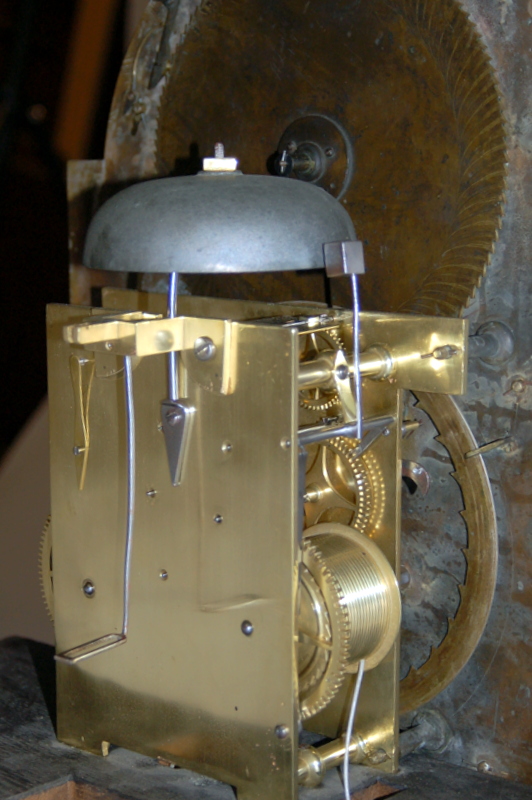
Lovely 8 day moon movement by James Clarke of London C1770
Moon Workings
The picture above shows the beautiful workings of this James Clarke 8 day antique clock. You will notice one large extending piece of brass for the front plate top. This is so that the dial feet can miss the moon disc. Lovely high quality 5 pillar London movement, all now beautifully restored back to showroom condition.
I will now return to why so few London clocks have moon features.
Reasons why there so few London clocks with Moons
I suppose there are two main reasons. The first reason which is an important point to start from is the size of the London dials. Provincial 12 inch dials tend to be 17 inches high which would allow for a full semi circle to the arch. Easily enough space for a feature like a rotating moon disc. On a London clock the height is 1 inch less. That means on a 12 inch wide dial, the height of the dial is only 16 inches. The space to the arch is now no longer a full semi-circle and far more restricting. On the dial above you will notice the arch is not a semi-circle. The cartouche around the arch tapers to the centre.
Trading outside London
The second reason is centred around the fact that London is London. Trading in the UK outside London was not really required back then There were plenty of wealthy clients in and around London. Moons generally were required to check when to travel. Generally merchants would travel on and around full moons, so the risk of the Highwayman was not so great. Clearly some clocks like those with high tide, will also occur sometimes with moons.
High Water Tidal Clocks
Knowing when your high tide in your local port like London bridge was also important for the merchants. Travelling around London with the fact they had good street lighting fired by oil lamps after 1750 was not so hazardous. Knowing when the next full moon was, was not really as important.
As discussed in my other blog about moon phase clocks, there were lots of different types of moon. It is the rolling moon like that on the James Clarke clock that was the most popular. Two moons appear on these discs, but only one can be visible at any one time. Generally on London clocks the moon is accompanied by a starry sky rather than country scenes on provincial clocks.
29 and a half days in a lunar month
There are, as previously discussed, 29 and a half days in a lunar month. We divide up the 12 months into either 31, 30,29 or 28 days to compensate. The exact lunar cycle is 29 days, 12 hours, 44 minutes and 2.8 seconds I believe, I hope my memory is right ! The clocks moon as it is 29 and a half days and is therefore fairly accurate, once set !
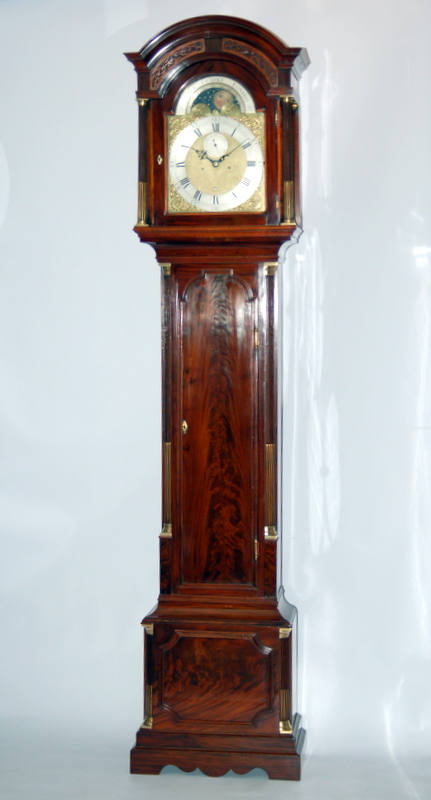
Full length picture of the James Clarke London mahogany clock
James Clarke Clock
The James Clarke antique grandfather clock picture above shows what a top quality clock should look like. The dial and movement show amazing high quality features and detailing. The case shows only the finest London case making features of the late 18th century. Quarter columns and brass capitals to the base. Moulding to bridge top door and base and 2 plinths are but some of these lovely features. To view this clock please visit our shop in London, Pendulum of Mayfair or contact us through our website https://www.pendulumofmayfair.co.uk . James Clarke is listed as working in Newgate Street, London and was apprentice in 1760 and a member of the Clockmakers Company from 1768-78.
I have written many pieces about different types of antique clocks. In my next few blogs, I would like to concentrate on clockmaking from different parts of the British Isles. My first port of call is to the great country of Scotland. As I speak this great country is still part of the United Kingdom. Fingers crossed after over 300 years of being together, it will still be part of the United Kingdom come September 2014.
Clock Makers from North Britain
A great reference book on this topic is Scottish Clockmakers. This is written by John Smith, this charts the development of clockmaking in Scotland from 1453 to 1850. In this book it shows the importance of the Hammermen in Scotland. An organization governing antique clocks and various other trades. In London, clocks were produced by the rules governed by the Clockmakers Company. By 1650 clockmakers started increasing in Scotland.
Hammermen
This was when the clockmakers started being recognized by this branch of the locksmith trade, the various Hammermen Incorporations. The clockmakers were recognized as a branch of the Hammermen in Aberdeen.
Below I have given some but by no means all of the leading lights of Scottish antique clockmaking in the 17th and 18th and 19th centuries. Apologies to those makers I have left out, as the list is very long.
Quality Clock Makers in Scotland
There were a number of very distinguished Scottish makers: such men as Humphrey Milne Edinburgh; Andrew Brown,1665-1712 Edinburgh; Alexander Brownlie 1710-39 Edinburgh;James Cowan, 1744-81 Edinburgh;John Smith Pittenweem unknown-1814; Thomas Gordon; Thomas Reid 1762-1823 Edinburgh; James Howden and son 1764-1842 Edinburgh;Laurence Dalgleish; Alexander Dickie 1762-1808 Edinburgh; Alexander Cumming 1733-1814 Edinburgh /London; finally Dallaway and sons Edinburgh 1785-1812 being but a few of them.
Dial Painters in Scotland
The last entry on this list deserves a mention even though they are not strictly clockmakers. Dallaway produced nearly all the white dial grandfather clock dials in Edinburgh during the end of the 18th century. In England this was carried out in Birmingham by Wilson and Osborne.
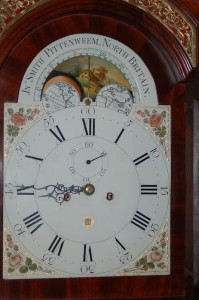
John Smith Pittenweem
There are some very special names on the list above, John Smith produced some amazing clocks from a tiny fishing village called Pittenweem in the 18th century. You will notice most of the other top makers come from the major towns like Edinburgh. To produce the spectacular clocks that John Smith did in such a tiny place miles from anywhere is astonishing. He deserves special mention. He has clocks in Royal collections and there is a superb example pictured below. The case I believe was purchased from a London case maker on John Smiths only recorded visit to London. A really rare example.
Lovely Scottish Cabinet Work
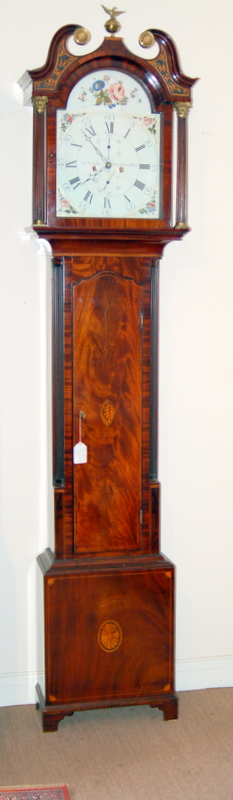
The finest Scottish Grandfathers clocks from the middle to the end of the 18th century had there very own distinctive elegant case style as shown by the clock pictured by the top clockmaker below.
You will notice superb case design on the Pre C1800 antique clocks from the east coast of Scotland. The clock above is from Prestonpans is a small town to the east of Edinburgh, but for all account is classical Edinburgh case design for the period.
East Versus West Coast Scotland Case Making Style
Antique Clocks from Edinburgh and further through Perth and Dundee to Aberdeen case design is really good. I must admit in over 40 years of seeing clocks to the west coast of Scotland though the case design is not the finest in this vicinity. Whereas we have owned and sold hundreds of clocks from Edinburgh, Perth and Dundee, we have only wanted to own one clock from Glasgow in all that time. Most of the time the grandfather clocks from the west coast are not so elegant. The hoods tend to be not greatly proportioned. It is in my opinion clocks from cities like Edinburgh and the east coast of Scotland managed to find some of the best proportions in case design of all clocks, and Glasgow case design some of the worst.
Case style changed in every town
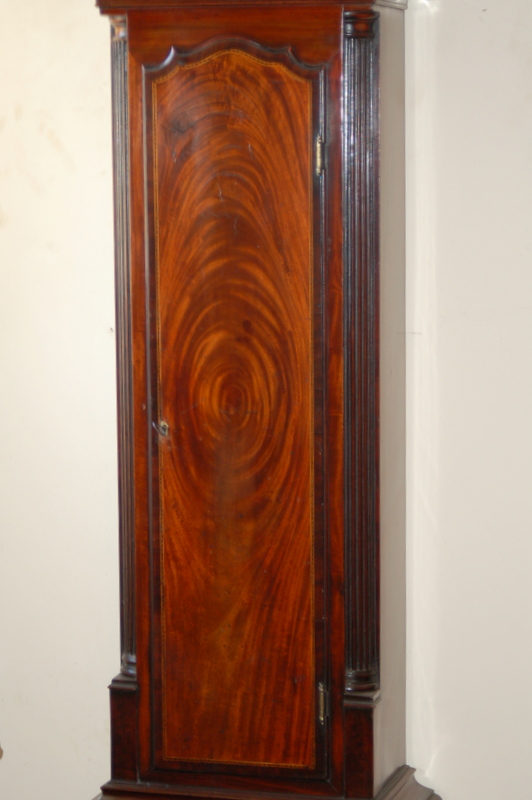
The contrast in design is very large but I suppose everyone’s taste is different! In the picture below you will see the lovely figuring of the mahogany to the trunk door. Many Scottish examples have this twirl to the trunk door from the tree veneers. A lovely feature, quarter columns etc make the elegance of the Scottish cabinets even better. You will not go far wrong in choosing an antique grandfather clock from Scotland, especially if it was made pre C1800 and from the east coast of Scotland.
Lovely Trunk Door from a Edinburgh Clock C1790
Conclusion
We also stock a superb selection of Scottish antique clocks. Most of them pre C1800 but occasionally we have a lovely later Scottish clock like this one from a small town called Old Deer. You can find this clock by clicking here: Old Deer Scottish Antique Grandfather Clock.
I am sure I am not alone in thinking the ticking of antique clocks holds some mystical or mesmeric fascination.
Time in Motion
Watching time in motion was also a fascination of our forefathers. It was with the technological advances in the glass making industry, that movements could be housed surrounded by simple glass domes. These domes were essential to cover these mechanical time masters. Dirt and dust always needs to be kept to a minimum in all mechanical devices. In Britain from the start of the 19th century clock makers produced some lovely, highly visable clocks that were called skeleton clocks.
Visible Movements
By their very name these movements were stripped out down to the bone. Making their full workings of the clock on show. Up to then most movements had been hidden away from view. Such beauty should be admired and on show and not hidden away. The birth of the skeleton clock appeared from C1820 and continued throughout the 19th century in England.
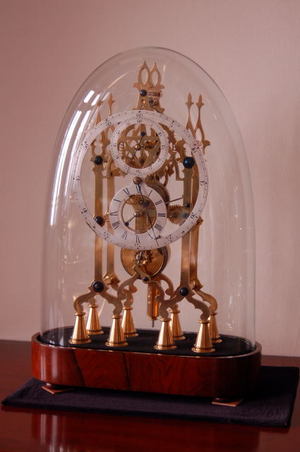
Lovely Early 19th Century Fusee Skeleton Clock
Beautiful Movements
As you can see from the antique clock above. The clock has been designed to show off the quality of the movement as much as possible. The plates that support the wheels were made as delicate as possible to show off the wheel work. The dial is made up of the separate parts. The hours ring, seconds ring and minutes ring. These would normally be on a solid brass silvered dial but this would of hidden the movement, and so individual rings are made for each separate time aspect.
Inverted Y frame Skeleton Clocks from France
In France at the time skeleton clocks were also being made.They tended to use inverted Y frames for the posts, whereas more elaborate structures tended to be used for English skeleton clocks. At the start the inverted Y frame can be also seen on the some English examples. This soon changed to more elaborate designs. Also the superb fusee was used on the English clocks, this is by far the best means of time-keeping for a spring driven clock.
19th century fashion
As the 19th century developed two train or striking skeleton clocks were produced. Also skeleton clocks that depicted well known buildings. Three train skeleton clocks were produced. The music copied some of the bell sounds from building clocks at the time. Clearly with two train or especially three train movements it gets harderand harder to see the individual wheels inside. The simplicity has gone and I suppose these are produced more as a statement of the clock makers talent. This shows just how complex these movements could be. The quality workmanship being highly visable but more as a wow overall feature.
Single Fusee C1860 Skeleton clockSkeleton clock dome removed
Further details of this single fusee skeleton clock above can be found on our website below.
Conclusion
The production of fine skeleton clocks lasted throughout the 19th century. This probably peaked in the years after the Great Exhibition of 1851. In the period from 1860 to 1880 many lovely skeleton clocks were manufactured. These were sometimes on ebonized bases, walnut, mahogany or rose-wood bases or sometimes on marble bases. By around C1900 not many skeleton clocks were produced. Fashions changed from the slightly more elaborate designs of the Victorian period to the more simple Edwardian era, which is such a shame. These lovely clocks were then seen mostly in kit form through the 20th century and far poorer examples produced. With the clocks we sell, we like to stick to higher quality 5 or 6 spoke wheel work. The more rudamentary late examples in kit form tend to be just robust 4 spoke wheel work and very simple design plates.