Posted on

Antique Novelty Clocks


I have featured previosuly many antique clocks from the 17th/18th and 19th centuries. As you probably know I am not a big fan of most 20th century clocks. There are still some fun clocks made during this period though and I will focus on a few here. The clocks I will be discussing here are so-called novelty clocks.

Art Deco Clocks

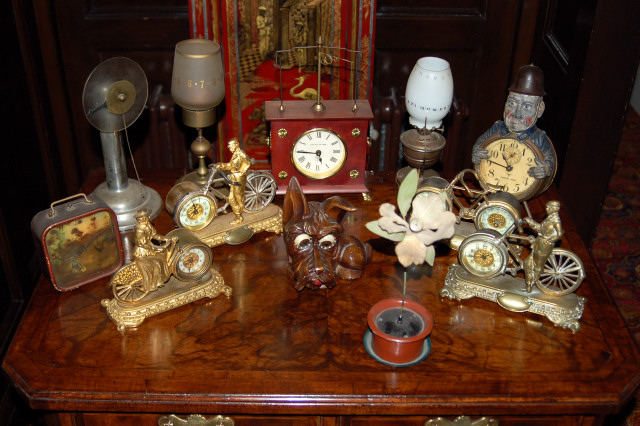
You will see from the picture above there are lots of things you can collect that are really fun and interesting. We have a selection of bicycle clocks, one of these even has a barometer in the back wheel. You can occasionally see such items on your travels. As with anything collectible you will probably expect to pay from about £500 to £750 for a nice example dating from the beginning of the 20th century.

You will notice candle clocks, oil lamp clocks and clocks where the eyes tell the time in the case of the dog. Clocks in the the form of a policeman, where the helmet is the alarm bell. There is an unusual petal clock, where the centre of the flower is the time and the mechanism is in the plant pot.

Collecting fun clocks

I hope you agree these are all very interesting and highly collectible antique clocks. Such items are increasing in value. If you start collecting and form a nice collection your money will be well invested. Our business can will advise in this regard.

Personally when I was young I used to collect Art Nouveau Balloon clocks. I have amassed a large collection of these over the years. My passion started when I was about 13 and have loved antique clocks all my life. I grew up in a family antique clocks business with its own in house antique clock restoration department. I had to either love antiques or hate them.

Conclusion

The more you understand about antique clocks, the more you love them. My advice is to start collecting when you are young. Learn from those willing to give you good advice and soak up all this information like a sponge. It is really rewarding now giving back to others all I have learnt over the years and I hope you continue to enjoy my blog.

Posted on

Regional Characteristics of Antique Grandfather Clocks

Antique grandfather clock cabinet production was separate from the clock maker. The clock maker just produced the fine antique clock movements. As you can imagine communities stayed very much together during the early years and people did not travel long distances. As a result you will notice every area of the country in the 18th century had a very different case style. It is very easy to place the manufacture of an antique clock cabinet from just a very few features on the case.

Case Styles on Antique Clocks

Further case styles can be found by clicking here.

London cabinet designs changed only slightly during the 18th century. You will see after C 1720 and up to C 1800 usually two plinths, moulding to trunk door and high quality walnut, mahogany veneers or fine lacquer work cases. Examples of this can be seen below. After about C 1800 London clocks can lose the second plinth and the moulding to the door, but you will still see them being quite similar in design. You will also find these close similarities in cases of clocks within 50 miles or so of London. Many clock makers actually bought London style cases in these areas.

London Case Styles


Scottish case styles

You will find many regional designs of cabinets. After looking for a while you will get a good idea of where the clock maker was based from just looking a certain case features. In Scotland for example, especially the East Coast you get some wonderful cases from C1770 to c1810. They are all very slender, shaped top to the trunk door, high proportion base and standing on bracket feet. The most similar characteristic is the swan neck pediments to the hood.


North Western UK Case Styles

You will also find Manchester, Liverpool and Bristol cabinets to be quite distinctive. In the 18th century these areas were very wealthy, especially because of the trade going on with the West Indies and the USA. Manchester was the birth place for the industrial revolution. Cabinets in Manchester and Liverpool, tend to be quite large with quite imposing features,  Og feet, Corinthian columns, fine veneers. You will see a typical high quality Liverpool case below.


Bristol was another very important port in the 18th century and the clocks made in this part of the country are very distinctive. Wobbly doors are very common and scenes engraved to dial are very popular, pierced swan neck pediments and OG bracket feet show the fine cabinet work. Again it is easy to see the wealth in this part of the country in the 18th century, the cases are very flambouyant. Understanding case design and the styles of the various parts of the UK cabinet design is important when looking to buy an antique grandfather clock. You can use this knowledge with further research to pinpoint all those important questions that you need reassurance with, when purchasing antique grandfather clocks. Our shop Pendulum of Mayfair takes all these worries away from you.


Posted on

English Antique Dial Clocks


In my last post I talked about tavern clocks. These are really the start and a branch of English dial clocks. In this post I would like to focus on the more standard wooden dial clocks or drop dial clocks. These run from about C 1770 to right up until modern day. I will focus up until WWII. High quality fusee wall clock were made for station clocks and post offices etc  up until the advent of radio controlled quartz clocks.

The Act of Parliament in 1797 imposed a tax on clocks and watches. This forced many clock making factories to close or cut back production or swap production to these wall clocks. Many which could escape the tax. When the tax was repealed many factories that swapped over production to dial clocks. They increased production to take advantage of the more favourable conditions.

Large Established Movement Firms

During the 19th century movement factories making fusee movements for these dial clocks were becoming increasingly successful. The later you go through the 19th century more and more movements for these dial clocks are made by larger established firms. It was found increasingly that the clockmaker bought in movements for his clocks during the 19th century and fewer and fewer clocks were made by the clockmaker on the dial. Production had turned to a form of assembly. In fact from the middle of the  19th century onwards more and more clocks were signed by the retailer of the clock and not the actual maker.

Verge Dial Clocks

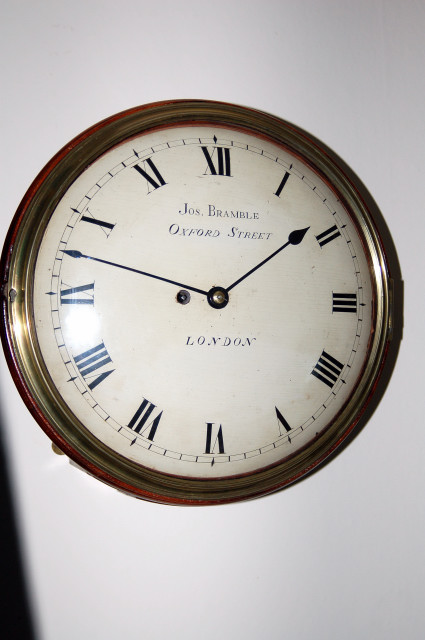
The earliest round dial wall clocks are very collectible and they are found with silvered brass dials,  verge movements and ‘salt box cases’. It is rare to find these types of clocks. Most dial clocks will be from C 1820 in date and typically the most I see on my travels date from around C1860/80.  These clocks will usually have mahogany cases and anchor escapements. 99% of these clocks will not be striking and have only one train, just for the timekeeping. The dials can either be flat or convex as will be the glass.

Standard 12 inch Dial Clocks

The most popular size for manufacture was 12 inches across the dial, using a flat white painted dial. More collectible dial clocks tend to have 8 inch or 10 inch dials and the very large 18inch dials are also very hard to find. Most of the best spring driven wall clocks throughout the 19th and even 20th centuries will have fusee movements. These are far better movements than the typical French movements made throughout the 19th century. The French may have excelled in design with interesting mystery clocks etc but the British still excelled in the quality of the movements made through this period.


Wooden Dial Clocks

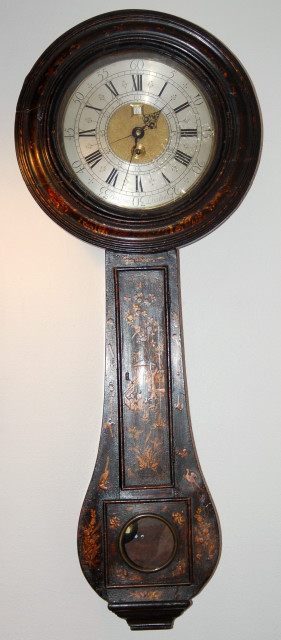
As I have pointed out the earliest dials were silvered brass dials. Most of the dials produced after C1820 are iron white painted dials, but you will sometimes find a rare example of a wooden dial dial clock like pictured above right.


RAF SECTOR CLOCKS

During the 20th century dial clocks still had an important role to play in the emerging factories. In the post offices and stations many were used in the UK. RAF sector clocks are very rare and were used during WWII and the Battle of Britain. These wall clocks are very collectible and so be very careful when purchasing. Many have repainted dials and are made to look like original sector clocks. RAF sector clocks commonly had 14 inch dials and movements were generally made by the Elliot company and they were dated. The cases usually had a RAF log on the back and a date as well. The finest examples had fusee movements whereas some cheaper examples had going barrel movements. These sector clocks allowed you to see which squadron was in the air at any one time.

Which Squadron was Flying

There were normally three colours painted to the dial in triangles by the side of the numerals. see picture below. Our London store www.pendulumofmayfair.co.uk sometimes has one of these rare antique clocks in stock.


Posted on

Antique Tavern Clocks


Antique tavern clocks have been studied widely and many books have been written. I wish to correct the commonly held view that these clocks started life only as early as C.1720. You may know these antique clocks by another name, they are sometimes called ‘ Act of Parliament’ clocks.

Act of Parliament Clocks

They were later commonly called this as a result of the tax imposed on clocks and watches in July 1797. With the government being short of funds as a result of many years of war, extra ways to increase tax were thought out. The Act imposed a duty of 5 shillings on every clock, 10 shillings of every gold watch and 2s.6d on every silver or other watch. Assessors were sent round to take account of how many clocks you owned above a certain value.

Public Houses Exempt from the Clock Tax

There were certain exemptions to the Act, these included public houses. Alot of these tavern clocks as the name says were housed in public houses. They were exempt from this very unpopular tax. It led to a decline in the clock trade and luckily was repealed after only 9 months of it being in force.

Lacquer and Chinoiserie Decoration

These tavern clocks were usually decorated in lacquer work. They had wooden dials that were made up from usually three sections. They also usually had simple single 5 wheel train movements. The extra wheel in the train generally makes them go for longer than a standard longcase clock, even though they actually have a shorter drop. They usually had brass hands so the time could easily be read against the black painted dial. The earliest dials known were wooden and shaped like a shield. Then later circular dials were introduced and tear drop shapes to the cabinets.

When did they start?

Many books on the subject commonly state the earliest examples of these clocks are from C1720. We have owned for over 10 years, a clock of this form that is pre 1700 in date. It is an amazing tavern clock, it is the only antique clock of this type I have ever seen with an original brass dial, instead of the usual wood form. The antique clock maker is from a family which emigrated to London from Augsburg in Germany. Bushman is a fantastic clock maker and by all accounts the finest clockmaker to come out of Germany! He is mentioned as being on a par with the great Thomas Tompion in some quarters.


Augsburg Influence

If I took a picture of the clock minus the hood it looks like a very early Augsburg table clock. I can see where the idea for the manufacture started. I believe this clock to be one of the first, if not the first,  tavern clock. John Bushman is provable in London between 1661 until just after 1692 ( date of death unknown). We do know he came from the Augsburg area, but you can see the influence from the design of the cabinet work on this clock. Bushman was admitted to the Clockmaker’s Company in 1662. You can see the huge pull of this Guild which I have talked about previously. The best clockmakers from all over Europe came to London. Everyone wanted to come to London and work in the 17th and 18th centuries. It truly was the centre for clock making in the world at the time.

Many people will ask if this clock has 5 wheel train, how does it have a second hand, a sweep centre seconds hand in this case. The movement has a one to one reversing wheel to enable for it to do this. You can see the amazing engraving to the unusual dial and superb unrestored lacquer work to the case. A very rare collectors clock, for more information please contact me direct.


Posted on

Humidity: Antique Furniture and Clocks

Humidity – Does it really matter?

Please read this before it is to late. This particular topic is very dear to my heart. It is vital for not only for people that own antique clocks and furniture, but people that care about their health. No doubt many ears pricked up when I mentioned health. Yes that’s right. Low humidity and high humidity have been found to be major contributors to asthma. Humidity changes and the incorrect humidity will effect all things like your plaster, cornice or your newly laid expensive wood floor. If you do not take action splits or the joints opening up or general warping can occur.

Not Low or High Humidity

All natural things are susceptible to damage from either low or high humidity, whether that be mold damage or shrinkage damage. Antique furniture pieces are often veneered, which means a flamboyant wood like mahogany on the outside and oak or pine on the carcass. Different woods have differing expansion rates. Rapid changes to humidity or prolonged low humidity will therefore lead to warping, splitting or cracks developing in the veneers. Veneers on antiques are stuck on normally by ‘animal glues’, after changes to humidity and temperature over time veneers tend to drop off.  This can be an early sign of the incorrect humidity levels in your home or office.

Early Signs of Problems

Another early warning sign is the hood glass on your grandfather clock splitting from side to side. The door frame shrinks leaving the glass no where to go. If this happens get your humidity levels urgently checked before expensive restoration work is required. If this problem is left untreated it may be too late.

Humidifiers Are Vital

Antique clocks and furniture should be kept in a controlled environment. Rapid changes to humidity or prolonged low or high humidity can cause damage as described above. Low humidity is damaging for antiques, as a result many antiques have been ruined by central heating. This is a real shame and something that is easily corrected.

Purchase a hygrometer

Humidity is the amount of moisture or water molecules in the air. Keep your humidity between 40-65%. Purchase a hygrometer to check whether you have an issue. Humidity levels can be adjusted to the correct levels by either a humidifier (if you have low humidity) or a de-humidifier. (in cases of high humidity)

Customers can benefit if you have low humidity and like it warm can increase your humidity. Higher humidity will make you will be able to have noticeably lower temperatures and still feel comfortable. Slightly increasing your humidity can therefore save on heating costs. Contact me now at Pendulum of Mayfair, for more information.

Conclusion

By controlling your humidity to the desired levels you can therefore:

1) save your antiques from damage

2) save money on your heating bill

3) look after your health in the process

Posted on

Dating Antique Painted Dial Clocks

Dating clocks

Longcase or grandfather clocks were made in Britain from about 1658 and during the first few years their production was confined almost exclusively to London. One of the earliest provincial grandfather clocks I have seen is dated 1689 by a maker called John Washbourn.

Painted dials on the other hand were brought out just after C.1770, these were made to compete with the single sheet dial or one-piece brass dial, that was introduced around C.1760.

I like to catagorize painted dial grandfather clocks into three seperate time periods.

Period 1 – 1770 – 1790

Painted dial manufacture and painting was started in Birmingham by two individuals called Osborne and Wilson. They were in partnership between 1772 and 1777, they later went there own ways producing dials on their own merit, Wilson died in 1809. White dial production became very popular in Birmingham in the 18th century. Towards the end of the 18th century there were a large number of dial painters situated in Birmingham. Most dial manufacturer’s stamp their names on the iron false plate behind the dial. It is true to say Birmingham dominated the market in painted grandfather clock dial production, but there were a few other areas that set-up dial painting and manufacture for example in Halifax and Edinburgh. 

Falseplate

The very earliest dials were attached to the front plate of the movement directly. After a short time, dials were attached by means of an iron false plate. This made it easy for the clock maker to attach his dials. It would not interfere with any part of his movement. Also it meant you could have smaller dial feet, which were therefore more stable and less prone to bending.


The two dials above are exceedingly early white dials and just have the gold leaf decoration to the corners. These type of dials date from about C.1772-1775

Below you will see the second stage of period 1 antique clock dials. Some colour is added to the gold leaf decoration to the corners and arch. These clock dials below date from C1775-C1785

You will notice in London gold leaf decoration and flower to the corners is earlier than the corresponding dials in the provinces. In London new advances were always ahead of their time. Even though dial painting originally started in Birmingham. Early London dials around C1775 will have gold leaf decoration and flowers to the corners. Sometimes London dials have no decoration at all. Also sometimes the chapter ring and the strike/silent ring are porcelain or painted with the rest of the dial left brass.


There is therefore three stages in my opinion of period 1 antique clock white dials. The last stage of period 1 is between C.1785 and C.1795. This is when the dial painter drops the gold to the corners and sometimes a scene is included or a bird.

Period 2 – 1790 – 1810

Period 2 can be mixed in certain ways with period 1 dials. They are certainly in no way inferior to period 1 dials. In fact the two dials I have included here are amazing works of art. I suppose it is the real height of dial design and some of the dials produced certainly in the C.1790-C1800 period are of the finest detailing.

Period 3 – 1810 onwards

I must admit  period’s 1 , 2 and the very start of period 3 white dials are the most collectable. These are of the highest value and my favourite. The two pictured below are very nice clocks both dating from start of the 19th century.  As the 19th century progresses the dials become larger and the scenes not so well painted. Generally if your dial is 13 inches or below and your clock is an antique and not a copy. Your clock will date from earlier than C.1820 as a rule of thumb.

Conclusion

You will also notice the dial progression, the very earliest white dial grandfather clocks are mostly white. As time progresses more of the dial becomes painted. The later you go, the painting gets quite dense. On the later mid 19th century ones, these sometimes are not of a very high quality or very appealing. The dials below are very good period 3 antique clock dials, and still very collectable. The clock dial on the left is a rare oval dial. You will notice most dials produced were either square and arched. Visit our homepage https://www.pendulumofmayfair.co.uk for further information.

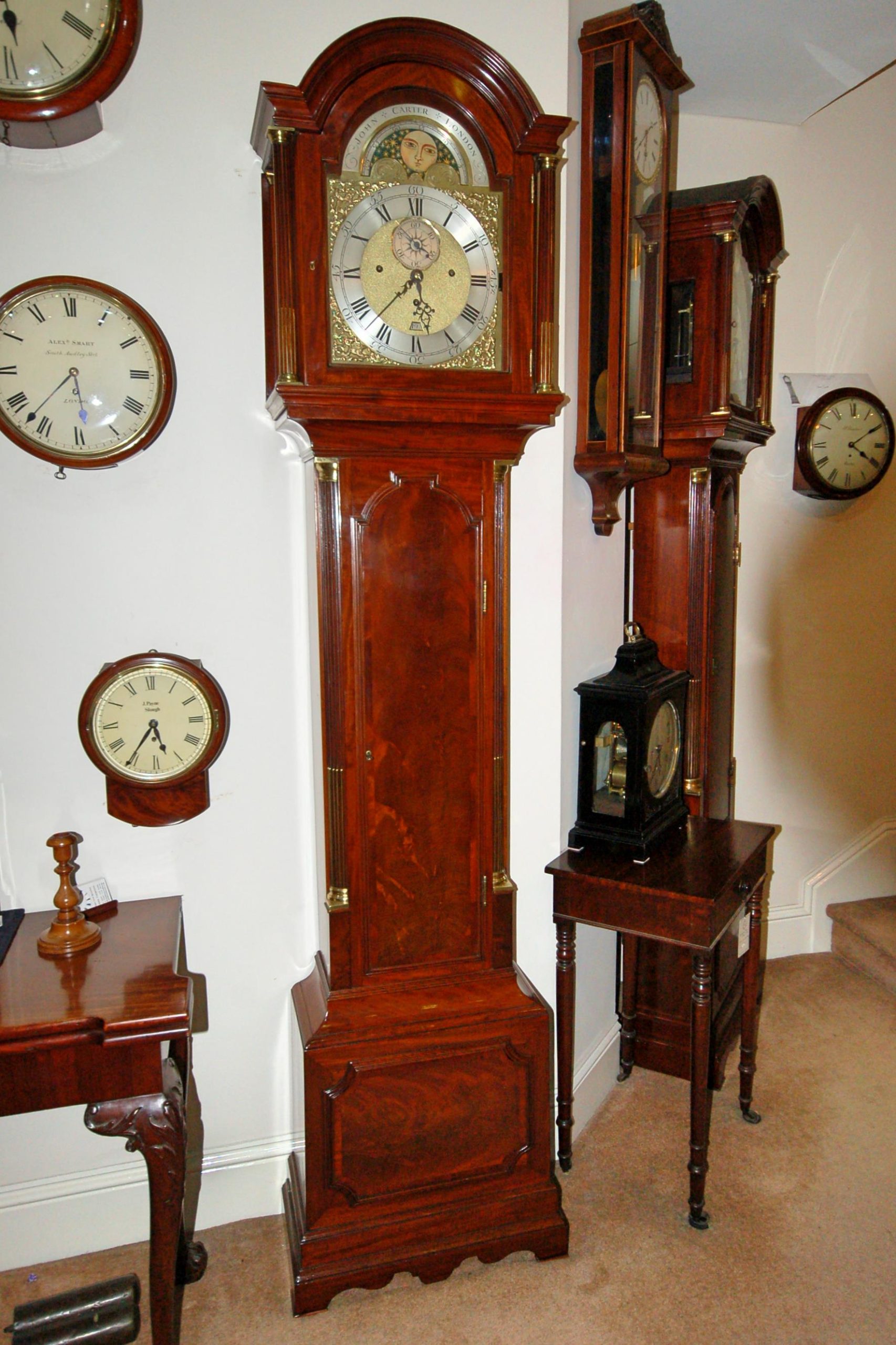
Antique Grandfather Clock by John Carter – London C1770

John Carter london mahogany moonphase to the arch grandfather clock

A superb London mahogany longcase clock with the dial signed by John Carter of London C1770.

The 8 day arched brass dial movement with three train mechanism. Striking the quarters on a peel of bells.

The lovely arched brass dial with chapter ring and spandrels, seconds and calendar features, finely matted centre and rare moon-phase feature to the arch.

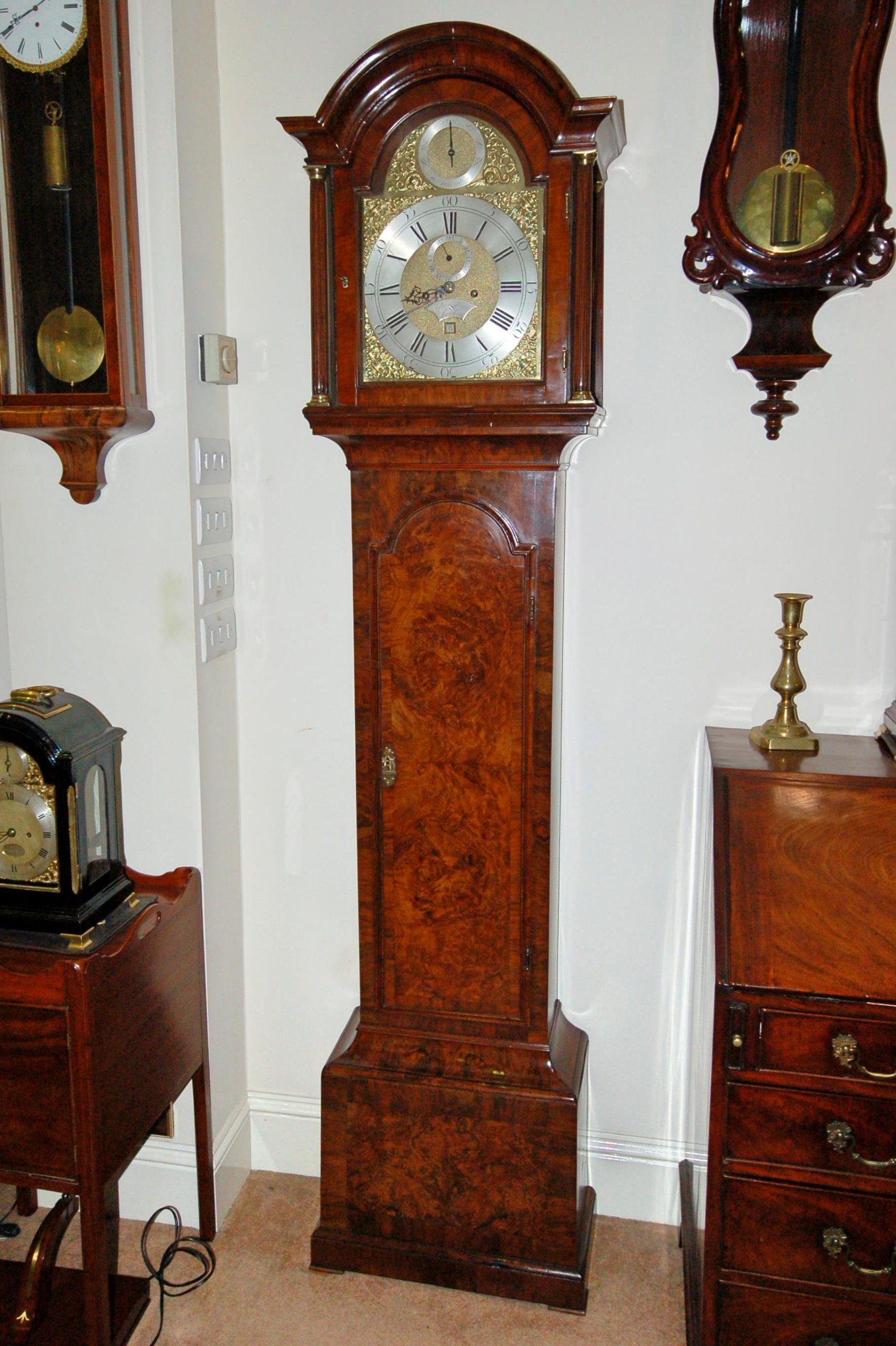
The lovey quality cabinet with high quality London case features, quarter columns with brass strung and reeded and brass capitals, dome top to the hood and reeded and brass strung hood columns. Moulding to door and base panel. Standing on two plinths the lower shaped.

A London mahogany clock by John Carter shown in Fig 228/229/230 of the well known clock book Cescinsky and Webster- English Domestic Clocks.

Antique Grandfather Clock by Elias Aylmer Stopes – 1730

stopes walnut clock

A superb example of an early 8 day duration 18th century walnut veneered grandfather clock with arches brass dial and strike silent.

The arch dial with urn and dolphin brass spandrels, finely matted centre, subsidiary seconds and calendar features and strike silent to the arch.

The superb quality 5 pillar movement striking the hours on a single bell.

The outstanding quality walnut veneered cabinet with dome top to the hood and reeded hood columns. Long book-matched veneered and moulded trunk door. Also with cross-banding to the base panel. All together standing on a walnut veneered single plinth.

A clock by this well regarded London clockmaker is listed on page 196 of the reference book English Domestic Clocks by Cescinsky & Webster.A fine choice collector’s clock of superb colour and patination.

Antique Grandfather Clock by Lawrence – Lancaster C1820

A very rare early 19th century oval dial 8 day duration grandfather clock, the dial signed Lawrence of Lancaster.

The lovey painted scene dial with subsidiary seconds, calendar and inset moon-phase to the centre. Rocking father time to the arch.

The 8 day duration movement striking the hours on a single bell.

The outsanding cabinet probably made by the famous firm Gillows of Lancaster. Typical Lancaster round top to the trunk door. Finely matched mahogany veneers to the trunk door and the base.

John Lawrence of Lancaster is recorded in Clocks of North Lancashire & Westmoreland by Susan Stuart as a clockmaker in Penny St, Lancaster from 1754 and was made a freeman of the city.

Brief History Gillows Cabinet Making Firm

Antique Regulator Clock Dial Signed F. Wiggins and Sons – Minnories, London

A lovely ‘8-day’ duration mahogany mercury compensated pendulum regulator clock with round silvered dial from the mid 19th century.

The fine round brass silvered dial signed by a likely retailer F.Wiggins and Sons Minnories London like these special clocks commonly were. The movement numbered by by what looks like a Thwaites and Reed Number from the mid 19th century.

Lovely large quality movement with dead-beat escapement and maintaining power. The pendulum hanging from the backboard with beat adjustment.

The cabinet of good colour and patination. It is veneered in what looks like the rare ‘plumb-pudding’ mahogany wood, to give distint grain effect.

The dial with typical regulator layout. Case of good proportions.