So you have finally managed to take the plunge and purchase your antique clock. There are many antique clocks available on the market but not all are original examples. There is nothing worse than spending lots of hard earned money on something that you later find out to be not what you originally thought. Regularly you will only find out something is amiss when someone knowledgeable visits your home. I have had to break bad news when asked for my comments on many occasions.
When buying an antique clock to purchase from someone you can trust. Finding someone like this is never easy. Try and find someone who is long established and are specialists in this field. Maybe they will offer you a money back guarantee. You should then have peace of mind.
Some restoration will have been carried out on all antique clocks. This should be sympathetic restoration though and not major surgery. I have devised some basic things to look out for below.
Genuine London Antique Clock C.1770
Look. Smell. Feel.
Probably the most common part of an antique grandfather clock to have been replaced is the base of the clock. Clocks used to stand on cold, damp floors, and many bases simply rotted away or were attacked by the dreaded woodworm. Clearly the bottom feet or plinth is an acceptable part of restoration but not the entire base section. Easy signs of new bases are when the wood does not match the trunk door. If the figuring of the wood and colour is different be-ware.
On London and south country clocks the backboard should be old and full length. If the backboard is rotted at the bottom and stops way short of the bottom, this is something to be careful of. If the backboard has rotted away, how much of the base has been rebuilt? In North country clocks, backboards can be made in two pieces from the later part of the 18th century.
Style Issues
Movements have sometimes been replaced. Make sure the case style corresponds to the makers location. i.e. London mahogany clocks do not have swan neck pediments but dome or pagoda tops. You can look at some good reference clock books for information on what clock cases should look like for different areas of the country. Each area of the UK in the 18th century had a distinctly different style of cabinet feature. For instance London clocks do not use simple oak cases but these are either veneered in walnut, ebony, mahogany or decorated with chinoiserie.
Look for Spare Holes
Does the dial belongs to the movement? Are there any spare holes in the front plate where another dial has been ? If the clock has a brass dial, this is attached directly to the front plate. Not by means of an iron false plate. (as used on white painted dial clocks) The winding holes on ‘8-day’ clocks are well placed within the centre of the dial These do not spoil the engraving or chapter ring.
Dial Features
If the clock is an ‘8-day’ example that the clock has a second hand. 99% of all ‘8 day’ clocks should have a second hand to just below the 12 0’clock position. If there is an obvious reason why a second hand cannot be fitted like a ‘penny moon’ feature then this is OK. As a rule though ’30Hr’ clocks do not usually have second hands, and so if the clock has had a later ‘8-day’ movement fitted this is why you should wonder why there is no second hand.
Does the age of the movement corresponds to the age of the cabinet? All dials have dating features, for instance inside quarter divisions, type of spandrels. You can date these very easily with good reference books. English walnut cases date from the 17th century up to about 1760. Mahogany cabinets date from about 1750 onwards. Oak cabinets tend to run straight through the 17th and 18th and 19th century’s.
Any Packing Under Seatboard?
Look for any obvious packing under the seat-board that cannot be accounted for? If the seat-board is old and warped ? A small piece of packing may be necessary.
Prior to 1820 all English antique clocks movements should strike on a bell and not a gong. Gong striking is popular around C1900.
Look for rub marks from where the weights and pendulum have banged over the years. If you see 1 smooth rub on inside under trunk door and your clock has 2 weights, this is not a good sign. If there are marks on backboard far away from where pendulum is hanging, and the clock is keeping time. Ask what would have caused these marks.
If the pendulum feather has been changed for a stiffer example, the pendulum height can change slightly This should only be a slight change.
Fitting Issues?
Investigate whether the dial fits the mask correctly and there are no large gaps. The size of glass should be similar to the size of the dial.
Is the face made from 1 piece of brass? This brass prior to C1800 will be cast brass and so thick and thin. The arch section of the dial should be from the same section of brass. If a square dial is later converted to an arch dial case, this is why some dials are made of two pieces.
Carved Cases?
Finally I have never seen an original fully carved pre C.1820 Longcase clock. The Victorians loved later carving GIII clocks though, and so beware buying one of these examples. Later carving would dramatically effect the clocks value.
Conclusion
I wish you luck in your search. Buying from a recognized antique clock dealer may be slightly more expensive but you will get peace of mind. You should aim to get a money back guarantee that your clock is a genuine antique and a fully working example. It is easy to spend your good money buying a clock with a chequered history. Please take your time and not rush into a decision you will later regret.
As they say an antique clock is for life and not just for Christmas. In our business we say, hard to find easy to sell. Original examples will provide you will years of pleasure and a good solid investment, Pendulum of Mayfair only sells top quality examples.
Time is at the heart of life itself. From the moment we are born, to the moment we die, man has always been intrigued by time. From the earliest days on earth, even pre-historic man lived by a form of time. Life for them revolved around light and dark: sleep, wake, hunt, eat,sleep again. Life and time are cycles that we cannot stop, we cannot slow. What the early mathematicians and astronomers tried to do was make time more exacting.
‘Water clocks’, ‘candle clocks’, and early ‘sundial clocks’ were developed, many of these in countries like China. It is amazing the evolution of countries over time, China played a huge part in the introduction of many new ideas and inventions, in the early world. It was in the UK that developed the measurement of time and put it in a more practical way. All these early antique clocks show the passing of time and try and measure it. Sundial clocks like Cleopatra’s Needle dating from about 1500 BC, was brought to England in 1877 and now stands on the Thames Embankment in London. Forms like Cleopatra’s needle and later sundials all use the elevation of the sun in the sky to tell the time.
Equation of Time
As society developed a more accurate way of measuring time was needed. Sundials, all well and good, are a pretty useless way of telling the time on a cloudy day. Also sundials are not accurate, because of the eliptical rotation of the earth. This inaccuracy is up to 15 minutes per day, sometimes slower, sometimes faster than sundial time. Mathematicians developed a yearly equation of time sheet for these inaccuracies. From this, is was possible to set your clock from these sheets.
Some amazing clockmakers produced this equation of time feature, on a year calendar, on their actual clocks. Setting you clock in the 17th century was not easy though and many were still not accurate. It was not until the introduction of the long pendulum, invented by Christian Huygens in 1657 did both clocks accuracy increase and more widespread sale of clocks happened. Towards the end of the 17th and early 18th centuries clocks became more affordable.
As many will know as a result of the great book by Dava Sobel – ‘Longitude’, the problem of inaccuracy of clocks, was even more important at sea.
King Charles II founded the Royal Observatory in 1675 to solve the problems of Longitude of sea. The produced a Lunar method of telling time at sea. This could be inaccurate though and had many problems.
John Harrison
As a result in 1714, the British Government by Act of Parliament, gave a reward of £20,000 (a huge prize at the time) to solve the Longitude problem. John Harrison devoted his life’s work to solving this issue, and he produced various chromometers on display in Greenwich, London, these were called H1, H2, H3 and H4 dating from 1730 to 1760.
Longitude
These clocks were fantastic and clearly solved the problem. Harrison though was not part of the establishment at the time, he was a simple carpenter from Lincolnshire. It took him over 10 years to win his prize, and even then, only by the intervention of the King. Harrisons inventions led to the modern day ships chronometer, these were still widely used until the middle of the 20th century. His inventions led the UK to become an important sea power, and saved countless sailors lives.
Antique clocks were crucial in the 17/18th centuries both on sea and land. During the 18th century accuracy came to within a few minutes a week. It was not until temperature compensated pendulums and other regulator features on the movements, that happened in the latter part of the 18th century, that accuracy came to within a few seconds a week for these precision clocks.
The quest for the measurement of time was in effect solved. Time is central to everyones life, like it was with these great ancestors of ours. Many sayings are taken from these antique clocks, time flies , time shows the path of mans decay, all very morbid, but it is fact. We might have learnt how to measure time, but we can not slow it.
Nothing is so important as time, it is fundamental to life itself. We at Pendulum of Mayfair care for all aspects of antique clocks, please contact me at https://www.pendulumofmayfair.co.uk.
Setting up your ‘Antique Grandfather / Longcase & Bracket Clock’ at Home
Congratulations on your purchase of a Longcase clock from Pendulum of Mayfair Ltd / Coppelia Antiques. Given proper care and conditions your Longcase clock should give many years reliable service.
1) Winding:
’30Hr’ clocks are generally wound with a rope or chain. This should be done once per day.
‘8 Day’ clocks may either have one weight (typically regulator clocks) or two/three weights. All weights are to be wound by inserting the correct size of key on to the winding arbour. Your clock should arrive unwound, so on winding, the lines should follow the grooves in the barrel (if applicable) ‘8-day’ clocks are usually wound clockwise
‘Month’ duration clocks typically as above but since these clocks have an extra wheel in the train they are generally wound anti-clockwise.
2) Time:
When setting the time never move the hands backwards. If you move the clock hands backwards past a striking section you may cause damage to the movement. Always let the clock strike each hour/quarter etc when setting the time. It is also a good idea to wind the clock prior to setting the time and starting the clock.
3) Calendar:
As the clocks allow for 31 days per month, when there is less than 31 days, you need to adjust the calendar. Depending on the sort of calendar of your clock, this can be done from the front (hand variety) or the rear (square or lunette variety). The calendar disc on the latter sort is attached to the back of the dial. You can move the square or lunette type from the front but you may leave finger prints to the dial, that will leave a mark over time. If the calendar does not want to move, wait for a few hours and try again, it may be in mesh. Generally the calendar can be moved by hand between 3 and 5pm each day.
4) Regulation:
If you notice a day after set-up the clock is running fast by a few minutes, the only thing that controls the timekeeping is the pendulum. (assuming the minute hand is not loose) Stop the clock by grabbing the pendulum and move the nut on bottom of the pendulum anti-clockwise, in effect lengthening the pendulum. Generally 1 turn either way would make the clock gain/lose 1 minute per day. Up= Faster, Down = Slower.
5) Striking:
If your clock is count wheel strike, occasionally the clocks strike may go out of sequence. This can happen if the clock has been left to run out. There is a lever on the movement which you can lift to adjust this. Alternatively if the clock is striking 4 but pointing to three and the time is 3.10 by the clock, move the clock hands past four quickly and on to five before the clock has finished striking five. The clock will now be in sequence again, striking five and pointing to five.
HUMIDITY
You should always keep your antique clock in R.H. 40-65%. Never keep your clock in dry or damp conditions. As a result of central heating over the last 20 years more damage has been done to antiques than at any time in the previous 300 years. Always check your humidity level. It is recommended in dry conditions you purchase a Humidifier or in damp conditions you purchase a DE-Humidifier.
WAXING
Always use a Beeswax polish every few years, never use spray polishes on antiques.
OILING
You should oil your clock movement every year or so with a specialist clock oil. This can be applied with an artists brush. Oil needs to be applied to the pivot holes on the front plate and backplate. (I.e. where the pinions of the wheels go through front and backplate) It is also advisable to oil the pallets and the pulleys that the weights hang on. You do not need to oil any of the gears in the movement. A few drops of oil should oil an entire movement, do not over oil as this will attract dust and cause wear.
SETTING UP YOUR LONGCASE CLOCK ON DELIVERY
Parts of a Longcase Clock:
1) Trunk
2) Hood
3) One / Two / or Three Weights
4) Pendulum
5) Movement
Tools Required to install your Longcase Clock and Fix it to a Wall
1) Drill
2)Wood baton (8inch * 2inch * thickness of skirting (generally 1inch thick)
3) Screwdriver and screw to screw clock into baton
4) 4/5 thin wooden packing blocks to straighten clock and make it lean against the wall
5) Raw plug and screw to fix baton to wall
Introduction
It is always advisable to fix your antique clock to the wall. If this is not done you run the risk of the clock being knocked over. Sometimes if the clock is not firm the clock may stop when the weights are level with the pendulum. The clock may rock slightly. You can avoid the fixing to the wall by just packing up the front feet up and thus throwing the clocks weight to the wall. This is done when you screw the clock to the wall in any case, but I would recommend fixing.
Process
The process outlined below appears very difficult but it is easily carried out by most people. If you do not wish to undertake this process, you can ask any joiner to do this for you. Let them have our instructions if they are unsure of the process.
The first step after unpacking the boxes that the clock is packed in, is to check the clock for any damage in transport. Inform your shipper if there is any. Hopefully this is not the case and you can continue with the fixing of your clock.
Location
Find the most suitable place you would like the clock to be. With the use of the thin packing blocks under the clocks front feet, place the trunk of the clock against the wall in this position.
The second step requires some assistance from a willing family member. Now you have set the trunk straight against the wall. (by eye is fine) Whilst one person takes the movement and places it on the cheeks of the case, the other person brings the pendulum. Do not leave the movement unattended on the cheeks. Keep your hand holding the clock until at least the pendulum is connected. Now thread the pendulum up though the crutch (the slot to the rear of the movement) and finally onto the back-cock of the movement.
Nearly there
Generally it is now safe, if the movement is far back on the cheeks, to let go of the movement. Do so carefully, making sure the movement does not overbalance.
At this stage put the hood onto the trunk and with your hands under the bottom of the seatboard. Lever the movement into the correct position in the mask, making sure the hood is still firmly back. The dial now should be fitting the mask evenly on both sides. At this stage you can carefully take the hood off and if applicable screw the movement down into the cheeks. It will then be stable and in the correct position. This is an optional stage of the process.
Fixing the clock to the Wall
Now comes the time for fixing the clock to the wall. If you do not wish to do this, all you need to do is hang the weights on the clock and follow the latter stages of the process.
Mark the wall through an existing central hole in the clocks backboard. (if there is one about chest height as you open the trunk door) If not drill a small hole through the clocks backboard at this point and mark. Temporarily at this height and to one side of the clock put the baton you are going to use just behind the clock. Leave it there sticking out from one side of the clock for the moment while you check the pendulum is free and not touching the backboard.
Wood Baton same size as skirting board
You have now checked the baton is of the correct thickness. If the pendulum is still touching the back of the clock while the baton is temporarily behind the clock and the movement is correct in the mask. (not been pushed back) use a slightly thicker baton and recheck.
Make sure clock is straight
Now you are happy with the thickness of the baton. Mark the position of where the clock is standing and move the clock to one side. (two people can lift the complete clock to one side or alternatively dismantle in the reverse order you set up). Make sure you know exactly where the clock was positioned. To one side of the mark you have on the wall Make sure you now test the wall so that there is no problem with drilling here. (no cables etc behind)\
Test the wall for cables
Drill the hole to one side of the mark you have made to the correct length of your raw plug. Attach raw plug and screw baton to wall. Re-assemble clock in exactly the original place. With exactly the correct number of packing pieces under the front feet. Screw through the hole in the clock’s backboard into the wood baton now fixed to the wall. Your clock is now secure.
You can now attach the clock weights and wind the clock. The clock should come to you unwound so on winding the lines should follow the grooves in the barrel (if present)
Swing the pendulum to start the clock
Now you can swing the pendulum and listen to the tick. The clock should tick evenly, I.e. tick, tock. Not tick, tooooooock. If the clock is straight and you are happy with this you need to adjust the beat. You will need to bend the crutch away from the sound of the long tock. If the clock is not in beat even if all the hands of the clock are free and not touching the dial or each other. TYe clock will stop within a few minutes. If the clock is in beat though and the clock stops at five past one for instance the hands may be touching. Gently ease them away from each other.
Relax
Now your clock is set-up you can now sit back and relax.
If you want to set the clock up in a corner position, it is basically the same process as above but you will need a T-shaped baton. The baton will be on the wall and you will have a baton on the back of the clock with a adjoining piece of wood connecting the two. The above process may seem complicated but it really is not. You should take no more than 20 minutes for a practical person or 45/50 minutes for fitting in a corner.
SET-UP SUMMARY SHEET
1) Decide where you want clock and fit a wooden baton to wall, similar thickness to skirting.
2) Place case in front of this and fix it to the piece of wood.
3) Place movement in case and get someone else to hang pendulum on whilst you steady movement.
4) Put the hood on and then slide you hand under seatboard to position in the dial in the mask correctly
5) Remove hood and attach weights correctly to pulleys.
Wind Up Clock Only Now
6) Carefully wind up clock making sure the lines are not twisted and winding evenly on barrels
7) Wind the clock to a point where the lines fill the barrel, do not over wind. Leave a gap of about 2inch between the underneath of the seatboard and the pulley.
8) Swing the pendulum gently and listen to see if the clock is in beat. Tick – Tock. If the sound is correct, set-up is complete, if not adjust beat of clock by bending crutch away from the sound of the long tock.
9) If the timekeeping is fast, adjust by lowering pendulum rating nut on bottom of pendulum. Roughly one turn down will make the clock go slower by one minute per day and vice versa
10) Always wind the weights before moving the hands of the clock.
A sensational victorian singing bird automaton French clock. Together with decorated buildings around the outside. 8 day two train movement striking the hours and half hours on a bell.
The scene is a house within a waterfall setting and central tree. Automaton birds tweeting and moving amongst the boughs of leaves and branches in the tree. A drinking bird in the pretend stream and a pretend waterfall all working. The waterwheel also fully working. Inside the base of the dome is a musical box. A real showstopper and collector’s piece.
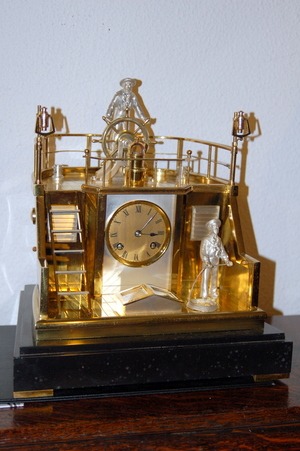
A stunning ‘Ship’s Quarter Deck’ mantel clock by Guilmet. Outstanding condition and in gilt brass rather than the more standard bronze. This makes this clock look absolutely superb.
Gong striking movement with the silvered helmsman forming the pendulum. The gilt brass and silvered case in the form of a ship’s quarter deck set with a working binnacled compass. Additional sailor down the steps with a coil of rope. The clock being on a stepped black marble base.
The two train movement has the stamp of Guilmet and a stamp for Medaille d’or Paris. The sailor on the top moves back and forth with every tick of the pendulum. A truly outstanding collector’s clock.
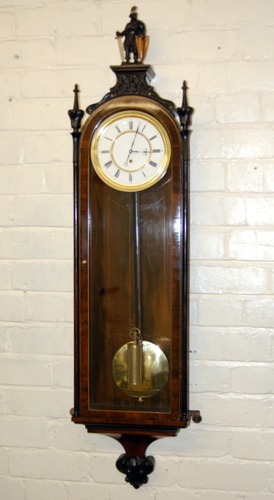
A very rare 8 day timepiece. Weight driven rosewood and boxwood strung Vienna wall clock with soldier to the top. Two piece porcelain dial and brass engine turned bezel.
A fine week duration 2 piece porcelain dial French 4 glass clock. Together with visible escapement to the dial and bell strike.Fine bevelled glass to the brass case.