Posted on

Better Together Campaign


I have been a passionate writer on my blog about all aspect of antique clocks over the last few years. I have tried to give the general public much needed information. They can then understand about various different horological matters. Never have I entered any political debates. This blog is to plead with the Scottish people not to give up on our longstanding Union. On 1st May 1707 our two great countries formed the Act of Union. This was passed by the Parliament of England and Scotland following negotiations agreed the previous year.

Act Union 1707

We have stood together in good times and bad. It is better together than apart I believe. Yes I am English, but I am British as well. I love Scotland and the Scottish people. Is their rivalry when England play Scotland ? Yes there is and I would not expect anything different. Maybe I am different but when Scotland are playing in any tournament to most people. I give my full support to them. I am sure the majority of other proud Englishmen do as well.

I stand with our great Union

You only need to see Andy Murray’s support at Wimbledon. He is a proud Scot, but English people still love him and cheer him on.  We have rivalry on a city basis with Manchester United and Manchester City. Like Glasgow has, but we stand together for our national teams. I stand by our great union and I hope the great nation of Scotland wakes up and sends Alex Salmond and this Independence vote packing.

It is worth standing up for

To destroy something so easily that lasted centuries would be a sad reflection on modern day society.  Scotlands voice, England voice in the world will be louder together. Further details of this special antique grandfather clock by John Smith.

I could not resist but end this by adding a special antique clock image that brings all this home. It is a lovely clock from a small town in Scotland called Pittenweem. Pittenweem is a small and secluded fishing village tucked away in the corner of Fife on the east coast of Scotland. Look how the clockmaker signed this clock ‘ NORTH BRITAIN ‘. I am sure he was a proud Scot, but he also, a proud Brit as well. This clock dates from around C1790

Daniel Clements

PendulumClocks@aol.com Antique Clocks Twitter


Posted on

Wood Identification Guide

For antique furniture and clocks different types of wood were used in their manufacture. In this handy guide I am going to cover some of the main woods used. These woods can be of solid form but most flamboyant grained woods are used as hand cut veneers. The carcass is generally made from oak or pine in the provinces or oak generally in London.

Woods Used in London and Provinces

In London oak is only used as a carcas material in the 17th and 18th centuries. Whereas in the provinces you will find antique grandfather clocks being made of oak as the finished wood. Clearly oak was veneered on as well, especially in London by English Walnut up to say C1750 . Then from this date fine Honduras and Cuban mahogany veneers are found. On some clocks you will find very early examples to be of ebony construction or ebonized (black stained fruitwood generally)

Chinoiserie Clocks

You can also get oak grandfather clocks in London that were painted and decorated by Chinoiserie or lacquer work. The finest examples were sent out on boats and decorated in China.  On some later clocks you will see these veneered in more exotic woods. Rosewood or maple or even ewe wood. I suppose the smaller size means you can use veneers of the more slow growing and smaller trees.  With early clocks these exotic woods were used as well in small pieces and matched. We have owned a lovely walnut burr oyster veneered grandfather clock.

Below is a selection of woods used for antique clocks and furniture during the 17th and 18th and 19th centuries in England. A brief insight into each wood pictured is given. I hope from this blog you will discover what type of wood your clock or piece of furniture is manufactured from.

Honduras Mahogany


Cuban mahogany
Plum Pudding (spotted) mahogany

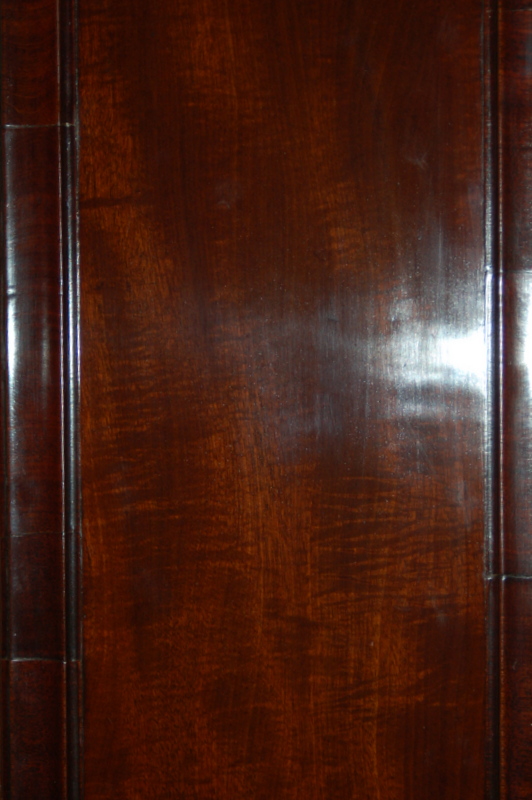
Mahogany can be a beautiful wood, it starts in the UK being used around C1750 and continues being used throughout the 18th and 19th centuries. Two most common variants are Honduras (lighter) and Cuban mahogany (darker). It is a close grain hardwood coming commonly from the South America or the West Indies type regions. This tree can be found quite wide and so large sections could be veneered with this wood.

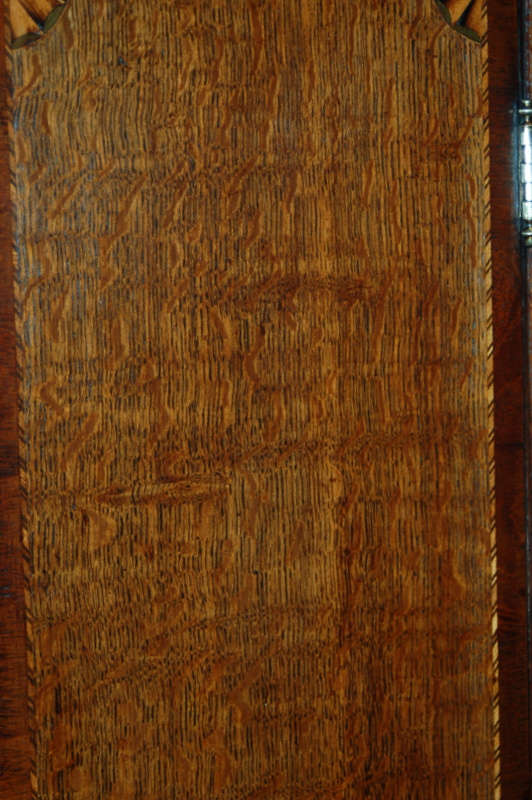
Quarter Cut or star-fleck figured oak
Solid English Oak

English Oak

English oak is a slow growing and so very heavy wood. Used in construction and veneered some of the time, but it is a beautiful wood in its own right. Oak being so heavy and close grained it is good at preventing things like wood worm. It is one of the reasons why London used it in the construction of its clock cases ahead of pine. Pine is used in the provinces as a rule for carcases as it is cheaper. You will notice the weight difference between an antique clock veneered on oak and an antique clock veneered on pine. Oak just gets better with age and polishing, we call this the patina. Less close grain oak can come from countries like Japan. This wood although called oak, is a far poorer wood to the slower growing English oak.

The climate effects the grain of the wood

English Burr Walnut
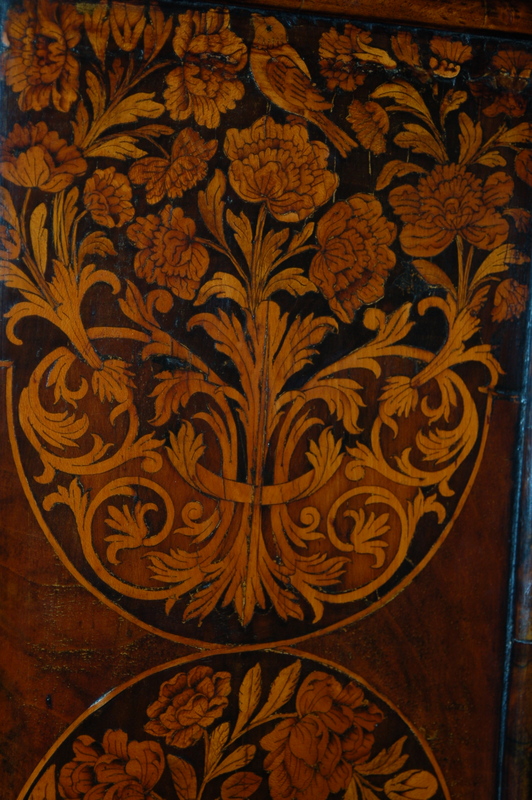
Marquetry inlay on English Walnut
Marquetry on Walnut
Continental walnut


Walnut is a lovely wood and English walnut gets used as veneers in antique furniture and clock manufacture up until C1750. After this date most walnut used is Continental walnut. Continental walnut is a quicker growing tree and so the grain is never as fine as English burr walnut. Again English walnut is a very heavy wood with a close grain. The tighter the burr or knot in the walnut the better. Walnut can range in colour from quite light if the sun has taken it, to quite dark. Walnut is used on all of the German wall regulators or commonly called ‘Vienna  style’ wall clocks  etc through the 19th century.

Satinwood

Satinwood used as a blank canvass to artists

Satinwood being a very light wood was used towards the end of the 18th centuries and early 19th centuries in the main. Many expensive pieces are manufactured with Satinwood veneers. We have some Pergolesi painted tables with satinwood veneers. I suppose the light colour makes the painting stand out better.

Pine

Pine, many of you will be familiar with this wood. It is rare to see a surviving antique grandfather clock made in this wood like the above. It was prone to woodworm unfortunately. Some were painted and this helped preserve them.Many provincial cabinets were constructed out of pine and then veneered. Pine is also used alot today as it is a relatively cheap wood, unlike oak. Clearly as you can see from the grain and if you lifted it from the weight , it is a fairly quick growing tree.

Lacquer or Chinoiserie

Oak can be veneered or painted

Oak was only used on internal construction of cabinets of English London clocks. When this wood was used and if it is not veneered in London you will find it sometimes decorated with lacquer work or Chinoiserie. This is gold leaf and gesso. The best types of these works are seen when they were sent out to China in the early/mid 18th century and decorated their.

I think I have covered the majority of main woods used in English cabinet making. There are others like ewe wood, maple , elm, fruitwood and rosewood. These are not covered as they are used alot less. I hope this blog has been of help to you. If you are still struggling with finding out what wood your clock or piece of furniture is made from, please send me a picture to PendulumClocks@aol.com

Daniel Clements – Pendulum of Mayfair


Posted on

How to properly repair a longcase clock cabinet

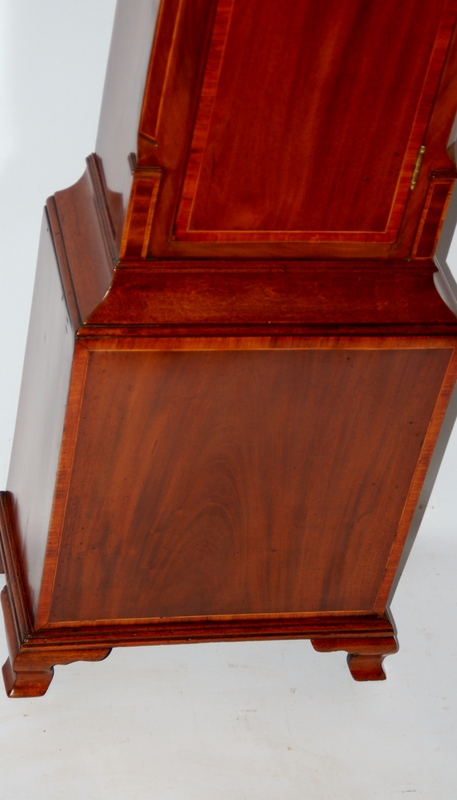
From the very onset of our business we have always had our own highly skilled staff employed in Cheshire. They undertake skilled antique clock and furniture repairs for our London shop. Antique clock repair is something that can only be carried out by highly qualified and time-served skilled staff. It is important to know what they are doing. In my latest blog I will be looking at the restoration of a badly damaged antique clock cabinet. This clock was damaged by a very hungry owners dog ! You can see from the pictures below, taken prior to restoration, the damage to the base and trunk door areas on the clock.

One very hungry pet dog

Clock Cabinet Repair Restoration


As you will notice damage was to the sides of the base and the bottom of the door in the main. This is very intricate antique clock restoration. Our skilled cabinet restorer carefully restored this clock to its former glory. Whilst the restoration of the antique clock was ongoing. We noticed the two sides of the base banding had been replaced with mahogany veneers over the years. We took this away and replaced the mahogany with the banding to match the trunk door. This being tulip wood.


Furniture Repairs

As you will see from the finished restored pictures. Close up pictures of the damage from the clock, the skills of a craftsman. All repairs were carried out in hand cut veneers of wood. This was a like for like match. Animal glues were used like in the original. After all the antique clock repairs were carried out at our base here in Cheshire. The clock was redelivered back to very happy owners.


Repairs Done Sympathetically

Restoring antique clocks like we have done for over 40 years here at Pendulum of Mayfair or Coppelia Antiques is vital to be done properly. Do not have a clock that has been poorly restored. This would take away from the value of the clock. Restoring your antique clock sympathetically can add thousands of pounds to the value. If the clock is genuine and basically all there. Spending £3,000 or so to restore your clock can be money in the bank.

Don’t cut costs in repairs

Spending £1500 for restoring your clock badly you may think you are saving money but do not be misled. Poor restoration can actually reduce the value of the clock, your £1,500 may well be lost. We charge out at competitive rates for unrivalled quality workmanship I believe. For a quote please send pictures of the item needed to be restored to the contact at the bottom of this piece.


Seldom seen damage

Can I point out before I go on, damage due to canines I have only ever encountered twice in all my time. I believe this was done by overexcited puppy’s with teething issues, you need not worry to much ! Basically antique clock cabinet repairs are much more standard. Loose moulding, little pieces of veneer lost, or he odd scratch here or there. Sometimes years of dirt to the surface of the case just needs carefully taking back and then the true colour of the cabinet can be achieved.


Colour of piece

The colour of every clock tends to be different and dependant on the wood and how this had reacted with the sunlight over the years. Hopefully if you choose a restorer he will preserve the colour and not just splash the stain of the day all over your clock. To many times I have seen furniture restorer throw shellac french polish to high gloss standards. Then stain whatever colour they were using that day on items. Rather than building up the finish underneath the years of grime, and basically wax finishing.

Wax finish is vital

Soft finish of wax, rather than the ploughed field of a poorly french polished and stripped surface is required. The grain on any antique clock takes years to fill with many years waxing. You do not want an open grain sticky finish, like what you will see on lots of modern furniture today.


Conclusion

I hope the three pictures included and the pictures of the clock now restored show what can be done by sympathetic highly skilled craftsman. We have undertaken repairs for Museums , a very important Embassy , and lots of major hotels in central London. We also undertake repairs for the general public. We have highly skilled staff specifically now just undertaking outside repairs.

Antique furniture and clock repair

It is a growing side of our business. Put your family heirlooms in safe hands and contact the specialist today. All public enquiries for antique clock repairs for a limited time will receive our special offer trade daily rate. You will need to quote ” antique clocks blog special offer” on your e.mail. Please hurry this is for a limited time only and applies to cabinet work.
We also have two full time horologists on staff to repair your antique clock movements. These are also highly skilled professionals. I suggest you should have a major overhaul of your clock every 40 years. If you have had this carried out properly a clean every 10 years or so. This will keep wear on any pivots etc to a minimum.

I hope you will agree the finish restored antique clock below looks stunning. The total time was approx 10 working days to restore movement and cabinet.

Any questions to

Daniel Clements

Manager: Pendulum of Mayfair- London  -0207 629 6606/ Coppelia Antiques Ltd – Cheshire 01565722197


Posted on

Create Your Pendulum Wish list for Christmas

If you could choose any Christmas present, what would it be? For many of us, it might be something beautiful or frivolous that we would never buy for ourselves. For others, perhaps something useful. Well, how about something that is both beautiful and useful, and will also, in due course, become a family heirloom? Have you considered putting an antique clock on your wish list? Pendulum of Mayfair have a range of beautiful antique clocks for sale, ranging from longcase clocks, otherwise known as grandfather clocks, through bracket clocks and wall clocks, to carriage clocks, so you can choose just the right clock for your home and the space available.

Do you want a large freestanding clock? Go for a grandfather clock. If you want a clock for your wall, you can choose either a longer case hanging clock or a round clock, rather like the modern wall clocks now available, but perhaps more beautiful. And if you want something to sit on a table or mantelpiece, have a look at the range of bracket clocks and carriage clocks available. You’ll be sure to find something that will fit the space you have in mind!

Posted on

Australia’s First Clock Maker

Antique clocks as we have looked at in my many blogs centered around London in the 17th and 18th centuries. The UK exported many of these clocks to different parts of the world. Pendulum of Mayfair website sells many of these fine clocks.

Fleeing UK to set up a new life overseas

Clock production only really set up in places like America, as a result of people fleeing persecution on religious grounds. It was slightly different how clock production was setup in places like Australia. Hundreds of convict ships sailed during the 18th and 19th centuries to Australia. As mentioned in my previous blog Henry Lane the clockmaker from London and Bristol was a prisoner on board the Perseus.  Clearly other convicts arrived in Australia who were also clockmakers in the UK. James Oatley was born in Warwickshire in 1770 but was found guilty of stealing bed linen. He was a horologist who arrived in Sydney in 1815. His talents also were noted and he became a highly regarded clock and watch maker. He was pardoned in 1821 and he was appointed Keeper of the Town Hall Clock by Governor Macquarie.

Sydney Clocks

It is Henry Lane Clock maker who I will be looking at here though. It is found a year after his arrival he had set up his business in Sydney in 1803. Clearly with no competetion to speak of, he was not short of work. He he is mentioned soon after his arrival advertising for an apprentice and a clock case manufacturer. In April 1804 he advertises for sale a ships chronometer and through these adverts you can tell he also manufactured watches at the time. Sydney was founded in 1788 . Again convict ships set sail from Portsmouth. The Town Hall clock that Henry Lane was asked to repair after it collapsed in 1806 was probably brought on one of these ships from the UK. The first tower clock in the UK to compare was at Salisbury Cathedral and it was made in 1386, over 400 years earlier !

Conditional Pardon Henry Lane 1808

In 1808 Henry Lane has been given a conditional pardon and by 1811 Henry was appointed Government Clock Keeper. He held this position until his death on the 15th April 1815. The earliest editions of the Sydney Gazette gives lots more information about Henry Lane. He has grandfather clocks and watches advertised for sale. It is an interesting history that I suggest readers delve deeper.

Close Bonds Between UK and Australia

Australia and the UK have a unique history from 1788. It is probably one of the closest international relationships in existence. It has a shared history, culture, institutions and language. The only change is that people go to live in Australia freely from the UK today ! Even the current Australian Prime Minister was born in the UK in Wales. There has always been a fierce rivalry especially in sport between our two nations but we have always had a special bond. Many of the people who live in Australia today have some connection with the UK, either in past or present history.


Posted on

The story of the Bristol UK clockmaker Henry Lane.

I will be looking at the start of clockmaking in Australia. The interesting story of the 18th century antique clock specialist Henry Lane. I need to pay special thanks to John Houstone, Kevin Fahy and Bill Bradshaw. The Australian Antique Collector and the Power House Museum in Australia for their help.

From Bristol to Australia making Clocks

I have been associated with antique clocks all my life and I learnt about the story of Henry Lane from one of our clients. Many years ago we had for sale a stunning Bristol antique clock by this maker at our retail antique clock shop in London, Pendulum of Mayfair Ltd. The power of the internet made it possible for a client in Australia to notice this clock and travel all the way from Australia to London, UK. He viewed and eventually purchase this magnificent clock. The clock itself is pictured below.

I hope you will agree it is a fantastic and rare 3 train musical mahogany Longcase clock of ‘8-day’ duration. Lovely typical high quality Bristol cabinet with fretwork beneath swan neck pediments to hood. Reeded chamfered sides with brass stringing to trunk and base.  The dial with high quality matted centre, chapter ring/spandrels, recessed polished and engraved seconds and calendar, strike/silent to arch. Movement of high quality playing 6 different possible tunes every hour.

Henry Lane Started Clockmaking in Australia

As many of my readers are aware there are literally thousands of antique clockmakers. Some you know and some you don’t. Henry Lane was one I did not know anything about, clearly he was not a prolific clockmaker. You could tell though from the quality of this clock, he was a fantastic maker.  The workmanship was of the highest order, and it included some very unusual features. It is rare for one to get a genuine 18th century musical example. Anyone capable of such work, had to be of the highest order. There is nothing really listed in the main clock reference books about him, other than he worked in Bristol and London.  Our client opened my eyes to this interesting story though and I give him special thanks.

Henry Lane Arrested

Saturday, 4th Jan 1800 was the day when Henry Lane’s life changed for ever. He arrived with his companion Mrs Charlotte Holland in Chipping Sodbury on the morning coach from Bristol. Henry paid the fare with a one pound Bank of England bill. He paid another bill with a five pound bill, on both occasions he received change. His companion Charlotte went on a shopping trip, she made payments with similar five pound bills in three different shops. Likewise receiving change in each shop. It was in the last shop that the husband of the last shopkeeper noticed something strange about the bill and correctly deduced it to be a forgery.

Forged Five Pound Notes

She seemed ‘all in a tremor’ , Charlotte was put in custody of a policeman who escorted her to the Swan Inn. Henry walked past this place and was recognized as Charlotte’s companion on the coach. He decided to run but he was caught. Henry tried to dispose of other bills by eating them. One pursuer forced Henry to open his mouth, he found two more forged bills inside. Henry was taken to the inn where Charlotte was kept.

Henry stood trial on the 5th April 1800 and Charlotte on the 30th July 1800. Interest in the trial was large in Bristol at the time and a full transcript of the trial is on public records. This will be given as a reference at the end of this piece. At his trial Henry gave a statement that he had received these notes as a settlement of a debt and he did not know they were forged. His evidence was weakened by the fact he booked the coach in a false name and he had tried to eat the notes when caught, and the fact he had tried to flee.

Sentencing

The judge adjourned and returned by pronouncing a sentence of death.  The Bristol Journal of 19th April 1800 announced ‘the execution of Henry Lane will take place at St Michael’s Hill on Friday next’. The issue of the 26th April reported the sentence had been commuted to transportation for life by Royal clemency. I am not sure what connection Henry Lane had to the Royal family but a crown is engraved to the centre of the arch to this dial !

At Charlotte’s trial in Gloucester on the 30th July 1800 she was also sentenced for transportation for life. Henry left Spithead on the Perseus with 112 other male prisoners on the 12th February 1802 and he arrived in Sydney cove on the 4th August. Charlotte left on the Glatton on the 23rd September, 1802 and arrived on the 11th March, 1803.

Journey To Australia

Henry who at his trial was 50 years of age and had a wife and family. Not much was known about the relationship with Charlotte but it is clear by 1806 Charlotte was living with Henry in Sydney. Charlotte is described to the Governor in 1810 as a ‘housekeeper’. In Rev Samuel Marsden’s Female Muster of 1806, she is described as a ‘concubine’. That is  a woman in an ongoing, marriage-like relationship with a man to whom she cannot be married for a specific reason! Eventually on the 27th October 1813, they married at St John’s Parramatta. The assumption is made Henry’s wife in Bristol, England had died by that time.

I will look at Henry work and life in Australia in my next blog. This is a compelling story I hope you agree. More can be found about the trial by reading the following.

1.The Only Genuine Trial of Henry Lane taken by a Short Hand Writer – Rosser and Co., Bristol 1800


Posted on

Interesting Clock from Leverpoole

Very rarely do we get the pleasure of buying back our special antique clocks. I believe you can count on one hand the clocks we have had back in over 40 years, for either financial or relationship reasons. I would like to write my first post for this year on a clock we sold about 20 years ago and have recently had the pleasure in buying back. It has just been completely overhauled again and is now back in showroom condition. It is pictured on our website.

Clockmakers Sometimes Could Not Spell

This antique clock is a beautiful mahogany brass dial moon phase example from the last quarter of the 18th century. ‘Wheat-ear’ engraving to the dial edge, lovely matted and engraved clock dial centre. Subsidiary seconds and calendar features and moon phase to the arch. Superb flame mahogany veneers. The cabinet even has an old pulley attached to the hood where a cord was run from the repeat lever of the movement to probably the bedside of the owner. This would let him know the last hour struck.

Liverpool Wealthy Area in the 18th century

We have not had to many examples from this clockmaker. He was clearly a special clockmaker of the 18th century to produce such outstanding workmanship. It is amazing though just how many clockmakers could not spell.(yes even worse than me!) The really quirky feature on this clock is how the maker has spelt Liverpool. He has spelt it probably how he said it, ‘Leverpoole’. This really made me smile.

Fantastic Self Taught John Harrison

I remember John Harrison the famous clockmaker who solved the Longitude problem. He taught himself to read I believe at home with a physics book. Correcting some of the equations as he went. Clockmaking in the 17th and 18th and even 19th century’s was a top profession. You only really entered through family connections. Long apprentaships and long hours followed before you qualified.

I have seen so many funny spellings on antique clocks but this spelling of Liverpool really tops the bill for 2012. I would welcome you sending me any other funny antique clock name spellings with their pictures to pendulumclocks@aol.com and I will post them on this blog for you.


Posted on

The most famous clock in the world – Big Ben

Big Ben


The worlds most photographed antique clock has been standing proudly to dominate London’s skyline for over 150 years. Big Ben is how everyone has come to call it,  is the nickname for the great bell of the clock. Now everyone refers to Big Ben as the overall clock and tower. The tower as it so happens is to be renamed the Elizabeth Tower in honour of the Queen. This is to celebrate the Queen’s 60 year reign.

Great Tom

The clock tower as we know today as ‘Big Ben’ is not the first clock tower to stand in Parliament’s grounds. The first tower nicknamed ‘Great Tom’ was built in 1288-90. A second tower replaced the first in 1367 and this was the first chiming public clock in England. In 1707 this tower had fallen into a state of disrepair and was demolished. When a terrible fire destroyed most of the Palace of Westminster in 1834, architects submitted designs for the new Palace. Of the 97 designs submitted, Sir Charles Barry’s was picked. His design did not originally have a clock tower but this was added to his design in 1836. Construction of this tower began in 1843.

Dent Clockmaker

Clearly the manufacture of the mechanism for the clock needed to be done by a specialist. The Queens clockmaker at the time was Vulliamy and he wanted to design and make the clock. Other specialist clockmakers also believed they should make the clock. A series of disputes therefore resulted and it was decided to appoint a referee to make the decision on who made the clock. The decision was left to the Astronomer Royal, Sir George Airy. He set the standards by which the clock must keep, Denision a barrister and gitfted amateur clockmaker assisted in this decision.

Delays in Building Big Ben

All this led to delays in the decision. It was not until Feb 1852 that it was decided that Dent was to  build the clock to Denison’s own design. Dent died in 1853 and so the clock was completed by Dents stepson, Frederick in 1854. It cost £2,500 to make. The tower itself was still not finished though and so the clock was kept at Dents factory in the meantime.

Denison Design

Denison made refinements to the clock while waiting for the clock tower to be finished (1859). He invented a ‘Double Three-legged Gravity Escapement’. This was a revolutionary and an ingenious invention and refinement. It made sure the pendulum was unaffected by external factors, such as wind pressure on the clock hands. A constant impulse was always applied to the pendulum. This escapement won worldwide acclaim, it is now known as the ‘ Grimthorpe escapement’, and Denision was later made Baron Grimthorpe in 1886 as a result.

Long Pendulum of Big Ben

The pendulum to the clock is 13 feet long and installed in a windproof box, it beats every 2 seconds. On top of this pendulum there are old coins. Adding weight to the top of the pendulum will lift the pendulum’s centre of gravity and thus shorten the effective length of the pendulum. This has the effect of speeding the clock up by just under half a second a day.

Symbol of London Big Ben

The clock has become one of the main symbols for the United Kingdom and London in particular. From the news programs like ITN to New Year celebrations, to General Election’s end of voting. Big Ben is the centre of our life. It stands proud and has had numerous years superb service. It has sted the test of time and London would not be the same without it. A truly remarkable achievement. The clocks Westminster Chime is typical of clocks after C.1860 and is found on many modern clocks. Most Georgian antique clocks just strike the hour on a single bell.

Daniel Clements – www.pendulumofmayfair.co.uk


Posted on

Careers in Horology

It is this time of year when many students start thinking about careers. Working in the field of antique clocks as a horologist can be very rewarding.

The horologist was a top profession in the 18th century

In the 17th and 18th centuries it was one of the top professions. Now I suppose the doctors and dentists or bankers and accountants are today.  It is a shame that many colleges do not offer courses in horology but some still do.  West Dean College still provides excellent courses in horology. There is an excellent article in the Independant newspaper on these horology courses and ‘breathing life into old treasures’. It is possible to do home study courses in horology with the British Horological Intstitute. It is also possible to do a BA Hons course at Birmingham City University in horology.


Excellent Career Path

I believe it is an excellent career path for young students. What I have found in the last 20 years or so is many people retiring into studying horology. This is fine but if young people knew how rewarding learning and working with antique clocks was, they would gain a head start in the field. Many people retire to work in horology as it has many benefits. It brings enjoyment in bringing something special back to life. Many workshops can be setup at home and so it is a great way to work for yourself and be your own boss.


It is also a great career path to other forms of engineering or maybe working as a specialist auctioneer of clocks and watches. Working and repairing antique clocks brings you lots of knowledge along the way about the way things were made. Knowing how to date antique clocks for auctioneering. This is all valuable information and a great basis from which you can carve out a valuable and rewarding career in what ever you then may choose to do.

Specialize in clocks

There are fewer specialists in this field today and so a bigger chance to make a name for yourself. In the 17th and 18th century every little village had its own clockmaker and London was the centre of clockmaking with the Clockmaker’s Company. Today there are few world recognized horologists. George Daniels was a watchmaker who was regarded as a special talent, he died recently. He gave alot to his field and certainly made a difference. It is certainly possible with the right enthusiasm and drive for students who enter this field today. Make the same difference and to enjoy what they do. I suppose this is a rare in many jobs today. Most people go to work to earn a living, but to actually enjoy your job, this is what makes your job special.

Daniel R Clements – Pendulum of Mayfair Ltd

Posted on

The Clockmakers Company

I have mentioned about the Clockmakers Company before, but I believe this institution needs mentioning in further detail.

Royal Charter 1631

The Clockmaker’s Company was founded under a Royal Charter of King Charles I in 1631 This makes this organization coming up to 400 years old and one of the oldest guilds in the world.  It is the main reason why London and the UK became the centre of clock making in the 17/18 and 19th centuries. The guild kept standards very high. Its powers were restricted on the whole to the city of London but its influence stretched further afield. This vital group was important in quality control, training and the welfare of its members. 

Conditions of being a Member

To sell and manufacture antique clocks within the city of London one first had to become a freeman of the Clockmaker’s Company.  This was achieved by becoming an apprentice to a free cloc kmaker. This was done through purchase or by the right of a child to follow a parent into the profession. Quality was kept extremely high, as if standards slipped the Company had to right to confiscate or destroy your work.

It was also important for the Clockmaker’s Company to manage the various arts of clock making into one cohesive unit. Everyone was working together for the benefit of each other. i.e. the bell makers, engravers etc

Visit London

It is important if you visit London to go to the Clockmaker’s Companythis was situated in the Guildhall, but it is now based at London’s Science Museum. They have in my opinion one of the finest collections of clocks and related information in the world. John Harrison’s 5th marine chronometer completed in 1770 is on view here.

Below is a list of the masters of this Clockmaker’s Company from 1631 up until 1875. This guild is still going strong today. The Company was and still is governed by a “Court” of ten or more “Assistants”. Each year a Master is elected and three wardens and a clerk who attends to its day to day business. You will notice some very famous antique clock makers below.

The Worshipful Company of Clockmakers (1631-1875)

1631-1649

The Masters
1631 David Ramsey
Named in the Charter
1632 David Ramsey
Sworn 22nd October
1633 David Ramsey
Represented by his Deputy
Henry Archer
1634 Sampson Shelton
1635 John Willow
1636 Elias Allen
1638 John Smith
1639 Sampson Shelton
1640 John Charleton
1641 John Harris
1642 Richard Masterson
1643 John Harris
1644 John Harris
1645 Edward East
1646 Simon Hackett
1647 Simon Hackett
1648 Robert Grinkin
1649 Robert Grinkin

1650-1699

1650 Simon Bartram
1651 Simon Bartram
1652 Edward East
1653 John Nicasius
1654 Robert Grinkin
1655 John Nicasius
1656 Thomas Holland
1657 Benjamin Hill
1658 Benjamin Hill
1659 Simon Hackett
1660 John Pennock
1661 John Coxeter
1662 John Coxeter
1663 John Pennock
1664 Henry Child
1665 Jeremy Gregory
1666 Jeremy Gregory
1667 Jeremy Gregory
1668 Thomas Taylor
1669 Thomas Taylor
1670 Thomas Claxton
1671 Nicholas Coxter
1672 Samuel Home
1673 Samuel Home
1674 Jeffery Bailey
1675 Jeffery Bailey
1676 Jeremy Gregory
1677 Nicholas Coxeter
1678 Ralph Almond
1679 Samuel Vernon
1680 Walter Hayes
1681 John Brown
1682 Richard Ames (died)
Benjamin Bell
1683 Richard Lyons
1684 Thomas Wheeler
1685 Richard Jarratt
1686 Edward Norris
1687 Thomas Taylor
1689 Nathaniel Barrow
1690 Henry Wynne
1691 Henry Jones
1692 Nicasius Russell
1693 William Knotsford
1694 William Clements
1695 Wither Cheney (excused)
Walter Henshaw
1696 John Sellar (excused)
Edward Stanton
1697 John Ebsworth
1698 Robert Williamson
1699 Robert Halstead

1700-1749

1700 Charles Gretton
1701 William Speakman
1702 Joseph Windmills
1703 Thomas Tompion
1704 Robert Webster
1705 Benjamin Graves
1706 John Finch
1707 John Pepys
1708 Daniel Quare
1709 George Etherington
1710 Thomas Taylor
1711 Thomas Gibbs
1712 John Shaw
1713 Sir George Mettins (Lord
Mayor 1724-1725)
1714 John Barrow
1715 Thomas Feilder
1716 William Jaques
1717 Nathaniel Chamberlain
1718 Thomas Windmills
1719 Edward Crouch
1720 James Markwick
1721 Martin Jackson
1722 George Graham
1723 John Berry
1724 Joseph Williamson (died)
1725 Peter Wise
1726 Langley Bradley
1727 Cornelius Herbert
1728 James Drury
1729 Richard Vick
1730 Thomas Stones
1731 John Marsden
1732 William Bertram (died)
1733 William Tomlinson
1734 Edward Faulkner
1735 Hugh Richards
1736 James Snelling
1737 Thomas Wrightson
1738 John Maberly
1739 John Pepys
1740 William Sherwood
1741 John Stafford
1742 Thomas Hughes
1743 David Hubert
1744 John Hiorne
1745 Joshua Appleby
1746 Mathew Skinner
1747 Nathaniel Delander
1748 Samuel Whichcote
1749 William Scafe

1750-1799

1750 Henry Horne
(Change to new style calendar)
1751 Nathaniel Style
1752 Joseph Stephens
1753 Henton Browne
1754 Jasper Taylor
1755 William Webster
1756 Francis Perigal
1757 Charles Cabrier
1758 Conyers Dunlop
1759 Devereux Bowley
1760 Stephen Goujon
1761 Benjamin Sidey
1762 John Jones
1763 Anthony Benn (died)
1764 Samuel Whichcote
1764 William Addis
1765 Thomas Hughes
1766 Daniel Fenn
1767 Peter Higgs
1768 Samuel Charrington (died)
Charles Merry
1769 Thomas Garle
1770 James Brown
1771 Daniel Aveline (died)
1772 Eliezer Chater
1773 David Rivers
1774 William Rogerson
1775 Francis Perigal
1776 Joseph Stephens
1778 Southern Payne
1779 William Plimley
1780 Francis Atkins
1781 Robert Poole
1782 Thomas Lea
1783 Nathaniel Sargeant
1784 James Green
1785 Hilton Wray
1786 Edward Tutet
1787 Charles Howse
1788 James Richardson
1789 Benjamin Sidey
1790 Richard Style
1791 Daniel Fenn
1792 The Rev. Dr. Robert
Hamilton
1793 Samuel Fenn
1794 William Rivers
1795 Harry Potter
1796 John Jackson
1797 John Ward
1798 Richard Duncombe
1799 John Marriott

1800-1849

1800 Matthew Dutton
1801 William Plumley
1802 Edward Gibson
1803 Timothy Chisman
1804 William Pearce
1805 William Robins
1806 Francis S Perigal Jnr
1807 Samuel Taylor
1808 Thomas Dolley
1809 William Robson
1810 Paul Philip Barraud
1811 Paul Philip Barraud
1812 Harry Potter (died)
1813 Isaac Rogers
1814 William Robins
1815 John Thwaites
1816 William Robson
(First Master to be sworn in
January of the following year)
1817 John Roger Arnold
1818 William Robson
1819 John Thwaites
1820 John Thwaites
1821 Benjamin Lewis Vulliamy
1822 John Jackson Jnr
1823 Benjamin Lewis Vulliamy
1824 Isaac Rogers
1825 Benjamin Lewis Vulliamy
1826 John Jackson
1827 Benjamin Lewis Vulliamy
1828 Richard Ganthany
1829 Richard Ganthany
1830 William Harris
1831 William Harris
1832 William Harris
1833 John Sharp
1834 Edward Ellicott
1835 Edward Ellicott (died)
John Sharp
1836 William James Frodsham
1837 William James Frodsham
1838 John Grant
1839 John Grant
1840 William Gravell
1841 William Gravell
1842 Joseph Fenn
1843 Joseph Fenn
1844 Richard Pinfold Ganthaed (died)
1845 George Atkins
1846 John Grant
1847 Benjamin Lewis Vulliamy
1848 Francis Bryant Adams
1849 Francis Bryant Adams

1850-1875

1850 John Aldington Perry
1851 John Aldington Perry
1852 George Harker
1853 George Harker
1854 James Adams
1855 Charles Frodsham
1856 John Carter, Alderman
1857 James Adams
1858 John Grant
1859 John Carter (Lord Mayor
1859/1860)
1860 William Rowlands
1861 George William Adams
1862 Charles Frodsham
1863 Joseph Fenn
1864 John Carter, Alderman
1865 Francis Bryant Adams
1866 John Garratt Curtis Addison
1867 William Rowlands (died)
1868 John Grant
1868 George William Adams
1869 William Lawley
1870 George Moore
1871 John Garratt Curtis Addison
1872 William Wing
1873 Charles Wellborne
1874 William Lawley
1875 George Moore