What are antique longcase clocks? Well, most people know them as grandfather clocks, but the ‘proper’ name is longcase clocks. And since many of those around now date from the 1700s, there are few people who would argue with the description ‘antique’!
But surely people like me don’t buy antique clocks, whether grandfather clocks or not? If that’s your next question, think again. A grandfather clock was and is many families’ most prized possession, and there’s something very appealing about thinking about all the family history that has passed under the unheeding gaze of the clock over the years. What stories could it tell, if only it could speak?
And an antique longcase clock makes a lovely gift, perhaps for a wedding, especially of one of your own children. Or, if you’d rather enjoy the clock yourself, think of it as buying a future heirloom for your family! They will certainly thank you for it in years to come.
You can buy antique grandfather clocks much more easily than you may have thought.
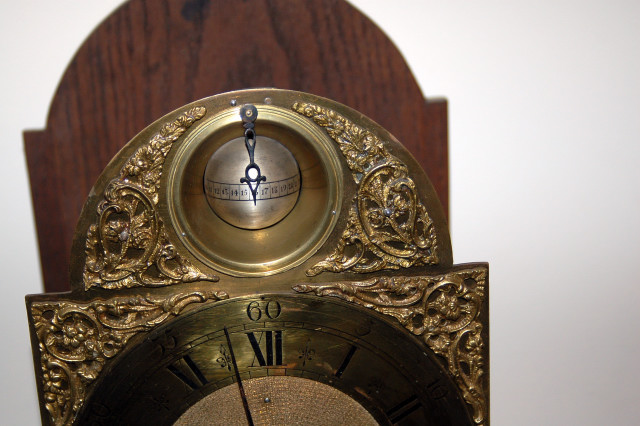
Superb brass dial Longcase Clock C.1780 by Lawrence Dalgleish of Edinburgh.Lovely flame mahogany veneered cabinet. Featuring ‘8-day’ duration movement.The arch brass dial with chapter ring and spandrels. Also with polished and engraved centre. Together with centre date, seconds feature, and strike/silent to arch.
All the Longcase clocks from this point on are unrestored. Featuring clocks that can be viewed on request at our Cheshire base. All clocks showed need both cabinet and movement restoration and are shown as is. Clearly this is a new very informative section as it gives you an insight into what the clocks look like prior to some tender loving care. We only use very sympathetic restoration. In addition it takes approx 3-4 weeks.If you like one of the clocks listed in this section,let me know.If there is a clock restored similar I will also let you know and suggest this as an alternative. If this is not suitable and you prefer the unrestored example.I will put the clock in our queue to be restored. You are welcome to then see the clock once restored with absolutely no obligation.
I will use a price band to give you an idea of price at this stage. This is an approx price once restored. Clearly sometimes because of unforseen work. The clock may be pushed into a different price band. I will let you know on this as soon as this becomes evident.
Price Band A 2,500 to 5,000 Price Band B 5,000 to 7,500 Price Band C 7,500 to 10,000 Price Band D 10,000 to 15,000 Price Band E Over 15,000 Price Estimates in UK Sterling
When I come to think of 18th century antique furniture design, I think primarily of 4 names. There is the great Thomas Chippendale, George Hepplewhite, Thomas Sheraton and last but by no means least Robert Adam. Robert Adam was probably better known for his influence on architecture in the 18th century but he also designed lovely pieces of furniture.
Famous Floral Designs, Pergolesi
It was on one of his trips to the Continent to study foreign designs he came across Michael Angelo Pergolesi. Pergolesi was one of the main characters in the start of painted antique furniture. Designs on antique furniture up to this point had been inlaid into the wood surface.
Pergolesi trip to UK
Pergolesi stayed in the UK until the end of the 18th century. He worked with the celebrated Adelphi firm. He designed and painted beautiful pieces of furniture and the occasional antique clock. Many of these works decorated with fine figures, flowers and classical urns. He published a book of these designs taken between 1777 and 1801. He worked with other leading figures at he time, many were members of the Royal Academy. These individuals revolutionized the decoration applied to antique furniture.
Pergolesi Designs
Pergolesi designs on antique furniture are rare by the fact he worked only a sort period of time in the UK. Those who worked with him in this area left London to work overseas before the end of the 18th century. With this short window of opportunity, very few pieces were made by these celebrated artists and designers, making them highly sought after. Later work like this can be seen in the late 19th century. This is when this type of work hit a revival in the fashion moods at the time.
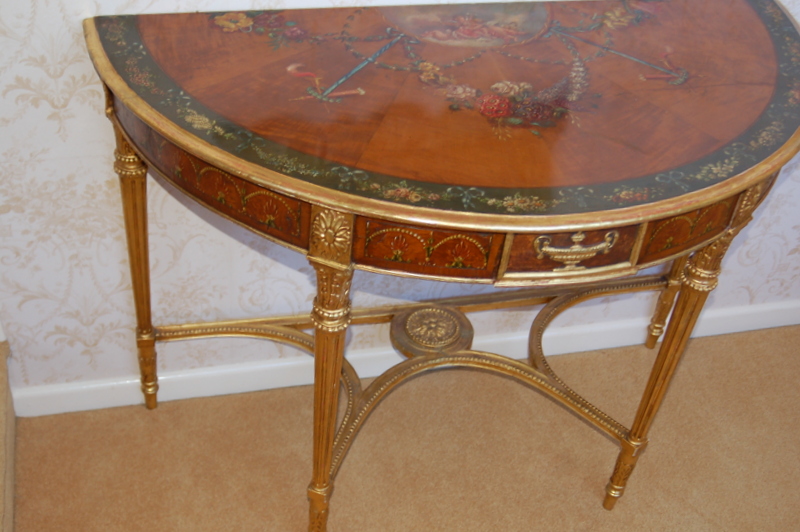
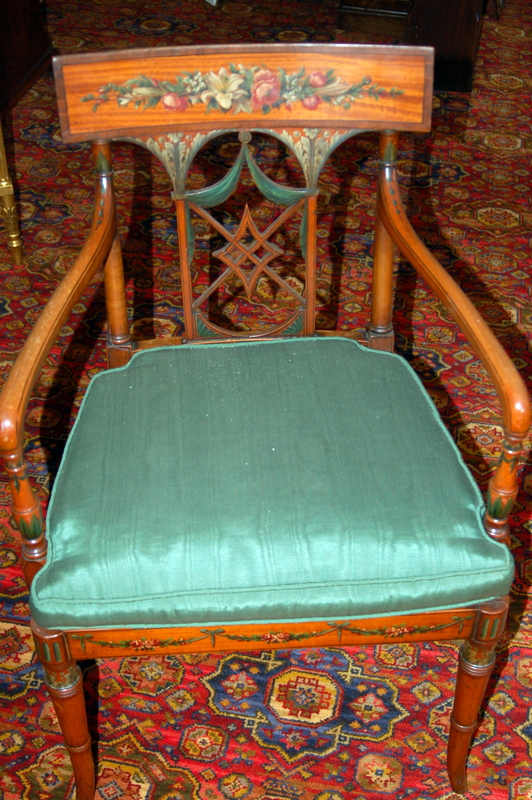
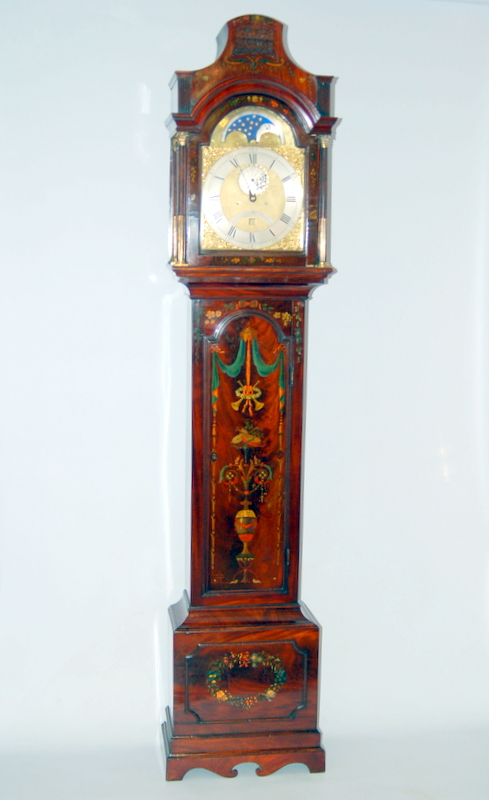
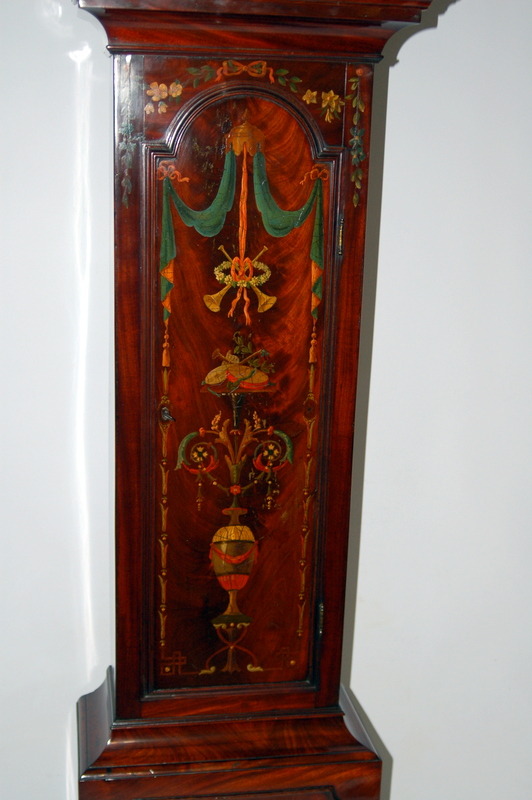
Most of written information on this subject can be found by reading books on the ‘Age of Satinwood’. Many pieces were decorated on this wood surface as satinwood offers a ‘plain canvas’ so to speak for the artists work. It is also true though you will see works decorated on mahogany cabinets in the last quarter of the 18th century. One outstanding such painted decorated clock is seen below.
The following piece ,’The Swing of the Pendulum’, is taken from April 2014 edition of Antique Collecting. It is based on John Andrews interview and discussions with myself Daniel Clements. Manager of Pendulum of Mayfair Ltd.
Figure 1. Superb and rare GIII, arched, brass dial, mahogany, ‘8-day’ London-style Longcase clock by John Grantham Newbury. Bat and ball automaton.
Interesting clock facts
It takes courage to come from a business in the provinces and open up in the West End of London. Especially when so many antiques concerns have been doing precisely the opposite. But this is what Pendulum did twenty years ago Taking Fred Perry’s shop and residence at 51, Maddox Street by buying the freehold. We then had control over the rent as one important cost element. This having been achieved as a deliberate long-term measure. The costs of converting the shop were a safe investment and Pendulum of Mayfair was launched.
Family Business
Many businesses in this field have come about as a result of what was a part-time hobby. A source of incidental income becoming so absorbing that the plunge to launching into full time was taken. Daniel Clements says that his father is a classic example. He used to say that he became a dealer in 1974 to pay for his vice of collecting. As a qualified mechanical engineer he was engaged in building factories. Designing new machines all over the world, acting as engineering director at Pilkington’s. But his love of clocks, playing with and restoring them, became a passion. This provided relaxation from the stresses of work. Eventually bringing about the decision to leave his job and set up as a dealer full time.
Nearly half a century old
When he did this 40 years ago it was considered to be a crazy thing to do. Like many who have entered the antiques business after years of dealing on the fringes of it. The impulse was too strong to resist. Even now, in his seventies, Mr Clements love of clocks is still as powerful as it was when he set up the business of Coppelia Antiques in Cheshire forty years ago. This passion has led to the establishment of a highly regarded business with a worldwide field of activity.
Figure 2. Superb ‘8-day’, c.1790, white-dial, moonphase, mahogany Longcase by collectable and well-regarded maker Bancroft Scarborough.
Finding special clocks
Throughout the 40 years since its start, Daniel Clements says the greatest pleasure the business has provided is in finding special antique clocks. Then restoring them as sympathetically as possible. Over the years they have developed the skills of lots of young people in their care. Trying to instill a love of old things and learning about their origins along the way. Touching old things, smelling them, and getting under ‘their skin’ is a long process and needs patience and understanding.
The workshop
The clock workshop is the hub of the entire operation and nothing is allowed to leave until Mr Clements is satisfied with the result. A familiar motto of the business is the saying ‘well bought, is half sold’. The special type of antique clocks Pendulum look for are so hard to find, selling them is the easiest part.
Figure 3. Lovely ‘8-day’, London, musical Longcase with mahogany cabinet, c.1770, Herring of London.
So many customers are now long term friends
Over the years many special pieces have come into their hands and customers have become friends.Examples of this provide instances of expertise combining with history to provide the customer with a truly remarkable acquisition. One particular clock sold to an Australian client was by the clockmaker Henry Lane. This was a superb musical Bristol Longcase clock from c.1790. Henry Lane, as it happens,was the first clockmaker in Australia. The story of how this comes about was a compelling one.
Transported to Australia
Henry was sentenced to death for forging money.This sentence was later changed by an act of clemency to transportation to Australia. He left Spithead on the Perseus with 112 other male prisoner son the 12th February 1802. This is what Clements feels is so special about antique clocks: they have a history and you can research more about the clockmaker’s life. They are a living working museum to the past and attractive pieces of furniture as well. How proud master clockmakers would feel if they could see their clocks still working perfectly in many homes today.
Figure 4. Fine c.1785 Peter Wood, painted-dial, mahogany, bell-top, double-fusee bracket clock with anchor escapement striking on bell and with repeat.
The Centre of London
With the Pendulum shop being situated right in the heart of London they have sold and restored clocks to many VIPs. Large companies like Asprey’s and Garrard’s, and major hotels like the Conaught. Recently they had the pleasure of restoring some really complex antique clocks for the Russian Embassy in London. Clements states that ‘the Ambassador and his assistants have shown us great kindness and consideration. We have lovely presents from them and also were delighted to attend their special day earlier this year. This was another of the fantastic memories we have built up over the years. The clocks were a challenge but they now look wonderful and are now fully functioning & proudly taking up their prestigious places at the Embassy. It was a real honour for us, and it shows how far we have come as a business over the years.’
Figure 5. Early 19th-century, double-fusee bracket clock by Hanson of London.
Great finds
Another entertaining example comes from their local specialist auction house in Chester. They had a lovely little clock for sale at auction about 20 years ago. There were four clocks in the sale,of which one was of great interest: it was catalogued as an ‘electric clock‘. When the hood was taken off the clock, the movement looked as though it was in a salmon tin, because it was enclosed. ‘We instantly knew what this clock was,and so, says Clements, my mother and father decided to split up in the room.My father said to my mother: you bid; if the other dealers see me bidding they will twig. My mother started bidding on the clock but she was very laid back. So much so that the auctioneer asked her are you bidding Ma’am? She said yes and the auctioneer slammed the hammer down.
Dust Encased Regulator
One dealer who was standing by my father noticed it was his wife bidding. He asked what the clock that she had just bought was. My father said, ‘oh, my wife collects electric clocks.’ Of course it was not an electric clock at all. The clock’s movement had been dust encased. It was a fantastic clock by John Holmes of London. The cartouche had been reversed on the dial and engraved electric clock. It clearly had been used as a ‘slave clock’ in the early 20th century, to drive other clocks around a factory.
‘Daniel Clements says ‘I wish these bargains happened more often but it is not the case. Everyone thinks they have a master piece under their pillow or in their garage. The guy who purchased this ‘electric’ clock was told the story. He laughed; luckily he did not mind paying a handsome profit at the time.
This clock will have appreciated many times in price since then though. Investing in antique clocks is just about as safe as houses. These master timekeepers come from an age where intrinsic labour costs are built in. Movements are handmade and built to exacting standards; they will continue telling the time in peoples’ homes for hundreds of years to come. Even throughout the recession, good genuine clocks have always appreciated in price.’
Figure 7. J & B Levi Dover, early (c.1795), mahogany, verge wall clock with silvered dial.
Hyman Russian Clock
‘I also remember when we purchased a lovely regulator clock with a painted dial. This clock was made for Catherine the Great of Russia. She was the most renowned and long ruling female leader of Russia. The clock came from the Winter Palace.It was brought out on a horse and cart just before the Russian Revolution at the start of the 20th century. I wish we had kept this clock, but then I wish we had kept many clocks we have sold over the years. We are in a business where we only buy what we love and we grow very attached to all our clocks. They are like extended branches of our family. Once you have restored the clocks, you feel part of them.Like selling puppies etc., the potential owners of our clocks, all get proper vetting! Luckily the people who love clocks are generally lovely people.’
Always Learning
Figure 8 . Mid-19th-century Austrian ‘2- day’ automaton and quarterstriking, large and impressive clock.
‘Every clock we buy and sell has its own story. You realize you are always learning new things; a lifetime is not nearly long enough. We can be proud of restoring and bringing back to life some lovely antique clocks. Yesterday’s craftsman’s work will live on at our shop in London, Pendulum of Mayfair Ltd. We stock some of the finest antique clocks anywhere in the UK. All these are fully restored and come with a year’s guarantee. All antique grandfather clocks are delivered free of charge anywhere in the UK. We have a full export shipping service to all four corners of the world. The USA is one of our biggest markets.’
At a time when there are so many stories of retrenchment in the antiques business it is a pleasure to find one of sturdy optimism.Pendulum of Mayfair at 51 MaddoxStreet, London W1S 2PH
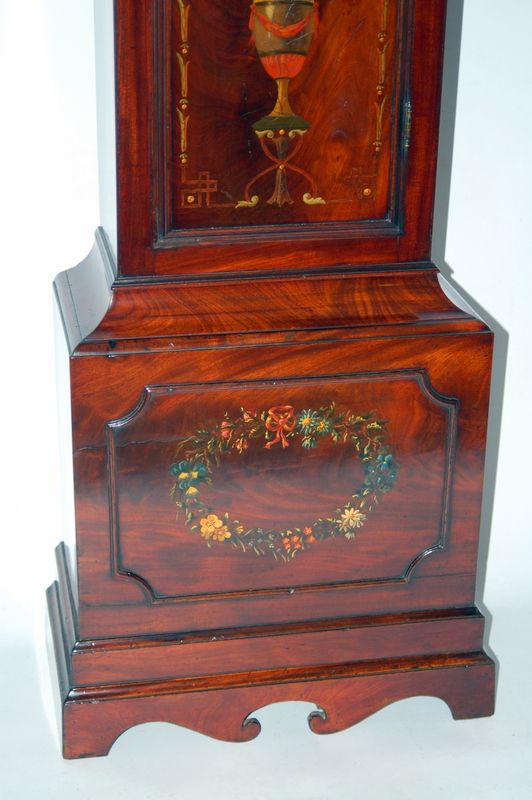
From the very onset of our business we have always had our own highly skilled staff employed in Cheshire. They undertake skilled antique clock and furniture repairs for our London shop. Antique clock repair is something that can only be carried out by highly qualified and time-served skilled staff. It is important to know what they are doing. In my latest blog I will be looking at the restoration of a badly damaged antique clock cabinet. This clock was damaged by a very hungry owners dog ! You can see from the pictures below, taken prior to restoration, the damage to the base and trunk door areas on the clock.
One very hungry pet dog
Clock Cabinet Repair Restoration
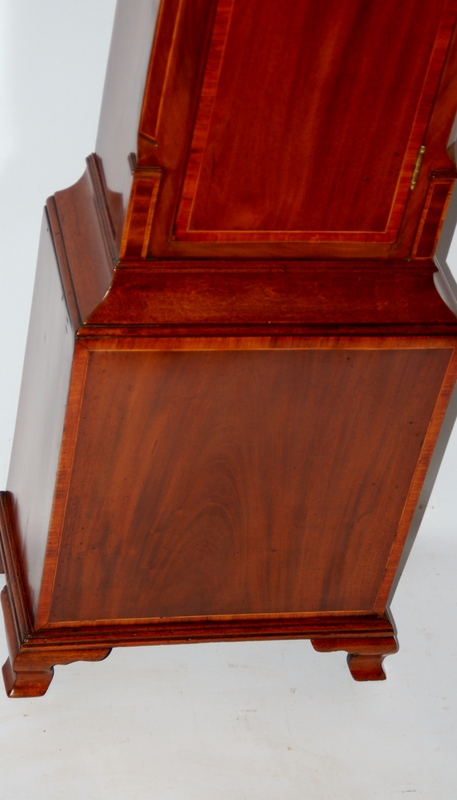
As you will notice damage was to the sides of the base and the bottom of the door in the main. This is very intricate antique clock restoration. Our skilled cabinet restorer carefully restored this clock to its former glory. Whilst the restoration of the antique clock was ongoing. We noticed the two sides of the base banding had been replaced with mahogany veneers over the years. We took this away and replaced the mahogany with the banding to match the trunk door. This being tulip wood.
Furniture Repairs
As you will see from the finished restored pictures. Close up pictures of the damage from the clock, the skills of a craftsman. All repairs were carried out in hand cut veneers of wood. This was a like for like match. Animal glues were used like in the original. After all the antique clock repairs were carried out at our base here in Cheshire. The clock was redelivered back to very happy owners.
Repairs Done Sympathetically
Restoring antique clocks like we have done for over 40 years here at Pendulum of Mayfair or Coppelia Antiques is vital to be done properly. Do not have a clock that has been poorly restored. This would take away from the value of the clock. Restoring your antique clock sympathetically can add thousands of pounds to the value. If the clock is genuine and basically all there. Spending £3,000 or so to restore your clock can be money in the bank.
Don’t cut costs in repairs
Spending £1500 for restoring your clock badly you may think you are saving money but do not be misled. Poor restoration can actually reduce the value of the clock, your £1,500 may well be lost. We charge out at competitive rates for unrivalled quality workmanship I believe. For a quote please send pictures of the item needed to be restored to the contact at the bottom of this piece.
Seldom seen damage
Can I point out before I go on, damage due to canines I have only ever encountered twice in all my time. I believe this was done by overexcited puppy’s with teething issues, you need not worry to much ! Basically antique clock cabinet repairs are much more standard. Loose moulding, little pieces of veneer lost, or he odd scratch here or there. Sometimes years of dirt to the surface of the case just needs carefully taking back and then the true colour of the cabinet can be achieved.
Colour of piece
The colour of every clock tends to be different and dependant on the wood and how this had reacted with the sunlight over the years. Hopefully if you choose a restorer he will preserve the colour and not just splash the stain of the day all over your clock. To many times I have seen furniture restorer throw shellac french polish to high gloss standards. Then stain whatever colour they were using that day on items. Rather than building up the finish underneath the years of grime, and basically wax finishing.
Wax finish is vital
Soft finish of wax, rather than the ploughed field of a poorly french polished and stripped surface is required. The grain on any antique clock takes years to fill with many years waxing. You do not want an open grain sticky finish, like what you will see on lots of modern furniture today.
Conclusion
I hope the three pictures included and the pictures of the clock now restored show what can be done by sympathetic highly skilled craftsman. We have undertaken repairs for Museums , a very important Embassy , and lots of major hotels in central London. We also undertake repairs for the general public. We have highly skilled staff specifically now just undertaking outside repairs.
Antique furniture and clock repair
It is a growing side of our business. Put your family heirlooms in safe hands and contact the specialist today. All public enquiries for antique clock repairs for a limited time will receive our special offer trade daily rate. You will need to quote ” antique clocks blog special offer” on your e.mail. Please hurry this is for a limited time only and applies to cabinet work.
We also have two full time horologists on staff to repair your antique clock movements. These are also highly skilled professionals. I suggest you should have a major overhaul of your clock every 40 years. If you have had this carried out properly a clean every 10 years or so. This will keep wear on any pivots etc to a minimum.
I hope you will agree the finish restored antique clock below looks stunning. The total time was approx 10 working days to restore movement and cabinet.
Any questions to
Daniel Clements
Manager: Pendulum of Mayfair- London -0207 629 6606/ Coppelia Antiques Ltd – Cheshire 01565722197
The purpose of this blog is to trace the antique bracket clock from its beginnings. This started at the latter end of the 17th century up until the mid 19th century or Regency Period in England.
Best Clocks in the World
During the entire period that I have mentioned above, clock making in Britain was acknowledged to be the best anywhere in the world. Clock makers in the UK maintained this position until at least the mid 19th century. Then imports arrived on our shores from France, Germany and eventually the USA. Clock makers in the UK refused to lower standards and change to the manufacturing methods used by our continental neighbors and those further afield.
Fusee Mechanisms
I have mentioned in my previous blog about lots of different antique clocks. These were manufactured in the UK during our supremacy in the field of clockmaking. I have only really touched on antique bracket clocks. Examples of such clocks can be found on our clocks site by clicking here. I only mentioned these in my piece in antique clock descriptions.Touching on them, describing the differences between mantel clocks and bracket clocks.
During the 18th century,’ the great Georgian period of clockmaking’, many thousands of lovely bracket clocks were manufactured. These at the time were actually costlier to produce than the equivalent longcase clock.
More Expensive making Fusee Bracket than Longcase Clocks
It was expensive making the springs and the fusee’s. The fusee was an ingenious invention. The spring slackens off over the week and before the invention of the fusee, timekeeping would become more eratic. The clock would thus go slower. On fusee clocks however the power delivery is evened out over the course of the week.
Bracket Clocks were only produced by the top clock makers
Bracket clocks were thus only really manufactured by the top makers in the 17th/early to mid 18th century During this time you will find most manufactured in and around London. Clearly the skills were available in London and the customers were there that could afford them. Bracket clocks were also made in the large towns of the UK, but you will not find many provincial bracket clocks, especially early in the 18th century. You will find most provincial bracket clocks dating from the end of the 18th century and on into the 19th century. There are always exceptions though.
Balance Wheel Escapement
The earliest form of escapements were called the balance wheel. Only a handful of these type of clocks still exist. The vast majority of the bracket clocks up to about C1760 were controlled by a ‘verge’ escapement. You will see on lots of these clocks a window on the dial This is where you can see the pendulum swinging by means of a circular brass disc. This brass disc has a connecting rod to the verge bob pendulum at the rear of the clock.
Different woods used
The bracket clocks made up to the mid 18th century, tend to be ebonized. Actual ebony (rare) or walnut veneered, sometimes even marquetry on walnut. In the following years mahogany is used. After 1800 you will see the introduction of more exotic woods like rosewoods and other fruit woods. You will also see the introduction around C1760 of the anchor escapement.
Verge Escapement
The verge escapement was great in so much that the crown wheel was at right angles to other wheels in the train. Therefore and was far easier to put and stay in beat. i.e. not so temperamental to being knocked. The disadvantage of the verge escapement is that the timekeeping is far less accurate than the later anchor escapements. For this reason some original verge escapements are later converted to anchor. This needs to be checked when buying as it is nice to get an original example of either.
Engraved Backplates
The other big difference with the verge earlier clocks, many have profusely engraved backplates. Some anchor escapements have these around C 1760 as well but the later you go through the 18th century, the fine detailing and engraving gets less and less. Around C1800 only a border of engraving is common on the bracket clocks. After C 1800 most bracket clocks have no engraving and at best only the makers name engraved to the backplate.
Conclusion
I will finish this by mentioning the name bracket clocks. I am sure you will assume they all stood on a seperate bracket, but this is not the case. Only a very few had a purpose made bracket. Most were just to be placed on your sideboard or chest of drawers or fireplace. The back door of many 18th century bracket clocks is glazed Meaning you can see the finely engraved backplate on your fireplace, by putting a mirror behind the clock. Clocks commonly have a pull repeat feature to let you know the hours and sometimes the quarters. This was important with no electricity. A string could be put by your bed that was connected to the clocks rack mechanism this would let you know either the last hour or next hour, or on some like I say the hour and the quarter. i.e. 4.15.
Highly Sought After Clocks
Genuine Bracket clocks are highly sought after, especially smaller original examples. Larger examples are easier to find and are less commercial as a rule. All bracket clocks tend to go for a minimum of ‘8-days’. Longer duration examples are also possible. Visit our homepage at www.pendulumofmayfair.co.uk for more information.
Antique grandfather clock cabinet production was separate from the clock maker. The clock maker just produced the fine antique clock movements. As you can imagine communities stayed very much together during the early years and people did not travel long distances. As a result you will notice every area of the country in the 18th century had a very different case style. It is very easy to place the manufacture of an antique clock cabinet from just a very few features on the case.
London cabinet designs changed only slightly during the 18th century. You will see after C 1720 and up to C 1800 usually two plinths, moulding to trunk door and high quality walnut, mahogany veneers or fine lacquer work cases. Examples of this can be seen below. After about C 1800 London clocks can lose the second plinth and the moulding to the door, but you will still see them being quite similar in design. You will also find these close similarities in cases of clocks within 50 miles or so of London. Many clock makers actually bought London style cases in these areas.
London Case Styles
Scottish case styles
You will find many regional designs of cabinets. After looking for a while you will get a good idea of where the clock maker was based from just looking a certain case features. In Scotland for example, especially the East Coast you get some wonderful cases from C1770 to c1810. They are all very slender, shaped top to the trunk door, high proportion base and standing on bracket feet. The most similar characteristic is the swan neck pediments to the hood.
North Western UK Case Styles
You will also find Manchester, Liverpool and Bristol cabinets to be quite distinctive. In the 18th century these areas were very wealthy, especially because of the trade going on with the West Indies and the USA. Manchester was the birth place for the industrial revolution. Cabinets in Manchester and Liverpool, tend to be quite large with quite imposing features, Og feet, Corinthian columns, fine veneers. You will see a typical high quality Liverpool case below.
Bristol was another very important port in the 18th century and the clocks made in this part of the country are very distinctive. Wobbly doors are very common and scenes engraved to dial are very popular, pierced swan neck pediments and OG bracket feet show the fine cabinet work. Again it is easy to see the wealth in this part of the country in the 18th century, the cases are very flambouyant. Understanding case design and the styles of the various parts of the UK cabinet design is important when looking to buy an antique grandfather clock. You can use this knowledge with further research to pinpoint all those important questions that you need reassurance with, when purchasing antique grandfather clocks. Our shop Pendulum of Mayfair takes all these worries away from you.
Antique tavern clocks have been studied widely and many books have been written. I wish to correct the commonly held view that these clocks started life only as early as C.1720. You may know these antique clocks by another name, they are sometimes called ‘ Act of Parliament’ clocks.
Act of Parliament Clocks
They were later commonly called this as a result of the tax imposed on clocks and watches in July 1797. With the government being short of funds as a result of many years of war, extra ways to increase tax were thought out. The Act imposed a duty of 5 shillings on every clock, 10 shillings of every gold watch and 2s.6d on every silver or other watch. Assessors were sent round to take account of how many clocks you owned above a certain value.
Public Houses Exempt from the Clock Tax
There were certain exemptions to the Act, these included public houses. Alot of these tavern clocks as the name says were housed in public houses. They were exempt from this very unpopular tax. It led to a decline in the clock trade and luckily was repealed after only 9 months of it being in force.
Lacquer and Chinoiserie Decoration
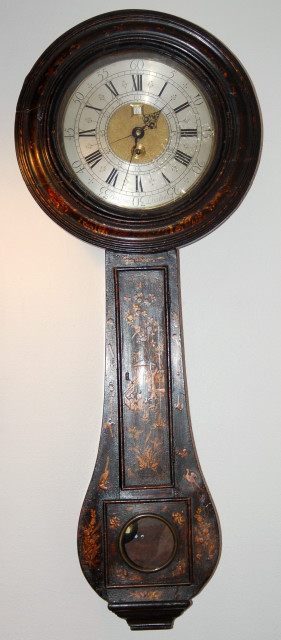
These tavern clocks were usually decorated in lacquer work. They had wooden dials that were made up from usually three sections. They also usually had simple single 5 wheel train movements. The extra wheel in the train generally makes them go for longer than a standard longcase clock, even though they actually have a shorter drop. They usually had brass hands so the time could easily be read against the black painted dial. The earliest dials known were wooden and shaped like a shield. Then later circular dials were introduced and tear drop shapes to the cabinets.
When did they start?
Many books on the subject commonly state the earliest examples of these clocks are from C1720. We have owned for over 10 years, a clock of this form that is pre 1700 in date. It is an amazing tavern clock, it is the only antique clock of this type I have ever seen with an original brass dial, instead of the usual wood form. The antique clock maker is from a family which emigrated to London from Augsburg in Germany. Bushman is a fantastic clock maker and by all accounts the finest clockmaker to come out of Germany! He is mentioned as being on a par with the great Thomas Tompion in some quarters.
Augsburg Influence
If I took a picture of the clock minus the hood it looks like a very early Augsburg table clock. I can see where the idea for the manufacture started. I believe this clock to be one of the first, if not the first, tavern clock. John Bushman is provable in London between 1661 until just after 1692 ( date of death unknown). We do know he came from the Augsburg area, but you can see the influence from the design of the cabinet work on this clock. Bushman was admitted to the Clockmaker’s Company in 1662. You can see the huge pull of this Guild which I have talked about previously. The best clockmakers from all over Europe came to London. Everyone wanted to come to London and work in the 17th and 18th centuries. It truly was the centre for clock making in the world at the time.
Many people will ask if this clock has 5 wheel train, how does it have a second hand, a sweep centre seconds hand in this case. The movement has a one to one reversing wheel to enable for it to do this. You can see the amazing engraving to the unusual dial and superb unrestored lacquer work to the case. A very rare collectors clock, for more information please contact me direct.
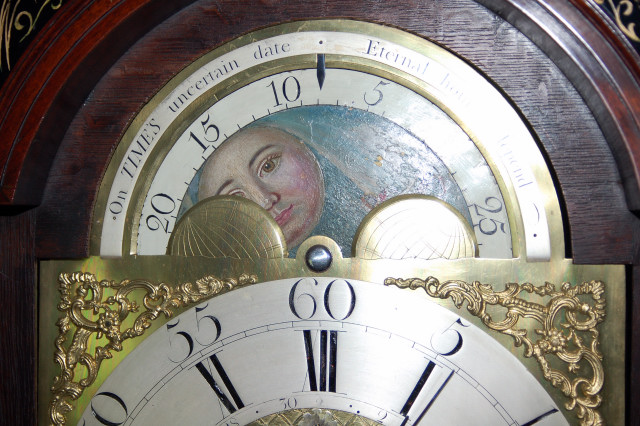
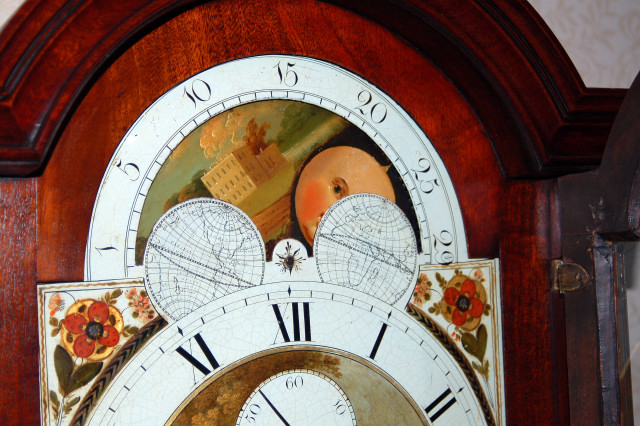
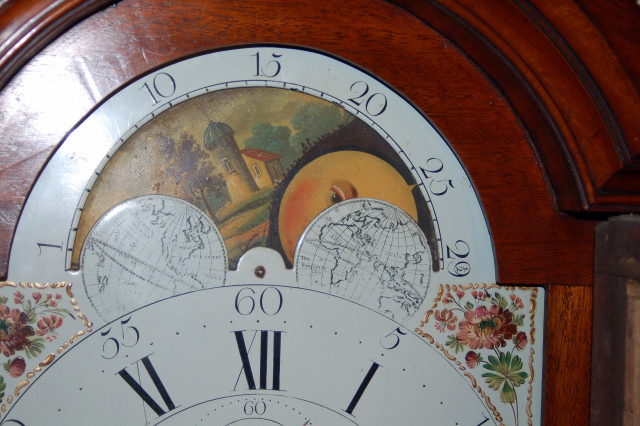
We often get asked about moon phase grandfather clocks. Were they just a form of decoration or were they an important feature on clocks? The lunar moon repeats with a cycle of 29.5 days. This is shown on all antique clocks with a moon feature as a result the moon disc moves once or twice per day.
Moon Disc Use On Clocks
On early pre C.1800 examples they certainly were more of a feature that the owner required for a specific purpose. That purpose was first and foremost travel, whether you would be travelling by ship or travelling by road. Knowing when the next full moon was vital part of life back in the 18th century. A merchant might live near the coast and need to know when the next high tide was. This feature will also be accompanied by a moon disc and he could look at his clock. On that day it would say the high tide would be 7am /7pm etc.
Stationary or Fixed High Tide Indicator on clocks
Tidal times are sometimes stationary. i.e. set to the port of the clock. Bristol Key etc or variable by an indicator to the arch which can be set to your local port, high tide time.
On an 18th century antique clock, a moon disc can either be a circular disc to the arch or a globe moon to the arch, sometimes called a ‘Halifax Moon’. They also could be, or a small ‘penny moon’ normally to the dial centre. This is where the seconds disc normally would be. Clocks with moon discs and not accompanied with high tide indicators were for help when travelling by road.
Highwayman Higgins
The highwayman was always a risk for the merchant in the 18th century. Tt was always advisable to travel on days with the full moon and lots of light. Generally the highwayman did not work on such nights They were more likely to be recognised. The most famous of northern highwayman was a Edward ‘Highwayman’ Higgins, who was a gentleman by day and a thief by night. He resided on Gaskell Avenue in Knutsford. This is only 5 miles from where our antique clock workshop is based. Higgins was hanged for his crimes in 1767.
London longcase clocks with moon features are very collectible as London had street lighting in the 18th century. Also the arches on London clocks are slightly reduced and not a full semi-circle. They were not really designed for moons. On provincial clocks you will notice the arch is a full semi-circle and alot more suited to a moon disc. It is for that reason finding a genuine London 18th century clock with a moon is highly sought after. Adding this feature to an 18th century London grandfather clock, can add up to £5,000 to the price on an equivalent clock.
Conclusion
I have been talking above about pre C.1800 clocks and clocks where the dials are 12 inches from side to side or less. Later clocks with dials of 13 inches or even larger are more likely to have moons and are not quite so rare. Clearly lots of later 19th century wider examples can have moons. These are more common and the moon disc on these is more for a form of decoration in my opinion than for any other purpose. We stock a few good examples at Pendulum of Mayfair of moon-phase clocks.