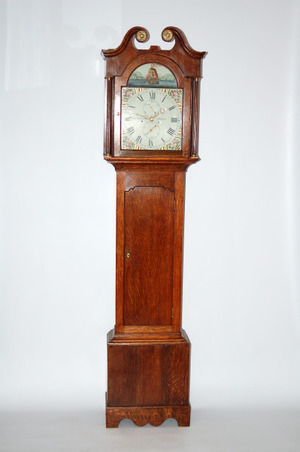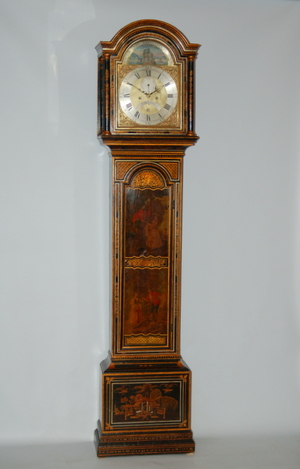
Red Lacquer Grand-daughter clock C1890

red lacquer grand-daughter clock

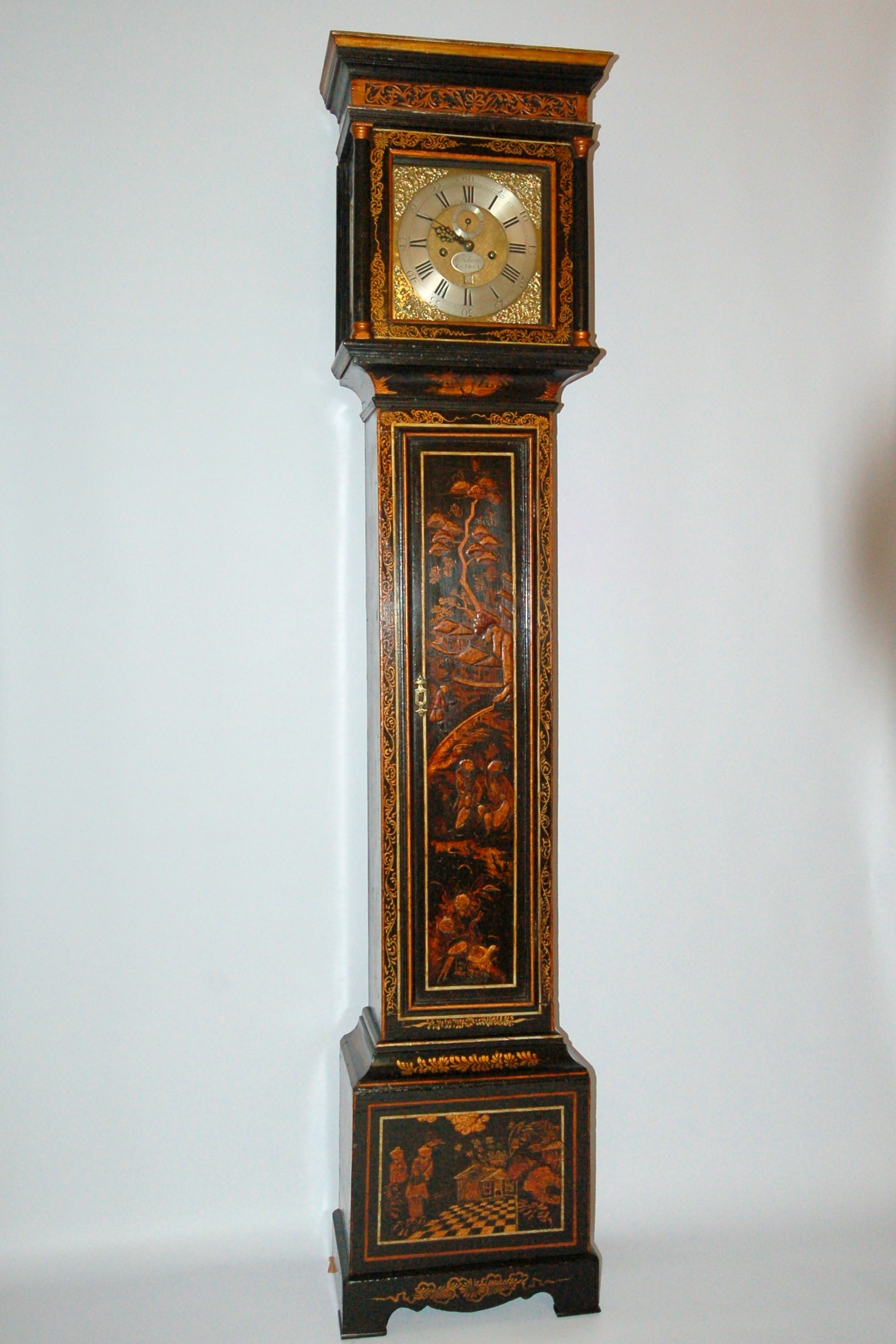
A simply outstanding red chinoiserie or lacquer work grand daughter clock with three train quarter striking movement.

The fine small arched brass dial with chapter ring and spandrels and fine matted centre. The arch showing a boss with the words Tempus Fugit within. Silvered chapter ring with Roman Numerals and silvered boss to the arch.

The spring driven ‘8 day’ movement of good quality striking the hours and quarters on various gongs.

The rare red decorated cabinet with fine Chinese scenes. The case showing high quality London style case features on a small scale. Pagoda top to the hood.

A real collectors clock and in superb condition. The movement signed by Lenzkirch.

Posted on

Lacquer- Chinese Decorated Clocks

East India Company

When talking about antique lacquer clocks and their cases we need to discuss the China trade and the formation of the East India Company.

People today see the trade with China as a route for cheap goods or services. They also probably believe this trade route is a relevantly new process. This is far from the truth though on both counts. We have traded with China and areas of the world like this for many centuries. The ability to trade came about with our nation making huge advancements in marine technology that I have discussed in previous blogs.

Role of our Great Navy in Trade

We were undoubtedly a great sea power. Merchants in the 16th and 17th and 18th centuries were amazed at the many treasures and skills the Chinese people possessed. It was not until 1672 that the famous East India Company secured a trading post in Taiwan. This was ten years or so later than their counterpart, the Dutch East India Company which was expelled from the country by the Chinese. At the start of 1700, the company’s base was changed from Taiwan to Canton. With its Royal Charter the company was granted a monopoly of trade in the East Indies until 1833.

As I have discussed in previous blogs about the Clockmakers Company. London and the UK was the centre of the world’s clock making in the 17th and 18th centuries.

Trade With China

The China trade expanded many different skill sets though, and cabinets from English clockmakers were sent out to China to be decorated. True lacquering originated from Asia and it is obtained by applying many coats of the sap of the lac tree with polishing between coats. The colour or surface dye is mixed with this lacquer. (Black, blue, red, green and many other colours) Then the lacquered cabinet is decorated with raised gold leaf decoration. These skills are thought to have been employed in Japan and China as early as the third century BC. Clearly its importation into Europe came at a much later time and was facilitated by the East India Company described above.

Lacquer Decoration

Furniture, boxes and antique clock cases were all decorated in this way. They were then transported back to homes in the UK. It is suggested that very few clock cases were sent out to the Far East for decorating. I do not agree with this. If you look closely at the records of the East India Company. Many clocks and pieces of furniture are clearly listed, with the lacquered description clearly evident. I am not saying some lacquer production does not start up in the UK. Any that does I believe to be not of the same quality as the clock cases decorated out in the Far East. Later 18th and 19th century clocks with have been lacquered sometimes show an inferior quality. These from UK decorators trying to copy the highly skilled Chinese in this regard.

UK versus Chinese Quality in Lacquer Work

No lacquer cabinets have a decorators mark so we will never know for sure which is which. The records of the East India Company do show a large importation of lacquered products throughout this period, this is for sure. We have a great history in this country in the UK but it is amazing what countries like China manufactured many centuries earlier. The East India Company imported fantastic Chinese porcelain and many other items into the UK during this time. These were not inferior cheap products at all. UK Porcelain Factories in places like Stoke set up off the back of this. We need to remember the great contribution of the Chinese nation. This development is carried out far earlier than in the UK. https://www.pendulumofmayfair.co.uk

Antique Grandfather Clock by William Smith – London mid 18th century

William Smith London clock

A superb chinoiserie decorated grandfather clock with the dial signed on a silvered cartouche William Smith London.

The 10inch brass square dial with lovely brass spandrels and silvered chapter ring with Roman numerals. The centre with fine matting and subsidiary seconds and calendar apertures.

The 5 pillar good quality movement striking the hours on a single bell.

The lovely decorated lacquer-work cabinet with flat top to the hood with fretwork beneath, long decorated trunk door with applied moulding. Decorated base panel with sce4nes and gold leaf decoration. All standing on a shaped single plinth.

William Smith is recorded as working, as a clockmaker, in Cheapside, London from 1750 to 1780. A very well respected clockmaking family who made clocks for members of the royal family. One is engraved “This clock was made In the Year 1763 For her ROYAL HIGHNESS the PRINCESS AMELIA By W Smith Moorfields London.”

Antique Grandfather Clock by Higgs & Diego (James) Evans – London C1775

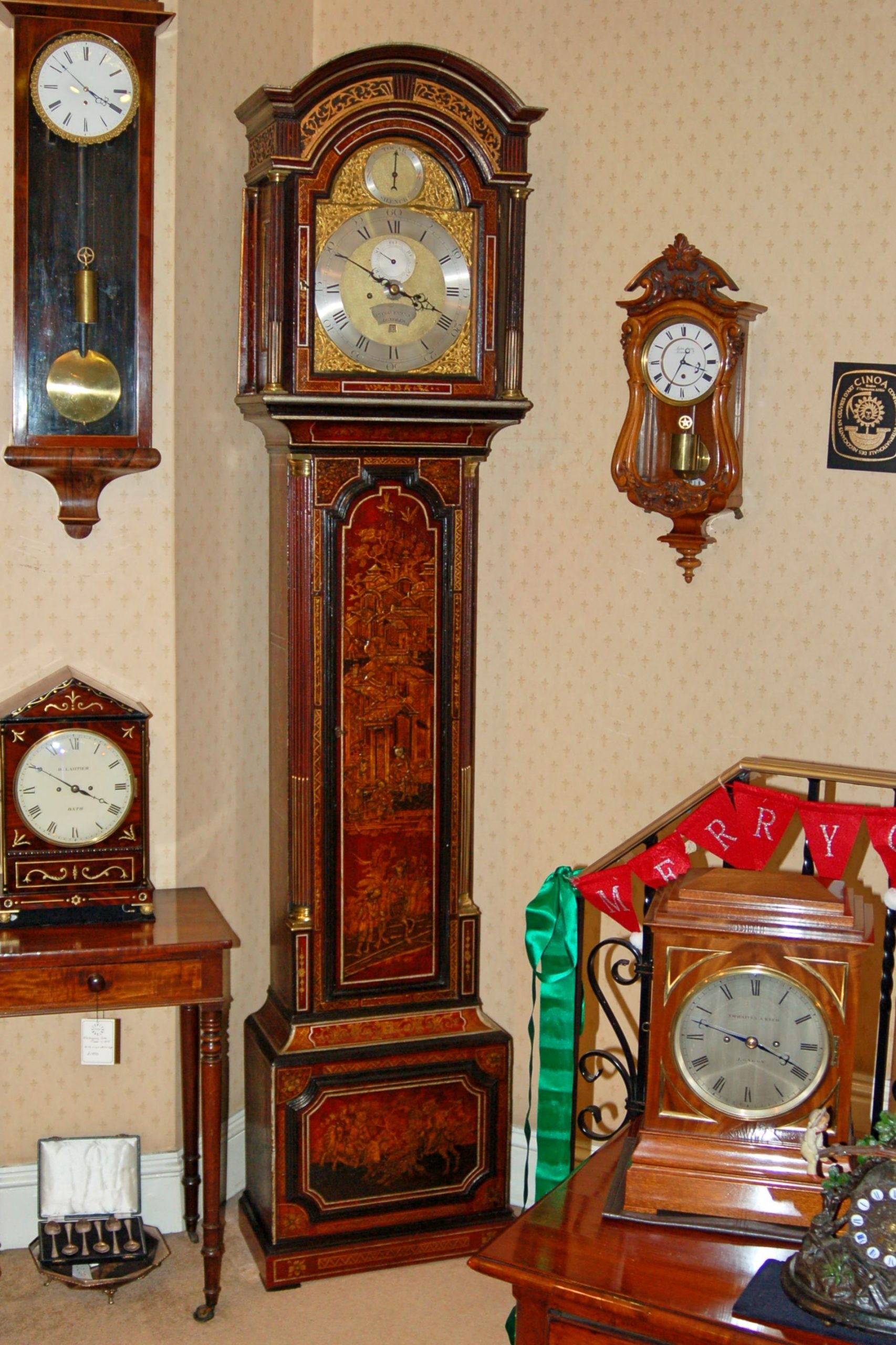
Lovely red lacquer grandfather clock by Higgs & Diego (James)Evans of London C1775. Featuring arched brass dial with chapter ring and spandrels, finely matted centre and strike silent feature to the arch. Also with subsidiary seconds and calendar and original alarm centre disc.

The fine 8 day duration movement striking the hours on a single bell but also with the alarm weight and feature. High quality wheel work.

The magnificently decorated cabinet showing Chinese Scenes. The cabinet of typical high quality London design and with standard quality features like quarter reeded columns. Reeded hood columns and brass capitals. Moulding to the trunk door and separate decorated base panel.

Higgs and Diego Evans were based at Sweetings Alley and later at the Royal Exchange. C1775-1825. Firm of Robert and Peter Higgs and James Evans. He was called Diego to appeal to the Spanish market. He has watches featured at the Science Museum South Kensington. Bracket clock illustrated Cezsinsky and Webster, also a longcase and bracket clock illustrated in Britten. A bracket clock in the Virginia Museum also signed Higgs and Diego Evans.One of the only makers I can recall that uses a different makers name to appeal to a different market. A lovely collector’s clock.

Antique Grandfather Clock by James Scholefield – London C1760

Scholefield main

A good mid 18th century ‘8 day’ duration lacquer longcase clock. The arched brass dial by James Scholefield of London. The cabinet showing good Chinese scenes. Furthermore the dial with chapter ring and spandrels. Including seconds and calendar rings, matted centre and strike/silent to arch. Finally the 5 pillar movement striking hours on a single bell.

Antique Grandfather Clocks

Repairs

All the Antique Clocks and furniture sold at Pendulum of Mayfair are restored sympathetically to a high standard at our own workshops. It gives us great pleasure and satisfaction working with antiques and understanding the skills and methods used by these 17th and 18th century craftsmen. Very few of the clocks that we make today will be in working order in 20 years time, let alone 200 years. Our legacy of the 20th century is basically a throwaway society.

When these Longcase clocks were produced in the 17th and 18th centuries, I wonder if their makers understood that these clocks would last virtually for ever. They were made then to a quality and not to a cost, and designed to last; I only wish their makers could see them still ticking in many homes today.

One would think as a nation our skills would have increased; have they? The skill industries are declining. In the 18th century one of the highest skilled and respected professions was the local clockmaker. We are truly honoured to work on these master timepieces!

Cabinet Restoration
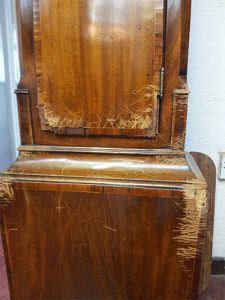
All the basic skills and methods were developed in house by the company’s owner. Just like the olden days we believe it is best to start young and give our youth of society a highly skilled trade and a better future. We consult local schools careers masters and handpick the most conscientious and caring students around. Training lasts for a period of approx. 5/6 years. We take great pride in the finished output of our workshop, even if the item in question is 500, or 50,000,we take the utmost care in trying to produce the best work possible, irrespective of how long it takes.

We do not cut corners; goods only leave our workshop when the owner himself is happy with them. If any part is not to the required standard, the item is sent back and finished to his satisfaction. At the opening of our London shop in November 1995, the head of Sothebys clock department was quoted as saying, ” no business restores their antiques as sympathetically.”

He was able to say this on good authority, because he was shown one clock that he had previously sold unrestored at his auction.

Our methods that we use in our workshop are special; we try and maintain the original colour and patination to give a soft finish. All repairs are carried out with wood of a similar age to the article being restored. We buy distressed antiques to saw up for veneers; this wood is then graded in to types and age, to provide as near as match as possible.

Over the last 20 years we have amassed considerable stocks of material for restoration.

Antique bracket clocks in restoration

We have extensive stocks of over 200 Antique Longcase Clocks available unrestored awaiting restoration. All stock both restored and unrestored is kept in controlled environments for both temperature and humidity. If antiques are bought that have not been previously stored in the correct conditions as above, they are more likely to warp or split, whenever they are subject to central heating. It is advisable to keep antique furniture in R.H. between 40 and 65%.

Movement Restoration

Be very careful with whom you entrust your antique clock movement. Most of our time in the clock department is taken putting right what other so called restorers have done in the past. Because of this we like to work on untouched antiques in so called sleepy condition.

Again the work we do on this side of the antiques business is of utmost importance to us. We ship antique clocks to all corners of the world. They have to work properly; all movements are pre cleaned, then all the necessary work is carried out. We do the pivots/bushes, all to close tolerances. The bushes are of the Swiss bergeon type or are made by us out of cast brass, to match the colour of the movement. The pallets are restored with high-grade material, and then all the other necessary work is carried out. There is a final cleaning/polishing stage where we use gloves.

The dials are lacquered using a special colourless lacquer to keep them as clean as possible for years to come. Finished movements are then tested and regulated for timekeeping for 7-21 days. Longcase movements should not need maintenance after we have serviced them for wear for the next 40 years.

They will require oiling every 1-2 years and may require cleaning if kept in dusty atmospheres. Oiling takes 5-10 minutes and is easily carried out by the owner.

Conclusion
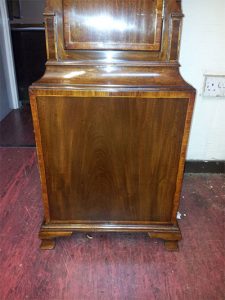
High quality restoration of antique grandfather clocks and longcase clocks

Buying an antique clock( be it longcase / grandfather / tallcase / wall / bracket clock) is a decision you should not take lightly. Whereas you normally buy a car for 3-5 years, a house for 10 years, one of our clocks will still hopefully be in your family in the next Millennium. You will not understand, unless you have owned one of our clocks, the pleasure they bring. Many of our customers have testified that it is like a nice person coming to live with you!

View our antique clocks available online and if you require any further information or references of our work, please contact me.

Daniel.R.Clements

Posted on

Great Christmas Gift Ideas

Silver looking around for that ideal stocking filler.

Have you ever been completely lost over what to get your loved one at Christmas?

If so you are one of millions of us rushing around at the last minute with no clue of what to get?
We usually spend hundreds of pounds on something that will be forgotten within a few days. How about some suggestions that will be a memorable present for many years to come ?

Everyone has a budget at Christmas. I will be looking a various options from a few hundred pounds to a few thousands pounds for those with bigger pockets. Maybe for ones like me that tend to save up and buy something really special once a year as a special treat.

Under 500£ Presents

Lovely Art Nouveau Balloon Clock C1900

Swan Neck Balloon Clock C1900

Lovely Art Nouveau Balloon clocks can be a wonderful Christmas gift. Fully restored examples in top condition and of the best quality can be found at under 500£. These lovely little clocks will give years of superb service. Always reminding the person of the day they receive this lovely gift.

Under £1,500 Presents

Ships wall clock

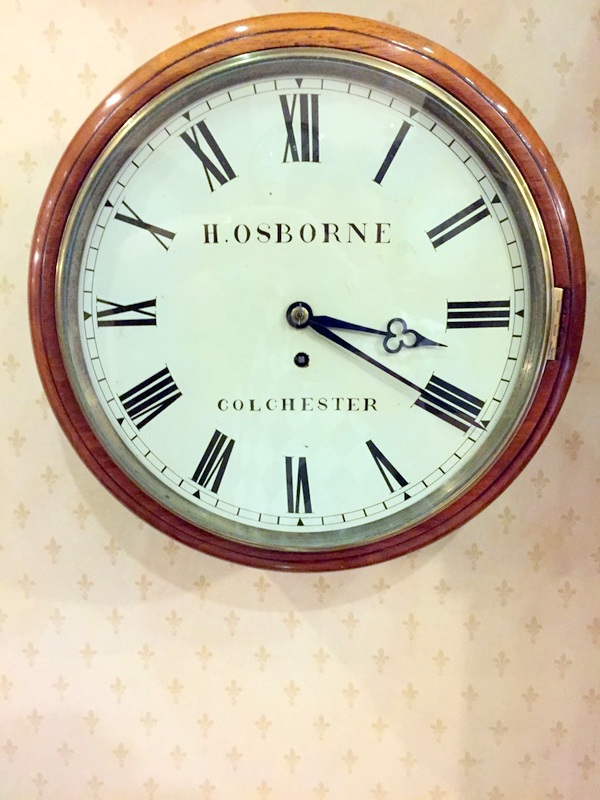
Osborne of Colchester Dial Clock

Antique pre c1900 Fusee wall clocks that have been overhauled and are in showroom condition are fantastic gifts. The earlier type can go from around £1,000 to £1,600. If you want to stretch the budget you can go for a smaller dial example. Convex dials or even rarer large face dials with fusee movement which all are more expensive.

Under £3,000 Presents

Joyce Bracket clock with round convex dial

skeleton clock C1860

For under or around £3,000 you can get a large selection of early or mid 19th century fusee timepiece bracket or skeleton clocks.

Under £7,500 Presents

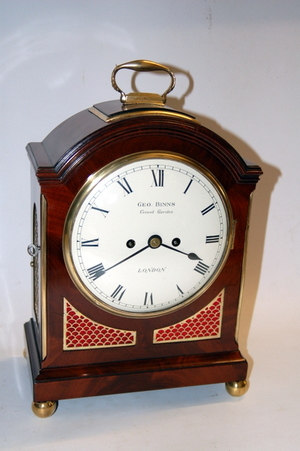
George Binns Bracket Clock C1820

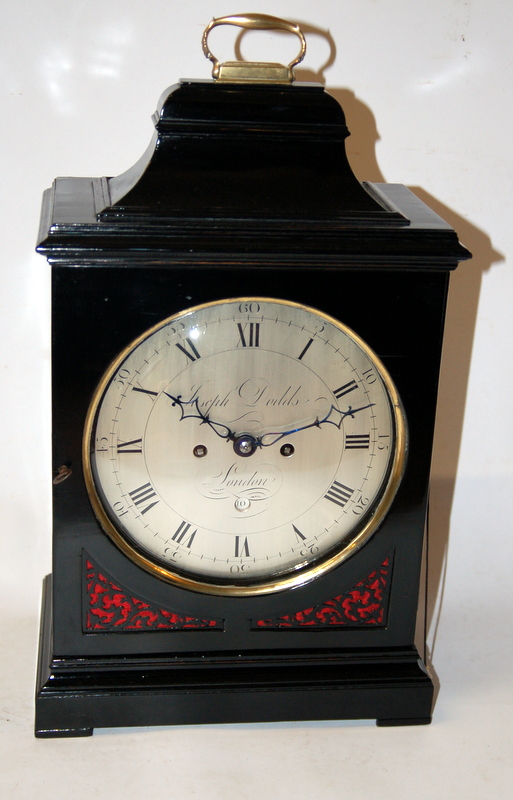
Dodds ebonized bracket clock

These superb fusee bracket clocks would be a lovely addition to any home. Woods from mahogany to walnut to ebonized fruitwood can be found on these examples. Most movements are of 8 day fusee type.

From £3,000-£30,000 Presents

porthouse grandfather clock

Old Deer Davidson Grandfather Clock

Pewsey London Grandfather Clock

Automaton Lacquer Grandfather Clock

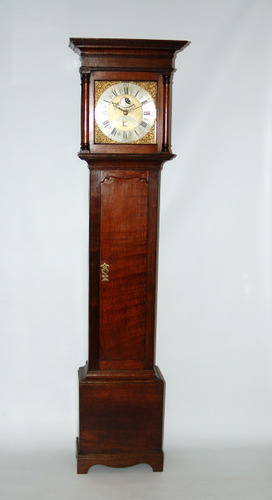
Antique grandfather clocks form an amazing addition to any home. They truly are the centre piece. Owning a lovely restored ticking antique grandfather clock is like having someone nice coming to stay with you.

I hope some of these pictures give you the inspiration this Christmas for that really special gift. If not for Christmas then for that special anniversary. Have a part of our nations history ticking away in your home very soon, you won’t regret it.

Daniel Clements

Posted on

Silvered Brass Dial Clocks


DSC_0237


 1771 Clock by Cranmer of Birmingham
1771 Clock by Cranmer of Birmingham

A couple of years ago I wrote an informative post on painted dial grandfather clocks. Their history and development. I have written this piece in conjunction with that post as the two really go hand in hand. Right I hear you all ask, well how are they connected?

Engraved Brass Dials

The rise of the white dial grandfather clock dials in Birmingham made the brass dial manufacturers sit up and take notice. This new technology could easily take over and this was centered in Birmingham. Dial painters would really have a monopoly over the supply. The clock makers who had specialist engravers and relied on the brass cast dials clearly had to do something. The white dials were pretty and they served a purpose of being easier to read the time on the clocks face.

A challenge to the white dial dominance

White dials with blued iron hands were really easy to read, even from a distance. The clock above is so significant as it is dated 1771 and is an all over brass silvered dial clock. The painted dials were recorded as starting in pretty much the same time as silvered brass dials. It is probably of a great deal of significance that the clock above was made in the same town as where the white dials started production in Birmingham. I believe Mr Cranmer has his ear to the ground so to speak.

First of its kind

He developed the dial above as one of the first of its kind, to compete with these new painted dials coming on the market. You will notice the unusual painted scene to the arch and the slightly strange thick engraving to the dial.  Further examples of silvered dial white dial grandfather clocks. These can be found on our website of Pendulum of Mayfair or by clicking here: Pendulum of Mayfair Ltd.


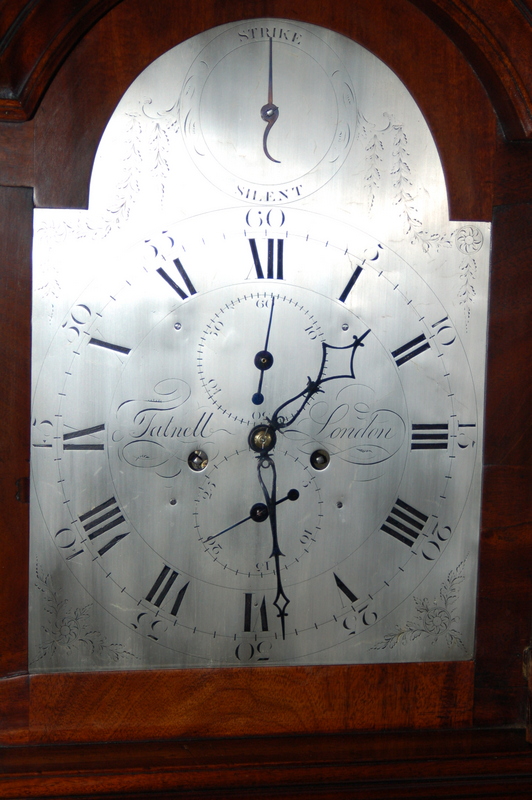
London silvered brass dial clock by Tatnell C1790

Tatnell London clock

You will see a later more standard London silvered brass dial clock by Tatnell of London. With an all over silvered brass dial, the dial is cast brass in the 18th century. this is then made to look like silver by rubbing with a white powder called silver chloride. This leaves deposits of silver on the dial. It gives it its silver look. In most cases the dial is then lacquered to make it slightly harder wearing. Generally though a silver coating on the dial will wear over time and needs re-silvering every generation.

Temporary Solution to White Dial Dominance

In the 20 years after the development of the painted dial grandfather clock dials sales boomed. The sales on the other hand of the standard grandfather clock dial decreased. The brass dial with chapter ring and spandrels started to become less popular. Up to 1790 as a result of the development of the silvered brass dials sales were running about equal. After C1790 though the sales of white dial continued at a pace. By C1820 you were looking at a market that was dominated with painted dial clocks. The painted dial manufacture set up in other places around the country. Not just in Birmingham. The brass dial clocks were on the decline. The silvered brass dial saved the production for 20/30 years. The decline of brass dials and rise of painted dials had taken hold.

Posted on

Wood Identification Guide

For antique furniture and clocks different types of wood were used in their manufacture. In this handy guide I am going to cover some of the main woods used. These woods can be of solid form but most flamboyant grained woods are used as hand cut veneers. The carcass is generally made from oak or pine in the provinces or oak generally in London.

Woods Used in London and Provinces

In London oak is only used as a carcas material in the 17th and 18th centuries. Whereas in the provinces you will find antique grandfather clocks being made of oak as the finished wood. Clearly oak was veneered on as well, especially in London by English Walnut up to say C1750 . Then from this date fine Honduras and Cuban mahogany veneers are found. On some clocks you will find very early examples to be of ebony construction or ebonized (black stained fruitwood generally)

Chinoiserie Clocks

You can also get oak grandfather clocks in London that were painted and decorated by Chinoiserie or lacquer work. The finest examples were sent out on boats and decorated in China.  On some later clocks you will see these veneered in more exotic woods. Rosewood or maple or even ewe wood. I suppose the smaller size means you can use veneers of the more slow growing and smaller trees.  With early clocks these exotic woods were used as well in small pieces and matched. We have owned a lovely walnut burr oyster veneered grandfather clock.

Below is a selection of woods used for antique clocks and furniture during the 17th and 18th and 19th centuries in England. A brief insight into each wood pictured is given. I hope from this blog you will discover what type of wood your clock or piece of furniture is manufactured from.

Honduras Mahogany


Cuban mahogany
Plum Pudding (spotted) mahogany

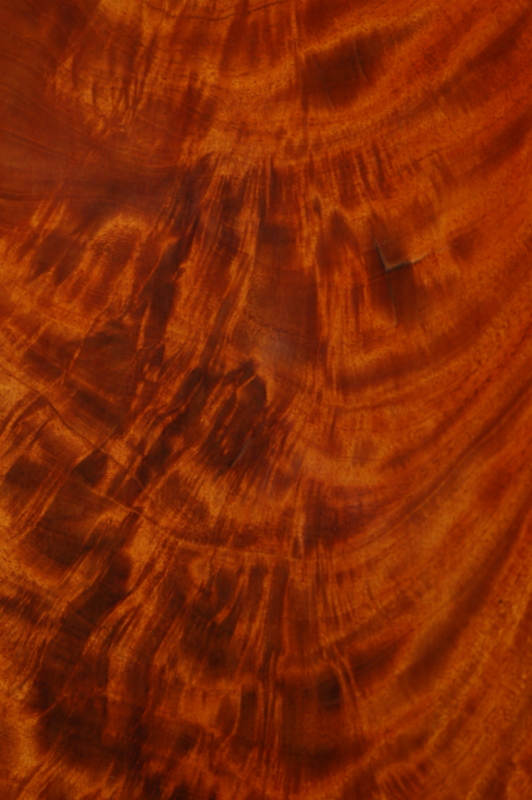
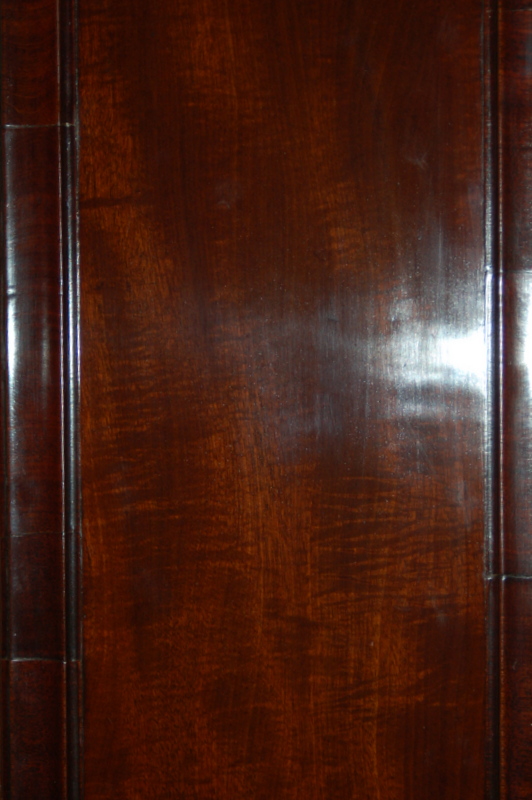
Mahogany can be a beautiful wood, it starts in the UK being used around C1750 and continues being used throughout the 18th and 19th centuries. Two most common variants are Honduras (lighter) and Cuban mahogany (darker). It is a close grain hardwood coming commonly from the South America or the West Indies type regions. This tree can be found quite wide and so large sections could be veneered with this wood.

Quarter Cut or star-fleck figured oak
Solid English Oak

English Oak

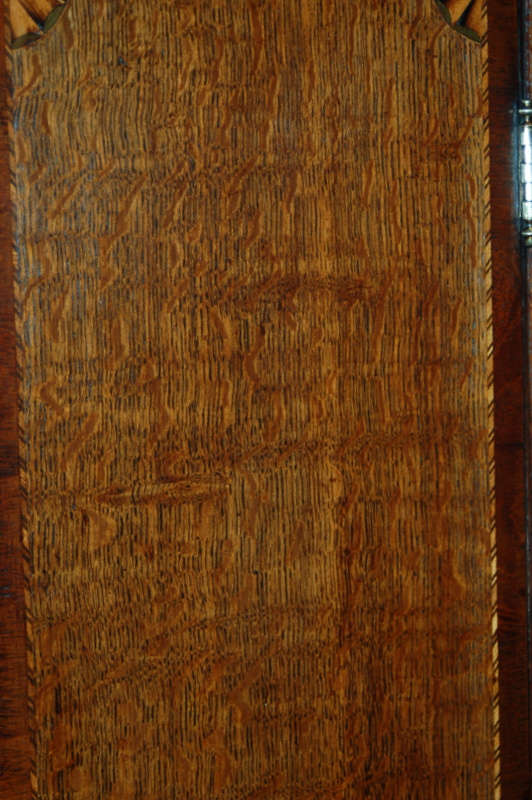
English oak is a slow growing and so very heavy wood. Used in construction and veneered some of the time, but it is a beautiful wood in its own right. Oak being so heavy and close grained it is good at preventing things like wood worm. It is one of the reasons why London used it in the construction of its clock cases ahead of pine. Pine is used in the provinces as a rule for carcases as it is cheaper. You will notice the weight difference between an antique clock veneered on oak and an antique clock veneered on pine. Oak just gets better with age and polishing, we call this the patina. Less close grain oak can come from countries like Japan. This wood although called oak, is a far poorer wood to the slower growing English oak.

The climate effects the grain of the wood

English Burr Walnut
Marquetry inlay on English Walnut
Marquetry on Walnut
Continental walnut


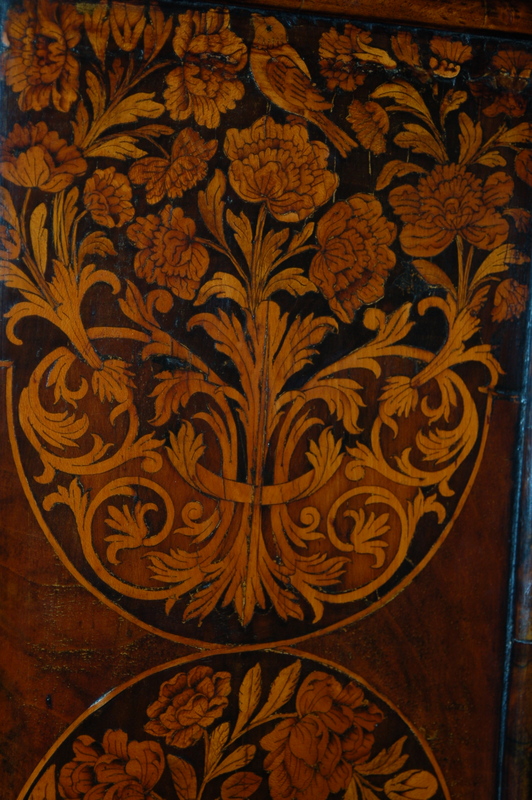
Walnut is a lovely wood and English walnut gets used as veneers in antique furniture and clock manufacture up until C1750. After this date most walnut used is Continental walnut. Continental walnut is a quicker growing tree and so the grain is never as fine as English burr walnut. Again English walnut is a very heavy wood with a close grain. The tighter the burr or knot in the walnut the better. Walnut can range in colour from quite light if the sun has taken it, to quite dark. Walnut is used on all of the German wall regulators or commonly called ‘Vienna  style’ wall clocks  etc through the 19th century.

Satinwood

Satinwood used as a blank canvass to artists

Satinwood being a very light wood was used towards the end of the 18th centuries and early 19th centuries in the main. Many expensive pieces are manufactured with Satinwood veneers. We have some Pergolesi painted tables with satinwood veneers. I suppose the light colour makes the painting stand out better.

Pine

Pine, many of you will be familiar with this wood. It is rare to see a surviving antique grandfather clock made in this wood like the above. It was prone to woodworm unfortunately. Some were painted and this helped preserve them.Many provincial cabinets were constructed out of pine and then veneered. Pine is also used alot today as it is a relatively cheap wood, unlike oak. Clearly as you can see from the grain and if you lifted it from the weight , it is a fairly quick growing tree.

Lacquer or Chinoiserie

Oak can be veneered or painted

Oak was only used on internal construction of cabinets of English London clocks. When this wood was used and if it is not veneered in London you will find it sometimes decorated with lacquer work or Chinoiserie. This is gold leaf and gesso. The best types of these works are seen when they were sent out to China in the early/mid 18th century and decorated their.

I think I have covered the majority of main woods used in English cabinet making. There are others like ewe wood, maple , elm, fruitwood and rosewood. These are not covered as they are used alot less. I hope this blog has been of help to you. If you are still struggling with finding out what wood your clock or piece of furniture is made from, please send me a picture to PendulumClocks@aol.com

Daniel Clements – Pendulum of Mayfair


Posted on

Japanese Pillar Clocks


In my various blogs to date we have studied clockmaking in the UK in great depth, this is with due reason. London was the centre of the clock making during the 17th/18th and 19th centuries. In my later blogs I have looked at clock making in France and Germany. Clock decoration carried out by the Chinese, on lacquer clocks. I wish to end this year with a quick look at antique clocks and timekeeping in Japan. I will focus on the humble Japanese Pillar Clock.


Japanese Time

Japanese clocks were somewhat different to European antique clocks in the 17th,18th and 19th centuries. The earliest clocks to come to Japan from missionaries and merchants had to be adapted to Japanese time. The Japanese clock makers had many challenges adapting these clocks. They also had the problem as a nation they were very isolationist after the mid 17th century. Their technology in this regard somewhat lagged behind the western clocks of the period.

So what is Japanese time I hear you ask? Surely all time is measured the same, well no not for the Japanese culture in these early periods. In fact it was not until 1873 that the Japanese government adopted the 24 hour system used in the West and the Gregorian calendar.

Adjustable Clock Divisions

Japanese time required 6 hours in the daytime from sunrise to sunset and 6 hours at night, from sunset to sunrise. As a result of the seasons these time periods were unequal and the divisions on Japanese clocks had to be adjustable. This was called unequal temporal hours. Daylight hours were longer in the summer and shorter in the winter, with the opposite at night. Clearly this produced problems and the European system of equal hours that did not vary with seasons was far simpler.

Rare Clocks Shitan Wood

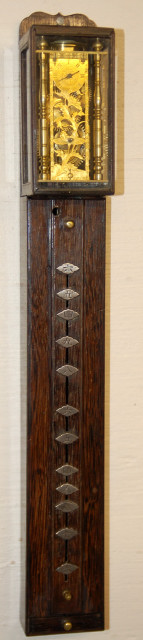
The Japanese pillar clock pictured here is a rare example that is a striking example, most are timepiece. It is also weight driven. It has a verge escapement, beautifully turned pillars and a foliot escapement. As the clock winds out the indicator tells the time by the scales on the door. Typical clocks had six numbered hours from 9 to 4 which counted backwards from noon to midnight. The dials did not have the numbers 1 to 3 for religious reasons. Dawn and dusk were marked as the sixth hour in Japanese timekeeping. A list of the strange dials for the hours is given on Wikipedia, please take a look.

The name pillar clocks comes from the fact they used to hang from the pillars or posts of the Japanese houses. These clocks were generally made from a wood called Shitan. Clearly because of the fragile nature of the construction only a few have survived and they are highly sought after. The movements go for just 1 day on a wind.

Summary

I hope you all have a happy and most important of all healthy Christmas and New Year. Soon restarting my antique clock blog in the New Year. I hope you have enjoyed and hopefully learned something from them. Again have a lovely holiday and see you soon.