Search


Pendulum of Mayfair

King House,
51 Maddox Street,
London W1S 2PH

Telephone:

+44 (0) 207 629 6606

Fax:

+44 (0) 207 629 6616

Email:

Pendulumclocks@aol.com

Coppelia Antiques

Holford Lodge,
Plumley Moor Road,
Plumley,
Cheshire
WA16 9RS

Telephone:

+44 (0) 1565 722197

Fax:

+44 (0) 1565 722744
whos who
Visit Pendulum of Mayfair on Facebook Follow Pendulum of Mayfair on Twitter View Pendulum of Mayfair LinkedIn Profile
Watch Pendulum of Mayfair on YouTube Pendulum of Mayfair RSS Feed

Antique Clocks Blog

English Lantern Clocks May 11, 2012

A typical verge 17th century lantern clock with alarm feature to dial centre. These clocks are hung from a hook on the wall and they have one weight which drives both the striking side and going side of mechanism. As a result these clocks go for 30 hours or less on a full wind.

As this is such a broad subject for discussion, I can only give a few important pointers in the development of English Lantern Clocks.  I will try and answer any questions you may have through my main website. The earliest practical timekeepers in homes in this country were the lantern clocks. They deserve discussion and I will do my best in a short piece to give a useful insight into their manufacture/ design and dates.

The name Lantern Clocks always causes much debate, some people suggest the word derives from a corruption of the word Latten, which used to describe copper alloys, much like brass in the Middle Ages. It is also suggested the name comes from the fact that the clocks shape looks like a rectangular lantern from the period.  In any event Lantern clocks, which are a type of weight driven clock hanging usually from the wall  came into homes in this country from about C1600. They remained very popular until the 19 th century. You will see many copies of these types of antique clock sold today, many with spring driven movements.

Lantern clocks were made almost exclusively of brass, you will only find a few posts within the movement and the clock hand made of iron, sometimes even the antique clock hand will be cut from brass. These clocks generally have a single hand to tell the time. The movements are of a maximum of 30 hours duration. I have never seen a period  ’8-day’ example. These clocks strike the hours on a single bell and are wound from a continuos rope system. Occasionally you will have an alarm feature to the centre of the dial. This alarm feature has sometimes been removed over the years.

The earliest mechanisms of these clocks have a balance wheel form of escapement, the development then continues onto the verge escapement and small bob pendulum. The problem with both these methods is accuracy for timekeeping is not great. It was the devlopment of the long pendulum by Huygens in 1656 that further developed these clocks.  Accuracy of  about 15 minutes per day was expected with an early balance wheel escapement lantern clocks, probably 5/10 minutes per day with the early verge escapements and to under a minute or so with the anchor escapements and long pendulum.

The invention of the long pendulum was both good and bad for the humble lantern clock though, it is clear some of the earliest provincial grandfather clocks were lantern clocks in wood cases shaped very much like coffins. As development continued antique grandfather clock production slowly wiped out the need for lantern clocks. Few lantern clocks tend to be made during the 18th century.

Original lantern clocks dating back to the 17th century are rare and these are highly sought after and collectable. The Victorians unfortunately changed many of the movements of these 17th century lantern clocks and put key wind late movements to them. I often see these clocks around the salerooms and it makes me sad. I have collected a number of genuine 17th century lantern clocks and many are pictured in the reknowned book by George White on English Lantern Clocks. If you wish to do a detailed study on these exceptional clocks I recommend reading this book.


  • email
  • Add to favorites
  • Facebook
  • Twitter
  • LinkedIn
  • Google Bookmarks
  • Digg
  • StumbleUpon
  • del.icio.us
  • Reddit
  • Tumblr
  • MySpace
  • Google Buzz
  • Live
  • NewsVine
  • Yahoo! Buzz

Antique Novelty Clocks April 27, 2012


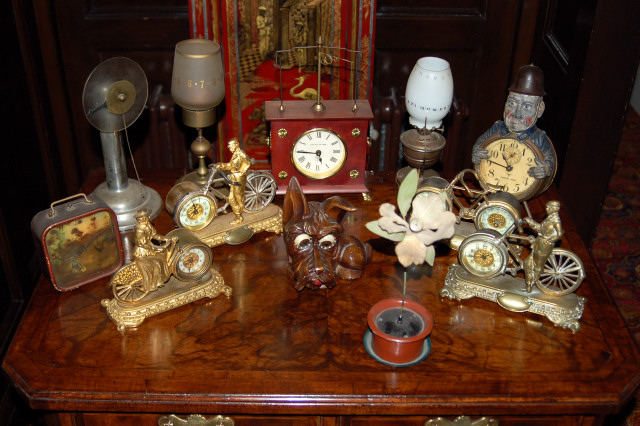
I have featured  many antique clocks from the 17th/18th and 19th centuries, as you probably know I am not a big fan of most 20th century clocks. There are still some fun clocks made during this period though and I will focus on a few here. The clocks I will be discussing here are so-called novelty clocks.

You will see from the picture above there are lots of things you can collect that are really fun and interesting. We have a selection of bicycle clocks, one of these even has a barometer in the back wheel. You can ocassionally see such items on your travels but as with anything collectable you will probably expect to pay from about £500 to £750 for a nice example dating from the beginning of the 20th century.

You will notice candle clocks, oil lamp clocks, clocks where the eyes tell the time in the case of the dog. Clocks is the form of a policeman, where the helmet is the alarm bell. There is an unusual petal clock, where the centre of the flower is the time and the mechanism is in the plant pot.

I hope you agree these are all very interesting and highly collectable antique clocks. Although such items are increasing in value, if you start collecting such items and form a nice collection, your money will be well invested.

Personally when I was young I used to collect Art Nouveau Balloon clocks, I have amassed a large collection of these over the years.  I started collecting when I was about 13 and have loved antique clocks all my life. I suppose growing up  in a family antique clocks business with its own in house antique clock restoration department, I had to either love antiques or hate them. The more you understand about antique clocks, the more you love them. My advice is to start collecting when you are young, learn from those willing to give you good advice and soak up all this information like a sponge. It is really rewarding now giving back to others all I have learnt over the years and I hope you continue to enjoy my blog.

  • email
  • Add to favorites
  • Facebook
  • Twitter
  • LinkedIn
  • Google Bookmarks
  • Digg
  • StumbleUpon
  • del.icio.us
  • Reddit
  • Tumblr
  • MySpace
  • Google Buzz
  • Live
  • NewsVine
  • Yahoo! Buzz

Regional Characteristics of Antique Grandfather Clocks April 20, 2012

The production of cabinets of antique grandfather clocks throughout the 18th and 19th century centuries was seperate than the clockmaker who produced the fine antique clock movements. As you can imagine communities stayed very much together during this time and people did not travel long distances in the main. As a result you will notice every area of the country in the 18th century had a very different case style. It is very easy to place the manufacture of an antique clock cabinet from just a very few features on the cabinet.

For example with the production of longcase clock cabinets in london, designs might have changed slightly during the 18th century but for the early 18th century and the late 18th century they are very much on the same thinking. You will see after C1720 and up to C1800 usually two plinths, moulding to trunk door and high quality walnut, mahogany veneers or fine lacquer work cases.  Examples can be seen below. After about 1800 london clocks can lose the second plinth and the moulding to the door but you will still see them being quite similar in design. You will also find these close similarities in cases of clocks within 50 miles or so of London, many clockmakers actually bought London style cases in  these areas.


You will find many regional designs of cabinets though and after looking for a while you will get a good idea of where the clockmaker was based from just looking a certain case features. In Scotland for example, especially the East Coast you get some wonderful cases from C1770 to c1810, all very slender, shaped top to the trunk door, high proportion base and standing on bracket feet. The most characteristic is the swan neck pediments to the hood.


You will also find Manchester, Liverpool and Bristol cabinets to be quite distinctive, in the 18th century these areas were very wealthy, especially because of the trade going on with the West Indies and the USA, and Manchester was the birth place for the industrial revolution. Cabinets in Manchester and Liverpool, especially at the end of the 18th century and later tend to be quite large with quite imposing features,  Og feet, Corinthian columns, fine veneers. You will see a typical high quality Liverpool case below.


Bristol was another very important port in the 18th century and the clocks made in this part of the country are very distinctive. Wobbly doors are very common and scenes engraved to dial are very popular, pierced swan neck pediments and OG bracket feet show the fine cabinet work. Again it is easy to see the wealth in this part of the country in the 18th century, the cases are very flambouyant. Understanding case design and the styles of the various parts of the UK cabinet design is important when looking to buy an antique grandfather clock. You can use this knowledge with further research to pinpoint all those important questions that you need reassurance with, when purchasing antique grandfather clocks.


  • email
  • Add to favorites
  • Facebook
  • Twitter
  • LinkedIn
  • Google Bookmarks
  • Digg
  • StumbleUpon
  • del.icio.us
  • Reddit
  • Tumblr
  • MySpace
  • Google Buzz
  • Live
  • NewsVine
  • Yahoo! Buzz

Vienna or German Wall Clock ? April 13, 2012

The term ‘Vienna Regulator’ wall clock is commonly used to describe a narrow weight driven wall clock. All these clocks seem bundled together in one big group. In my opinion this is wrong, there should be a clear differentiation between a true ‘Vienna Regulator’ clock and the later ‘Vienna Style Regulator’ wall clock or  properly described as a ‘German  Regulator’ wall clock.

Vienna regulator wall clocks are very special and an original example can be very expensive. These clocks were manufactured throughout the 19th century, but most were made from about C1800 to C1850. These clocks were  hand made and of very fine quality. These clocks are also very simple and very elegant. I suppose as the value of clocks like this are high and they are very simple, this is the reason why I have seen many copies of these type of clocks coming onto the market in recent years. Only buy an early Vienna wall clock from a specialist antique clock dealer who will give you a money back guarantee that it is genuine and fully restored.

German wall regulators can still be nice clocks, I particularly like the first 10 or 20 years they were made from about C1860. After C1880 these clocks become very ornate though and the quality tends to decrease. These clocks  were made in factories specifically set up to produce them. With the typical german efficiency, they made lots of these clocks, and the value is alot lower than the earlier Austrian handmade examples.


I often get asked how do you tell if I have got a German wall regulator or an earlier Austrian example. The easiest way you can tell the difference is that German weight driven wall clocks often have an imitation second hand to the dial. Austrian wall clocks did not normally use this feature, unless the clock could actually beat seconds. A seconds pendulum means the pendulum will need to be about 1 meter long. If you timed the period of 1 rotation on a german wall clock of the so called seconds hand, it will take about 40 seconds. It was in effect just a gimmick or put on the dial just for looks. The Austrians were purests and did not do this. An example of a true Austrian Vienna wall clock will a proper seconds hand is pictured above. You will notice the clock is very long. You will also see two examples below, a German wall regulator and an Austrian vienna regulator, see if you can see which one is which from my reasoning above.


  • email
  • Add to favorites
  • Facebook
  • Twitter
  • LinkedIn
  • Google Bookmarks
  • Digg
  • StumbleUpon
  • del.icio.us
  • Reddit
  • Tumblr
  • MySpace
  • Google Buzz
  • Live
  • NewsVine
  • Yahoo! Buzz

antique clocks March 30, 2012

I have worked in the field of antiques all my life and one specialist sideline I have is in interior design. Interior design is an important part of any home and should be considered before any purchase.
I love antiques and it is my belief that an antique grandfather clock should be central to any new interior design project. Antique clocks provide a superb focal point and they add so much character to any room setting.
It is a misnomer that you can not furnish a new home with antiques and that you need an old 18th century house. Antiques fit in any home to compliment the decor. I have designed very modern chrome interior houses and filled them with some special antique items and they work really well together. Do not think you can not use antiques to furnish a modern designer home, you will be surprised at how well they work in this regard.
A few special items, an antique chest, an antique clock, a lovely Georgian dining table bring a loving lived in feel to your home.
At Pendulum of Mayfair Ltd we can arrange a full interior design service and provide recommendations and special prices for complete house designs. Please contact me today to ask for more details.
Daniel Clements

  • email
  • Add to favorites
  • Facebook
  • Twitter
  • LinkedIn
  • Google Bookmarks
  • Digg
  • StumbleUpon
  • del.icio.us
  • Reddit
  • Tumblr
  • MySpace
  • Google Buzz
  • Live
  • NewsVine
  • Yahoo! Buzz