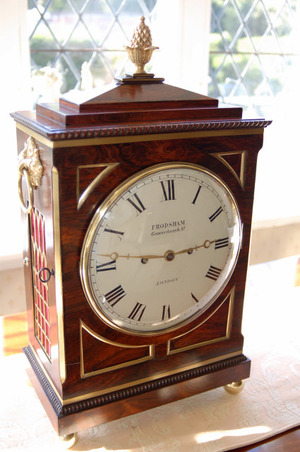
At present our family antiques business probably ships about 60% of its total sales of antique clocks abroad to countries like USA , Canada, Australia and China. For shipments to these countries antique clocks need to be professionally packed. So what does this entail?
Packing
After you have purchased your antique clock we offer a full door to door shipping service provided at present by a superb company that we have used for many years called the British Shop. They will pick the clock up from our shop in London or our premises in Cheshire and arrange for a crate to be made for the trunk , hood and movement, export and deliver to your home. The timber crate is necessary when export packing. The clock with have tissue/bubble wrap all around the polished surfaces, and then the trunk will be held down in the crate by battons. Further layers of bubble wrap and packing will then be used to fill the voids and further the item further.
The seperate parts of the clock will usually be kept apart to ensure they can not damage one another. The crate will then be screwed down and be ready for transport either by air or sea freight. I always recommend air freight as it is far quicker.
All documentation will be provided with the antique clocks to ensure they pass customs. Full setting up instructions are always available on our website or included with the crate.
It is important in my opinion to use a specialist antique shipper to minimize the possibility of any damge during transport. Accidents do happen from time to time though and so make sure you take out the proper insurance for your peace of mind.
On delivery of your crate, please check all items have arrived in perfect condition as the shipper normally has a timeframe in which he requires any damage to be noted and the insurance company informed. When the clock arrives always make sure you keep the antique clock in the correct humidity conditions. Above 40% to about 65% R.H is about ideal.
Clearly the UK was the centre of antique clock manufacture and the best clocks made in the 17th and 18th centuries were in the UK. If you are from the USA or other countries around the world, visiting the UK on holiday and choosing your very own antique clock is a special experience. We welcome our foreign customers and can provide them with special export prices. On antique grandfather clocks we are running a special promotion at the moment that normally means we can discount the clock for you to effectively cover the cost of export shipping door to door. Please ask me further about these special offers on all our antique grandfather clocks.
It is this time of year when many students start thinking about careers. Working in the field of antique clocks as a horologist can be very rewarding. In the 17th and 18th centuries it was one of the top professions, like I suppose the doctors and dentists or bankers and accountants are today. It is a shame that many colleges do not offer courses in horology but some still do. West Dean College still provides excellent courses in horology. There is an excellent article in the Independant newspaper on these horology courses and ‘breathing life into old treasures’. It is possible to do home study courses in horology with the British Horological Intstitute. It is also possible to do a BA Hons course at Birmingham City University in horology.
I believe it is an excellent career path for young students. What I have found in the last 20 years or so is many people retiring into studying horology. This is fine but if young people knew how rewarding learning and working with antique clocks was, they would gain a head start in the field. Many people retire to work in horology as it has many benefits as well as the enjoyment in bringing something special back to life. Many workshops can be setup at home and so it is a great way to work for yourself and be your own boss.
It is also a great career path to other forms of engineering or maybe working as a specialist auctioneer of clocks and watches. Working and repairing antique clocks brings you lots of knowledge along the way about the way things were made, and knowing how to date antique clocks. This is all valuable information and a great basis from which you can carve out a valuable and rewarding career in what ever you then may choose to do. There are fewer specialists in this field today and so a bigger chance to make a name for yourself. In the 17th and 18th century every little village had its own clockmaker and London was the centre of clockmaking with the Clockmakers Company. Today there are few world recognized horologists. George Daniels was a watchmaker who was regarded as a special talent he died recently, but he gave alot to his field and certainly made a difference. It is certainly possible with the right enthusiasm and drive for students who enter this field today to make the same difference and to enjoy what they do. I suppose this is a rare in many jobs today. Most people go to work to earn a living, but to actually enjoy your job, this is what makes your job special.
Daniel R Clements
I get asked about 4 or 5 times a day if I know anything or know how you can find more information about a particular antique clock maker. This is another special aspect of buying an antique clock, you are able to research about the maker. Clearly it is important first to check your clock is genuine and the makers name which will be engraved to the dial, has always been there, and has not been altered. Sometimes makers names have been changed for more famous names etc to try and increase the value. I always say be very careful if whoever you are buying your clock from really focuses on the maker and not alot else. A quality antique clock maker with lots written about him in the books will mean a quality case and a quality movement. Names are sometimes put on the chapter ring or on a cartouche.Certain makers have certain syles or features and an expert can recognize their work.
Once you have checked the name on your clock dial and you believe this to be the maker of your clock, one of the best research books for all 18th century clock makers, is a book called G.H.Baillie – Watchmakers & Clockmakers of the World Volume 1 ISBN 7198 0040 4 . Clearly Volume 2 is on later antique clock makers.
This book is a good starting point to your research on the clockmaker. Do not worry if you do not find your clockmaker listed. Every little town in the 18th century had clockmakers and not everyone is listed.
To find more information about the maker, especially on clocks that are not listed in this book, I suggest visiting the town of your clock. Say for instance your clock was Henry Lane of Dundee and nothing was written about this maker. I suggest going on a researching holiday up to Dundee for a week, more often than not if there is an 18th century church in that town, this is the place to start you search. The clockmaker on your dial will be either buried there, or have repaired the church clock at sometime and be listed in the church records. If you have the time you will find so much information that can not be found in any book.
If you have a genuine or wish to buy a genuine 18th century antique clock this can be quite a fun research project for one holiday. You can not do this with most pieces of furniture. I just believe it brings an added smile to your face when you find the history behind your clock that can be still ticking many centuries later in your living room. It is good to add any information you have found to the back of the clock door for all subsequent owners of the clock.
I get asked many times about what I would choose if I was starting a collection of antique grandfather clocks. We feel privileged in helping many special customers and friends source their own private antique clock collections. The most important part if you are deciding to build your own antique clock collection is to purchase them somewhere you can get a guarantee they are genuine and fully restored. I would also take you time in building up this collection, it can not be achieved overnight.
I believe the greatest antique grandfather clocks were produced between C1680 and C1820, I am now going to suggest a possible progression in dates and styles that you could choose to form this collection. It is true you might prefer a particular style of antique clock and then you could just collect this style. There is nothing wrong in doing this. You may prefer just famous London makers from the 17th and early 18th centuries like Thomas Thompion or Edward East or George Graham. I have no problem in collectors heading down this route. A route I will suggest here is a broad spectrum of special antique clocks from the entire range of this period suggested above. The collection could be increased still further from what is listed below by different dial shapes or antique clocks from different towns also showing distinctive case features.
1)
I think it is important to start your collection with a special early example of a London marguetry brass square dial grandfather clock by a reknowned but not necessary ultra famous maker. This clock will date from around C1690 and be a good ’8-day’ example, usually with a lentical to the trunk door.
2)
I think next on the list would be a good ’8-day’ or ‘month’ duration English burr walnut square brass dial grandfather clock, again by a good London clockmaker.
3)
I think it is then important to source a good arch or square brass dial early lacquer clock from C1715. This again will be a London area example.
4)
A burr-walnut arched brass dial caddy top London grandfather clock is also essential to any collection. These tend to date from C1715 to C1750.
5)
A good early arched or square brass dial provincial oak grandfather clock should form part of any collection. These dating from early to mid 18th century. These will be good ’8-day’ examples with maybe an early ‘penny’ moon feature or automaton to the arch or dial centre.
6)
An early oak or maybe pine 30 hour duration clock with brass square dial would be nice in any collection.
7)
Moving on to my favourite period in antique clocks from C1760 onwards. A good C1770 London mahogany arched brass dial is vital.
8
A superb London mahogany arch white dial ’8-day’ grandfather clock.
9)/10)11)
Moon examples of 7 and 8 are also important to any collection, as is an automaton example.
12)
A good Manchester moonphase grandfather clock from around C1770
13)
A typical Liverpool moonphase grandfather clock from around C1770
14)
A typical Bristol tidal times moonphase mahogany grandfather clocks from around C1770
15)
A typical Hull pagoda top mahogany grandfather clock from around C1770/C1790
16)
A good Edinburgh grandfather clock from the end of the 18th century
17)
A good white dial Dundee or thereabouts mhaogany arch dial grandfather clock from C1790
18)
A good London with attached hood columns arched brass dial mahogany grandfather clock.
19)
A good London with attached hood columns square silvered brass dial mahogany grandfather clock.
20)
Various Precision Regulator examples with the differing means of pendulum compensation.
I have tried to form the basis of a wide ranging collection, this could be a good tool for you to start building your own antique clock collection. Clearly there are some great clocks from other provincial towns around the country that I have not meantioned. You can also throw in some special provincial makers like Barber or Ogden or Deacon to the mix. I suppose a wide ranging collection should encompace as many duiffering cabinet styles from all the areas of the UK, that may also include one from the west coast of Scotand, or Ireland, even though I am not a big fan of the typical 18th century case styles from the these areas. This is just a personal taste though and one clock from each place as an example would not be out of place in any collection. I suppose this depends on space and finance though. I believe a minimum of 25 grandfather clocks would be required to be purchased to obtain a good overall wide ranging collection. This can then be bulked out if necessary be adding more towns or special collectable makers or features on certain clocks. Clock collecting can be quite addictive.
- Daniel Clements – Pendulum of Mayfair Ltd, 51 Maddox street, London -
The name John Harrison clockmaker will ring a bell with lots of people interested in antique clocks. Harrison was one of those special people that only ever come round ever generation or so. He was self educated and he started out on his journey as a humble carpenter but it was his love for clocks that made his so well known. John Harrison dedicated his lifes work to solving the longitude problem. It was fairly easy to find out ones latitude while at sea but finding your Longitude was not easy in the 18th century. The problem of finding ones Longitude at sea was of vital importance and our British Parliament offered a prize comparable to nearly 3 million pounds in todays money to find a solution in 1714. Many sailors have lost their lives by miscalculating their position by not knowing their exact longitude. It was Harrison who eventually collected this prize. His clocks are able to be viewed at Greenwich National Maritime Museum. The advent of the marine chronometer as we know today could not really have been carried out without the input and development of various other influential horologist of their time though.
One of the first attempts to invent a marine chronometer was made by the inventor of the pendulum clock, Christian Huygens, in 1675 he invented a chronometer but after tests it was not found to be accurate enough. Pierre Le Roy’s invention in 1748 of the detent escapement which is an important part of all later chronometers was also vital in the development of the chronometer, he incoorporated this detent escapement with a temperature compensated balance and the isochronous (equal time intervals) balance spring. Thomas Earnshaw and John Arnold in 1780 also were influencial in this field. They developed and patented simplified and detached spring detent escapements. They improved the escapements by bringing the temperature compensation to the balance, and improved the design and manufacture of the balance springs.
It is in my view the work started by John Harrison combined with the people listed above and various other individuals like Ferdinand Berthoud in France and Thomas Mudge in Britain that served as the basis for marine chronometers as we know them today. Marine chronometers pictured like the one above by Charles Frodsham can be seen still being used up until the World Wars, many years later. It is not until the electronic era and satellite navigation did these chronometers become retired to their various collectors homes and museums.
There were various difficulties for keeping precise time at sea, these chronometers solved these in various ways. The rolling motion of the boat was not good for these antique clocks and so the clocks movement were housed in a case and this case was attached to a gimbals that kept the movement horizontal under even the worst storm. These can be seen in the picture above and below.
The salt air was also not good for the mechanisms and the chronometers were sealed to be airtight.
Also temperature variations was one of the most important factors to overcome, temperature compensated balances reduced these erros to a minimum.
Spring driven fusee movements also compensated for the changes in the spring tension during the wind of the chronometer.
On a final point the addition of a winding cover to the rear of the brass cover for the movement was also added. On one fateful journey a spider entered the movement of one chronometer and slowed the mechanism. This caused the captain to wrongly position his boat on the charts. The boat hit rocks and many sailors lives were lost. Ever since then a cover was added to prevent this reoccuring. The picture below shows one way this was achieved. On later models a spring loaded disc was used. This needed to be held back while winding.
The marine chromometer was vitally important in the 18th and 19th centuries and was one of the reasons why this country remained one of the foremost naval powers. Its importance should not be understated.