Search


Pendulum of Mayfair

King House,
51 Maddox Street,
London W1S 2PH

Telephone:

+44 (0) 207 629 6606

Fax:

+44 (0) 207 629 6616

Email:

Pendulumclocks@aol.com

Coppelia Antiques

Holford Lodge,
Plumley Moor Road,
Plumley,
Cheshire
WA16 9RS

Telephone:

+44 (0) 1565 722197

Fax:

+44 (0) 1565 722744
whos who
Visit Pendulum of Mayfair on Facebook Follow Pendulum of Mayfair on Twitter View Pendulum of Mayfair LinkedIn Profile
Watch Pendulum of Mayfair on YouTube Pendulum of Mayfair RSS Feed

Antique Clocks Blog

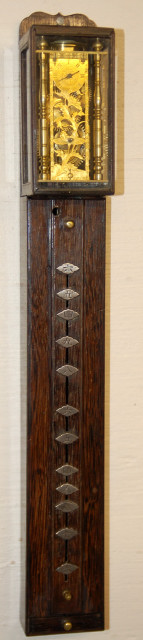
Antique Barometers September 7, 2012


Evangelista Torricelli is widely credited with the invention of the first barometer. Torricelli studied the workings of the great Galileo who was working in the field of vacuum theory.  It was Torricelli though that noticed weather changes effected the height of the liquid in Galileo’s water vacuum apparatus. These weather changes were related to air pressure changes. One problem Torricelli had was the water vacuum apparatus required a tube 35ft long at sea level. This meant on his home the apparatus he built was taller than his roof and many people in his neighbourhood were becoming very suspicious. People being accused of witches was commonplace at the time and so he needed to do something to keep his experiments more secretive. Discussion with Galleo before his untimely death in 1642 convinced Torricelli on the need to use a heavier material the water. Mercury or Quicksilver as it was then called was used, Mercury is 14 times or therabouts heavier than water and Torricelli found he only required a tube 32 inches long to keep his experiments going. It was therefore in 1643 the first working publicized barometer was invented. Torricelli died in 1647.

Many people copied and perfected Torricelli’s experiment like Blaise Pascal and in September 1648 Florin Perier who was the brother-in-law to Pascal at his request took his barometer to the top of mountain where he lived to see what effect it had on the height of the mercury. Pascals predictions were correct, the mercury was lower the higher one went.

It was not until about 1670 that barometers were starting to be sold and used in private homes as weather instruments. Lower pressures are associated with poorer weather and vice versa. It was found on fine sunny days the mercury stood at above 30 inches and on dull rainy days it stood at below 29 inches.  It was decided anywhere in-between was changeable weather. A scale of 28 to 31inches was decided upon and Fair, Changeable and Rain was engraved to the scale to correspond to the pressures. Later Stormy and Very Dry was added to the charts to correspond to 28 and 31 in Hg

Robert Boyle seems to be the first person to introduce the barometer to England. He was a writer and a student in Italy at the time of Torricelli’s experiments, he also studied the writings of Galileo. On his return to England he conducted vaious experiments of his own in this regard and came up with the famous Boyle’s Law deduction.

  • email
  • Add to favorites
  • Facebook
  • Twitter
  • LinkedIn
  • Google Bookmarks
  • Digg
  • StumbleUpon
  • del.icio.us
  • Reddit
  • Tumblr
  • MySpace
  • Google Buzz
  • Live
  • NewsVine
  • Yahoo! Buzz

The most famous clock in the world – Big Ben August 3, 2012

Big Ben


The worlds most photographed antique clock has been standing proudly to dominate Londons skyline for over 150 years. Big Ben is how everyone has come to call it,  is the nickname for the great bell of the clock but everyone now refers to Big Ben as the overall clock and tower. The tower as it so happens is to be renamed the Elizabeth Tower in honour of the Queen. This is to celebrate the Queen’s 60 year reign.

The clock tower as we know today as ‘Big Ben’ is not the first clock tower to stand in Parliament’s grounds. The first tower nicknamed ‘Great Tom’ was built in 1288-90. A second tower replaced the first in 1367 and this was the first chiming public clock in England. In 1707 this tower had fallen into a state of disrepair and was demolished. When a terrible fire destroyed most of the Palace of Westminster in 1834, architects submitted designs for the new Palace, of the 97 designs submitted, Sir Charles Barry’s was picked. His design did not originally have a clock tower but this was added to his design in 1836. Construction of this tower began in 1843.

Clearly the manufacture of the mechanism for the clock needed to be done by a specialist, the Queens clockmaker at the time was Vulliamy and he wanted to design and make the clock but other specialist clockmakers also believed they should make the clock. A series of disputes therefore resulted and it was decided to appoint a referee to make the decision on who made the clock. The decision was left to the Astronomer Royal, Sir George Airy and he set the standards by which the clock must keep, Denision a barrister and gitfted amateur clockmaker assisted in this decsion. All this led to delays in the decision and it was not until Feb 1852 that it was decided that Dent was to  build the clock to Denison’s own design. Dent died in 1853 and so the clock was completed by Dents stepson, Frederick in 1854. It cost £2,500 to make. The tower itself was still not finished though and so the clock was kept at Dents factory in the meantime. Denison made refinements to the clock while waiting for the clock tower to be finished (1859), he invented a ‘Double Three-legged Gravity Escapement’. This was a revolutionary and an ingenious invention and refinement. It made sure the pendulum was unaffected by external factors, such as wind pressue on the clock hands, a constant impulse was always applied to the pendulum. This escapement won worldwide acclaim, it is now known as the ‘ Grimthorpe escapement‘, and Denision was later made Baron Grimthorpe in 1886 as a reult. The pendulum to the clock is 13 feet long and installed in a windproof box, it beats every 2 seconds. On top of this pendulum there are old coins. Adding weight to the top of the pendulum will lift the pendulum’s centre of gravity and thus shorten the effective length of the pendulum, and so this has the effect of speeding the clock up by just under half a second a day.

The clock has become one of the main symbols for the United Kingdon and London in particular. From the news programs like ITN to New Year celebrations, to General Election’s end of voting. Big Ben is the centre of our life, it stands proud and has had numerous years superb service. It has sted the test of time and London would not be the same without it. A truly remarkable achievement. The clocks Westminster Chime is typical of clocks after C.1860 and is found on many modern clocks. Most Georgian antique clocks just strike the hour on a single bell.


  • email
  • Add to favorites
  • Facebook
  • Twitter
  • LinkedIn
  • Google Bookmarks
  • Digg
  • StumbleUpon
  • del.icio.us
  • Reddit
  • Tumblr
  • MySpace
  • Google Buzz
  • Live
  • NewsVine
  • Yahoo! Buzz

Public clocks July 27, 2012

Chester Eastgate Clock

In this piece I will be carrying on from my piece about researching antique clock makers, I suggested visiting the 17th/18th century church in the town your grandfather clock was built. Clockmakers often repaired the local church clock. These public clocks used what we call Turret clock movements to operate a series of dials in the church tower.

Most churches generally had a clock in the tower. A turret clock is the technical name for any large exterior public clock. These clocks can be in churches, town halls, banks, stable blocks, pretty much anywhere. We have installed these in homes and shops as a centre piece. Modern day clocks like this may use electric motors to drive the hands but all antique turret clocks have a large mechanical movement, the frame is normally made of cast iron. The movement is driven by large weights and a large pendulum, normally the escapement will beat 1 1/4 seconds or more, this is why you will not normally see seconds hands on these public clocks.  The public only ever normally see the clock dial, which again is normally a cast iron dial, with counter balanced clock hands. The hands will need to be counter balanced to stop them swinging down to the six o’clock position and stopping the clock.

The clocks movements can be timepiece or they can normally strike the hour on a single bell. Maintenance is required every 20 years or so and oiling every year. They are built basically along the same lines as a grandfather clock movement but everything is on a larger scale. Information about turret clocks can be found in various places on the internet. The company Smiths of Derby are still in existance and they still make and repair turret clocks today.

The clock pictured on my blog is a famous clock from the town of Chester. Chester a lovely northern city, the clock is called the Eastgate Clock. The mechanism was manufactured by the famous clockmakers Joyce of Whitchurch. Chester’s Eastgate Clock has 4 dials, so the time can be seen from Chesters famous Roman walls and from the streets from the other two sides. This clock is one of the most photographed in the world. I think we all know what the no.1 photographed clock is in the world. In my blog next week we will look at this clock, the one and only Big Ben.


  • email
  • Add to favorites
  • Facebook
  • Twitter
  • LinkedIn
  • Google Bookmarks
  • Digg
  • StumbleUpon
  • del.icio.us
  • Reddit
  • Tumblr
  • MySpace
  • Google Buzz
  • Live
  • NewsVine
  • Yahoo! Buzz

Antique Clock Descriptions July 12, 2012

Antique Bracket Clock

Antique Mantel Clock


Alot of people get confused why there are so many names to describe certain antique clocks. I noticed recently on Wikipedia for a search for Longcase clocks you will see they also get regularly called grandfather or tall-case clocks. Tall-case is a name commonly used for a grandfather clock in the USA. On the Wikipedia site it also mentions the terms grandmother and grand-daughter clocks and informs us that the difference is as a result of the height. This is true to some extent as clearly grand-daughter clocks are smaller than their larger counterpart the grandfather. It would be to simplistic to take this as the only reason for the name change though. For instance if you had a small 18th century oak longcase clock under 6ft, you would not call this a grandmother clock. All 17th and 18th century clocks can only really be described as either a longcase , grandfather or as people from USA like to say tall-case clocks. The date is also important when describing antique clocks. Grandmother and grand-daughter clocks were really smaller examples produced post C1880. We have some very small C1790 floor standing clocks, I would call these minature longcase clocks or apprentice pieces. The wording can get blurred here to some extent as it would not be unheard of to call these 18th grand-daughter clocks but I think period grand-daughter clocks (18th century) need to be differentiated from the later counterpart (19th and 20th century).

I have spoken in my previous blogs about the differences between Vienna wall clocks and German wall clocks. I have said you will commonly hear the later German wall regulator clocks being called ‘Vienna regulators’ even though most times this is not the case, so I will not expand on this hear.

I would like to finish this blog about the differences between what I call bracket clocks and mantel clocks. Again the easy difference is an age thing. 17th / 18th and clocks up to about C1850 will be commonly called antique bracket clocks. Later clocks from about C1850 to modern day examples are called mantel clocks. All bracket clocks will have english quality fusee movements, the mantel clocks can have going barrel english or german movement or possibly french movements. From the term bracket clocks you will assume no doubt that the difference is the earlier clocks had a seperate wall bracket that they stood on, this is not the case. Only some bracket clocks were produced with actual brackets, most were put on the large Georgian fireplaces. From a simplistic point of view if the clock has a fusee movement it would normally be called a bracket clock. Most mantel clocks do not have fusee movements.

17th ,18th and early 19th  century fusee antique bracket clocks are highly sought after, when they were introduced they were a real technological achievement and they actually were more expensive than the equivalent grandfather, only the top 5% of gentry could afford such clocks.

Daniel R Clements


  • email
  • Add to favorites
  • Facebook
  • Twitter
  • LinkedIn
  • Google Bookmarks
  • Digg
  • StumbleUpon
  • del.icio.us
  • Reddit
  • Tumblr
  • MySpace
  • Google Buzz
  • Live
  • NewsVine
  • Yahoo! Buzz

Security at Home July 6, 2012

Security is an important aspect of any home. You do not need antiques to be a target for the thief. Clearly these people are normally after your small valuable items, like cash, jewellery, gold and silver, even video recoders, ipads etc. All these items are easily sold on or with your gold items, melted down and sold for scrap.

When someone enters your home without permission, we feel violated, and it is something you will never forget. It is a good idea for your home to be your castle and make it secure, not necessarily just for the sake of your valuables but for the protection of youselves and your family.

My first advice is for you to contact three bodies. 1) Your local Crime Protection Officer , he or she will help you in many ways, and they will give you some good advice to improve on your security. 2) Contact your local Fire Prevention Officer, they will come out and make sure after you have secured your home, you have proper escape routes should the worst happen. Protecting your home so that no-one enters is one thing, but please make sure in case of fire, you can get out. 3) Your local Neighbourhood Watch scheme is also a good thing, they will keep you updated on what is happening around your area.

I believe it is important to install high quality window and door locks, and do not just leave the keys in these so the thief can unlock from the inside after gaining entry and make a quick exit. One really cheap way of vastly increasing your home security is to purchase some bolts for all your internal doors. These are quick to fit, can be easily unlocked in case of fire, no issue with finding the key, and the intruder can not break an upstairs or downstairs window and reach you. He will be confined to the room he gained entry to.

It is important to photograph all your valuable or sentimental belongings, recording any specific marks or features and take a note of the height. You could mark or microchip belongings as well. Photographs and having an up to date valuation if you have the items insured will greatly enhance the chance of having you items returned and if not at least be in a good position with the insurance company. It is important to have this information and pictures not in your home. It should be kept in a safe deposit box, bank or at a solicitors.

All grandfather clocks we advise screwing to the wall, any measures like this will also slow the thief down. Robbers are interested in getting in and out in a short as time as possible and so it is your small valuable items like jewellery and gold that is most vunerable not large antiques. A thief will normally scan your home for weaknesses, make sure you do not have any and so he will go elsewhere.

Having a top quality alarm and for this to be monitored is important, having the police on stand-by with panic alarms is also good for peace of mind.

We are resident at our premises 24/7 365 days a year and have various other important security features but if you do leave your home unattended, lock and shut all internal doors, set your alarm, set lights to come on with time clocks at random during the night and tell your neighbours you are going away. As with anything in life if you notice something suspicious note it down.

I am no expert in security but I hope there are some features listed above that you think are useful and may implement. Please do contact the specialist bodies though, it is amazing with all this help and advice out there, many people take security for granted, with the old adage, it won’t happen to me.

Daniel Clements

http://www.pendulumofmayfair.co.uk


  • email
  • Add to favorites
  • Facebook
  • Twitter
  • LinkedIn
  • Google Bookmarks
  • Digg
  • StumbleUpon
  • del.icio.us
  • Reddit
  • Tumblr
  • MySpace
  • Google Buzz
  • Live
  • NewsVine
  • Yahoo! Buzz