I have wrote a few blogs that I hope you enjoyed about antique cabinet restoration. Clearly antique cabinet restoration once carried out properly is a once in a lifetime operation as a rule. Antique clock movements meanwhile need to be cleaned and serviced at least every ten years.
Horology Department
All antique clock movements at Pendulum of Mayfair are properly serviced by trained high quality horologists. The movements are completely taken apart, cleaned and any necessary bushing & pallets re-facing carried out. Normally there will also be other repairs to undertake. Especially if the movement has not been properly services in the last 20 years.
Many clients believe if the clock is running and has been doing s,o this is sufficient. Dried out oil tends to mix with dust and other foreign bodies to become a grinding paste. Unless the movement is cleaned every 10 years or so this grinding paste can cause undue wear. This will also mean that when the next service is carried out extra work is required.
Service your clock every 10-15 years
It will normally take our horologists a couple of days to complete an overhaul of a grandfather clock mechanism. This only needs to be done every 10-15 years. Therefore a small price to pay to keep your antique clock in full working order and in tip top condition. Please only entrust your antique clock to the finest horologists. We have had our own workshop for over 40 years and all our staff are trained to the highest standards. We undertake work for Embassy’s, major London hotels and for many vip’s. Many clients have shipped their grandfather clock cases and movements back from the States. Then this work can be carried out by us. Poor quality restoration and repairs not to the highest standard can effect the value of your antique clock.
I have been a passionate writer on my blog about all aspect of antique clocks over the last few years. I have tried to give the general public much needed information. They can then understand about various different horological matters. Never have I entered any political debates. This blog is to plead with the Scottish people not to give up on our longstanding Union. On 1st May 1707 our two great countries formed the Act of Union. This was passed by the Parliament of England and Scotland following negotiations agreed the previous year.
Act Union 1707
We have stood together in good times and bad. It is better together than apart I believe. Yes I am English, but I am British as well. I love Scotland and the Scottish people. Is their rivalry when England play Scotland ? Yes there is and I would not expect anything different. Maybe I am different but when Scotland are playing in any tournament to most people. I give my full support to them. I am sure the majority of other proud Englishmen do as well.
I stand with our great Union
You only need to see Andy Murray’s support at Wimbledon. He is a proud Scot, but English people still love him and cheer him on. We have rivalry on a city basis with Manchester United and Manchester City. Like Glasgow has, but we stand together for our national teams. I stand by our great union and I hope the great nation of Scotland wakes up and sends Alex Salmond and this Independence vote packing.
It is worth standing up for
To destroy something so easily that lasted centuries would be a sad reflection on modern day society. Scotlands voice, England voice in the world will be louder together. Further details of this special antique grandfather clock by John Smith.
I could not resist but end this by adding a special antique clock image that brings all this home. It is a lovely clock from a small town in Scotland called Pittenweem. Pittenweem is a small and secluded fishing village tucked away in the corner of Fife on the east coast of Scotland. Look how the clockmaker signed this clock ‘ NORTH BRITAIN ‘. I am sure he was a proud Scot, but he also, a proud Brit as well. This clock dates from around C1790
For antique furniture and clocks different types of wood were used in their manufacture. In this handy guide I am going to cover some of the main woods used. These woods can be of solid form but most flamboyant grained woods are used as hand cut veneers. The carcass is generally made from oak or pine in the provinces or oak generally in London.
Woods Used in London and Provinces
In London oak is only used as a carcas material in the 17th and 18th centuries. Whereas in the provinces you will find antique grandfather clocks being made of oak as the finished wood. Clearly oak was veneered on as well, especially in London by English Walnut up to say C1750 . Then from this date fine Honduras and Cuban mahogany veneers are found. On some clocks you will find very early examples to be of ebony construction or ebonized (black stained fruitwood generally)
Chinoiserie Clocks
You can also get oak grandfather clocks in London that were painted and decorated by Chinoiserie or lacquer work. The finest examples were sent out on boats and decorated in China. On some later clocks you will see these veneered in more exotic woods. Rosewood or maple or even ewe wood. I suppose the smaller size means you can use veneers of the more slow growing and smaller trees. With early clocks these exotic woods were used as well in small pieces and matched. We have owned a lovely walnut burr oyster veneered grandfather clock.
Below is a selection of woods used for antique clocks and furniture during the 17th and 18th and 19th centuries in England. A brief insight into each wood pictured is given. I hope from this blog you will discover what type of wood your clock or piece of furniture is manufactured from.
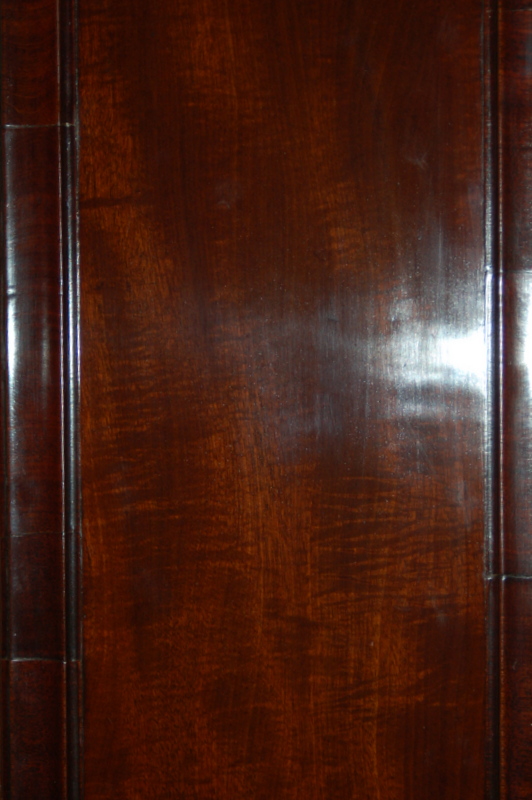
Honduras Mahogany
Cuban mahoganyPlum Pudding (spotted) mahogany
Mahogany can be a beautiful wood, it starts in the UK being used around C1750 and continues being used throughout the 18th and 19th centuries. Two most common variants are Honduras (lighter) and Cuban mahogany (darker). It is a close grain hardwood coming commonly from the South America or the West Indies type regions. This tree can be found quite wide and so large sections could be veneered with this wood.
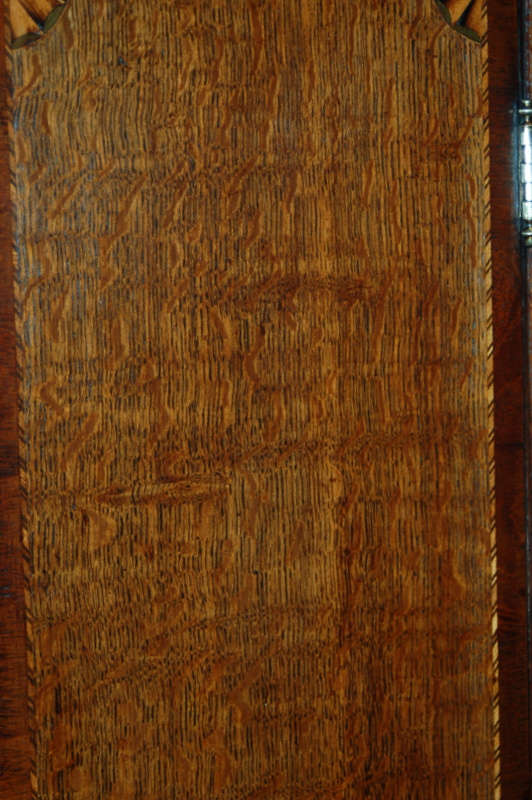
Quarter Cut or star-fleck figured oakSolid English Oak
English Oak
English oak is a slow growing and so very heavy wood. Used in construction and veneered some of the time, but it is a beautiful wood in its own right. Oak being so heavy and close grained it is good at preventing things like wood worm. It is one of the reasons why London used it in the construction of its clock cases ahead of pine. Pine is used in the provinces as a rule for carcases as it is cheaper. You will notice the weight difference between an antique clock veneered on oak and an antique clock veneered on pine. Oak just gets better with age and polishing, we call this the patina. Less close grain oak can come from countries like Japan. This wood although called oak, is a far poorer wood to the slower growing English oak.
The climate effects the grain of the wood
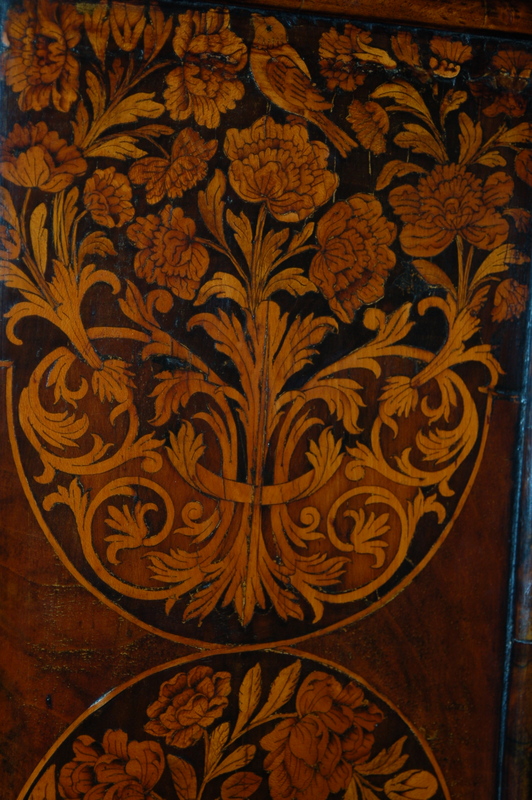
English Burr WalnutMarquetry inlay on English WalnutMarquetry on WalnutContinental walnut
Walnut is a lovely wood and English walnut gets used as veneers in antique furniture and clock manufacture up until C1750. After this date most walnut used is Continental walnut. Continental walnut is a quicker growing tree and so the grain is never as fine as English burr walnut. Again English walnut is a very heavy wood with a close grain. The tighter the burr or knot in the walnut the better. Walnut can range in colour from quite light if the sun has taken it, to quite dark. Walnut is used on all of the German wall regulators or commonly called ‘Vienna style’ wall clocks etc through the 19th century.
Satinwood
Satinwood used as a blank canvass to artists
Satinwood being a very light wood was used towards the end of the 18th centuries and early 19th centuries in the main. Many expensive pieces are manufactured with Satinwood veneers. We have some Pergolesi painted tables with satinwood veneers. I suppose the light colour makes the painting stand out better.
Pine
Pine, many of you will be familiar with this wood. It is rare to see a surviving antique grandfather clock made in this wood like the above. It was prone to woodworm unfortunately. Some were painted and this helped preserve them.Many provincial cabinets were constructed out of pine and then veneered. Pine is also used alot today as it is a relatively cheap wood, unlike oak. Clearly as you can see from the grain and if you lifted it from the weight , it is a fairly quick growing tree.
Lacquer or Chinoiserie
Oak can be veneered or painted
Oak was only used on internal construction of cabinets of English London clocks. When this wood was used and if it is not veneered in London you will find it sometimes decorated with lacquer work or Chinoiserie. This is gold leaf and gesso. The best types of these works are seen when they were sent out to China in the early/mid 18th century and decorated their.
I think I have covered the majority of main woods used in English cabinet making. There are others like ewe wood, maple , elm, fruitwood and rosewood. These are not covered as they are used alot less. I hope this blog has been of help to you. If you are still struggling with finding out what wood your clock or piece of furniture is made from, please send me a picture to PendulumClocks@aol.com
18th century musical grandfather clocks are very rare examples. I will only see a genuine fine example once every few years. In this blog I will be looking at two late 18th century examples. One fine grandfather clock by Joseph Herring of London C1770. Also a superb rare provincial musical clock by Edward Bilbie of Chewstoke C1780 pictured below.
After discussions and research on the Bilbie family of clockmakers. You can see the example on the left is one of the finest provincial musical clocks by this maker. It bears all the hallmarks of what a Bilbie clock should look like. The lovely polished and engraved dial, with the doric columns superbly engraved to the dial centre. The name on a cartouche to the arch finely engraved and either side, a strike/silent feature and 4 different tunes.
Multiple Tunes
The tunes being ‘ Lincoln Time ‘ , ‘ Bath Time ‘ , ‘ 104th Psalme ‘ , ‘ 23 rd Psalme ‘. Why Lincoln Time, Bath Time I can understand as it is 20 miles away from Chewstoke, but Lincoln Time I do not know the reason. Maybe these were customer selections in the 18th century. The delightful engraving to the centres and outer edges of the arch show what fine craftsman Bilbie was. Bear in mind this is a provincial clock, it really is top quality workmanship.
Lovely quality Bilbie Clock
The dial also shows seconds and further delicate engraving around the edge. A calendar to the dial centre, chapter ring and fine gilded spandrels to the corners of the dial. All dials of this period are cast brass, and all the hands etc are worked on by hand. These are lovely quality iron hands which are eventually protected by being blued.
High quality musical movement
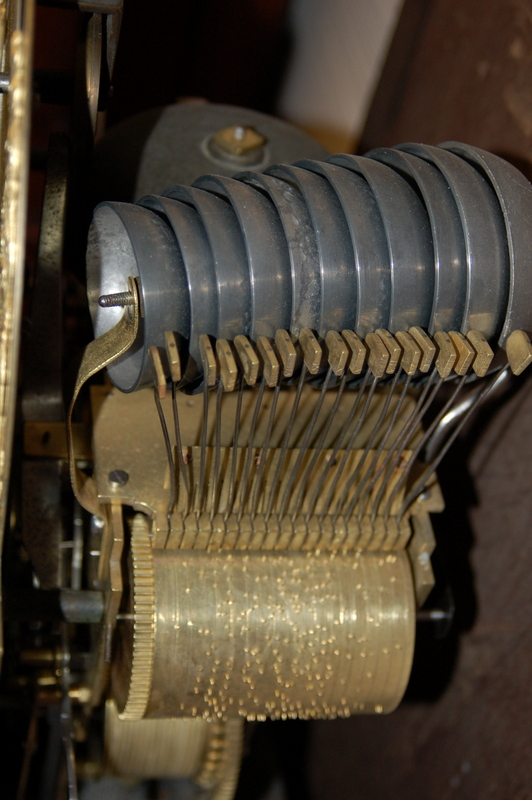
The fine music played by this immense high quality movement is played by means of 12 hammers on 10 bells. This is on a intricate pin wheel barrel. Finding all the right notes for the differing tunes is so complex. The bells would of been cast by hand. I believe Bilbie did this himself, he had his own foundry , which was very rare. To get the bells so well sounding is a real credit to his talent. You will see a casting mark on the largest bell, but all bells play superbly.
Three train movements
The movement as I have described has 3 trains. One is for the timekeeping , one is for the hours , and the final one is for the music. This plays once every 3 hours. Hence 8 times a day one can wonder at this clockmakers talent. This is not only a lovely furnishing piece but it is a horological work of art as well.
Work of Art
The 8 day movement is also lovely in lots of other ways, everything is built to precision and to a high quality. It is clear high quality pieces were not only built in London. In the pictures below I will show London quality construction, it is very similar to Bilbie’s work here.
Joseph Herring Musical Clock
The pictures are of a Joseph Herring London musical Longcase clock. The only real differences between this and the Bilbie are one of two more hammers and an extra bell and a few more pins to the barrel. Very similar movements, both really high quality 8 day examples.You will see from both, the typical three train layout of the dial on these two genuine examples.
4 Tune Musical
The Herring plays 4 tunes as well, some strange 18th hits at that. ‘ Speed the Plough ‘ , ‘ March in Blue Beard ‘ , ‘ Beggar Girl ‘ , and finally one to top the lot off , ‘ Go to the Devil & Shake Yourself’. Maybe the last could come from a modern day rock song. It is definately a strange title for an 18th century tune. These as you can expect are not listed on Youtube. From this blog no doubt some of our clients, who are rock and pop stars, may make these 18th century classics into modern day hits. Watch this space !
We have restored lots of special pieces of antique clocks and furniture over the years. Many of these fine pieces can be viewed at our London antique clock shop, Pendulum of Mayfair in London. We have also restored many grandfather clocks and smaller clocks. These for large banks, famous hotels and various other institutions in central London. The lovely thing about restoring antiques whether it is a grandfather clock or a smaller item, is every repair is different.
Every clock repair is different
The only thing that remains the same if it is an intricate repair is the lovely comments you receive when the repairs have been carried out properly. The transformation of an item into showroom condition makes restoring very rewarding.
It is with great shame over the years there are hardly any proper courses on restoring. There are few antique movements or cabinets courses available in our great universities. These courses used to give a great grounding for young students.
Appeal for more Technical Courses
I now can only recall a couple of courses available in which you can study horology. In this country, one of them being at West Dean. It is with this in mind that all our staff have had to be taught in house by our owner Roy Clements. From humble beginning in a small village in Cheshire, we now have one of the foremost restoration facility’s in the UK. This has mean over the last few years we have even undertaken the restoration of many clocks. For special places like the Russian Embassy in London.
Famoous Places we have been asked to restore for
The Russian Embassy Residence clocks were great projects for us. More important was to meet such wonderful new people. His Excellency the Ambassador Alexander Vladimirovich Yakovenko and his wife were amazing with us and so were his staff. We will always treat them as friends and thank them for being so hospitable to us. It is very hard in one generation to meet important people like this and be honoured with the responsibility. To be entrusted with the restoration and repair of important clocks, but it shows this can be done. Nothing is not achievable if you work hard enough and are dedicated in what you do.
Examples of Cabinet Restoration
I have listed a lovely piece of antique cabinet restoration below. I wrote some time back but it is a clear idea of what needs to be done in restoring items properly. Always give you items to be restored to a professional. Sometimes poor repairs and restoration can destroy the value of any antique.
From the very onset of our business we have always had our own highly skilled staff employed in Cheshire. They undertake skilled antique clock and furniture repairs for our London shop. Antique clock repair is something that can only be carried out by highly qualified and time-served skilled staff. It is important to know what they are doing. In my latest blog I will be looking at the restoration of a badly damaged antique clock cabinet. This clock was damaged by a very hungry owners dog ! You can see from the pictures below, taken prior to restoration, the damage to the base and trunk door areas on the clock.
One very hungry pet dog
Clock Cabinet Repair Restoration
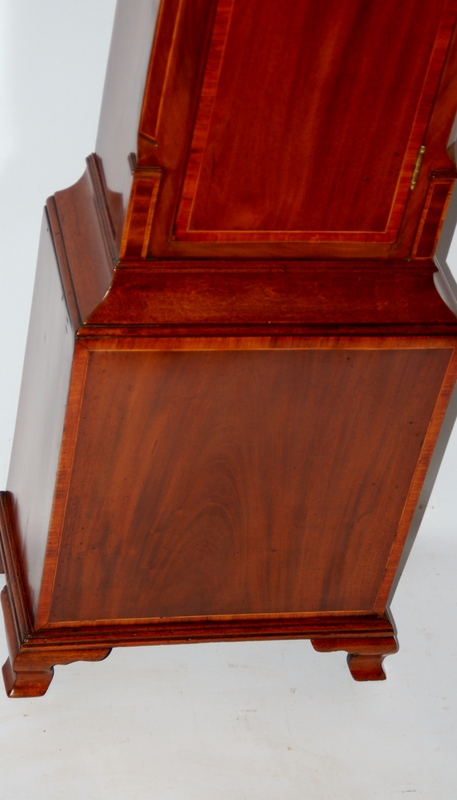
As you will notice damage was to the sides of the base and the bottom of the door in the main. This is very intricate antique clock restoration. Our skilled cabinet restorer carefully restored this clock to its former glory. Whilst the restoration of the antique clock was ongoing. We noticed the two sides of the base banding had been replaced with mahogany veneers over the years. We took this away and replaced the mahogany with the banding to match the trunk door. This being tulip wood.
Furniture Repairs
As you will see from the finished restored pictures. Close up pictures of the damage from the clock, the skills of a craftsman. All repairs were carried out in hand cut veneers of wood. This was a like for like match. Animal glues were used like in the original. After all the antique clock repairs were carried out at our base here in Cheshire. The clock was redelivered back to very happy owners.
Repairs Done Sympathetically
Restoring antique clocks like we have done for over 40 years here at Pendulum of Mayfair or Coppelia Antiques is vital to be done properly. Do not have a clock that has been poorly restored. This would take away from the value of the clock. Restoring your antique clock sympathetically can add thousands of pounds to the value. If the clock is genuine and basically all there. Spending £3,000 or so to restore your clock can be money in the bank.
Don’t cut costs in repairs
Spending £1500 for restoring your clock badly you may think you are saving money but do not be misled. Poor restoration can actually reduce the value of the clock, your £1,500 may well be lost. We charge out at competitive rates for unrivalled quality workmanship I believe. For a quote please send pictures of the item needed to be restored to the contact at the bottom of this piece.
Seldom seen damage
Can I point out before I go on, damage due to canines I have only ever encountered twice in all my time. I believe this was done by overexcited puppy’s with teething issues, you need not worry to much ! Basically antique clock cabinet repairs are much more standard. Loose moulding, little pieces of veneer lost, or he odd scratch here or there. Sometimes years of dirt to the surface of the case just needs carefully taking back and then the true colour of the cabinet can be achieved.
Colour of piece
The colour of every clock tends to be different and dependant on the wood and how this had reacted with the sunlight over the years. Hopefully if you choose a restorer he will preserve the colour and not just splash the stain of the day all over your clock. To many times I have seen furniture restorer throw shellac french polish to high gloss standards. Then stain whatever colour they were using that day on items. Rather than building up the finish underneath the years of grime, and basically wax finishing.
Wax finish is vital
Soft finish of wax, rather than the ploughed field of a poorly french polished and stripped surface is required. The grain on any antique clock takes years to fill with many years waxing. You do not want an open grain sticky finish, like what you will see on lots of modern furniture today.
Conclusion
I hope the three pictures included and the pictures of the clock now restored show what can be done by sympathetic highly skilled craftsman. We have undertaken repairs for Museums , a very important Embassy , and lots of major hotels in central London. We also undertake repairs for the general public. We have highly skilled staff specifically now just undertaking outside repairs.
Antique furniture and clock repair
It is a growing side of our business. Put your family heirlooms in safe hands and contact the specialist today. All public enquiries for antique clock repairs for a limited time will receive our special offer trade daily rate. You will need to quote ” antique clocks blog special offer” on your e.mail. Please hurry this is for a limited time only and applies to cabinet work.
We also have two full time horologists on staff to repair your antique clock movements. These are also highly skilled professionals. I suggest you should have a major overhaul of your clock every 40 years. If you have had this carried out properly a clean every 10 years or so. This will keep wear on any pivots etc to a minimum.
I hope you will agree the finish restored antique clock below looks stunning. The total time was approx 10 working days to restore movement and cabinet.
Any questions to
Daniel Clements
Manager: Pendulum of Mayfair- London -0207 629 6606/ Coppelia Antiques Ltd – Cheshire 01565722197
If you could choose any Christmas present, what would it be? For many of us, it might be something beautiful or frivolous that we would never buy for ourselves. For others, perhaps something useful. Well, how about something that is both beautiful and useful, and will also, in due course, become a family heirloom? Have you considered putting an antique clock on your wish list? Pendulum of Mayfair have a range of beautiful antique clocks for sale, ranging from longcase clocks, otherwise known as grandfather clocks, through bracket clocks and wall clocks, to carriage clocks, so you can choose just the right clock for your home and the space available.
Do you want a large freestanding clock? Go for a grandfather clock. If you want a clock for your wall, you can choose either a longer case hanging clock or a round clock, rather like the modern wall clocks now available, but perhaps more beautiful. And if you want something to sit on a table or mantelpiece, have a look at the range of bracket clocks and carriage clocks available. You’ll be sure to find something that will fit the space you have in mind!
I am an antique clock fanatic and have loved antique clocks and everything about time all my life. I presently run our family business Pendulum of Mayfair Ltd in central London and Cheshire. Various people have looked at changing the clocks time over the years. Most have been unsuccessful in convincing enough people. Either because the changes affect Northern England or Scotland or by people not understanding the major benefits. The system below would benefit pretty much everyone I believe.
Changing time
My proposal is very clear and easy, and will greatly improve most people’s lives. In understanding GMT it is very simple. The hours of daylight are roughly split into the same hours before midday as after. I believe this is fine when there are shorter hours of the day in winter and GMT should remain during the Winter.
Winter and Summer Time
I do believe it works when there are around 16 and ¾ hours of daylight in summer. This spread of time equally between morning and afternoon no longer works for modern living. This is why we have British Summer Time. I believe this should be further enhanced . Sunday March 31st and Sunday October the 27th should remain as the allotted days for changes but British Summer Time should be +2 not +1 (you can call it Double British Summer Time) We will be at the same time as Europe for these months. If you look at the sunrise times for middle England under GMT on the 18th June it is 03.46 under +1 at present this would be 04.46 under my system this would be 05.56. Still early for sunrise, but we will gain by an extra 2 hours of daylight throughout the summer (instead of 1), saving on electricity, enhancing peoples lives.
The need to change
The latest sunset would be 22.31 under this proposal. The economic benefits and peoples health benefits from the extra daylight are considerable. I am sure this would gain the massive support of the majority of the population if this was put to them under a referendum.
Daniel Clements from our London antique clock business , I would welcome your views. Follow my antique clock tweets on twitter.
Are you interested in buying a new wall clock for your house? Have you thought about maybe making your new clock an old clock, and buying a classic wall clock? Pendulum of Mayfair have a great stock of antique clocks. We have plenty of beautiful wall clocks that will enhance any home, modern or older, contemporary or traditional in style.
Wall clocks have been around since at least the late 1700s, and Pendulum even have an early wall clock for sale, from around 1795. It has a lovely 12 inch brass dial, and was made by William Mills in London. Imagine owning a clock that has been working since around the time of the French Revolution. Perhaps it even graced the walls of an escaped aristocrat! It’s worth paying a bit extra to buy that little bit of history, even if you have to imagine the story for yourself. And If you’d like a clock from slightly later, there are plenty available from the mid-nineteenth century, in sizes ranging from 8 inches to 16 inches in diameter, many with mahogany cases, but some with oak. You’ll be spoilt for choice!
Browse the selection of beautiful antique clocks available online, or for more information, call 0207 629 6606 or email pendulumclocks@aol.com.
Here at Pendulum of Mayfair, we are a leading provider of antique clocks. With our main showroom based in Central London you can come and see us directly to view the fantastic antique clocks we have available.
Although we realise we’re not the only provider of antique clocks within the UK, from previous customer feedback, we’re more than confident that we’re one of the best. Here at three reasons why –
Experience – We have been selling antique clocks for a number of years. We know what it takes to deliver an impeccable service to all of our customers.
Quality – The antique clocks we sell are only the highest of quality. On our website you will be able to see images of our current stock to help give you an excellent idea of what we supply.
Price – Although cheapest doesn’t always mean best, especially when it comes to antique clocks, we ensure that our prices are extremely competitive to ensure excellent value for money for you.
We hope from the information above, you feel that we’re the best choice for you when you wish to purchase an antique clock.
To find out more, please call us on 0207 629 6606. We look forward to hearing from you and assisting you further.